Article
4 min read
The EU Pay Transparency Directive: A Practical Guide for UK Businesses
Legal & compliance

Author
Ellen Simmonds
Last Update
May 26, 2026

Key takeaways
The directive doesn't apply to the UK, but most UK businesses aren't as insulated from it as they think.
The UK is already the top destination for cross-border hires globally, meaning UK businesses are competing for talent that expects EU-standard pay transparency.
Deel gives you the infrastructure to manage pay compliantly across jurisdictions. The commitment to compliance has to come from your organisation.
The EU Pay Transparency Directive came into force in June 2023. EU member states had until June 7, 2026, to transpose it into national law. While the UK is not legally bound to the directive, your organisation should be paying attention, regardless of how many employees you have in EU member states.
Whether the directive applies to your business directly, indirectly, or not at all depends on factors most UK HR teams haven't fully mapped yet. And even for businesses with no EU presence, the rules of the game around pay transparency are changing — in the UK, in the talent market, and in candidate expectations — faster than legislation alone can explain.
This guide is written specifically for UK businesses navigating that complexity, focusing on what the directive means for you, practically, and what to do about it.
If you want to jump straight to action, our EU Pay Transparency Readiness Checklist helps you identify your obligations.

EU Compliance with Deel
EU Pay Transparency Directive Readiness Checklist
The UK government has also opened a call for evidence on broader pay transparency reforms. Among the measures under consideration: requiring salary ranges in job adverts, banning salary history questions, and giving employees the right to pay comparison information. Anyone who's read the EU directive will recognise those provisions immediately. The UK isn't implementing the directive, but it's clearly reading from the same script.
The question for UK businesses isn't whether pay transparency obligations will increase domestically. It's when, and how far ahead of that curve you want to be.
Are you in scope? The three UK business profiles
Not every UK business faces the same situation. Before you decide how to respond to the directive, you need to know which of these three profiles fits your organisation.
Profile 1: Directly in scope
You have 100 or more employees working in EU member states. It doesn't matter where your headquarters is — if your workforce crosses that threshold in EU jurisdictions, you must comply with the directive's requirements in those locations. That includes pay transparency obligations for job applicants, employee rights to request pay comparison information, gender pay gap reporting by worker categories, and, where gaps exceed 5%, a requirement to conduct joint pay assessments and take corrective action.
If this is you, the June 2026 transposition deadline has already passed for most EU member states. See our EU Pay Transparency Directive Readiness Checklist for your next steps.
Profile 2: Indirectly in scope
You may not have a legal entity in any EU member state, but you employ EU-based workers, actively recruit from EU talent pools, or compete with EU-headquartered businesses for the same candidates. You're not legally obligated to comply with the directive. But the market won't make that distinction on your behalf.
According to our 2025 State of Global Hiring Report, the top EoR hiring destinations for UK-headquartered businesses are Spain, the Netherlands, and Germany — three jurisdictions now fully subject to the directive. If your cross-border hiring follows that pattern, you may be closer to being directly in scope than you realise.

Insights
State of Global Hiring Report (2026)
EU candidates who've seen salary ranges in job postings, who know they have the right to request pay comparison data, and who've worked for employers where pay secrecy clauses are prohibited — those expectations travel with them when they apply to your roles.
Profile 3: UK-only operations
You have no EU staff, no EU hiring, and no plans to change that. The directive doesn't apply to you today. But domestic pressure is building — through the government's call for evidence, through the incoming mandatory action plans, and through shifting candidate expectations in the UK market. Businesses in this profile have the most runway, but they're not immune to the direction of travel.
The two-rulebook problem
For businesses with both UK and EU staff, the directive creates a genuinely difficult operational challenge: you're now running two different standards for the same workforce.
On one side: EU-based employees with the right to request pay comparison data, protected from pay secrecy clauses, covered by reporting obligations that include bonuses and benefits in kind. On the other: UK-based colleagues with none of those rights, whose compensation data sits in a different system under a different framework.
That split creates friction in ways that are easy to underestimate.
-
The pay information request you weren't expecting. An EU-based employee exercises their right to request pay comparison data. You provide it — as required. A UK-based employee in the same role sees that happen and asks the same question. There's no legal obligation to answer, but declining creates a perception problem that's hard to manage.
-
The contracts that need updating. Pay secrecy clauses — provisions that prohibit employees from discussing their compensation with colleagues — are common in UK employment contracts. Under the directive, those clauses are void for EU-based employees and need to be removed. If your contracts are templated centrally, that means a targeted review of every EU employee agreement.
-
The data gap you probably didn't know you had. The directive defines pay broadly — base salary, bonuses, benefits in kind, and variable components. UK gender pay gap reporting uses a narrower definition. If you're planning to use your existing GPG data infrastructure to meet the directive's EU reporting requirements, you'll likely find it isn't sufficient.
-
The manager is caught in the middle. A UK-employed People manager oversees a team that spans London, Amsterdam, and Berlin. What are their obligations when an EU direct report makes a pay information request? Who owns the compliance decision — the manager, HR, Legal? Without clear internal protocols, this falls through the cracks.
The answer most businesses with multi-jurisdictional teams are landing on is to harmonise upward: apply the stricter standard consistently across the organisation rather than maintaining two parallel frameworks. It's more work upfront, but it's operationally cleaner, easier to communicate to employees, and better positioned for where UK law is heading anyway.
The talent market won't wait for legislation
Compliance timelines are one thing. The talent market moves faster.
In tech, financial services, and professional services (the sectors where UK businesses most often compete with EU-headquartered employers for the same candidates) salary transparency has already shifted from differentiator to baseline expectation. Candidates who've seen salary ranges in job adverts aren't just pleasantly surprised when they appear. They're increasingly suspicious when they don't.
Our 2025 State of Global Hiring Report found that the UK is the single largest destination for cross-border employee hires among top-funded startups globally — ahead of Canada, Germany, Australia, and Spain. UK businesses aren't competing with EU employers in the abstract. They're the primary target market for internationally mobile talent, and that talent increasingly arrives with direct experience of directive-compliant employers, where salary ranges in job postings and the right to request pay comparison data are standard practice. The gap between your practices and their expectations is visible from the first job posting.
The same dynamic shows up in retention. When employees can't access clear information about pay structures, pay ranges, and the criteria for progression, trust erodes — particularly among those who suspect they may be underpaid relative to peers. That suspicion is now easier to act on, with more salary data publicly available and more peer conversations happening than ever before.
UK businesses that treat pay transparency as a future compliance concern are already making a talent acquisition and retention decision. The question is whether they're making it consciously.
The internal case for moving now
For People leaders who need to bring leadership or finance teams along, the case for acting ahead of a legal deadline can feel like a hard sell. Here's how to make it.
The cost of a split standard compounds over time. Maintaining different pay practices for UK and EU employees isn't a stable equilibrium. As your EU-compliant pay data gets reported and potentially becomes more visible, and as UK employees become more aware of their EU colleagues' rights, the inconsistency becomes harder to explain and harder to defend. Reputational risk from visible disparities between published EU data and unpublished UK practices is a real exposure, particularly for businesses with active employer brand programmes.
Manager confidence depends on clarity. When pay bands, progression criteria, and compensation philosophy aren't clearly documented and consistently applied, managers default to instinct. That's where unintentional bias enters pay decisions — not through malice, but through the absence of structure. Building transparent pay frameworks now protects the business from future equal pay risk, regardless of which jurisdiction that risk materialises in.
Getting ahead is cheaper than catching up. A pay audit conducted on your own timeline, with the right people involved and sufficient runway to address findings, costs less — in time, resource, and disruption — than one conducted under legal pressure or in response to an employee claim. The businesses that will struggle most with the directive aren't those that started late. They're those who didn't start at all until they had to.
Framed correctly, proactive pay transparency isn't a compliance burden. It's a signal to candidates, employees, and the market that your business is run with integrity — and that's a competitive advantage that doesn't expire when legislation changes.
Useful resource:
Catch up on our expert-led webinar: EU 2026: AI, Pay Transparency, and the Future of Work
Where Deel fits in
Let's be direct about something: no software platform can guarantee your compliance with the EU Pay Transparency Directive. Compliance is an organisational commitment. It requires decisions about pay philosophy, job architecture, governance, and culture that only your business can make. Any vendor that tells you otherwise is overselling.
What the right infrastructure does is remove the operational barriers that make compliance harder than it needs to be.
For most UK businesses with EU operations, those barriers are real. Pay data lives across multiple systems — UK payroll on one platform, EU payroll managed through local vendors, compensation data in spreadsheets, HR records somewhere else. Producing the directive's required reports — gender pay gaps by worker category, pay band distributions, variable component breakdowns — requires a complete, accurate, consolidated view of compensation data. If that data doesn't exist in one place, the reporting challenge starts well before any compliance question.
Deel gives you that foundation. Specifically:
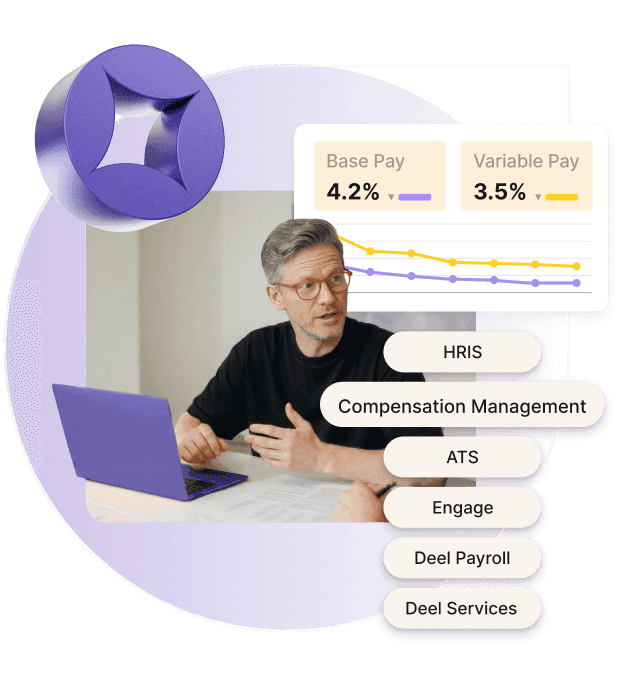
A single view of your global workforce. Deel’s HRIS consolidates employee data, compensation records, and pay structures across jurisdictions — so the data infrastructure for compliance reporting actually exists, rather than needing to be assembled from disparate sources each time a deadline approaches.
Consistent pay structures across borders. Deel's compensation management tools let you build and apply pay bands and progression criteria consistently across geographies. That's the starting point for any meaningful pay transparency framework — and for the job architecture work that the directive's equal pay requirements rest on.
Compliant payroll across UK and EU jurisdictions. Rather than reconciling between separate local vendors with different data formats and reporting timelines, Deel Payroll runs across multiple jurisdictions from a single platform. When your reporting obligations differ by country — as they do under the directive — that consistency matters.
Real-time compliance monitoring. EU member states are transposing the directive into national law at different speeds and with different specifics. Deel monitors regulatory changes across 150+ countries and surfaces alerts when local legislation shifts — so your team isn't relying on manual tracking to stay current.
Contract and policy management. Identifying and updating legacy provisions — like pay secrecy clauses that are now void for EU employees — is easier when employment contracts and policy documents are managed within the same platform as your HR and payroll data.
Deel doesn't make the decisions. Your People, Legal, and Finance teams do. But it gives you the data infrastructure to make those decisions accurately, execute them consistently across borders, and demonstrate compliance when it matters.
If you're working out where to start, our Pay Transparency Readiness Checklist helps you map your current obligations. And if you want to talk through what compliance looks like for your specific setup, book a call with our team.
EU Compliance with Deel
Tackle pay transparency, all in one place
Ellen Simmonds is a content marketing manager with a decade of experience in tech, leadership, startups, and the creative industries. A long-time remote worker, she's passionate about WFH productivity hacks and fostering company culture across globally distributed teams. She also writes and speaks on the ethical implementation of AI, advocating for transparency, fairness, and human oversight in emerging technologies to ensure innovation benefits both businesses and society.