Article
1 min read
How to Build the Right IT Setup for Customer Support Teams: A Practical Checklist
IT & device management

Author
Dr Kristine Lennie
Last Update
July 03, 2026

Table of Contents
Step 1. Hardware provisioning
Step 2. Account creation and identity setup
Step 3. Customer support software and tooling
Step 4. Security and endpoint configuration
Step 5. Network and connectivity requirements
Step 6. IT support access and escalation paths
Step 7. Ongoing access hygiene and role changes
Step 8. Offboarding and device recovery
IT that scales with your customer support teams: how Deel IT helps
Key takeaways
Customer support teams depend on a connected technology stack to deliver fast, consistent customer service. Devices, helpdesk platforms, CRM systems, communication tools, and secure access all need to be ready before day one, because every missing dependency delays an agent's ability to support customers.
Getting customer support hires productive from day one requires treating onboarding as a coordinated IT workflow rather than a series of individual setup tasks, with hardware, identity, applications, connectivity, security, and support prepared in the right sequence before the first shift.
Deel IT helps organizations automate IT setup from a single platform by managing device provisioning, application delivery, security, and lifecycle workflows, helping customer support teams stay connected to the tools they need to resolve customer issues from day one.
Customer support is one of the few functions where a new hire's readiness is visible almost immediately. If devices arrive late, accounts aren't provisioned, or key systems are inaccessible, ticket backlogs grow, response times slip, and experienced team members are pulled away from customer work to troubleshoot onboarding issues.
This checklist gives IT and HR teams a structured way to provision, secure, and maintain the full IT setup for customer support staff: from first-day readiness through ongoing access hygiene and eventual offboarding.
Step 1. Hardware provisioning
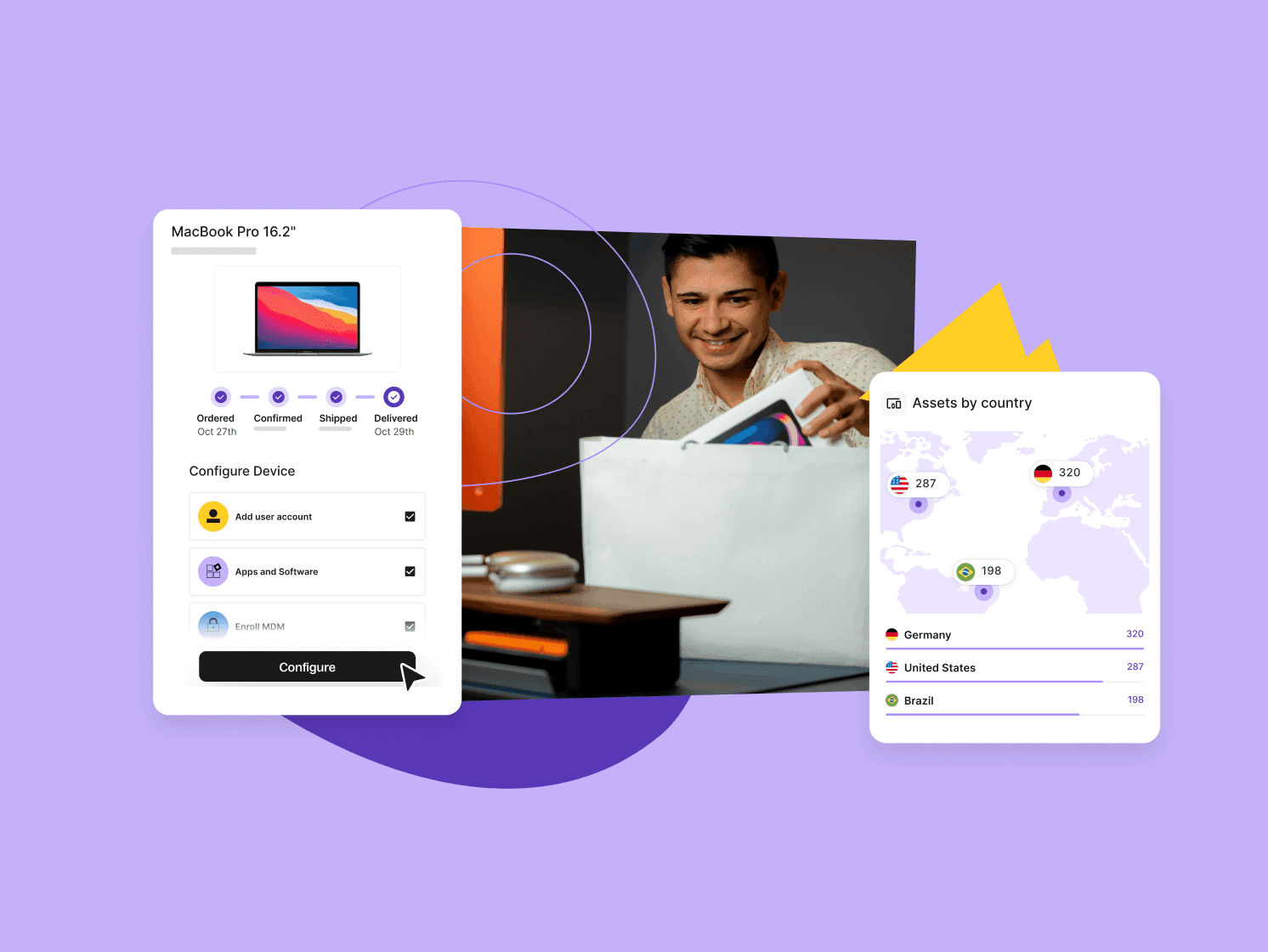
Before a support agent can handle a single ticket, the right hardware needs to be in their hands: configured, enrolled, and ready to use. Achieving that consistently requires a repeatable provisioning and shipping process, especially for remote and distributed teams.
You will need to:
☐ Select and standardize a hardware configuration appropriate for support roles (laptop or desktop, headset, and second monitor if required)
☐ Order hardware with enough lead time to account for shipping, customs, and local delivery timelines, especially for remote or international hires
☐ Pre-image devices with the required operating system, security baseline, and core applications before shipping
☐ Enroll devices in Mobile Device Management (MDM) during provisioning, not after the first login
☐ Confirm the device has been delivered and received before the employee's start date
See also: Why New Hires Start Without Equipment — and How to Fix It
Step 2. Account creation and identity setup
Support agents need secure, reliable access to every system they depend on from the moment they start. That means account creation, identity setup, and application provisioning should begin before day one so that everything is ready on time.
This includes:
☐ Create a company email account and confirm credentials are delivered before day one
☐ Enroll the new hire in Single Sign-On (SSO) and confirm all support-related applications are connected
☐ Enforce Multi-Factor Authentication (MFA) on all accounts from the first login
☐ Assign the correct Role-Based Access Control (RBAC) profile for the employee's support tier (Tier 1, Tier 2, or specialist)
☐ Confirm the identity provider is synchronized with your HRIS so role changes and departures automatically trigger access updates
Read: IAM Best Practices for IT Teams
Step 3. Customer support software and tooling
Support roles depend on a specific software stack: helpdesk platform, CRM, communication tools, and knowledge base. Each tool needs to be provisioned, configured, and tested before the agent's first shift.
Make sure you:
☐ Provision access to the primary helpdesk or ticketing platform (for example, Zendesk, Freshdesk, or Intercom) with the correct queue assignments and permissions
☐ Grant access to the CRM with the appropriate data visibility for the agent's role and region
☐ Set up communication tools, including internal messaging (for example, Slack or Teams) and customer-facing channels such as live chat, phone, and email
☐ Provide access to the internal knowledge base, documentation, and escalation workflows
☐ Confirm all SaaS licenses are assigned and active, not just provisioned in name
☐ Test the setup end-to-end by confirming the agent can log in, open a ticket, and send a message before their first shift
Find out: How to Manage SaaS and App Licensing Across a Distributed Team
Step 4. Security and endpoint configuration
Customer support agents handle sensitive customer data, including account details, payment information, and personal records. To minimize the risk of unauthorized access or data loss, endpoint security should be in place before a device is ever used.
You should:
☐ Confirm full-disk encryption is enabled and verified on all devices
☐ Apply the organization's operating system hardening baseline by disabling unnecessary ports, enforcing screen lock, and restricting local administrator rights
☐ Confirm the MDM policy is active and the device is reporting a compliant status
☐ Enable endpoint management with real-time monitoring for unauthorized access and policy drift
☐ Confirm remote lock and remote wipe capabilities are enabled for all enrolled devices
☐ Ensure the agent has completed security awareness training before handling live customer data
Read: How to Improve IT Compliance with Automated Device Management
Step 5. Network and connectivity requirements
Support agents, especially those working remotely, need a stable, secure connection to perform at the level the role demands. This is why all network requirements should be communicated and verified before day one, not troubleshot during the first shift.
Here is what to do:
☐ Communicate minimum internet speed and stability requirements to the new hire before the start date
☐ Require VPN use for access to internal systems, customer data, and administrative panels
☐ Confirm the VPN client is pre-installed and configured on the provisioned device
☐ Provide clear instructions for connecting to the company Wi-Fi or VPN on the first login
☐ Document the escalation path for connectivity issues so the agent knows who to contact and how to get support
Discover the benefits of 24/7 IT support for distributed teams.
Step 6. IT support access and escalation paths
Support agents need to know how to get help when something breaks, and IT needs a way to resolve issues quickly without disrupting customer-facing work. This is especially important for remote agents working outside standard business hours.
Take the following steps to build an effective IT support and escalation process:
☐ Confirm the agent knows how to raise an IT support ticket and the expected response time
☐ Provide access to a self-service IT portal or knowledge base for common issues, such as password resets, VPN reconnection, and application access
☐ Ensure 24/7 IT support is available for agents working across time zones or outside standard business hours
☐ Document escalation paths for hardware failures, account lockouts, and application outages
☐ Confirm the IT team has remote access capabilities to troubleshoot the agent's device when needed
Read: How to Manage Remote IT Support
Step 7. Ongoing access hygiene and role changes
IT setup doesn't end on day one. As support agents change tiers, move to specialist roles, or take on team lead responsibilities, their access profile needs to stay current. Access creep is a common and preventable risk in support teams where role changes happen frequently.
Your to-do list for role changes should include the following actions:
☐ Review access permissions whenever an agent changes role, tier, or team
☐ Remove access to tools and queues that are no longer relevant to the agent's current role
☐ Conduct a scheduled access review across the support team at least once every quarter
☐ Confirm Role-Based Access Control (RBAC) profiles are updated in the identity provider, not just in individual applications
☐ Audit SaaS license assignments to identify unused or over-provisioned tools
Read: What Happens When Access Is Not Revoked on Time
Step 8. Offboarding and device recovery
When a support agent leaves, the exit process needs to be as structured as the setup. Unrevoked access and unrecovered devices are the two most common IT failures at offboarding — and both are preventable.
You must:
☐ Revoke all application and system access on the agent's last day, or immediately upon notification if the departure is involuntary
☐ Disable SSO and MFA credentials to prevent access through connected applications
☐ Initiate device recovery through a tracked and documented process, confirming receipt and maintaining the chain of custody
☐ Perform certified data erasure on recovered devices before reassignment or disposal
☐ Reassign or reclaim SaaS licenses within 48 hours of the employee's departure
☐ Confirm all access to customer data has been removed and document the revocation for audit purposes
Read: Most Common Offboarding Failures in Remote Teams
IT that scales with your customer support teams: how Deel IT helps
Deel IT gives IT teams a single platform to manage devices, access, security, and support throughout the employee lifecycle, helping every employee stay productive from onboarding through offboarding.
Here is what Deel IT covers:
Global device procurement across 130+ countries: Source from our 240+ item device and accessory catalog, and ship pre-configured hardware to any new hire
MDM enrollment at provisioning: Every device is enrolled in policy before it ships, so encryption, screen lock, and compliance monitoring are active from first login
Automated access provisioning tied to your HRIS: The moment a hire is confirmed, SSO, MFA, and role-based application access are provisioned automatically — helpdesk platform, CRM, and communication tools included
Instant access revocation at offboarding: When an agent leaves, all access is revoked automatically across every connected application
24/7 global IT support: Around-the-clock support helps agents quickly resolve device, application, and access issues, regardless of time zone or shift pattern
Remote device management: Troubleshoot devices remotely, deploy updates, enforce policies, and remotely lock or wipe devices when needed without disrupting customer operations
SaaS license management: Track every application used across the support stack, reclaim unused licenses, and maintain the right level of access as roles change
Automated offboarding and device recovery: When an agent leaves, access is revoked automatically, devices are recovered through a tracked process, and certified data erasure creates a complete audit trail
Book a demo with Deel IT to see how the full IT lifecycle for your customer support team can run without the coordination overhead.
Deel IT
Procure, deliver, manage, and secure devices anywhere

FAQs
What hardware and setup does a customer support agent need?
Support agents need standardized hardware—typically a laptop or desktop with a quality headset—pre-imaged with OS, security baseline, and core applications before shipping. Devices must be enrolled in MDM at provisioning with full-disk encryption enabled and should arrive before the agent's start date, not on it. For remote agents, a second monitor and stable internet are often required to handle ticket volume effectively.
Which software tools must be provisioned before an agent's first shift?
Before day one, provision access to the helpdesk or ticketing platform with correct queue assignments, CRM with appropriate data visibility for the agent's role, internal messaging and customer-facing communication channels, and the internal knowledge base and escalation workflows. Confirm all SaaS licenses are assigned and active, then test end-to-end: the agent should be able to log in, open a ticket, and send a message before their first shift.
Why is network connectivity and VPN access critical for support agents?
Support agents—especially remote workers—handle sensitive customer data like account details and payment information, which requires a secure, stable connection to perform at required levels. VPN must be pre-installed and configured on the device before day one, with minimum internet speed requirements communicated to the hiree beforehand. Without reliable connectivity configured in advance, agents face dropped calls, slow ticket systems, and potential security gaps during their first shift.
How should access be managed when support agents change roles or tiers?
Review and update access permissions whenever an agent changes tier, role, or team, removing access to tools and queues no longer relevant to their position. Conduct quarterly access reviews across the full support team to prevent access creep—a common risk when role changes happen frequently. Ensure RBAC profile updates flow through the identity provider, so changes apply across all connected applications, not just individual tools.
Dr Kristine Lennie holds a PhD in Mathematical Biology and loves learning, research and content creation. She had written academic, creative and industry-related content and enjoys exploring new topics and ideas. She is passionate about helping create a truly global workforce, where employers and employees are not limited by borders to achieve success.