Article
1 min read
How to Build the Right IT Setup for Sales Teams: A Practical Checklist
IT & device management

Author
Dr Kristine Lennie
Last Update
July 03, 2026

Table of Contents
Step 1. Confirm hardware requirements before the start date
Step 2. Device management and security configuration
Step 3. Provision core accounts and access on day one
Step 4. Configure sales-specific software and integrations
Step 5. Apply security and compliance settings for the role
Step 6. Set up communication and collaboration tools
Step 7. Confirm IT support access and escalation paths
Step 8. Complete the offboarding setup before it's needed
IT that scales with your sales team: how Deel IT helps
Key takeaways
Sales teams spend their day moving between CRM systems, customer calls, email, messaging, and sales engagement platforms. When any part of their IT setup is missing, new hires lose valuable selling time before they have the chance to ramp.
Getting sales hires productive from day one requires treating onboarding as a coordinated IT workflow rather than a series of individual setup tasks, with hardware, access, security, software, and support prepared in the right sequence before the start date.
Deel IT helps organizations automate IT setup from a single platform by managing device provisioning, application delivery, security, and lifecycle workflows, so every new hire is ready to work from day one.
Sales teams run on speed. A delayed laptop, a missing CRM license, or a broken video call setup on day one doesn't just frustrate a new hire: it delays pipeline activity, slows ramp time, and signals to a new rep that the company isn't ready for them.
This checklist covers every IT action required to get a sales hire fully operational: hardware, software, access, security, and communication tools, in the order they need to happen.
Step 1. Confirm hardware requirements before the start date
Sales roles require reliable video for customer calls, enough processing power for multiple browser tabs and CRM workflows, and, in some cases, a mobile device for field work. Getting this wrong means a rep spends their first week working around their equipment instead of learning the product. You need to:
☐ Confirm whether the role is field-based, remote, or office-based — this determines the hardware configuration
☐ Order a laptop with sufficient RAM and processing power for CRM, video conferencing, and browser-heavy workflows (16GB RAM minimum is a reasonable baseline for most sales roles)
☐ Confirm keyboard layout, power adapter, and OS preference (Mac vs Windows) based on company standard and local requirements
☐ Order a headset or speakerphone rated for call quality — built-in laptop audio is not sufficient for customer-facing calls
☐ Confirm whether a mobile device is required for the role and order accordingly
☐ Verify shipping address and expected delivery date against the confirmed start date — allow buffer for customs if the hire is international
Here are the 6 top IT accessories for boosting employee productivity.
Step 2. Device management and security configuration
Before a sales rep receives their device, IT should confirm it is configured for management and protected by the organization's baseline security controls. This helps ensure devices remain visible, compliant, and recoverable throughout their lifecycle. Make sure you:
☐ Verify the device is enrolled in, or configured for, Mobile Device Management (MDM) as part of provisioning
☐ Apply the company's baseline security configuration, including disk encryption, screen lock requirements, and operating system update policies
☐ Assign the device to the appropriate MDM policy group for the sales team, if role-based policies are in use
☐ Confirm remote lock and device wipe capabilities are enabled and available through the management platform
☐ Document the device serial number, assigned user, and shipment details in the asset register
Apply these 6 steps to ensure endpoint compliance for remote international workers.
Step 3. Provision core accounts and access on day one
Sales reps need a specific set of tools to be active and ready before they can do anything productive. Account provisioning that happens reactively (i.e, after the hire asks for access) adds days of friction to ramp time. The goal is for every account to be live before the rep opens their laptop for the first time. Here is how you can help:
☐ Create the company email account and confirm it is active before the start date
☐ Provision Single Sign-On (SSO) access and confirm the rep can authenticate before day one
☐ Enforce Multi-Factor Authentication (MFA) on the account from first login — do not leave this as a self-service step
☐ Grant CRM access (Salesforce, HubSpot, or equivalent) with the correct role and territory permissions applied
☐ Provision video conferencing (Zoom, Google Meet, or equivalent) and confirm the account is linked to the company domain
☐ Add the rep to the correct Slack or Teams channels — sales team, regional channel, deal review, and any relevant customer channels
☐ Confirm calendar access and sharing permissions are configured correctly for the team
Read this simple guide to unified application licensing and access management.
Step 4. Configure sales-specific software and integrations
Beyond core accounts, sales roles depend on a stack of tools that need to be configured, not just provisioned. A CRM license with no territory data loaded, a dialer with no phone number assigned, or a sales engagement platform with no sequences connected is effectively unusable on day one. Key steps here include:
☐ Provision a sales engagement platform (Outreach, Salesloft, or equivalent) and confirm the email integration is active
☐ Assign a direct dial number or configure the VoIP/dialer setup (Aircall, Dialpad, or equivalent) — confirm outbound calling works before the start date
☐ Connect the CRM to the rep's email and calendar so activity is logged automatically
☐ Provision access to the sales intelligence or prospecting tool (LinkedIn Sales Navigator, Apollo, ZoomInfo, or equivalent)
☐ Confirm access to the document management or e-signature platform (DocuSign, PandaDoc, or equivalent) if the role involves closing
☐ Provision access to the sales enablement or content library (Highspot, Seismic, or equivalent) if in use
☐ Verify all integrations between tools are active, e.g., CRM ↔ dialer, CRM ↔ email, and engagement platform ↔ calendar
Discover how to choose IT equipment for any role.
Step 5. Apply security and compliance settings for the role
Sales reps handle customer data, contract information, and pricing, all of which carry compliance obligations. Security settings should be applied at provisioning, not added later when a gap is identified. This is especially important for teams operating across multiple regions where data handling requirements differ. You should:
☐ Confirm data handling and storage policies are communicated to the new hire before they begin working with customer data
☐ Apply Role-Based Access Control (RBAC) so the rep has access to the data their role requires — and no more
☐ Confirm the device is encrypted and that the encryption status is visible in the MDM console
☐ Verify the rep's accounts are covered by SSO and MFA — confirm no application is accessible outside the identity provider
☐ If the role involves handling payment or contract data, confirm relevant compliance requirements (GDPR, SOC 2, or regional equivalents) are documented, and the rep has completed any required training
☐ Confirm the rep is enrolled in the company's security awareness training before they begin customer-facing activity
See: How Effective is Your Awareness Training Against Cyber Threats? An 8-Question Checklist
Step 6. Set up communication and collaboration tools
Sales reps spend a significant portion of their day on calls, in meetings, and coordinating internally. Communication tools that aren't configured correctly (e.g., wrong time zone, no calendar permissions, no access to shared drives) create friction that compounds across every working day. To avoid these issues:
☐ Confirm communication and scheduling tools are configured correctly, including time zone settings where applicable
☐ Confirm the rep has access to shared drives or document repositories relevant to their role (pitch decks, case studies, pricing sheets)
☐ Add the rep to recurring team meetings and confirm calendar invites have been sent
☐ Confirm the rep's email signature is configured to the company standard
☐ Verify the rep can join and host video calls with external participants — test this before the start date if possible
☐ Confirm the rep has access to the internal knowledge base or wiki (Notion, Confluence, or equivalent)
See also: How AI Improves Global Team Collaboration: 6 Use Cases and Tools You Can Try Now
Step 7. Confirm IT support access and escalation paths
Sales reps working across time zones or in the field need to know how to get IT help when something breaks, and it needs to be fast. A rep who can't reach IT support during a customer call or before a demo has no fallback. Support access should be communicated on day one, not discovered when something goes wrong. You need to make sure you:
☐ Communicate the IT support channel to the new hire on or before day one: Slack channel, ticketing system, or helpdesk link
☐ Confirm the rep knows the escalation path for urgent issues (broken device, locked account, failed authentication before a customer call)
☐ If the rep is in a time zone outside the core IT team's hours, confirm whether 24/7 support is available and how to access it
☐ Confirm the rep has access to self-service IT resources (password reset, VPN setup, device troubleshooting guides) without needing to raise a ticket
Read: The Benefits of 24/7 IT Support for Distributed Teams
Step 8. Complete the offboarding setup before it's needed
Offboarding preparation is part of the IT setup process, not a separate task. Sales roles carry elevated offboarding risk — CRM data, customer contacts, pricing information, and active deal records are all sensitive. The controls that make offboarding clean need to be in place from day one.
☐ Confirm the device is enrolled in MDM with remote wipe enabled
☐ Confirm all accounts are provisioned through SSO so deprovisioning can be executed from a single action
☐ Document all applications the rep has access to in the asset register: this becomes the deprovisioning checklist when they leave
☐ Confirm the CRM is configured so customer data and deal records are owned by the account, not the individual user — this prevents data loss at departure
☐ Confirm the rep has not been granted local admin rights or the ability to install unapproved software
Discover the most common offboarding failures for remote teams.
IT that scales with your sales team: how Deel IT helps
Sales teams hire quickly, operate across regions, and depend on multiple systems to stay productive. When device management, access provisioning, software licensing, and support are handled manually, delays and inconsistencies are difficult to avoid.
Deel IT gives IT teams the ability to manage devices, access, software, security, and support from a single platform, regardless of whether employees work in sales, HR, design, engineering, or any other function.
Here is what that means:
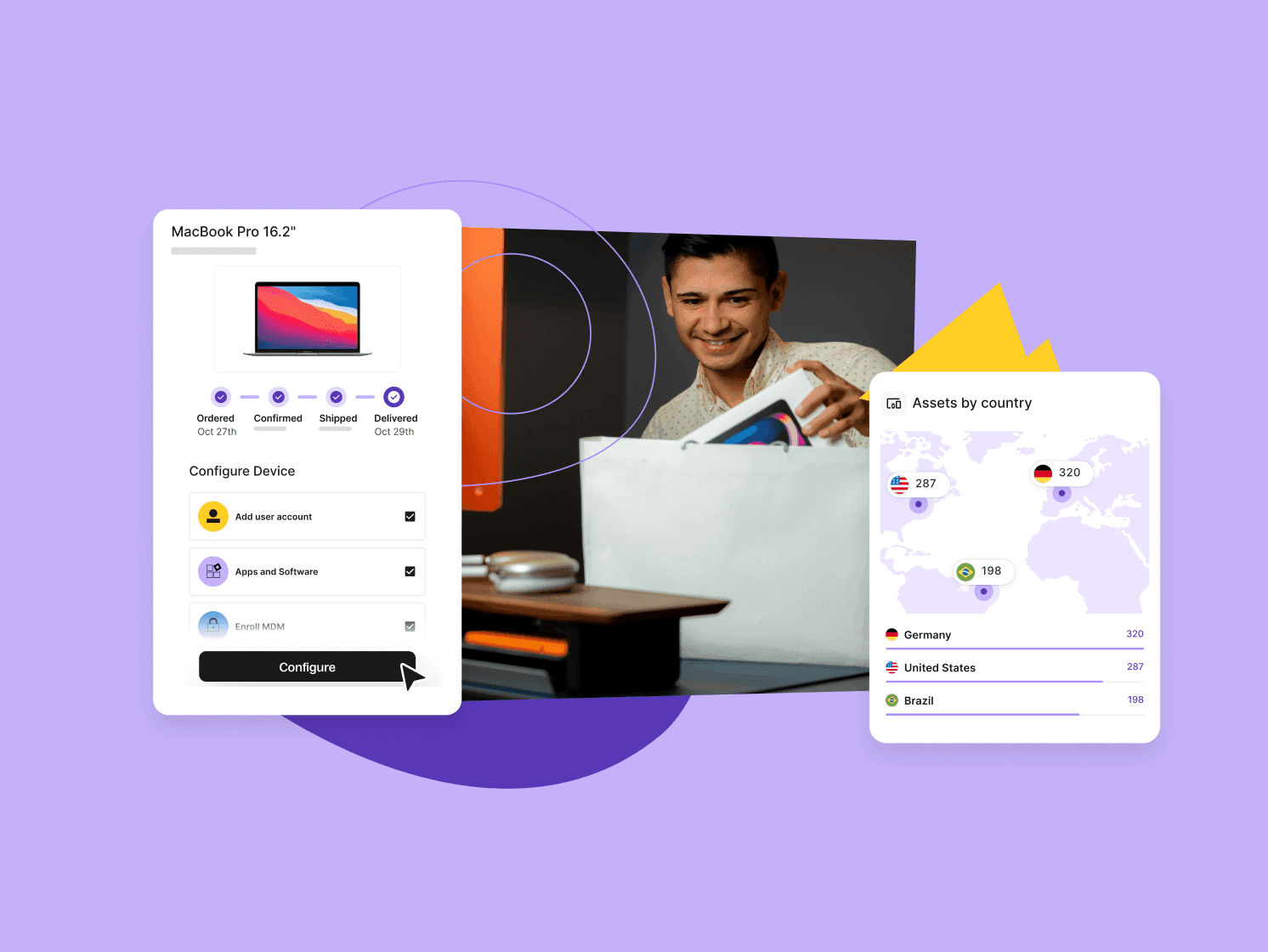
Global device procurement across 130+ countries: Source, configure, and ship pre-imaged laptops and peripherals to any new sales hire, customs, and logistics fully handled
MDM enrollment at provisioning: Every device ships with encryption, screen lock, and security policy applied — not as a post-delivery step; the rep has to complete it themselves
Automated access provisioning tied to your HRIS: The moment a sales hire is confirmed, SSO, MFA, CRM access, and role-based permissions are triggered automatically — accounts are live before day one
Centralized SaaS and license management: Every sales tool — CRM, dialer, engagement platform, intelligence tools — tracked, assigned, and reclaimed from one place. Unused licenses are identified and eliminated
Automated deprovisioning at offboarding: When a sales rep leaves, access revocation is triggered automatically across connected systems the moment employment ends
24/7 global IT support: Live helpdesk coverage in every time zone, so a rep in Singapore or São Paulo gets the same response time as one in London or New York
Lifecycle audit trail: Device status, asset ownership, and lifecycle events are tracked and reportable from one platform, so IT can demonstrate what was in place and when, without reconstructing records from multiple systems
Sales reps should be selling on day one. Book a demo to see how Deel IT gets them there.
Deel IT
Procure, deliver, manage, and secure devices anywhere

FAQs
What hardware does a new sales rep need on day one?
A sales rep needs a laptop with at least 16GB RAM to handle CRM workflows, multiple browser tabs, and video conferencing simultaneously, plus a dedicated headset or speakerphone rated for customer calls—built-in laptop audio isn't sufficient. The device must ship with MDM enrollment, disk encryption, and remote wipe enabled before arrival, not after the first login.
Which software and tools need to be configured before a sales hire starts?
Before day one, provision a company email account, SSO with MFA enforced at first login, CRM access with correct territory permissions, video conferencing, and messaging channels. Sales-specific tools—engagement platform, VoIP dialer with assigned phone number, sales intelligence tools, and e-signature software—should all have active integrations so activity logging, calendar syncing, and outbound calling work immediately.
How should CRM data and customer information be secured during onboarding?
Apply Role-Based Access Control (RBAC) so reps only access customer data and pricing their role requires, and ensure all application access flows through SSO with MFA enforced. Route all CRM integrations through the company account rather than individual user accounts, so data ownership is clear and isn't lost if the rep leaves.
Why should offboarding controls be set up during onboarding?
Offboarding controls configured at hire—MDM remote wipe verified active, all accounts provisioned through SSO, every application documented in an asset register—prevent data loss and access gaps when a rep leaves. If CRM ownership is tied to company accounts instead of individual users, customer data and deal records stay with the company rather than disappearing at departure.
Dr Kristine Lennie holds a PhD in Mathematical Biology and loves learning, research and content creation. She had written academic, creative and industry-related content and enjoys exploring new topics and ideas. She is passionate about helping create a truly global workforce, where employers and employees are not limited by borders to achieve success.