Article
7 min read
How to Register a Sole Proprietorship (Proprietorship Firm) in India
Contractor management

Author
Dr Kristine Lennie
Last Update
June 10, 2026

Table of Contents
What is a sole proprietorship (proprietorship firm) in India?
How does a sole proprietorship (proprietorship firm) work in India?
Sole proprietorship (proprietorship firm) vs other business structures in India
Step-by-step guide: How to register a sole proprietorship (proprietorship firm) in India
Financial and tax obligations for sole proprietorships in India
Launch your contracting career and stay compliant with Deel
FAQs
In India, many entrepreneurs choose to start out as a sole proprietorship (proprietorship firm) because it’s quick, inexpensive, and flexible. You don’t need to invest a minimum amount of capital, and you can begin operations almost immediately.
At the same time, there are some drawbacks. A sole proprietor carries unlimited liability, meaning your personal and business finances are treated the same. Depending on your state, you may also need to complete several registrations. Still, for freelancers, consultants, shopkeepers, and service providers, the independence and simplicity often outweigh the challenges.
Disclaimer: This article is for informational purposes only and is not a substitute for legal advice. Please always check official sources or seek professional guidance before taking action.
What is a sole proprietorship (proprietorship firm) in India?
A sole proprietorship in India is not a separate legal entity under the Companies Act. It simply refers to an individual carrying on business in their own name or under a trade name.
It is commonly referred to as a proprietorship firm, and depending on context, you may also see terms like:
Sole proprietorship
Proprietorship firm
Self-employed business
Independent contractor
How does a sole proprietorship (proprietorship firm) work in India?
| Category | Description |
|---|---|
| Official name | Sole proprietorship (proprietorship firm) |
| Registration body | Income Tax Department, Goods & Services Tax (GST) Council |
| Minimum capital | None required |
| Liability | Unlimited—personal and business assets are legally the same |
| Tax structure | Progressive income tax. Business income is taxed as personal income at rates from 5% to 30% depending on total income. |
| Naming conventions | You may use your own legal name or a trade name; trade names may need registration, depending on the state |
| Key advantage | Quick and inexpensive to start |
| Key disadvantage | Unlimited liability and limited access to credit or investment |
Sole proprietorship (proprietorship firm) vs other business structures in India
While a sole proprietorship (proprietorship firm) is the simplest way to run a business, it isn’t the only option. Many entrepreneurs in India also consider forming a Private Limited Company or an LLP. Here’s how they compare:
| Feature | Sole proprietorship (proprietorship firm) | Private limited company / LLP |
|---|---|---|
| Liability | Unlimited | Limited |
| Setup cost | Very low | Higher—incorporation fees and compliance |
| Taxes | Personal income tax (5%–30%) | Corporate tax regime that depends on the type of company and profit |
| Setup time | A few days to a week | Usually longer |
| Best for | Freelancers, consultants, small shops | Startups, scaling businesses, raising capital |
Compliance
Unlock Continuous Compliance™ with Deel

Step-by-step guide: How to register a sole proprietorship (proprietorship firm) in India
Step 1: Check if you are eligible to become a sole proprietor (proprietorship firm) in India
To start a proprietorship firm, you must be either an Indian citizen or a resident with valid proof of identity and address. Foreign nationals can also register, but they generally need a business visa and local address documentation. The key documents you will use are your PAN (Permanent Account Number), issued by the Income Tax Department for tax purposes, and your Aadhaar, the 12-digit unique identity number issued by the Unique Identification Authority of India (UIDAI) that serves as both ID and address proof.
Step 2: Choose your business name
You can operate under your own name or choose a trade name. Trade names should not infringe trademarks. Trade names should not infringe trademarks (i.e., they must not copy or conflict with existing registered brand names). To open a business bank account under a trade name, banks typically require a Shop & Establishment certificate (a state-issued license proving your business premises are legally registered. You can search your trade name's availability using the government's online tool.
Step 3: Gather required documents
You’ll usually need:
PAN card of the proprietor
Aadhaar card or another form of ID and address proof
Proof of business address (rental agreement, utility bill, ownership papers)
Bank account details
Shop & Establishment licence application (state-specific)
Activity-based licences (e.g., FSSAI registration for food businesses)
Step 4: Register with the authorities
Since there is no central incorporation process for proprietorships in India, you will need to complete a few separate registrations depending on your business. First, you must obtain a PAN from the Income Tax Department if you don’t already have one. If your annual turnover crosses the prescribed thresholds or if you engage in interstate supply, you will also need to complete GST registration through the GST. Most states also require a Shop & Establishment Act licence, issued by the state’s Labour Department, as proof that your business premises are legally registered. Finally, you can optionally apply for Udyam registration, which recognizes your business as an MSME (Micro, Small, and Medium Enterprise) and provides access to government benefits and subsidies.
Step 5: Pay fees and contributions
The costs of setting up a proprietorship firm vary depending on your location and activity. A Shop & Establishment licence typically ranges from ₹500 to ₹3,000, depending on the state and the number of employees. GST registration itself does not carry a government fee, though you may incur compliance and filing costs. In addition, if your annual income tax liability is greater than ₹10,000, you must pay advance tax in instalments across the year.
Step 6: Meet post-registration obligations
Once your proprietorship is registered, you must issue clear, compliant invoices that include your details and GSTIN (a 15-digit Goods and Services Tax Identification Number issued when you register for GST, combining your state code and PAN) if applicable. These records are essential for filing annual income tax returns and, if registered, periodic GST returns. You should also keep licences such as your Shop & Establishment registration updated whenever your business changes.
Financial and tax obligations for sole proprietorships in India
You are responsible for:
-
Income tax: Business income is taxed as personal income under progressive rates of 5%–30%. You can choose between the New Tax Regime (default, higher exemption but fewer deductions) and the Old Tax Regime (lower exemption but more deductions). Filing is done annually through the Income Tax Department.
-
Presumptive taxation: Small businesses and professionals may opt into simplified taxation under the Income Tax Act. Instead of maintaining detailed books, income is calculated at a fixed percentage of turnover, and tax is paid accordingly.
-
VAT(GST): Registration is mandatory if your turnover exceeds a certain threshold (thresholds differ across states). Registered businesses must collect and remit GST and file periodic returns through the GST portal.
-
Advance tax: If your annual income tax liability exceeds ₹10,000, you must pay advance tax in quarterly instalments (June, September, December, and March).
-
Social security contributions: Sole proprietors do not contribute to social security for themselves. However, if you hire employees, you must register and contribute to Employees’ Provident Fund (EPF) and Employees’ State Insurance Corporation (ESIC)
-
Record-keeping: You are required to keep proper records of invoices, receipts, and accounts for at least six years. Authorities may request access during audits or assessments.
-
Invoicing: Invoices must clearly include your name or trade name, address, and GSTIN (15-digit Goods and Services Tax Identification Number) if registered. They should also carry sequential numbering, client details, and a description of goods or services supplied.
Launch your contracting career and stay compliant with Deel
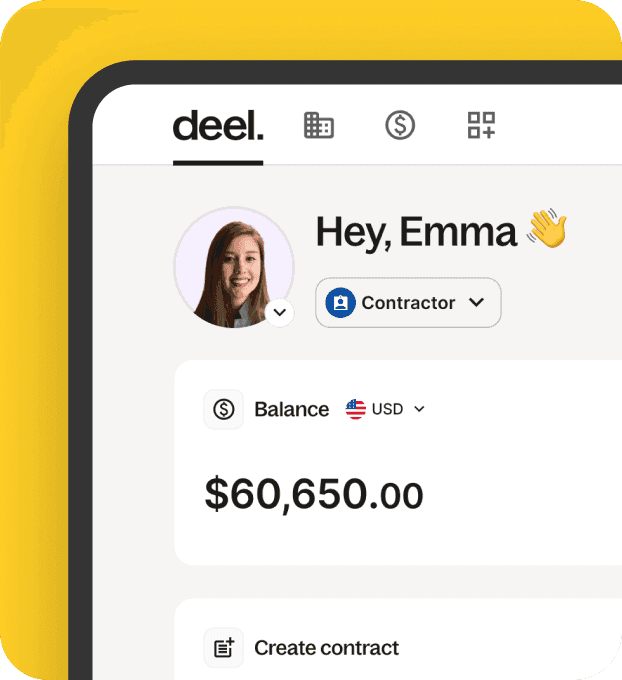
Registering a sole proprietorship gives you independence, but it also means handling taxes, invoices, and records on your own. Deel’s all-in-one platform helps you manage obligations without the stress. With Deel, you can:
Automate invoicing and expense tracking with essential Bookkeeping tools
Create, send, and sign localised work agreements
Keep accurate records for tax season
Access expert tax advice and compliance support
Get paid through multiple payment and withdrawal methods
Spend your earnings in USD with the Deel Card
Access funds early with Advance
Enjoy contractor perks from 150+ partners
Stay independent, without the admin overload. Sign up to Deel for free today.
Deel has completely alleviated the stress of being a global freelancer. The platform's simplicity and reliability mean I can trust payments are on time, allowing me to focus on work instead of paperwork.
—Sabrina Montero,
Colombia
More resources
FAQs
What is the minimum capital required?
None. You can start a proprietorship firm with any amount.
Do proprietorship firms need GST registration?
Yes, if turnover exceeds thresholds or if you supply interstate.
What contributions apply?
As a sole proprietor, you are responsible for tax contributions such as income tax (5%–30% depending on income), advance tax if your liability exceeds ₹10,000 a year, and GST if your turnover requires registration. Social security contributions like EPF or ESIC only apply if you hire employees.
Can a sole proprietor hire employees?
Yes, but once you do, you must comply with labour laws, EPF, and ESIC requirements.
How long does registration take?
Usually, a few days to a week, depending on state processing times.
Can foreign nationals register?
Yes, but they require valid visas, residency proof, and often more documentation.
Do I need a separate bank account?
Not legally required, but strongly recommended for bookkeeping and compliance.
How do I close a proprietorship firm?
Cancel GST if registered, inform your state’s Labour Department, and file a final tax return.
Are there incentives?
Yes, such as Micro, Small, and Medium Enterprise (MSME) benefits through Udyam registration and simplified presumptive taxation, including benefits and subsidies.
Can I use Deel as a proprietor?
Yes. Deel allows sole proprietors to receive payments globally in multiple currencies.
Does Deel generate compliant invoices?
Yes. Deel automatically issues invoices with the required legal details.
Can Deel help with taxes?
Yes. Deel provides downloadable reports for tax filings.
Does Deel offer contracts?
Yes. Deel includes locally compliant contract templates.
Can I access benefits with Deel?
Yes. Deel offers optional health, retirement, and other perks typically reserved for employees.
Contractors
Manage all your clients from one place.
Dr Kristine Lennie holds a PhD in Mathematical Biology and loves learning, research and content creation. She had written academic, creative and industry-related content and enjoys exploring new topics and ideas. She is passionate about helping create a truly global workforce, where employers and employees are not limited by borders to achieve success.