Article
7 min read
How to Shift from Fixed to Flexible Workforce Planning
Global hiring
Employer of record
Contractor management

Author
Jemima Owen-Jones
Last Update
September 17, 2026

Table of Contents
What is flexible workforce planning?
Step 1: Audit your current workforce cost structure
Step 2: Map roles to the right employment model
Step 3: Set a target flexible-to-fixed ratio
Step 4: Manage worker classification risk at scale
Step 5: Build the operational infrastructure for a blended workforce
Step 6: Monitor your blended workforce
Hire flexibly with Deel
Key takeaways
Fixed workforces drain margins when revenue drops. Permanent hires leave you paying for capacity you don't use. Flexible hiring—mixing employees with contractors—lets you adjust costs with demand.
The right employment model matters more than cost alone. Use employees for ongoing work that needs your control and direction. Use contractors for defined projects where you can set clear deliverables and completion dates.
Deel's EOR solution and Contractor Management let you run both models together. One platform handles employment obligations. The other handles contractor agreements. You get the flexibility without the compliance risk.
Excess headcount destroys margins when revenue falls. Too little capacity delays delivery when demand rises. Most companies face this choice: hire permanent staff and absorb the fixed cost, or stay lean and miss opportunities.
Fixed workforce plans assume every new need requires a permanent hire. This leaves you with no options before you even understand the work. Finance can't forecast flexibly. HR can't respond quickly. Delivery teams get stuck between overstaffing and understaffing.
We've worked with 40,000+ companies facing this problem. The best performers use a blended approach: an employee core for ongoing work that needs your direction and control, plus independent contractors for defined projects where deliverables are clear. This mix lets you fund capabilities while adjusting costs as business needs change.
This guide is for finance leaders, HR teams, and operations managers building workforce plans that actually work. You'll learn how to audit labor costs, choose the right employment model for each role, set realistic targets, and run a rolling 90-day review that keeps finance and HR aligned.
What is flexible workforce planning?
Flexible workforce planning means adjusting your workforce's capacity and cost as business needs change. Stop treating every need as a permanent hire. Instead, decide which work needs ongoing employees and which work suits independent contractors.
For this guide, a fixed model relies on permanent employees for planned demand. A flexible model combines an employee core, including EOR employees where appropriate, with independent contractors for eligible work. Keep your existing team. Flexibility adds options—it doesn't replace what works.
| Planning choice | Permanent-employee model | Blended employee and contractor model |
|---|---|---|
| Best fit | Sustained work requiring close coordination and continuity | Sustained core work plus specialist projects |
| Cost pattern | Recurring employment costs | Recurring employment costs plus contract-specific commitments |
| Operational benefit | Consistent ownership and retained knowledge | Specialist skills for specific projects |
| Trade-off | Unused capacity when demand falls | More coordination, handoffs, and classification review |
The aim is to improve workforce flexibility and stability together. Keep essential knowledge with your employee team, and fund independent projects where the deliverables justify the commitment.
Your hiring structure and your contractor strategy address different questions. How you employ people (EOR, direct hire, PEO) is separate from which services you buy through contractors. Together, they let you balance cost with operational needs.
Deel HR
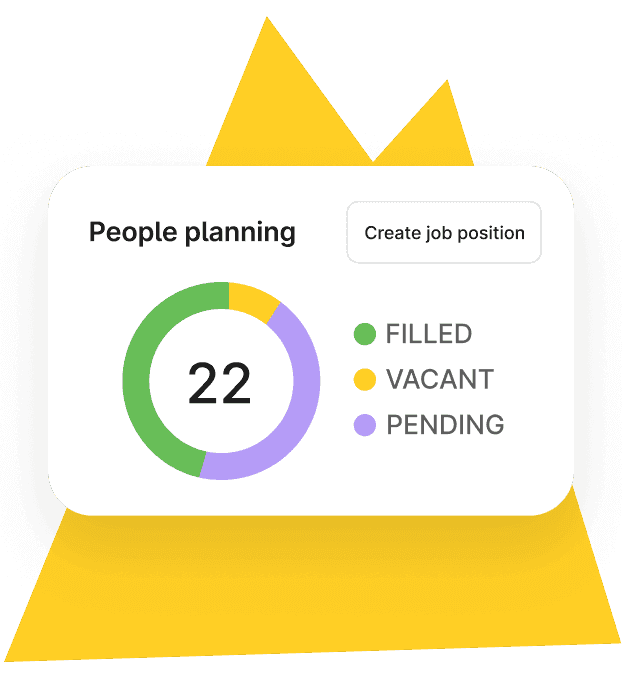
Smarter end-to-end workforce planning
Step 1: Audit your current workforce cost structure
Start with spending you've already committed, not the number of people on your organizational chart. Build your audit using the same period and currency as your revenue forecast. This lets finance compare costs directly.
Extend your existing headcount planning process to include contractor commitments alongside employee costs. Keep worker type, spend category, and flexibility level in separate fields. Flexibility level = how easily you can reduce the cost. A contractor on a guaranteed retainer may create a substantial fixed commitment even without an employment contract.
Build your workforce cost inventory
Gather employee pay, employer costs, benefits, and payroll admin fees
Add recruitment, equipment, onboarding, and relevant management costs using a consistent method
Capture contractor fees, platform costs, minimum commitments, renewal dates, and cancellation terms
Record notice periods, accrued time off, and severance obligations. Get local advice
Assign each cost to the revenue stream, function, or project it supports
Add up employee cost this way: employee pay + employer costs + benefits + payroll admin fees. Do this for your full review period. Then add up contractor cost: agreed fees + service charges + internal support costs over the same period. Compare equivalent work and expected output rather than an employee's annual salary with a contractor's hourly rate.
Don't count costs you can't change. Only mark costs as flexible if you can reduce or stop them. Include contractual milestones and legally required payments in your fixed costs.
For context on different working arrangements, refer to the BLS contingent worker release. Use your own contracts and financial records, rather than a national workforce benchmark, to classify spending in this audit.
Test a revenue drop. Keep labor costs fixed. Then ask: where does lower demand leave you with staff but no work for them? That gives you a specific margin problem to solve through redeployment, changed hiring priorities, or future project-based sourcing.

Guide
Optimize HR spending
Step 2: Map roles to the right employment model
Assess the relationship first. Don't compare costs until you understand the work. A role you manage daily is different from a project with clear end dates.
Your employee core should cover sustained responsibilities such as product ownership, people management, and operational accountability. If you need to hire in a country where you have no office, use Deel's EOR. Don't try to make it work as a contractor agreement.
Independent contractors can suit specialist assignments, bounded projects, and some market-testing work. A short assignment or a specialist title doesn't establish independence on its own. If you need employee-like control, review the employment route even when demand is uncertain.
Use these criteria to compare Deel Contractor and Deel EOR for each proposed engagement:
| Decision criterion | Employee or EOR direction | Potential contractor direction |
|---|---|---|
| Control | You direct day-to-day work and set the schedule | You specify results while the provider controls delivery, subject to local rules |
| Duration and scope | The role owns continuing responsibilities | The engagement has clear outputs and an end date |
| Integration | The person participates in your ongoing management structure | The provider delivers a separable service |
| Jurisdiction | Employment is legal under local rules | Local law allows independent work |
| Knowledge continuity | You need lasting internal ownership | You can document and transfer the completed work |
These criteria guide intake, not a legal determination. Have your legal or compliance team confirm the applicable classification requirements before approval.
Write the business outcome and expected duration before selecting worker type
Document who controls delivery and how the work connects to your team
Confirm the work is legal in that country
Pick one person to review scope changes
Don't reclassify existing employees as contractors just to cut costs. Start with new work or real changes in the role. Always check with local specialists before switching worker types.
Deel Hire
Hire employees globally with the #1 Employer of Record
Step 3: Set a target flexible-to-fixed ratio
Set your target based on work you can actually do with contractors. Don't copy benchmarks from other industries. A business with recurring regulated operations will need a different mix from one with clearly separated implementation projects.
Track two separate numbers. First: what percent of your work can go to contractors? Second: what percent of your pay budget can you cut? These are different questions. Many contractors doesn't mean low costs—some contractors have guaranteed retainers.
Define your capacity measure consistently, using planned hours or another common workload unit where appropriate. Avoid counting a short specialist assignment as equivalent to an ongoing full-time role. For costs: divide the money you can cut by your total labor budget. Only count costs as adjustable if you can actually reduce or stop them. Document what you excluded and why.
Use research on workforce planning to broaden the questions you test, then build targets from your own scenarios:
| Scenario | Protect | Adjust | Trigger for review |
|---|---|---|---|
| Growth | Employee ownership of recurring delivery | Add eligible specialist projects against confirmed demand | Backlog exceeds your delivery capacity |
| Contraction | Critical operations and customer commitments | Cut uncommitted projects and move employees to critical work | Revenue forecast falls below the approved plan |
| Market entry | Clear accountability and local compliance | Test defined services before expanding ongoing roles | Sustained demand starts to grow |
Set a target range for each function, with an explanation of the work behind it. Include costs for training, knowledge transfer, and severance. Add time for each. A plan that ignores these transitions will overstate how quickly you can adjust capacity.
Validate delivery before approving the ratio
Talk to your department leaders first. Can they deliver the forecast with the employees you keep and the contractors you add? If no, change the work plan instead. Don't stretch contractor classifications just to fit your target ratio.
Step 4: Manage worker classification risk at scale
Worker classification depends on the actual relationship and applicable law, not just the contract's title. As you expand across jurisdictions, you need local assessment rather than a single global contractor checklist that promises the same answer everywhere.
Two US frameworks illustrate why you must keep the rules distinct:
| Framework | Core question | Planning implication |
|---|---|---|
| Federal economic-realities analysis | Does the worker depend economically on the business or operate independently? | Review the Department of Labor guidance and confirm current requirements with counsel. |
| California ABC test | Can the hiring business satisfy the required conditions for independent-contractor status? | Check California's independent contractor guidance, including exceptions and alternative tests. |
Neither framework supplies a universal international rule. Different authorities within the same jurisdiction may also apply different classification standards. Don't treat an assessment for one legal purpose as approval for every other purpose.
Build review into the engagement lifecycle to address employee and contractor misclassification:
Confirm classification before signing the agreement.
Document the working practices that support the assessment.
Reassess when scope, supervision, location, or duration changes.
Escalate ongoing employee-like work for an employment review.
Use Deel's worker classification assessment
Deel's worker classification assessment analyzes your engagement against employment law cases to identify misclassification risk. The tool uses AI and case-law research to classify workers with over 90% accuracy.
This helps you:
Confirm classification before you sign
Spot risk before it becomes costly
Make decisions with confidence backed by case law
Hundreds of businesses use this assessment to reduce compliance risk. It takes the guesswork out of contractor versus employee decisions.
Global Hiring Toolkit
Misclassification Assessment

Use employment when the role requires it
When the role requires employment, an EOR arrangement provides an employment route instead of continuing a contractor relationship. It doesn't erase past exposure or remove every compliance obligation. Account for local employment terms and a properly managed transition, rather than assuming that changing the payment method resolves the issue.
Step 5: Build the operational infrastructure for a blended workforce
Deel provides the operational infrastructure to run a flexible workforce across employment and contractor models. You classify workers, set your targets, and choose the right Deel service for each engagement—then Deel handles the compliance, administration, and payments.
You have three options:
Option 1: Deel EOR (Employment)
For ongoing roles where you need employment in a country where you have no entity. Deel is the legal employer and handles all employment obligations, compliance, and payroll.
Use this if:
You need to hire employees in a new country
You want a full employment relationship with benefits and protections
You want Deel to own employment compliance
Deel EOR:
Acts as the legal employer
Handles all employment compliance and tax withholding
Manages payroll and benefits
Takes responsibility for employment obligations
Option 2: Deel Contractor Management (self-serve)
You classify workers, create contracts, and process payments directly. You keep full control but also keep compliance responsibility.
Use this if:
You have legal and compliance resources in-house
You want to classify and approve each contractor yourself
You're comfortable holding the classification risk
Deel Contractor Management:
Provides compliant contractor agreement templates
Processes contractor payments
Lets you manage renewals and ongoing work yourself
You confirm classification and hold compliance responsibility
Option 3: Deel Contractor of Record
Deel handles worker classification, compliance review, and hiring. You avoid classification risk and liability. Deel is responsible for proper classification and ongoing compliance.
Use this if:
You want to avoid classification risk
You prefer Deel to handle compliance and liability
You want simpler operations with less compliance burden
Deel Contractor of Record:
Reviews and confirms worker classification
Creates compliant contractor agreements
Handles contractor onboarding and administration
Manages ongoing compliance and reassessment
Takes responsibility for proper classification
Choose your path
Start with your compliance capacity and risk appetite. For employment, choose Deel EOR. For contractors, choose between managing it yourself (self-serve) or having Deel own the compliance risk (Contractor of Record).
All three options integrate with your finance and HR systems. Give finance and HR consistent engagement identifiers and cost-center definitions. Preserve the distinction between an employment end date, a contractor end date, and a project completion date—each creates a different action.
Deel Contractor of Record
Minimize misclassification risk

Step 6: Monitor your blended workforce
Deel's compliance infrastructure continuously monitors your workforce as it evolves and as employment laws change. This means you can adjust your mix of employees and contractors without legal risk.
How Deel's continuous compliance works
Deel monitors:
Changes in worker scope, location, or duration
New employment laws in each country where you hire
Classification risk as your engagement with each worker changes
Opportunities to transition contractors to employees when it makes sense
When laws change or a contractor's work becomes more employee-like, Deel flags it. You get ahead of risk instead of discovering it in an audit.
Between Deel's monitoring, if a material change happens—revenue drops, a contractor's role becomes full-time, a law changes—escalate it immediately. Don't wait for a scheduled review.
Use Deel's dashboard as your source of truth
Deel's HR dashboard gives you a complete view of your workforce: all workers, their classification, engagement type, location, and compliance status. Use this dashboard to:
See your current employee and contractor mix at a glance
Track upcoming renewals and end dates
Review compliance flags and required actions
Plan transitions and hiring with confidence
This gives finance a single source for workforce forecasts and gives HR the visibility to implement changes responsibly.
Hire flexibly with Deel
You now have the framework. Audit your costs. Map your roles to employee or contractor. Set targets you can defend. Use Deel's infrastructure to hire, manage, pay, and monitor safely.
Deel's EOR, Contractor Management, and Contractor of Record services handle the compliance. You focus on capacity and strategy.
Ready to get started? Book a demo below.
Deel Hire
Find, hire, and manage anyone, anywhere

FAQs
What is the difference between an EOR employee and a contractor for cost planning?
Budget for recurring employment costs and applicable employment obligations for an EOR employee. For a contractor, budget for the agreed services and contractual commitments, which aren't necessarily adjustable on demand.
How do you decide when to convert a contractor to an EOR employee?
Review employment when the actual work requires ongoing employee-like responsibilities or control. Confirm local requirements and plan the transition, rather than using duration alone as the deciding factor.
What is a healthy flexible-to-fixed workforce ratio?
Choose a ratio based on your sustained work, eligible independent projects, and revenue scenarios. Track adjustable spending alongside capacity so your target reflects real commitments.
How does worker classification risk change when operating globally?
You need to assess each relationship under the applicable local rules, which can differ across jurisdictions and legal purposes. Reassess when the work, location, or supervision changes.
This article is provided for general informational purposes and should not be treated as legal or HR advice. Refer to applicable local regulations and consult a qualified professional for specific guidance.
Jemima is a nomadic writer, journalist, and digital marketer with a decade of experience crafting compelling B2B content for a global audience. She is a strong advocate for equal opportunities and is dedicated to shaping the future of work. At Deel, she specializes in thought-leadership content covering global mobility, cross-border compliance, and workplace culture topics.