Article
5 min read
How to Solve Cross-Country Access Provisioning Challenges for EOR Employees
IT & device management

Author
Dr Kristine Lennie
Last Update
October 08, 2026

Table of Contents
What makes access provisioning for EOR employees across multiple countries different?
Step 1: Map your access provisioning workflow across countries
Step 2: Connect your HR, EOR, and access management systems
Step 4: Automate onboarding and offboarding lifecycle events for EOR employees
Step 5: Enforce security and compliance requirements across countries
Step 6: Review and refine your provisioning process
Connect EOR, HR, and IT workflows with Deel
FAQ
To manage access provisioning for EOR employees across multiple countries, connect your EOR, HR, and identity management systems to automate access as employees join, change roles, or leave. Set permissions based on roles and locations, apply consistent security controls, and account for local privacy requirements. Deel can help coordinate these workflows across your global workforce.
Managing device and system access for employees hired through an Employer of Record (EOR) is straightforward in a single country. But spread that workforce across five or ten jurisdictions, and it becomes a different problem entirely: each region brings its own employment law, data privacy requirements, and IT asset management norms.
The disconnect between HR and IT is where most problems start. When identity events don't flow automatically from your HRIS through your EOR and into downstream applications, access provisioning becomes a manual, error-prone process that slows onboarding, creates lingering accounts at offboarding, and leaves audit trails incomplete.
This guide walks through how to map, automate, and govern access workflows for EOR staff across borders, so your team can scale into new markets without rebuilding controls from scratch each time.
What makes access provisioning for EOR employees across multiple countries different?
When you hire through an EOR, the EOR is the legal employer of record in each country, handling local payroll, contracts, and employment compliance on your behalf. But your internal IT team still controls what systems those employees access, which creates a coordination challenge that neither side can solve alone.
Unlike access management for employees on your direct payroll, EOR provisioning means reconciling your corporate access policies with country-specific legal frameworks, tax systems, and data privacy requirements.
For example, a role involving payroll data may have a different lawful basis for processing in the EU than in the Philippines. Document retention timelines differ. So do data subject rights, identity attributes used to create accounts, and regional rules around cross-border data transfers.
What makes this tractable is a synchronized approach: connecting your access management system to your EOR and HR platforms through standardized workflows, common data definitions, and consistent lifecycle statuses. When those pieces are aligned, your security policies translate reliably across borders rather than needing to be rebuilt for every new market.
Identity Access Management
Seamlessly provision device and app access for global teams
Step 1: Map your access provisioning workflow across countries
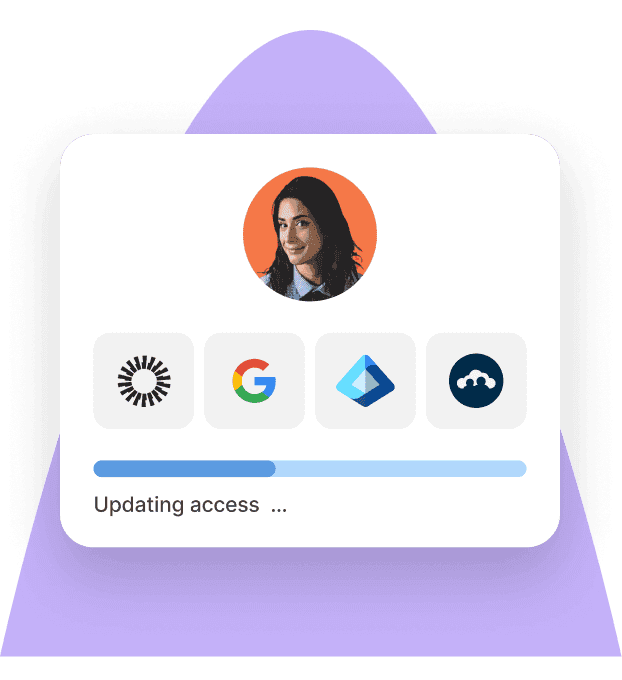
Before automating access provisioning, map how employee data moves between your HRIS, EOR platform, access management systems, and downstream applications. EOR onboarding and offboarding workflows often span multiple teams and organizations, making it important to identify handoffs, dependencies, and manual steps before introducing automation.
Start by diagramming the path from HRIS record creation through the EOR platform, access management system, and application provisioning tools, then back again at offboarding. Pay attention to dependencies (email must often exist before Single Sign-On (SSO) group assignments can happen, for example) and to the gaps where data goes silent between systems.
Use a table like the one below to map how employee information moves through your provisioning process and identify where delays, manual work, or compliance risks occur.
| Workflow stage | System used | Team responsible | Information passed to the next step | Manual action required? |
|---|---|---|---|---|
| [e.g., Hire approved] | [HRIS] | [HR] | [Identity, role, location, and employment details] | [Yes/No] |
| [e.g., Employee onboarded through EOR] | [EOR platform] | [HR Operations] | [Payroll, employment, and compliance information] | [Yes/No] |
| [e.g., Identity created] | [IAM platform] | [IT] | [User account, groups, and access policies] | [Yes/No] |
| [e.g., Application access granted] | [SSO platform] | [IT] | [Application assignments and permissions] | [Yes/No] |
| [e.g., Device provisioned] | [MDM platform] | [IT] | [Device enrollment and security policies] | [Yes/No] |
| [e.g., Employee offboarded] | [HRIS/EOR platform] | [HR and IT] | [Termination status and access removal actions] | [Yes/No] |
Once you've mapped the core onboarding and offboarding workflow, compare how the process differs across countries. Look for variations in systems, approval requirements, compliance obligations, data ownership, and account provisioning timelines. A data flow diagram can also help identify where personal data is stored, replicated, or transferred across borders, which is important for demonstrating compliance with local privacy requirements.
The template below can help you document country-specific provisioning requirements, responsible teams, and potential bottlenecks before designing automation workflows:
| Country | Platforms involved | Responsible teams | Local provisioning considerations | Common challenges |
|---|---|---|---|---|
| Germany | HRIS, EOR, IAM | HR, Legal, IT | GDPR requirements and data transfer controls | Delayed approvals or data residency constraints |
| Philippines | HRIS, EOR, Payroll | HR and IT | Local payroll and benefits enrollment requirements | Missing employee data or onboarding delays |
| Canada | HRIS, EOR, IAM | HR and IT | Privacy and record retention requirements | Delayed offboarding or inconsistent access removal |
| [Your country] | [Systems involved] | [Teams involved] | [Local requirements] | [Risks or bottlenecks] |
Don't overlook:
Don't overlook:
Edge cases like contractor-to-employee conversions, location transfers, and temporary assignments
Countries where background checks or identity verification create delays that affect provisioning timelines
Fallback procedures when required data is missing or late
Standardized lifecycle states (pre-hire, active, leave, terminated) so automation triggers fire consistently
Read: Why most companies get onboarding automation wrong between HR and IT
Step 2: Connect your HR, EOR, and access management systems
Manual handoffs between HR and IT (emails, tickets, Slack messages) are where provisioning breaks down. The right integration layer eliminates those handoffs entirely, so access changes happen automatically when employment records change. Unlike direct employees, EOR workers often exist across multiple systems owned by different parties, making integration reliability especially important.
The best option depends on what's already in your stack. Native integrations between your EOR, HRIS, and IAM platforms are the simplest path when they exist. Middleware can bridge systems that don't connect natively. Custom APIs give you the most control but come with the highest maintenance burden.
The right approach depends on your existing technology stack:
Use native integrations when your EOR, HRIS, and IAM platforms already support direct connections. They are typically the fastest to deploy and easiest to maintain.
Use middleware when you need to connect multiple systems that don't integrate directly or when workflows span several countries and platforms.
Use custom APIs when you need highly specific provisioning logic, custom approval flows, or integrations that aren't supported by existing connectors.
Whichever route you take, make sure integrations are reliable, auditable, and easy to maintain. Test provisioning workflows before deployment, document data flows between systems, and establish clear ownership for troubleshooting integration failures.
Also, plan for localization at the integration layer. Some countries require data residency controls or restrict which attributes can be shared across borders. Your integration architecture should support selective field syncs and regional routing — not just a single global data pipeline.
Read: How automation replaces 500 hours of IT work annually
Step 3: Define roles and implement least-privilege access controls
With your integration framework in place, the next task is defining what access each role actually needs. The principle of least privilege is straightforward: users get only the permissions required to do their job, nothing more. EOR employees may require different access policies based not only on role, but also on employing entity, country of hire, or local regulatory restrictions.
Role-Based Access Control (RBAC) assigns permissions based on predefined job functions. Attribute-based access control (ABAC) goes further, adjusting permissions dynamically based on attributes like location, department, or contract type. Both approaches reduce the surface area for unauthorized access and make it easier to demonstrate that permissions are intentional.
Localization matters here as much as it does in the mapping phase. An HR employee in France may need access to payroll tools under EU data protection rules, while a counterpart in Brazil faces different national privacy constraints that limit what data they can view. Tailoring permissions by jurisdiction keeps you compliant without blocking people from doing their jobs.
Strengthen the model with these additional controls:
Segregation of duties: Prevent risky combinations, like a single user being able to both create and approve payments
Just-in-time elevation: Grant time-bound privileged access for sensitive tasks, revoked automatically after completion
Data classification and masking: Restrict visibility of highly sensitive attributes (government IDs, for example) or present redacted views by default
Role lifecycle governance: Periodically audit roles to prevent access creep / privilege creep and retire legacy groups as systems evolve
Where possible, document authorization policies as code, version them alongside application changes, and maintain a clear approval chain for exceptions. This makes outcomes repeatable and auditable even when hiring accelerates across multiple countries at once.
Resources for cross-country access provisioning
Align HR and IT on lifecycle execution with Guide to HR-IT Communication for Employee Lifecycle Execution
Assess how automated your provisioning actually is using our IT Provisioning Self-Assessment
Standardize your security controls globally by applying this IT Security and Compliance Checklist for Remote Workers
Tighten your offboarding process with our Employee Offboarding Checklist
Step 4: Automate onboarding and offboarding lifecycle events for EOR employees
Good access provisioning should be invisible to the employee. A new hire's accounts should be ready before they start. When someone leaves, their access should disappear before their last day is over, not days later when IT finds out through a forwarded email.
Automation makes both of these reliable by using EOR and HR lifecycle events as the source of truth for provisioning and deprovisioning actions. During onboarding, account creation, device provisioning, and application access should be triggered automatically when the EOR employment record is created. During offboarding, revocation should fire the moment the termination is recorded in your HRIS or EOR platform.
A complete automated lifecycle looks like this:
EOR employment record is created
Provisioning trigger fires to the IAM platform
System access and devices are configured automatically before the employee's start date
On termination, the EOR status change triggers automatic access revocation across all systems
An audit log is generated, confirming completion of each step
To make this reliable across countries, build in pre-boarding stages — SSO profile, email alias, mandatory training assignments — that are created in advance but activate only on the start date. For hardware, use country-specific logistics with chain-of-custody tracking and automated collection reminders at offboarding. Where local notice periods or statutory requirements apply, align deprovisioning windows accordingly. Accounts that can't be deleted immediately (due to legal hold requirements, for example) should move to an archival state rather than staying active.
Deel IT
Automate IT operations in 130+ countries
Step 5: Enforce security and compliance requirements across countries
Automated provisioning gets access to the right people at the right time. Security controls ensure that access stays protected once it's granted.
The baseline for any remote or globally distributed workforce includes Multi-Factor Authentication (MFA) for all logins, SSO with centralized identity management, VPN enforcement for sensitive systems, and continuous logging of access events. These aren't optional — they're the floor.
Beyond the baseline, the controls that matter most for EOR environments include:
Endpoint management and Mobile Device Management (MDM): Enforce encryption, screen lock policies, and patch levels across all devices, wherever they are
Data loss prevention and contextual access policies: Apply geofencing, device posture checks, and session controls for sensitive applications
Secrets and key management: Enforce strict rotation schedules and scope privileges tightly
Cross-border data flow documentation: Document where employee data moves between the EOR, HRIS, IAM platform, and downstream applications, and ensure transfers comply with local privacy requirements
Compliance isn't just about having these controls in place — it's about being able to prove they worked. Every access change should produce an auditable record that's retrievable when regulators ask. Embedding privacy-by-design into new integrations from the start is far less painful than retrofitting it later.
Read: How to improve IT compliance with automated device management
Step 6: Review and refine your provisioning process
Access provisioning isn't a one-time project. As teams grow, systems change, and regulations evolve, provisioning workflows need regular review to remain secure, efficient, and compliant.
Make ongoing governance part of your process:
Conduct regular access reviews: Verify that employees still have the permissions required for their current role and remove access that is no longer needed
Monitor provisioning performance: Track onboarding delays, provisioning errors, failed integrations, and other indicators that may signal process gaps
Review exceptions and temporary access: Ensure elevated privileges, waivers, and country-specific exceptions remain justified and are removed when no longer required.
Update workflows as countries, providers, and regulations change: Review provisioning rules whenever you expand into new markets, change EOR providers, or introduce new compliance requirements.
Regular reviews help prevent access creep, improve audit readiness, and ensure your provisioning process continues to scale alongside your global workforce.
Read: How to maintain audit readiness and automate access revocation at enterprise scale
Connect EOR, HR, and IT workflows with Deel
Deel is an all-in-one HR, payroll, EOR, and IT platform that helps organizations manage the entire employee lifecycle from a single system. By bringing employment, onboarding, access provisioning, device management, and offboarding together, Deel reduces the manual handoffs that often slow down global workforce operations.
Deel IT helps organizations automate access provisioning, device management, and employee lifecycle workflows across distributed teams. Connecting identity, devices, and HR events, it helps ensure employees have the right access at the right time, wherever they're located.
With Deel IT, you can:
Automate access provisioning and deprovisioning: New hires, role changes, and terminations automatically trigger provisioning workflows across connected systems.
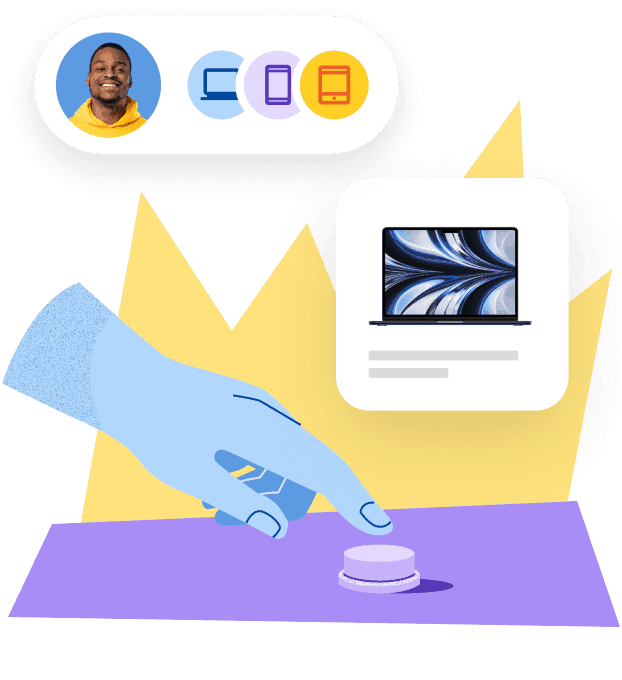
Enable day-one device readiness in 130+ countries: Devices can be procured, configured, and delivered before an employee's start date.
Deploy devices with zero-touch enrollment: Devices arrive enrolled in MDM and ready to receive policies, applications, and security controls automatically.
Manage identity, access, and devices from a unified workflow: Keep employee lifecycle events, access policies, and device management aligned across your environment.
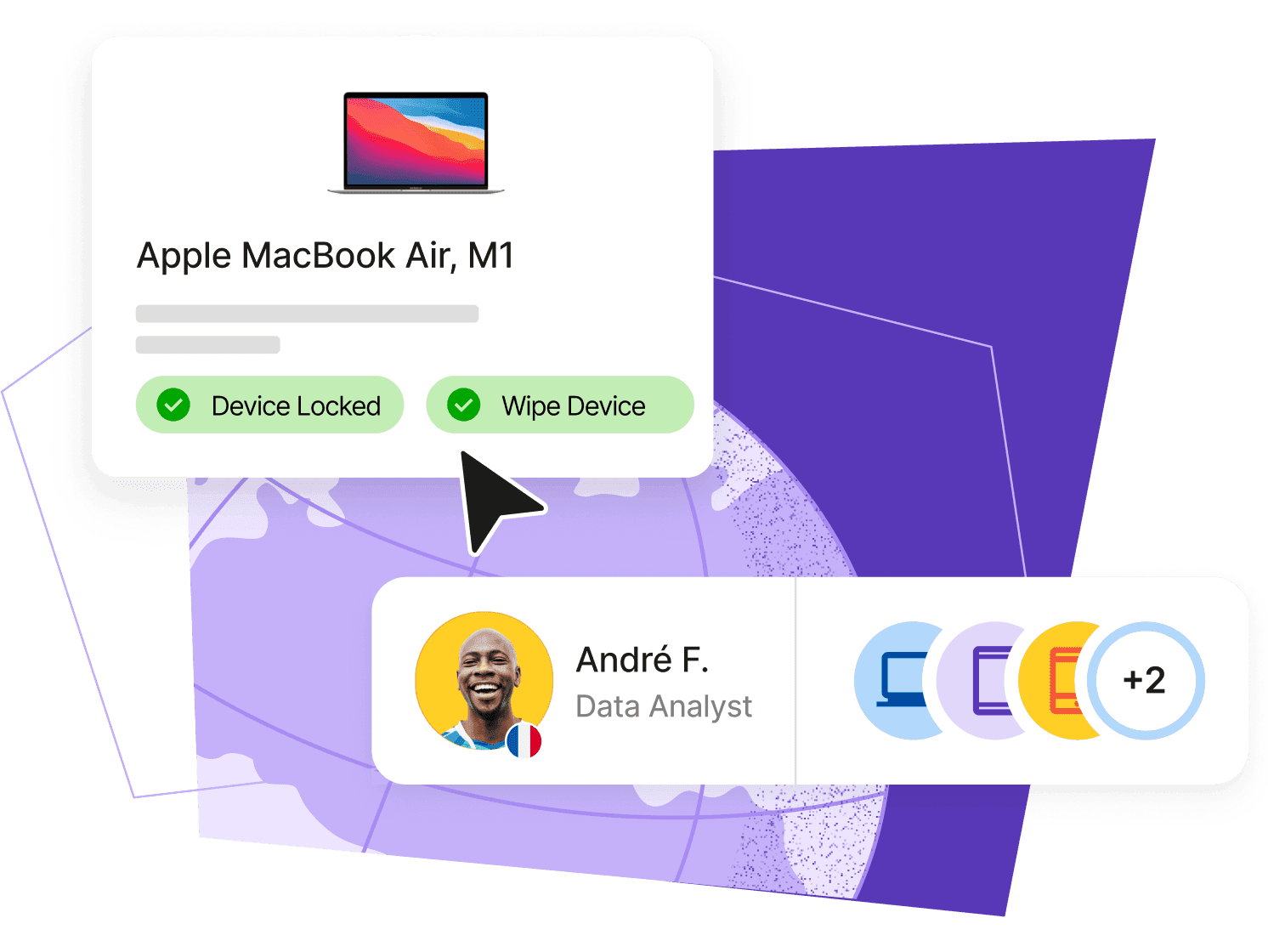
Coordinate offboarding across users and devices: Automate access revocation, device lock or wipe actions, and recovery workflows when employees leave.
Access 24/7 IT support: Get around-the-clock assistance for device, access, and provisioning issues across global teams.
When combined with Deel's Employer of Record services, you also get:
Hiring and employment support in 150+ countries: Employ talent globally without setting up local entities.
Locally compliant onboarding, payroll, and HR administration: Manage contracts, payroll, tax obligations, benefits, and employee lifecycle events through a single provider.
Built-in coordination between employment and IT workflows: Employee status changes can flow directly into access, device, and offboarding processes, reducing manual handoffs between HR and IT teams.
Book a demo to find out how Deel combines EOR, HR, and IT workflows in a single platform for managing global teams.
Deel IT
Procure, deliver, manage, and secure devices anywhere

FAQ
How do I manage access provisioning for EOR employees across multiple countries?
Start by establishing which system holds each employee's current employment status, who approves access, and which team handles changes or exceptions. Use those rules to coordinate provisioning across countries, with clear ownership and records of access changes.
What is cross-country access provisioning for EOR employees?
It's the process of granting, updating, and removing access to company systems for employees hired through an Employer of Record (EOR) in different countries. It requires coordination between the EOR, the company's HR and IT teams, and the systems employees use.
How do you automate access provisioning and deprovisioning for EOR staff?
Use supported integrations between your EOR, HR, and identity platforms to trigger account creation, permission changes, and access removal when employment records change. Provisioning protocols such as SCIM can help synchronize accounts with connected applications.
How can companies meet local compliance requirements when granting access?
Identify the privacy and data-handling rules that apply in each country, then reflect them in access permissions, data-sharing processes, and retention policies. Keep records of access changes and review requirements as regulations evolve.
Who is responsible for IT access management when using an EOR?
The company typically decides which business systems EOR employees can access, while the EOR manages local employment obligations. HR and IT teams should agree with the EOR on how employment changes are communicated and who is responsible for provisioning and offboarding.
What security controls should companies use for remote EOR employees?
Common controls include multi-factor authentication (MFA), single sign-on (SSO), role-based permissions, device management, and access logging. Companies can also use conditional access policies and regular permission reviews to protect sensitive systems.
Can Deel help manage access provisioning for EOR employees in multiple countries?
Yes. Deel combines EOR services with Deel IT to help companies coordinate employment changes, device provisioning, access management, and offboarding. Deel supports EOR hiring in 150+ countries and IT operations in 130+ countries, with availability varying by service and location.
What's different about managing access for EOR employees versus direct employees?
EOR employees are legally employed through a third-party provider, so employment updates may need to move between the EOR, your HR systems, and your IT tools. Direct employees generally involve fewer organizations in that process, although both groups need consistent security controls.
Dr Kristine Lennie holds a PhD in Mathematical Biology and loves learning, research and content creation. She had written academic, creative and industry-related content and enjoys exploring new topics and ideas. She is passionate about helping create a truly global workforce, where employers and employees are not limited by borders to achieve success.