Article
6 min read
A Complete Guide to Global IT Asset Management for Managers
IT & device management

Author
Dr Kristine Lennie
Last Update
October 07, 2026

Table of Contents
How to Set Up Remote Equipment Management for Employees in Different Countries
How Deel IT Simplifies Remote Equipment Management for Employees in Different Countries
FAQ
Managing equipment across countries works best when IT can handle device sourcing, configuration, security, support, tracking, and recovery through one consistent process. Deel IT brings these operations together across 130+ countries, giving IT teams visibility over devices throughout their lifecycle.
Managing company laptops is fairly straightforward when everyone works from the same office. Managing hundreds or thousands of devices across countries and time zones is a different story.
IT teams need to get the right equipment to new hires on time, keep devices secure and up to date, support employees when something goes wrong, and recover equipment when someone leaves. Add international shipping, customs, local requirements, and multiple vendors into the mix, and there's a lot to coordinate.
This guide explains how to set up remote equipment management across countries and how Deel IT can bring those operations together in one place.
How to Set Up Remote Equipment Management for Employees in Different Countries
The goal isn't to create a different IT process for every country. It's to build a consistent operating model that can work across locations while accounting for local requirements.
Here are four areas to get right.
1. Create a global process for sourcing and delivering devices
Start by defining the equipment your teams need, including laptops, desktops, and mobile devices. Then decide how you'll source, configure, and deliver those devices across locations.
Shipping equipment from a central office can mean navigating customs, taxes, import requirements, and longer delivery times. Buying locally may reduce some of those challenges, but can leave IT teams managing different suppliers in every market.
Whichever model you choose, aim for one repeatable process. Employees should receive approved, properly configured equipment without IT reinventing procurement and delivery every time the company hires in a new country. Your process should also account for information security compliance requirements when selecting and configuring devices.
2. Build regional data requirements into your IT policies
Global IT policies need to work across different regulatory environments. That means understanding where employees work, what data they access, and which requirements apply.
For example, the European Union's General Data Protection Regulation sets requirements for processing and protecting personal data. China also has rules affecting data lifecycle management, including its Personal Information Protection Law and requirements affecting cross-border information transfers.
Rather than treating each new country as a completely separate IT setup, establish company-wide security and device standards, then determine where those policies need to account for local requirements.
Deel IT
Automate IT operations in 130+ countries
3. Set up IT support that works across time zones
A device problem shouldn't leave an employee waiting until another country's working day begins.
More than half of IT professionals report an increase in helpdesk tickets, according to Ivanti research. For distributed teams, that makes the availability and scalability of IT support especially important.
One approach is a follow-the-sun support model, where unresolved requests move between teams as different regions come online. QCIC is one example of this model in practice. Ticketing systems and AI-assisted support can also help resolve common issues and route more complex requests to the right people.
Whatever model you choose, employees should have a clear way to get IT help regardless of their location or time zone.
4. Apply consistent security controls across the device fleet
Employees may work from home, coworking spaces, airports, hotels, and other public locations, so security policies need to follow the device rather than depend on the office.
Define requirements that IT can apply consistently across managed devices. These may include encryption, strong authentication, endpoint protection, software updates, and policies governing access to company data.
Centralized device management also gives IT teams better visibility into device status, making it easier to identify issues and enforce consistent security standards as the company grows.
How Deel IT Simplifies Remote Equipment Management for Employees in Different Countries
Deel IT is a global IT operations solution that runs device, application access, security, support, and recovery workflows across the worker lifecycle — from onboarding through offboarding. It is not a hardware reseller, a single-purpose MDM tool, or a logistics service; it's an end-to-end execution layer that teams can manage across 130+ countries without stitching together separate regional vendors and tools.
Instead of treating procurement, configuration, security, support, and offboarding as separate processes, Deel IT keeps them connected as employees join, work, change roles, and leave — automatically triggered by worker lifecycle events through HRIS connections such as BambooHR, Workday, and HiBob.
Best for: SMB, mid-market, and distributed enterprise teams (up to roughly 10,000 employees) that need to manage equipment for remote employees in different countries while reducing manual IT coordination.
Get new hires the right equipment from day one
Hiring someone in another country can leave IT juggling local suppliers, international shipping, customs, and device configuration before the employee even starts.
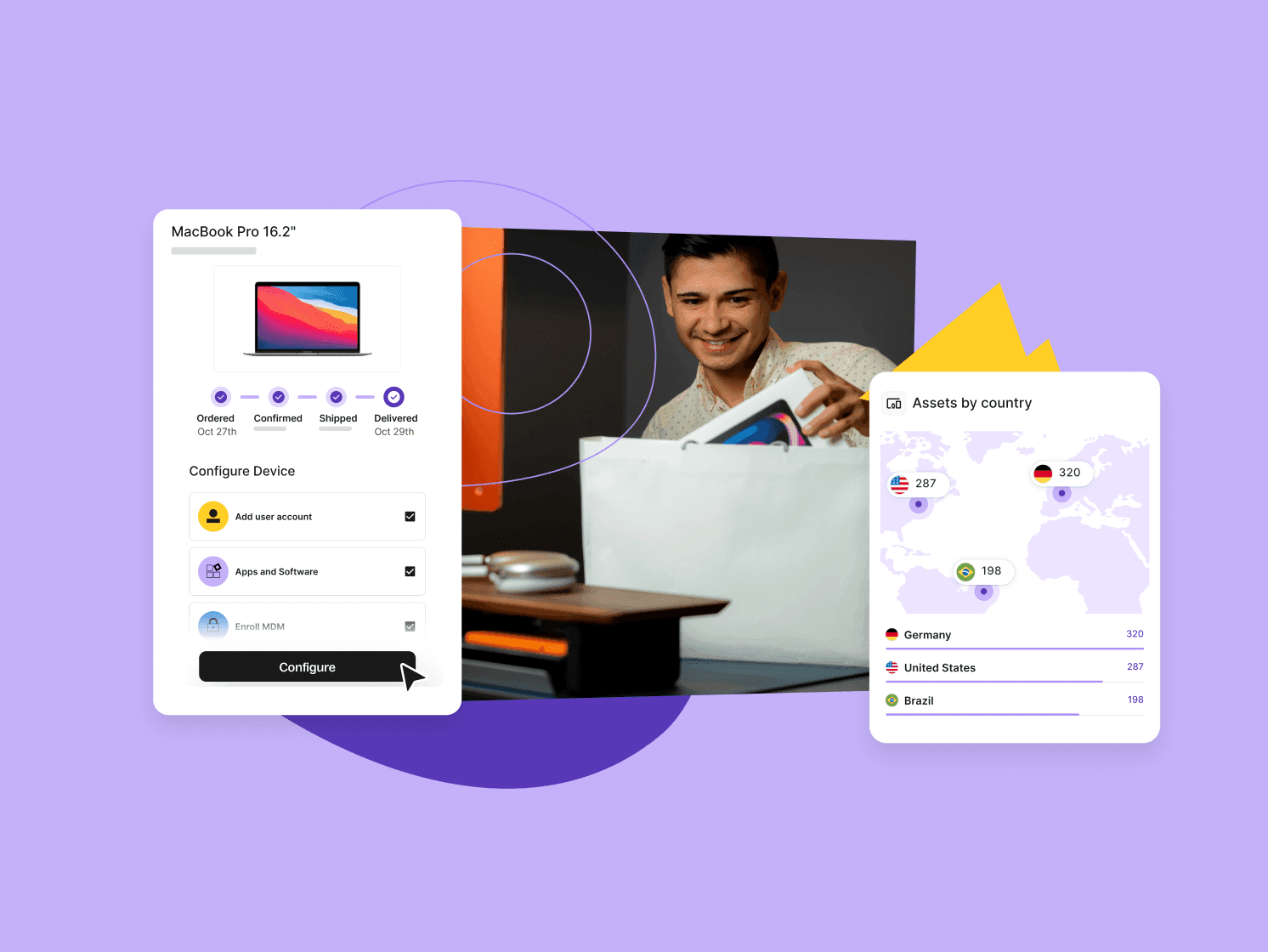
With Deel IT, companies can buy or lease approved devices across 130+ countries, configure them to company requirements, and ship them directly to employees with a 99.5%+ on-time delivery rate. IT teams can track devices centrally instead of managing separate procurement and delivery processes for each location.
Devices can also be configured with company policies and settings before they reach the employee, reducing setup work and helping new hires get productive faster.
Repairs and replacements are handled with very minimal input from our side ... Deel IT is like an extended IT wing of Tamara across the globe.
—Renjith Radhakrishnan,
IT solutions manager, Tamara
Manage and secure devices throughout employment
Once devices are deployed, IT needs to know where they are, who they're assigned to, and whether the right security controls are in place.
Deel IT gives teams centralized visibility across their device fleet, with asset tracking, mobile device management, built-in endpoint protection powered by CrowdStrike, and role-based application access workflows connected in the same IT operations platform. IT teams can apply and manage policies remotely rather than relying on physical access to the device.
Employees can also access 24/7 global IT support when they run into technical issues, reducing the burden on internal teams to provide round-the-clock coverage themselves.
Keep device refreshes and replacements under control
Replacing a laptop shouldn't mean starting the procurement process from scratch.
Deel IT connects procurement, inventory, repairs, replacements, and device tracking across the device lifecycle. That makes it easier to coordinate refreshes across countries without managing separate suppliers and processes in every location.
Recovered devices can also be stored and reused, helping teams get more value from existing inventory before purchasing additional equipment.
None of the other solutions came close to offering the ease that Deel IT provides. We're hiring quite frequently, and it saves us an absolute fortune.
—Jamal Issouquaein,
Recover devices securely when employees leave
Offboarding creates another logistical challenge: recovering company equipment from employees who may be thousands of miles from an office.
Deel IT can coordinate device collection, logistics, tracking, and security as part of the offboarding process. Recovered devices can then be prepared for storage or reuse, keeping them within the same lifecycle instead of disappearing into a separate returns process.
IT teams can also protect company information on managed devices as employees leave. Learn more about device retrieval and redeployment and Certified Data Erasure For Secure & Compliant Device Offboarding.
Bringing these workflows together also reduces the amount of manual coordination required across orders, shipments, repairs, replacements, returns, and inventory.
I’ve only heard great things about the service from the internal Voiceflow team in charge of the process. It’s one less task [for them] that used to take a lot of time and effort.
—Andrew Lawrence,
Co-founder and Head of Operations, Voiceflow
Voiceflow saved three days per new hire and more than $10,000 in equipment delivery processes after switching to Deel IT.
See also: How Deel IT Saves Time & Money at Every Stage of the Device Lifecycle
Deel IT
Procure, deliver, manage, and secure devices anywhere
FAQ
How do I set up remote equipment management for employees in different countries?
Create one operating model for sourcing, configuring, tracking, securing, supporting, and recovering devices across locations. The goal is to give IT consistent visibility and control without creating a separate equipment process for every country. Deel IT supports this across 130+ countries, from device procurement and delivery through ongoing management and recovery.
How can I keep track of company equipment across multiple countries?
Use a centralized asset inventory that records each device, who it's assigned to, its location, and its lifecycle status. Keeping this information in one system makes it easier to track equipment as employees join, move, receive replacements, or leave the company.
How do I get laptops and equipment to remote employees in other countries?
Set up a procurement and logistics process that can source approved equipment, configure devices before delivery, handle local shipping requirements, and track each asset. For larger distributed teams, using global or regional fulfillment can also reduce the need to ship every device internationally from a central office.
How do I secure company devices used by employees in different countries?
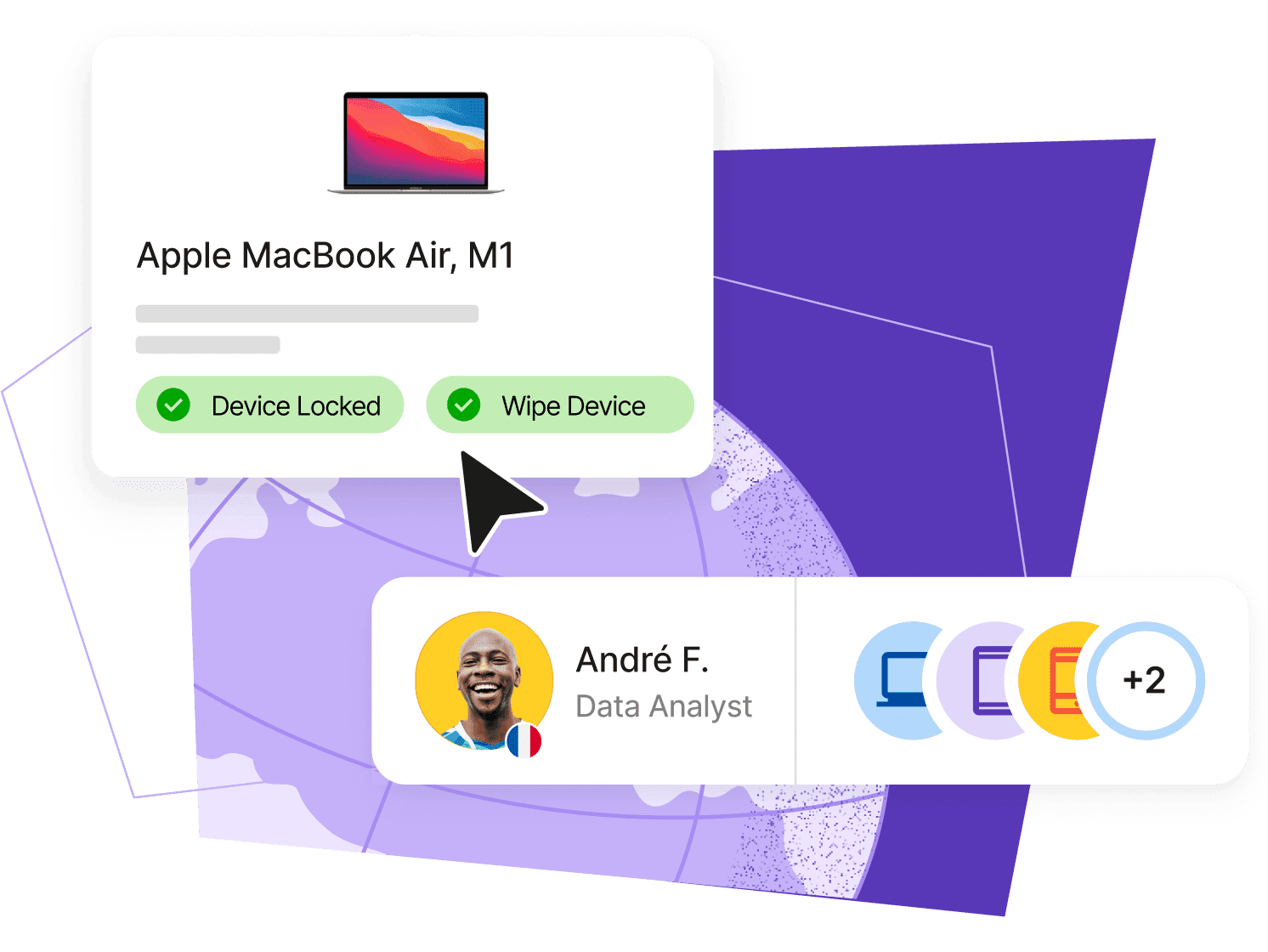
Apply consistent security requirements across managed devices, including encryption, endpoint protection, software updates, authentication, and access controls. Centralized device management allows IT to monitor these controls and take actions such as locking or wiping a device remotely when necessary.
How do I provide IT support across different countries and time zones?
Build a support model that gives employees a clear way to get help regardless of their location or working hours. Options include follow-the-sun support, centralized ticketing and remote troubleshooting, or a managed service with continuous coverage. Deel IT provides 24/7 global IT support for distributed teams.
How do I recover company equipment when an international employee leaves?
Make device recovery part of the offboarding process rather than treating it as a separate task. This can include securing the device, arranging collection and shipping, updating asset records, and deciding whether the equipment should be stored, redeployed, or retired.
Can remote equipment management integrate with our existing HR and identity systems?
Yes. Integrating equipment management with HR and identity systems can use events such as hiring, role changes, and departures to trigger IT actions. Deel IT works with systems including BambooHR, Workday, HiBob, Okta, Google Workspace, and Microsoft Entra ID, allowing companies to keep their existing systems while connecting them to device and access workflows.
Dr Kristine Lennie holds a PhD in Mathematical Biology and loves learning, research and content creation. She had written academic, creative and industry-related content and enjoys exploring new topics and ideas. She is passionate about helping create a truly global workforce, where employers and employees are not limited by borders to achieve success.