Article
17 min read
What Enterprise IT Governance Looks Like for a Global Workforce
IT & device management

Author
Dr Kristine Lennie
Last Update
May 11, 2026

Table of Contents
The authority model: who owns what when IT spans multiple countries
Device governance: enforcing standards across a fleet you can't physically see
Identity and access governance: making sure the right people have access to the right things, and only those things
Compliance governance: maintaining consistent controls across regulatory frameworks that don't align
Audit readiness: the difference between a system that proves itself and one that has to be reconstructed
The lifecycle connection: why governance breaks when HR and IT operate separately
What enterprise IT governance actually looks like when it works: a readiness checklist
How Deel IT helps global enterprises enforce standards everywhere
Key takeaways
At a global scale, IT governance stops being a compliance exercise and becomes the operational foundation that determines whether standards can be enforced consistently across the workforce.
Global IT governance only works when device management, identity and access controls, lifecycle automation, and audit logging operate as a connected system rather than as separate regional processes.
Deel IT helps global organizations enforce governance consistently across distributed workforces by automating device enrollment, access provisioning, and offboarding workflows across countries from a single platform.
Traditionally, IT governance was managed through policies, approvals, and periodic reviews. This worked when organizations operated from a smaller number of offices, supported centralized rather than distributed teams, and managed fewer devices, systems, and employee lifecycle changes. However, as organizations expanded across countries and entities, the operational demands placed on IT governance changed significantly.
What works in a more centralized environment often becomes difficult to manage consistently across a globally distributed workforce.
Signs your organization may be outgrowing traditional IT governance approaches include:
Your workforce operates across multiple countries, entities, or time zones
IT manages high volumes of onboarding, role changes, and offboarding across regions
Employees operate under multiple compliance, data residency, or employment requirements
Devices are provisioned and supported across distributed locations without local IT presence
Identity, access, and SaaS management span multiple systems and regional teams
IT operations rely on coordination across vendors, workflows, and distributed stakeholders
Audit preparation requires gathering evidence from multiple disconnected systems
If several of these apply to your organization, governance can no longer rely primarily on policy and manual coordination. This article explains what enterprise IT governance looks like when it operates at global scale.

Guide
The World at Work in 2026: Deel IT
The authority model: who owns what when IT spans multiple countries
The first structural question in global IT governance is not which tools to use, but who has the authority to make and enforce decisions across regions. Without a clear authority model, governance defaults to whoever is loudest or most local.
What it involves:
Central policy ownership with regional execution: Core security policies, access standards, and device requirements are set centrally and applied globally, with regional IT teams handling local execution within that framework, not outside it
Defined escalation paths: When a regional team encounters a local requirement that conflicts with global policy (e.g., a data residency law, a hardware import restriction) there is a defined process for escalation and exception handling, not ad hoc workarounds
Governance accountability mapped to roles: Each IT governance domain, such as device compliance, access control, application management, incident response, has a named owner at the enterprise level, not a shared assumption
HR and IT operating from shared data: IT actions are triggered automatically from authoritative HR data rather than informal communications uch as emails or calendar invitations
Why this matters: When authority is ambiguous, regional teams make local decisions that diverge from global standards. Over time, those divergences compound into an IT environment where enforcement is inconsistent, audit evidence is fragmented, and no single team has a complete picture.
How Deel IT helps: Deel IT connects directly to your HRIS, so IT actions are triggered automatically from authoritative HR data rather than informal communication chains. If already using Deel HR is your source of truth, Deel IT will pull data from there directly.
Read: Why global IT cannot scale on point tools at enterprise scale
Device governance: enforcing standards across a fleet you can't physically see
At enterprise scale, device governance is not about procurement efficiency, it is about maintaining a consistent security posture across thousands of endpoints distributed across countries, time zones, and network environments. The goal is to know the compliance state of every device in the fleet at any given moment.
What it involves:
Mobile Device Management (MDM) enrollment at provisioning, not post-delivery: MDM policies (encryption, OS version requirements, configuration baselines) are applied before a device reaches an employee, not after first login
Continuous policy enforcement across the fleet: Encryption status, OS patch level, and security configuration are monitored and enforced continuously, not reviewed periodically
Fleet visibility as a governance control: Real-time visibility across device ownership, compliance status, and location is maintained centrally instead of reconstructed from regional spreadsheets at audit time
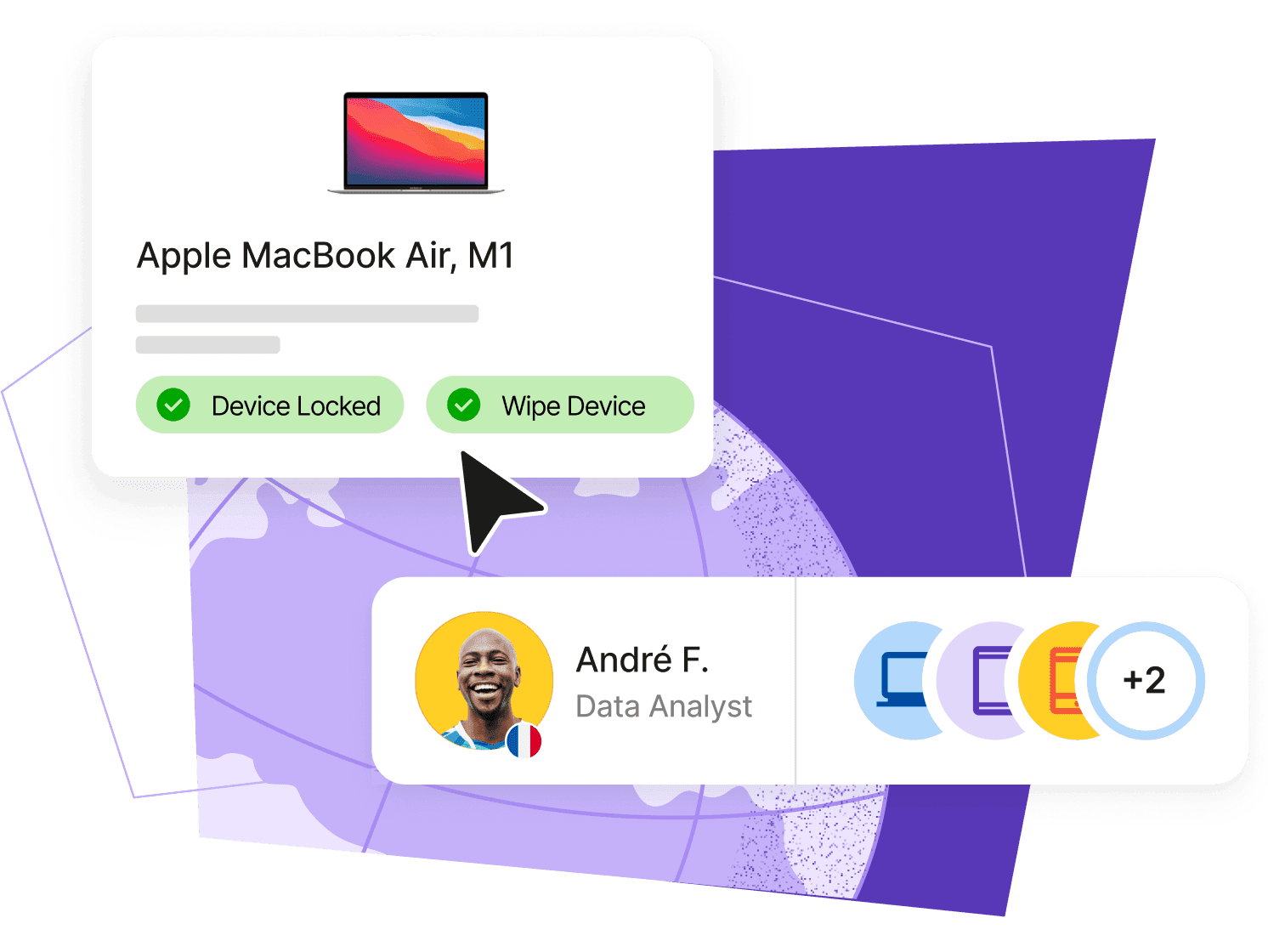
Remote remediation authority: IT retains the ability to lock, wipe, or remediate any device in the fleet remotely, including devices in countries where there is no local IT presence
Why this matters: A device that ships without MDM enrollment is operating outside policy coverage from day one. At enterprise scale, where hundreds of devices may be provisioned each month across dozens of countries, enrollment gaps accumulate into a compliance exposure that is difficult to quantify and harder to close retroactively.
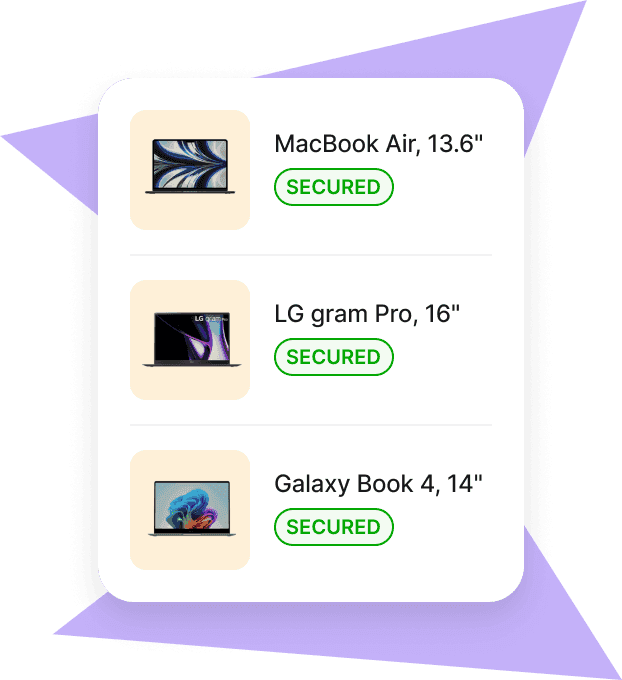
How Deel IT helps: Deel IT applies MDM enrollment at provisioning across 130+ countries, with continuous policy enforcement, real-time fleet compliance visibility, and remote lock and wipe capability, all managed from a single platform.
Mobile Device Management
Secure and manage IT devices across any operating system
Read: The hidden cost of global device management at enterprise scale
Identity and access governance: making sure the right people have access to the right things, and only those things
Identity and Access Management (IAM) is where governance most directly intersects with security. At a global scale, a often related to providing legitimate once and never revoking it, or access that accumulated across role changes without a formal review. The technical term is access creep. The governance consequence is an environment where no one can say with confidence who has access to what. Effective identity governance ensures that access is tied directly to role, employment status, and lifecycle events, and that permissions are updated or revoked automatically as those conditions change.
What it involves:
Role-Based Access Control (RBAC) tied to HRIS data: Access permissions are defined by role and provisioned automatically when a role is assigned
Single Sign-On (SSO) enforced across all applications: Every application in the enterprise stack is accessible through a single identity provider, with no application islands that bypass central authentication
Multi-Factor Authentication (MFA) enforced centrally: MFA is a baseline requirement applied across all users and all applications
Automated deprovisioning at exit: When employment ends, access is revoked across all systems automatically and immediately, not dependent on an offboarding checklist being completed
Continuous access review with clear ownership: Periodic access reviews are conducted against current role assignments, with a defined owner responsible for certifying or revoking each access grant.
Why this matters: When access is not revoked promptly at offboarding, former employees retain the ability to access systems, files, and data after their employment has ended. At enterprise scale, with hundreds of departures per year across multiple countries, the cumulative exposure from delayed deprovisioning is significant, and the audit burden of reconstructing who had access to what is substantial.
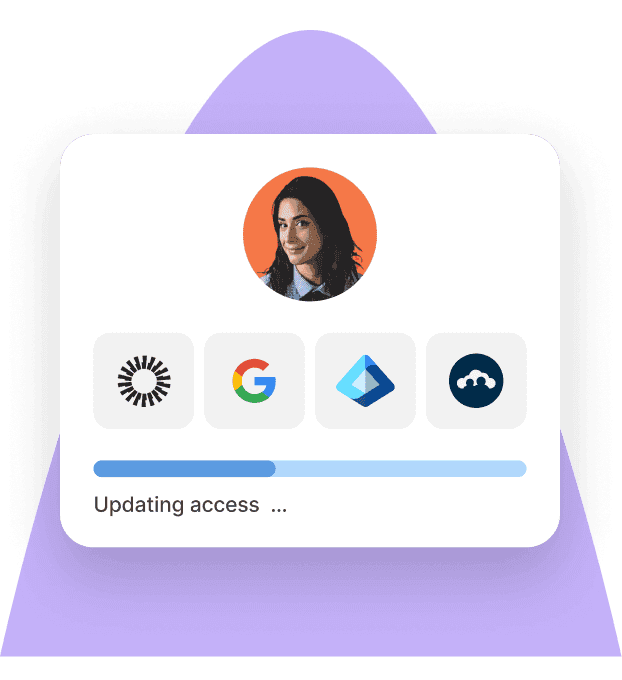
How Deel IT helps: Deel IT automates access provisioning and deprovisioning tied directly to HRIS lifecycle events, with SSO and MFA enforced centrally and full access visibility across all systems in a single view.
Identity Access Management
Seamlessly provision device and app access for global teams
Read: IAM best practices for distributed teams
Compliance governance: maintaining consistent controls across regulatory frameworks that don't align
Global enterprises operate under multiple overlapping regulatory frameworks simultaneously: data protection laws, employment regulations, and industry-specific compliance requirements that vary by country. The resulting governance challenge is to correctly understand and maintain a single set of operational controls that satisfies multiple frameworks without building a separate compliance process for each one.
What it involves:
A control framework that maps to multiple standards: Rather than running parallel compliance programs for SOC 2, ISO 27001, and regional data protection requirements, a mature governance model maps a single set of controls to multiple frameworks and maintains evidence centrally
Policy enforcement that does not depend on local interpretation: Security baselines (encryption standards, access requirements, data handling rules) are enforced technically, not communicated as guidance and assumed to be followed
Local requirements handled within a global system: Country-specific requirements are accommodated within the global framework, not managed as separate local exceptions
Compliance evidence generated continuously: Audit evidence (policy application timestamps, access grant and revocation records, device enrollment status) is captured automatically as operations run, not assembled retrospectively.
Why this matters: The cost of compliance is highest when evidence has to be reconstructed. When controls are enforced technically and evidence is generated continuously, audit preparation is a reporting exercise. When controls are enforced through policy documents and human process, audit preparation is an investigation.
How Deel IT helps: Deel IT helps enterprises enforce security controls, access policies, and device compliance standards consistently across regions while generating continuous audit evidence from a single operational system rather than fragmented tools and workflows.
Read: How to improve IT compliance with automated device management
Audit readiness: the difference between a system that proves itself and one that has to be reconstructed
Compliance governance describes what is being enforced. Audit readiness describes whether you can prove it. These are distinct disciplines, and at enterprise scale, the gap between them is where audit findings are generated. An organization can have strong controls and still fail an audit, because the evidence was never captured, was captured in multiple disconnected systems, or requires significant effort to compile.
What it involves:
A single system of record across devices, access, and applications: Audit evidence for device compliance, access grants, policy enforcement, and lifecycle events is held in one place, not distributed across MDM tools, identity providers, SaaS platforms, and regional spreadsheets.
Timestamped records for every governance action: Device enrollment dates, access provisioning events, policy change logs, and offboarding completion records are captured with timestamps and retained in a queryable format.
Lifecycle event traceability: For any employee, past or present, IT can reconstruct what devices they were assigned, what access they held, what applications they used, and when each was granted and revoked.
Exception and override documentation: When a governance exception is granted, a device exempted from a policy, an access grant made outside standard RBAC, the exception is documented, approved, and time-limited
Why this matters: When audit evidence has to be reconstructed from multiple systems, the reconstruction process itself introduces errors. Records that exist in one system but not another create inconsistencies that auditors flag as control gaps, regardless of whether the underlying control was actually operating. At SMB scale, a few hours of spreadsheet reconciliation may suffice — at enterprise scale, with thousands of lifecycle events across dozens of countries per year, that approach is not viable.
How Deel IT helps: Deel IT maintains a unified record of device status, access events, and lifecycle actions across the entire workforce. Key user actions, including authentication events, permission changes, and administrative activity, are logged with timestamps and accessible on demand through the platform’s audit trail, supporting compliance and audit readiness for frameworks such as SOC 2 Type II, ISO 27001, and regional data protection requirements.
Read: Identity and access management with Deel IT
The lifecycle connection: why governance breaks when HR and IT operate separately
Every governance control (device compliance, access management, policy enforcement, audit evidence) is activated by a lifecycle event. A hire triggers provisioning. A role change should trigger access adjustment. A departure must trigger deprovisioning. When HR and IT operate as separate functions with no automated connection between them, the governance model depends on humans communicating correctly and acting promptly every time. At enterprise scale, that dependency is one of the largest sources of governance failure. Effective IT governance depends on HR and IT operating as part of the same lifecycle system rather than as separate functions connected through manual coordination.
What it involves:
HR events as the authoritative trigger for IT actions: Hire and departure dates in the HRIS automatically trigger provisioning and deprovisioning workflows, rather than relying on manual communication between teams
Role change events propagating to access automatically: When an employee moves to a new role, their access profile updates to match the new role, permissions for the previous role are removed, not accumulated
Onboarding and offboarding as coordinated workflows: Device delivery, MDM enrollment, account provisioning, and access assignment are not parallel processes managed by different teams, but run as a single coordinated workflow with shared visibility
No governance gap at the lifecycle seam: Automated deprovisioning ensures access is revoked immediately when employment ends, eliminating the delays and gaps created by manual cross-functional coordination
Why this matters: When IT governance is designed as a system connected to HR data, lifecycle events enforce governance automatically. When it is designed as a set of policies that humans are expected to act on, governance quality is determined by how reliably those humans communicate, which, at enterprise scale across multiple countries and time zones, is not a reliable foundation.
How Deel IT helps: Deel IT connects HR lifecycle events—hire, role change, departure—directly to coordinated IT actions across devices, access, and applications, so governance controls execute automatically rather than depending on cross-functional communication.
Download: Strategic IT onboarding and offboarding guide
What enterprise IT governance actually looks like when it works: a readiness checklist
Strong governance is not a heavier process: it is a more connected system. Use the checklist below to assess whether your governance model can operate consistently across distributed teams, systems, and lifecycle events.
Authority and structure:
[ ] Central policy ownership is defined, with named owners for each governance domain
[ ] Regional IT execution operates within a global framework, not outside it
[ ] HR and IT operate from shared, authoritative data, not informal communication
[ ] Exception and escalation processes exist and are documented
Device governance:
[ ] MDM enrollment is applied at provisioning for all devices in all countries
[ ] Fleet compliance status (i.e, encryption, OS patch level, configuration) is visible in real time
[ ] Remote lock and wipe capability is available for every enrolled device
[ ] Device lifecycle events (assignment, reassignment, recovery, erasure) are logged with timestamps
Identity and access governance:
[ ] RBAC is defined for all roles and applied automatically at hire and role change
[ ] SSO is enforced across all applications, with no application islands
[ ] MFA is a baseline requirement, not a recommendation
[ ] Access is revoked automatically at departure, not dependent on a checklist
[ ] Access reviews are conducted periodically with documented outcomes
Compliance and audit readiness:
[ ] A single set of controls maps to all applicable regulatory frameworks
[ ] Compliance evidence is generated continuously, not assembled retrospectively
[ ] Lifecycle event records (provisioning, access grants, deprovisioning) are timestamped and retained
[ ] Audit evidence for any employee can be reconstructed on demand
How Deel IT helps global enterprises enforce standards everywhere
Deel IT is a global IT operations platform built for scale. It connects device lifecycle management, MDM, identity and access, application management, and 24/7 support into a single system that runs across 130+ countries.
Here is what Deel IT covers across the governance stack:
Global device procurement across 130+ countries: Source, configure, and ship pre-imaged hardware globally, with customs, shipping logistics, and device compliance requirements handled
Continuous endpoint management policy enforcement: Encryption, OS compliance, and security configuration applied and monitored automatically across the entire fleet
Automated access management tied to HRIS lifecycle events: Access provisioned at hire, adjusted at role change, and revoked the moment employment ends, with SSO and MFA enforced centrally across all applications
SaaS and application governance: Centralized license assignment, usage tracking, and reclamation, so the application environment reflects current role assignments
HR-IT lifecycle automation across onboarding, role changes, and offboarding: HRIS lifecycle events automatically trigger coordinated IT actions across devices, access, and applications, including provisioning, account setup, access changes, and deprovisioning, reducing reliance on manual coordination and checklists
Remote device remediation and data protection: IT teams can remotely lock, wipe, recover, and manage devices anywhere in the world, helping enforce security policies consistently across distributed workforces
24/7 global IT support: Around-the-clock support for employees and IT teams across time zones, including troubleshooting, repair coordination, replacement logistics, and device lifecycle support designed for distributed workforces
Unified audit evidence: Device status, access events, policy enforcement records, and lifecycle actions held in a single system of record, available on demand rather than assembled manually during compliance reviews
End-to-end device lifecycle management: Procure, deploy, repair, recover, store, wipe, and reassign devices globally from a centralized platform, with certified data erasure and lifecycle tracking built into the process
Book a demo to see how Deel IT enforces governance standards across your global workforce from a single platform.
FAQs
What is enterprise IT governance, and why does it matter for global companies?
Enterprise IT governance is the set of policies, processes, and controls that determine how an organization manages its technology assets, access rights, and compliance obligations. For global companies, it matters because inconsistent enforcement across countries creates security gaps, audit failures, and regulatory exposure that a single-country operation rarely faces.
How do you enforce consistent IT policies across employees in different countries?
Consistent enforcement depends on having automated, centralized systems for device enrollment, access provisioning, and offboarding rather than relying on regional IT teams to follow separate processes. When these workflows run through a single platform, the same controls apply whether an employee is onboarding in Germany or the Philippines, without requiring separate regional procedures.
What are the biggest IT governance challenges when scaling a distributed workforce?
The most common challenges are access sprawl, where employees accumulate permissions over time that no one reviews, and offboarding gaps, where departing employees retain access to systems longer than they should. Both problems get harder to manage as headcount grows across more countries and legal entities, because the volume of changes outpaces what IT teams can handle through coordination alone.
What should be included in an IT governance framework for a global organization?
A practical framework needs to cover device standards and enrollment, role-based access controls tied to employment status, a defined process for revoking access at offboarding, and audit logging that produces evidence of compliance across all regions. The framework only works in practice if the underlying systems can enforce these controls automatically and consistently at scale.
Dr Kristine Lennie holds a PhD in Mathematical Biology and loves learning, research and content creation. She had written academic, creative and industry-related content and enjoys exploring new topics and ideas. She is passionate about helping create a truly global workforce, where employers and employees are not limited by borders to achieve success.