
Checklist
Global Payroll Audit Checklist
Global payroll
Get the resource for free
Run effective payroll audits for enterprise teams
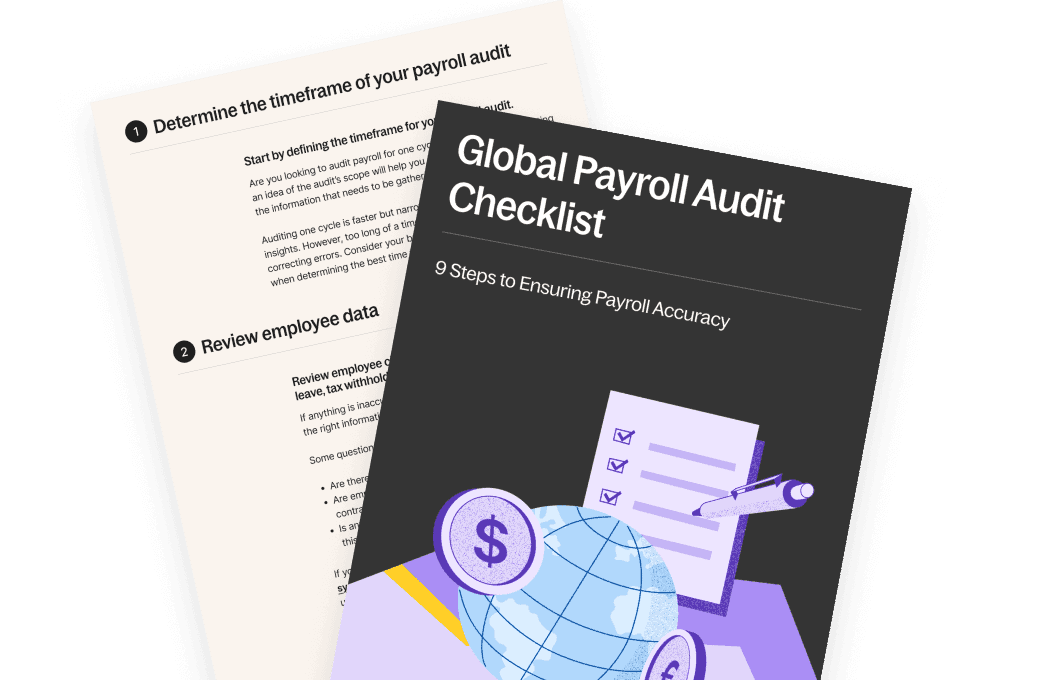
Managing an international workforce requires absolute precision. Our global payroll audit checklist guides enterprise HR and finance leaders through key steps, such as defining the audit scope, consolidating payroll data, and building continuous compliance.
Expanding across borders brings incredible growth opportunities but it also introduces operational friction. Handling multiple tax jurisdictions, varying employee benefit models, and complex labor laws can easily overwhelm traditional finance systems. A single unmapped regulatory update or mismatched employee record can trigger heavy regulatory fines, costly legal disputes, and lasting damage to your corporate reputation.
Regular internal tracking is the best defense against compliance risk. This checklist provides a framework to evaluate your payroll architecture, ensure ledger accuracy, and maintain a state of audit readiness.
Checklist overview
This checklist walks enterprise payroll teams through nine steps that cover the full scope of a global payroll audit. Steps include defining audit ownership and governance, reviewing employee data, validating variable compensation, consolidating multi-entity payroll data, and verifying tax withholdings across jurisdictions. It also covers payroll reconciliation across currencies and systems, labor and record-keeping compliance, and how to structure internal and external audit reporting for different stakeholders.
We also provide guidance on building a continuous compliance and governance roadmap, so your team isn't starting from scratch every time. Whether you're running a routine audit or responding to an operational shift, this checklist gives you a structured process to work through and a foundation for staying audit-ready year-round.
Who is this checklist for?
Enterprise HR Leaders managing multi-country compliance and maintaining workforce data hygiene
Finance Directors looking to simplify multi-currency reconciliations and eliminate ledger variations
Global Compliance Officers tasked with mitigating cross-border tax risks and preventing worker misclassification penalties
Operations Managers focused on consolidating fragmented payroll vendors into a unified workflow
How to implement the payroll audit checklist
We recommend using this checklist as a working audit framework. The most effective approach is to assign ownership before you start by identifying key stakeholders, which legal entities and jurisdictions are in scope, and what triggered this particular audit cycle. That groundwork determines the depth of the audit and who needs to see the findings when you're done.
Work through each step sequentially the first time, then adapt the cadence to your organization's needs. Highly complex jurisdictions or recently acquired entities may need more frequent reviews than stable, lower-headcount markets.
Once you've completed an audit, use the final section to turn your findings into a forward-looking governance roadmap. Assign remediation owners, set review timelines, and flag any systemic gaps to determine next steps and priorities.
Case studies: Deel’s impact on enterprise operations
Deel has helped enterprises transition from fragmented payroll setups to a unified, compliant infrastructure that delivers measurable financial and operational advantages.
FEMSA achieves compliant multi-country expansion
Large-scale corporate expansion demands absolute regulatory compliance across every new target territory. Consider the global beverage and retail company FEMSA, which needed to scale its international workforce rapidly across highly complex regulatory environments.
By partnering with Deel, FEMSA successfully hired more than 40 employees across nine different countries while maintaining compliance with local regulations. Access to dedicated compliance guidance allowed their internal teams to navigate complex local tax structures smoothly, ensuring audit readiness at every step of their growth journey.
How Bureau Veritas automated payroll compliantly
Managing multi-country payroll across East and Southern Africa exposed Bureau Veritas to severe compliance risks due to manual filing workflows and rapidly changing regional tax thresholds, social reports, and statutory updates.
By migrating its regional operations to Deel Payroll, the organization successfully eliminated these compliance vulnerabilities and replaced its fragmented processes with automated governance. Deel completely automated the company's statutory and social report submissions while proactively applying annual localized legislative changes across all countries before they came into effect.
This automated approach removed the risk of legal penalties, eliminated stressful year-end scrambles, and gave the payroll team total confidence that every cross-border submission was accurate and legally sound, while saving over eight hours of manual administrative work every single week.
Maintain global payroll compliance at scale with Deel
Transforming your global payroll operations from a source of regulatory risk into a streamlined model of efficiency requires an active commitment to governance. Leverage this checklist to assess your current gaps, update your data tracking protocols, and build a resilient infrastructure that protects your corporate bottom line.
Download the full global payroll audit checklist to identify compliance gaps and optimize your global payroll operations.
FAQs
What is a global payroll audit?
A global payroll audit is a comprehensive evaluation where an organization reviews and verifies its entire international payroll architecture, banking transactions, and employment records.
The primary purpose of this review is to guarantee that cross-border workers are compensated accurately according to their local contracts, while verifying that the business remains fully compliant with the evolving tax withholdings, labor standards, and financial reporting laws of every country where it operates.
How frequently should an enterprise conduct a payroll audit?
As a baseline operational practice, your business should perform a comprehensive payroll review at least once a year.
However, for scaling enterprises that manage a diverse mix of international contractors and full-time employees across multiple currencies, running reviews on a quarterly or biannual cadence is highly recommended. More frequent assessments allow your finance teams to identify minor data input mistakes, calculation errors, or unmapped local regulatory updates before they snowball into larger liabilities.
What are the main risks of an incomplete payroll audit?
Neglecting to perform a thorough review leaves your organization vulnerable to significant financial, operational, and legal hazards.
The most common penalties include severe government fines for tax underwithholding, expensive back-pay demands arising from contractor misclassification errors, and systemic accounting variances on your corporate balance sheet. Repeated payroll errors also degrade employee trust, lower retention rates, and can damage your company standing in competitive job markets.
Why does variable compensation increase global audit risks?
Variable compensation (performance bonuses, sales commissions, profit-sharing allocations, and international equity rewards) lack the fixed predictability of standard base salaries.
Every single variable distribution relies on separate background metrics that must be manually or digitally validated against authenticated source records, such as corporate compensation plans or signed board approvals. Additionally, complex financial events like restricted stock unit vestings trigger completely unique tax withholding obligations that vary by jurisdiction, making uniform processing impossible.