Article
31 min read
ChatGPT for HR Tasks: 25 Practical Prompts for HR Needs
Global HR

Author
Lorelei Trisca
Last Update
May 19, 2026

Table of Contents
How can HRs write good ChatGPT prompts?
Use cases and practical ChatGPT prompts for HR tasks
Risks of HRs relying on ChatGPT (and solutions)
Bring AI into your HR systems with Deel
Key takeaways
ChatGPT is one of HR’s most used tools right now. While helpful, specific prompts are key to getting good results.
Some important factors to include in ChatGPT prompts are company details, expected output format, tone, and intended audience.
Common ChatGPT risks include hallucinations, compliance risks, bias propagation, and privacy issues. You can address these risks by using a specialized and secure HR assistant like Deel AI. Experts vet its knowledge base, and any data is fully encrypted for security.
AI isn’t replacing HR but speeding up the busywork for them worldwide. HR leaders are either actively experimenting with or have concrete plans to implement generative AI tools (like ChatGPT, Google Gemini, etc.) for tasks such as writing job descriptions and internal communications. The secret to good results with ChatGPT is good prompts.
This article will help you make the most of ChatGPT. It includes a list of effective ChatGPT prompts for HR common use cases.
How can HRs write good ChatGPT prompts?
The key to using ChatGPT successfully lies in how you ask it to help. Prompts need to be as specific as possible.
Tracey Beveridge, HR Director at Personnel Checks, says prompts should include not only the task but also the tone, the intended audience, and the organization’s background.
Going by that advice, a good formula for HR prompts would be:
Task + Company background + Culture (optional) + Format + Tone + Intended audience (optional) + Any specific ask (optional)
So imagine you want ChatGPT to generate a job description for a software engineer.
A bad and incomplete prompt would be:
Generate a JD for a software engineer.
A more efficient and complete prompt would be:
Generate a job description for a junior software engineer for a fast-growing distributed fintech startup with core values of creativity, candor, selflessness, and inclusion in a bullet format and friendly tone that attracts early-career engineers with 2-3 years of experience in the finance space
With that understanding, now let’s get into the list of prompts.
Use cases and practical ChatGPT prompts for HR tasks
We’ve created a library of ready-to-use ChatGPT prompts for all areas where HRs are benefiting from AI. You can simply copy and paste the prompt and enter a few details to get started. Let’s check out all the prompts and reasons to use it:
Recruiting and hiring
Using AI for hiring saves up to 30% per hire. So when you’re planning your next hire, you can make use of ChatGPT to create job descriptions, send outreach emails, or create agreements. Make use of these prompts to get started:
Drafting job descriptions
Generate a job description for [job title] for a [company background] with [core values or culture] in a bullet format and friendly tone that attracts [any specific quality or experience you need in a candidate]. This job description must highlight [any specific ask].
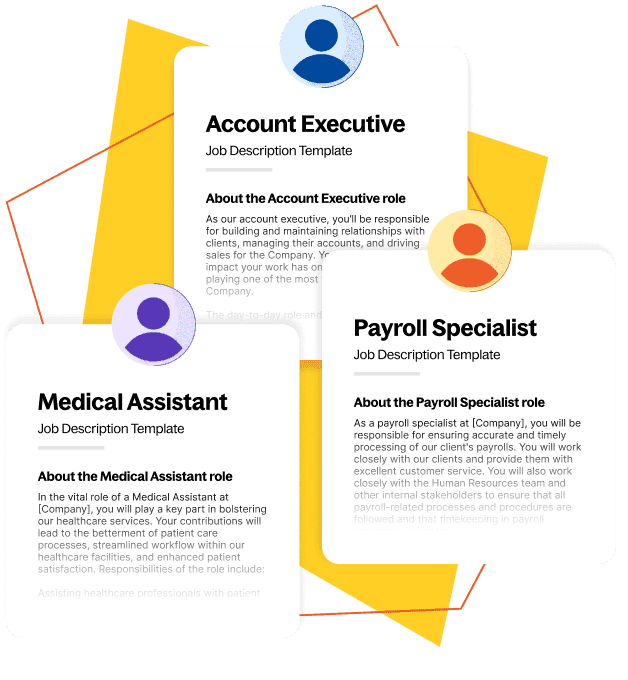
Job Description Templates
Don’t start your next hire from scratch
Creating outreach emails
Create an outreach email for a candidate for [position]. Our company is [company details and background] with [culture and values]. The mail must be in [format] and maintain [tone]. The candidates have [candidate experience and skills]. The email must also include [call to action].
Preparing interview questions
Create a list of interview questions for a position of [role]. The questions must be in line with our [company details and background]. The tone must be friendly but professional. The questions must be a mix of professional and behavioral skills assessing culture fit as per our [culture and values]. Must include questions that assess their [any specific ask].
Generating offer letters
Create a detailed offer for the position of [role]. The letter must be a formal business document in a professional tone. It must include our [company name], [company address] and mention [offer contingencies]. Include start: [start date], [salary], and [benefits].
Generating employment agreements
Create a detailed employment agreement for a position of [role] working as a [type of employment]. It must include our [company name], [company address], and describe our [culture and values]. The offer letter must have mandatory clauses and include [salary and benefits]. Also include a clause on [any specific ask].
Read more
Find the top ways AI has changed the recruitment game and where AI is solid in recruiting.
Onboarding
Onboarding is where you can lose a new hire. 21% of new hires who quit expected better onboarding. To improve the new hire experience, 38% of HRs are using AI in their practices and workflows as per our data commissioned with YouGov in June 2024. Common applications include:
Create welcome email drafts
Write an onboarding email for [company background], reflecting our [culture and values]. The email must start with warm greetings, have placeholders for key resources/links, and include next steps. Also, include [any specific ask].
Create a personalized onboarding checklist
Create a personalized onboarding checklist targeting new hires with [experiences and skills]. The tasks must be tailored for the [role] in the [company entails and background]. The checklist must be divided into weeks with milestones at the end of 30, 60, and 90 days. Use a professional and friendly tone that is suitable for onboarding communication. Include placeholders for any resources, links, or tools.
Free template
Streamline your onboarding process today
Create onboarding training outlines
Create an onboarding training outline for the [role] in [company details]. The candidate will be available [on site/remotely]. The training tasks must include both role-specific activities and training on our culture [culture and values]. It must include interactive role-plays and shadow learning activities.
Read more
Want to create a remarkable onboarding experience? Then, you need more than what ChatGPT can offer. Check out our article with 17 exciting ideas to make onboarding more fun.
Learn the top ways to improve onboarding success by using AI.
As an HR, you’re also expected to lay the entire foundation first for the career framework and competencies, and then define training outlines. That’s a huge task, and 35% of HRs are already using AI in employee training as per our internal data. Here’s how you can also use ChatGPT for it:
Training outlines
Create a training outline for [skill name] skills required for [role name] role in a [company details]. The training will be conducted [online/offline]. The training outline must include key objectives of every chapter and assessment details at the end. Keep the assessments in [expected format].
Performance management and feedback
There’s a shift from annual to continuous feedback, and that is definitely increasing the task list of HRs. As a result, 32% of HRs have used AI for performance management. We’ve covered some solid prompts for performance management tasks below to help you make the best use of AI:
Competency descriptions
Create competency descriptions for [skill name] skills in [department] for [company background]. Include descriptions for [number] proficiency levels that increase as per growth in the department. The description must have a measurable KPI for the competency and proficiency level.
Free template
Create actionable competency frameworks effortlessly
Drafting goal-setting frameworks
Write a goal-setting framework for employees at a [company details and background]. The framework must be in a structured format, reflecting our culture: [company values]. Include both individual and team-level goal-setting approaches. Use a professional yet friendly tone.
Writing performance review questions
Create a list of performance review questions to drive the entire review cycle for [company] with [culture]. Include relevant questions for review from self, peers, and managers. Use a professional yet supportive tone.
Free template
Streamline annual performance reviews
As your next performance review cycle approaches, are your people ready to give feedback?
Would you like to share peer review examples with your people? Then, check out our article, Peer Review Feedback Examples and Tips for Helping Coworkers Grow.
Creating engagement survey questions
Generate [number of questions] employee engagement survey questions to measure [survey purpose] at a [company] with [culture]. Include a mix of single-choice, multiple-choice, and open-ended questions and use a friendly tone.
Additional resource
Learn how AI is transforming performance management and its top benefits.
Employee communication
Internal communication has a strong impact on employee retention, according to a study by Staffbase. 53% of employees want to hear from their employer daily/weekly. AI can help achieve this speed. Some reference prompt for it below:
Internal announcement emails
Write an internal announcement email for [purpose] for [company details] and values [culture details]. The email must be in a clear, structured format with a subject line, greeting, body, and closing in a motivating tone. It must be targeted towards [employees, managers, or specific teams]. Include [specific ask or any action expected from mail recipients].
External announcement
Write an external announcement for a [purpose] for [company details]. The content must reflect our [branding]. Keep the announcement in a format suitable for [broadcast platform: social media platform, email, etc.]. It targets [intended audience]. Additionally, include [any specific ask/additional material/expected action from the reader].
Employee recognition or feedback messages
Write an email to [employee/manager/team] for [specific situation]. The email body must include [specific feedback]. Keep the tone empathetic yet professional. Additionally, include [any specific ask, e.g., next steps, reflection questions, or suggested actions].
Conflict resolution messages
Write an email to [employee/manager/team] for [specific situation]. The email body must include [expected action, feedback, or resolution approach]. Keep the tone empathetic yet professional. Additionally, include [any suggested actions].
Individual employee follow-ups
Draft a professional yet empathetic email to an employee for [email purpose]. The email must reflect our culture: [culture/values], and be structured clearly with a subject, body, and closing.
Also read
Explore 20 additional prompts to support your payroll decisions.
HR policy and compliance
AI tools like ChatGPT get access to vast amounts of text on regulations and can summarize it for you. This information helps you create compliant policies and processes. Use these prompts to test it yourself:
Summarizing legal/regulatory text
Summarize the key compliance obligations for employing [employees/contractors] in [country] in simple, employee-facing language.
First draft of workplace policies
Create a draft for [policy name] for [company details]. It must be in line with the legal regulations of [country name] and reflect our culture [company culture]. Keep the language professional but approachable, and divide the draft into clear sections with headers.
Free guide
Optimize HR with AI
Risks of HRs relying on ChatGPT (and solutions)
Using ChatGPT comes with its own risks. We discussed with seasoned HRs and consolidated the common risks they observed. Bonus: we also found solutions for them:
Hallucinations and misinformation
Wendy Makinson, HR Manager at Joloda Hydraroll, says while ChatGPT does save time, it doesn’t always get the facts right. She would always end up double-checking things before using any results to prevent any negative impact.
ChatGPT models tend to hallucinate often due to poor training data. It scrapes anything and everything off the internet without checking its authenticity. In OpenAI’s tests of its reasoning models, the company found the model hallucinating for every one in three requests.
Solution: Use specialized HR and legal assistants created in a controlled environment rather than depending on generic generative AI models for HR tasks. For example, the base training data for our Deel AI models is not pulled from the internet but created and maintained by 200+ legal experts. You can stay assured the model won’t go rogue.
Our global team can turn to Deel AI for instant answers to their HR questions, anytime. It’s been a huge time-saver for our People team, saving us a lot of time.
—Yunjung (Rina) Bae,
Director of People, MarqVision
Bias and discrimination
Tracey Beveridge adds that ChatGPT also propagates bias over time based on past historical prejudices in training data. This bias comes in job descriptions, interview questions, and candidate communications. That’s why she uses ChatGPT outputs only as drafts and edits them further.
Solution: Keep human experts involved in processes that could present bias and discrimination risks.
Legal and compliance risks
Mandi Odom, Director of People Operations at Search Atlas, highlights compliance red flags she found in ChatGPT. For example, ChatGPT suggested PTO policies that are not in line with laws in the target countries or states. You need to double-check every information with compliance implications for your organization.
Solution: Use solutions like Deel AI that are vetted by compliance experts. This will ensure no wrong or outdated data in the AI model’s training database, ensuring you have only the latest, relevant, and compliant information.
Hiring globally can be overwhelming for our clients. Deel AI gives us direct access to compliance insights, helping us address client concerns in real-time.
—Wouter Fluitman,
Co-Founder, Cocoroco.com
Data privacy and confidentiality
Sara Green-Hamann often uses ChatGPT to create candidate personas before interviews. But she won’t input any candidate data directly into ChatGPT. She scrubs off identifying information and uses dummy names to get answers. If you mistakenly enter any identifiable employee data, it could go directly into ChatGPT’s knowledge model for training.
Solution: Use AI models that don’t use your data for training. For example, Deel AI ensures that your conversations and organization data are not shared with any learning models. Our advanced enterprise-grade encryption, access to controls, and secure storage also ensure that your sensitive data stays protected.
Human touch erosion
Makinson also says that sometimes ChatGPT content is way too obvious. Candidates can see that the job descriptions are AI-generated, and the entire experience becomes entirely impersonal. This lack of authenticity in content and the missing human connection can hamper employees’ or candidates’ experiences.
Solution: Use AI tools for HR that don’t just operate like an external search engine but can also browse your internal data. This will help the tool personalize the output. For example, Deel AI connects with HR information systems and helps you get more personalized content.
Bring AI into your HR systems with Deel
ChatGPT is a great entry-level tool for HR professionals trialing the power of generative AI. However, it remains a general-purpose tool with limited interactions with HR systems. AI brings the most value when it can leverage internal people data and HR processes.
Deel is already a reputed player in supporting hiring, payroll, and HR operations. Now, we’re reimagining our entire infrastructure so that AI is seamlessly woven into the fabric of our operations. This approach allows us to deliver real-time, scalable value to our customers.
Deel AI is included with every Deel product, so you can get the answers you need faster than ever. Whether you’re stumped about local laws, want to generate a report or a learning course, or need tech support, Deel AI is always ready to help.
Also, we’ve just launched our AI Workforce, AI agents for HR who are ready to take onboarding, PTO, IT, and more tasks and be onboarded to your team.
Deel is already helping HR teams augment their workforce with AI. If you’re ready to see how, book a free demo today.
Through the AI incorporated in the learning development module I am able to build fantastic courses in half an hour.
—Lucía Rodriguez,
Head of HR, Ladonware
FAQs
What is ChatGPT?
ChatGPT is an artificial intelligence large language model (LLM) designed to communicate with humans using natural language. It’s trained on vast amounts of text data to generate human-like responses to questions and prompts. While ChatGPT’s abilities seem impressive, it’s critical to remember that it can’t understand the nuances of human language and conversation. As a result, its responses may seem a bit shallow or lacking in depth and insight.
When not to use ChatGPT for HR tasks?
ChatGPT is best avoided for sensitive employee-related tasks where there is a risk of leaking personal data to its knowledge model. Further, ChatGPT also can be wrong on compliance/legal related questions due to lack of clarity of its data sources.
Lorelei Trisca is a Product Marketing Manager at Deel passionate about the future of work and global talent. She drives go-to-market strategy, product launches, and global campaigns, while championing client enablement and product adoption to help teams get more value from the tools they use every day.