Article
6 min read
Fair Workweek Laws by State: The 2026 HR Compliance Guide
US payroll
Legal & compliance

Author
Shannon Ongaro
Last Update
July 21, 2026

Table of Contents
What are predictive scheduling and fair workweek laws?
Where the laws apply: The 2026 jurisdiction map
How predictability pay works in practice
Four obligations in nearly every jurisdiction
Enforcement and penalties
Preemption states
A practical compliance checklist for HR leaders
Simplify fair workweek management with Time Tracking in Deel
Key takeaways
Fair workweek laws are a combination of city and state ordinances, not a single federal standard, and 11 states now ban local jurisdictions from passing them entirely.
Most active ordinances require covered employers to give 14 days' advance schedule notice, pay predictability premiums for shift changes, and store scheduling records for at least three years.
Deel Time Tracking simplifies multi-state compliance by supporting rotating schedules, enforcing break and working-time rules, and automatically syncing approved hours directly into payroll.
Disclaimer: This article is provided for general informational purposes and should not be treated as legal or HR advice. Refer to your local state and municipal regulations and consult a qualified employment attorney for specific guidance on predictive scheduling compliance.
For employers in retail, hospitality, and food service, scheduling a workforce is not purely an operations decision.
In a growing number of cities, every last-minute shift change or canceled schedule carries a mandatory price tag set by local ordinance, regardless of whether the employer knew the rule applied to them.
The challenge is that these laws are local, inconsistent, and expanding. An HR leader managing locations in Chicago, Seattle, and Philadelphia is subject to three different sets of rules, with notice windows, penalty rates, and covered industries that differ across all three.
This guide explains what predictive scheduling laws require, maps every active jurisdiction with official government sources, identifies the 11 states that have banned local ordinances entirely, and explains how Deel can help you manage it all with built-in Time Tracking.
What are predictive scheduling and fair workweek laws?
Predictive scheduling laws, also called fair workweek laws, require employers to post work schedules a set number of days in advance and pay a premium when those schedules change inside the protected window. These laws responded to scheduling practices in retail, food service, and hospitality that gave workers little advance notice of shifts and left hours subject to last-minute cuts.
Most jurisdictions structure obligations around three pillars:
Advance notice: Employers must post work schedules, typically 14 days in advance, so workers can arrange childcare, second jobs, and other commitments
Predictability pay: When an employer changes a posted schedule inside the notice window, the employee receives a wage premium. Rates vary by jurisdiction
Right to rest: Employees can decline consecutive "clopening" shifts (closing one night, opening the next morning) without penalty. Employers who schedule them anyway typically owe time-and-a-half
There is no federal predictive scheduling law in effect. All existing obligations are state or city-specific, which means compliance depends entirely on where employees work, not where the company is headquartered
Time Tracking
Time tracked. Payroll trusted. Nothing to reconcile.
Where the laws apply: The 2026 jurisdiction map
As of 2026, one state and 11 municipalities have implemented predictive scheduling laws, based on the jurisdictions listed below. Oregon remains the only state with a statewide mandate. The remaining ten are city- or county-level ordinances, with Berkeley, Evanston, and Los Angeles County the most recent additions since 2024.
Active fair workweek jurisdictions
| Jurisdiction | Law | Effective | Covered industries | Employer threshold | Notice |
|---|---|---|---|---|---|
| Oregon (statewide) | Fair Workweek Act (ORS 653.412-653.485) | July 1, 2018 | Retail, hospitality, food service | 500+ employees worldwide | 14 days |
| New York City, NY | Fair Workweek Law (Admin. Code Title 20, Ch. 12) | November 2017 | Fast food, retail, utility safety | 20+ employees (retail) / 30+ locations (fast food) | 72 hrs (retail) / 14 days (fast food) |
| Seattle, WA | Secure Scheduling Ordinance (SMC 14.22) | July 1, 2017 | Retail, food service | 500+ employees worldwide | 14 days |
| San Francisco, CA | Formula Retail Employee Rights Ordinances (Art. 41 & 42) | 2015/2016 | Formula retail, janitorial/security contractors | 40+ locations worldwide, 20+ employees in SF | 14 days |
| Philadelphia, PA | Fair Workweek Employment Standards (Phila. Code Ch. 9-4600) | April 1, 2020 | Retail, hospitality, food service | 250+ employees, 30+ locations worldwide | 14 days |
| Chicago, IL | Fair Workweek Ordinance (MCC Ch. 1-25) | July 1, 2020 | Building services, healthcare, hotels, manufacturing, restaurants, retail, warehouses | 100+ employees globally (250+ for restaurants/30+ locations) | 14 days |
| Los Angeles City, CA | Fair Work Week Ordinance | April 1, 2023 | Retail | 300+ employees globally | 14 days |
| Los Angeles County, CA | Fair Workweek Ordinance | July 1, 2025 | Retail (unincorporated areas) | 300+ employees globally | 14 days |
| Emeryville, CA | Fair Workweek Ordinance | July 1, 2017 | Retail, fast food | 56+ employees globally | 14 days |
| Berkeley, CA | Fair Workweek Ordinance | January 12, 2024 | Healthcare, hospitality, manufacturing, retail, warehouse, restaurants | 10+ in Berkeley, 56-100+ globally depending on industry | 14 days |
| Evanston, IL | Fair Workweek Ordinance | January 1, 2024 | Building services, healthcare, hotels, manufacturing, restaurants, retail, warehouses | 100+ employees globally | 14 days |
Field Services
Deploy onsite workers compliantly in days

How predictability pay works in practice
Predictability pay functions as a mandatory wage supplement: it is owed to the employee at the moment an employer changes a posted schedule inside the protected notice window, with no waiver period and, in most jurisdictions, no way to avoid the obligation once the triggering event occurs.
The mechanics differ by jurisdiction, but the general structure is consistent:
Hours added or shift times changed (no loss of hours): The employer pays one extra hour at the employee's regular rate, in addition to wages for hours actually worked
Shift shortened or canceled: The employer pays a fraction of the wages the employee would have earned, typically half the regular rate for each scheduled hour not worked
Cancellation with very short notice: Chicago requires employers to pay 50 percent of the shift's wages when they cancel it with less than 24 hours' notice, per BACP's Fair Workweek FAQ
Oregon employers owe half the regular rate for each scheduled hour an employee doesn't work due to a reduced or canceled shift, and one additional hour of pay when start or end times change without a loss of hours, according to Oregon's BOLI.
As of July 1, 2026, Chicago's coverage threshold increased to employees earning at or below $33.85 per hour or $64,945.55 per year, with the cap adjusting upward each July, according to the city's BACP.
In San Francisco, changes made with less than seven days' notice require a premium of one to four hours' pay at the employee's regular hourly rate, depending on the notice given and the shift length, per SF's Formula Retail ordinance.
The right-to-rest rule and clopening
Most jurisdictions impose mandatory rest periods between shifts, typically ten or 11 hours. The intent is to prevent "clopening" shifts where an employee closes a location late at night and opens it early the next morning.
Under Oregon's law, an employer who schedules a shift starting less than ten hours after the previous one must pay 1.5 times the regular rate for all hours in the second shift. The employee can voluntarily consent to the schedule, but the pay premium still applies.
NYC's fast food rules require 11 hours of rest between a closing and opening shift; a worker who consents to a clopening shift must still receive a $100 premium, per NYC's Fair Workweek Law.
Deel Payroll - US
Compliantly run payroll in all 50 states

Four obligations in nearly every jurisdiction
Despite jurisdictional variation, most active fair workweek laws share a consistent core. Understanding this common structure helps employers build a baseline compliance posture before layering in jurisdiction-specific requirements.
1. Good faith estimates at hire
Upon hiring, covered employers must provide employees with a written estimate of expected hours, including the days and times of shifts and whether on-call shifts are expected. This estimate allows workers to make informed decisions before accepting the job.
2. Advance schedule posting
Nearly every jurisdiction in the table above requires 14 days' advance notice of work schedules. Employers must post the schedule in writing, paper or electronic, where employees can access it. NYC retail is an exception, requiring only 72 hours' notice.
3. Right to additional hours before new hires
Most jurisdictions require employers to offer additional available hours to existing qualified part-time employees before recruiting new workers or engaging contractors. This provision is designed to give part-time workers access to more consistent income without requiring them to seek a second job.
4. Multi-year recordkeeping
San Francisco, Seattle, and Chicago all require employers to retain scheduling records for a minimum of three years, per Seattle's OLS guidance and SF's OLSE materials. These records must be available to labor enforcement agencies on request and serve as the primary evidence base in any compliance investigation.
Washington state employers should check their Seattle obligations
If you have retail or food service operations in Seattle, the Secure Scheduling Ordinance has been in effect since July 1, 2017. Deel's guide to Washington employment and labor laws covers the broader employment law context for Pacific Northwest operations.
Enforcement and penalties
Enforcement agencies in active jurisdictions have moved well beyond education into active prosecution.
In March 2026, the department secured a combined nearly $2 million in restitution for more than 830 workers from a Dunkin'/Taco Bell franchisee and a retailer, showing that enforcement reaches smaller multi-location operators too, not just national chains.
Recordkeeping and anti-retaliation protections
Recordkeeping isn't optional. Covered employers must retain scheduling and payroll records — Seattle's ordinance and SF's OLSE guidance both require three years, for example — and agencies rely on these records to substantiate compliance during an investigation, so gaps in documentation increase risk during enforcement.
All active fair workweek laws also include anti-retaliation provisions barring employers from punishing workers for declining shifts, requesting predictability pay, or filing complaints — protections spelled out, for example, in Seattle's Secure Scheduling rules.
In NYC, it is explicitly illegal to fire, reduce hours, or otherwise penalize fast food employees for exercising their Fair Workweek rights. Chicago and Philadelphia include similar language prohibiting retaliation.
Deel HR
One place for simplified, smarter global HR
Preemption states
While cities have been expanding fair workweek coverage, a parallel set of state legislatures has moved in the opposite direction, enacting preemption laws that explicitly prevent cities and counties from passing their own fair workweek requirements.
Alabama, Arkansas, Florida, Georgia, Indiana, Iowa, Kansas, Michigan, Ohio, Tennessee, and Wisconsin have enacted preemption laws that prevent cities and counties from passing their own fair workweek ordinances.
The practical consequence for a multi-state employer is that compliance exposure is determined not just by where operations exist, but by which direction a state has moved on local authority. A Chicago location and an Indianapolis location can employ hourly workers in identical industries and face fundamentally different compliance obligations, not by operational choice, but by state politics.
Several state legislatures have introduced predictive scheduling bills in recent sessions, though most have stalled at the committee stage.
Virginia's 2026 attempt is a representative example: HB962, an omnibus labor bill that would have applied predictive scheduling requirements to hospitality employers, did not advance after a House subcommittee voted unanimously to remove it from the docket in February 2026, illustrating the uphill battle these proposals tend to face at the state level compared with city ordinances.
The more likely expansion pattern is city-to-city spread within states that have not yet passed preemption laws. Evanston followed Chicago, and Berkeley followed San Francisco and Emeryville in California. Employers should monitor legislative activity in major metros within states where local authority remains intact.
A practical compliance checklist for HR leaders
Compliance with fair workweek laws requires ongoing operational discipline, not a one-time policy update. The following steps form a workable baseline for multi-state employers:
Map your coverage: Identify every city and county where employees work, not just where the company is headquartered. Check each location against the active jurisdiction list above.
Confirm your threshold: Coverage depends on employee count (global or local, depending on the jurisdiction), industry classification, and wage level. Review each jurisdiction's specific criteria because they differ meaningfully.
Update good faith estimates: Ensure every new hire in a covered jurisdiction receives a written estimate of expected hours and schedule pattern before their first shift.
Build 14-day schedule posting into your workflow: Most covered jurisdictions require schedules to be posted at least 14 days in advance. This needs to be a workflow constraint, not a target.
Document every schedule change: Managers must record every change made inside the notice window: what changed, when the change was made, whether the employee was notified, and what predictability pay was owed and paid.
Set reminders for threshold updates: Chicago's wage threshold adjusts each July. Other jurisdictions may update coverage criteria over time. Assign someone to track changes annually.
Retain records for at least three years: Using a universal three-year standard reduces the risk of jurisdiction-specific gaps.
Monitor legislative developments in non-preemption states: If your operations span states without preemption laws, monitor major city councils for emerging ordinances, particularly in Illinois, California, Washington, Pennsylvania, and New York.
Compliance
Unlock Continuous Compliance™ with Deel
Simplify fair workweek management with Time Tracking in Deel
Maintaining fair workweek compliance across multiple cities gets complicated fast. When different sites follow different notice windows, break policies, and overtime rates, manual schedules and disconnected spreadsheets create severe compliance risks.
Deel’s Time Tracking solves this by serving as a built-in capability layer across the platform—connecting time capture directly to payroll execution in one workflow.
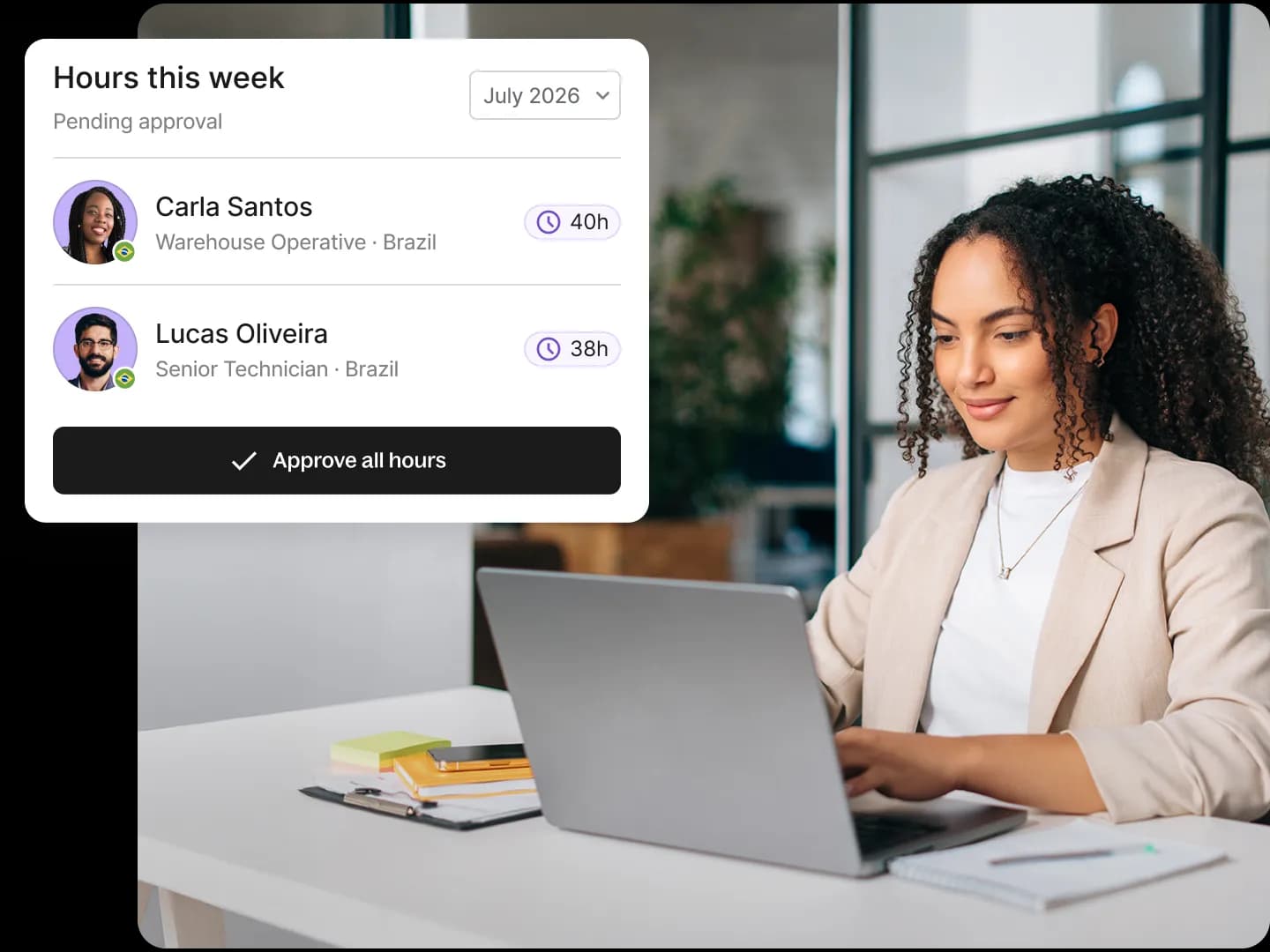
Automatic sync to payroll: Approved hours flow directly into payroll using a real-time API. This eliminates the need for flat files, spreadsheet uploads, and re-entry, preventing payroll errors before payslips are issued.
Break policy configuration: For US Payroll and PEO customers, managers can configure break policies for US meal and rest rules, ensuring time and attendance calculations match local standards.
Rotating schedules and shift patterns: Managers can assign rotating shift schedules individually or in bulk, helping teams handle complex cyclical patterns without relying on external scheduling tools.
Working-time controls & overtime rules: Set daily, weekly, or monthly working hour caps and configure custom overtime rules to enforce labor limits and capture correct rates before hours turn into compliance violations.
Location-based attendance verification: Built-in geofencing and structured Work Locations allow teams to validate clock-ins and clock-outs against physical sites. It provides privacy-conscious location verification without continuous worker surveillance.
Audit-ready records across worker types: Deel retains structured time submission records, approval histories, and Gross-to-Net (G2N) mapping in one system—whether for direct employees, PEO workers, or contractors—simplifying required multi-year recordkeeping.
Instead of managing time tracking as an isolated administrative task or managing separate tools for separate cities, Deel connects verified work directly to compliant pay.
Learn more about Time Tracking in Deel or book a demo today to see the platform in action, guided by an expert.
Deel Payroll - US
Stay compliant, save time, and pay your US team with confidence
Shannon Ongaro is a content marketing manager and trained journalist with over a decade of experience producing content that supports franchisees, small businesses, and global enterprises. Over the years, she’s covered topics such as payroll, HR tech, workplace culture, and more. At Deel, Shannon specializes in thought leadership and global payroll content.