Article
1 min read
How to Build the Right IT Setup for Finance & Accounting Teams: A Practical Checklist
IT & device management

Author
Dr Kristine Lennie
Last Update
July 03, 2026

Table of Contents
Step 1. Device provisioning and hardware setup
Step 2. Endpoint security configuration
Step 3. Identity, access, and authentication
Step 4. Application provisioning and SaaS access
Step 5. Data access controls and file permissions
Step 6. Compliance and regulatory configuration
Step 7. Offboarding readiness
Secure your finance teams with Deel IT
Key takeaways
Finance and accounting teams operate under some of the strictest security, compliance, and audit requirements in the organization. Every device, application, and access permission needs to be configured, documented, and traceable from day one to protect financial systems and maintain audit readiness.
Getting finance hires productive from day one requires treating onboarding as a coordinated IT workflow rather than a series of individual setup tasks, with devices, identity, applications, permissions, security, compliance, and support prepared in the right sequence before the first login.
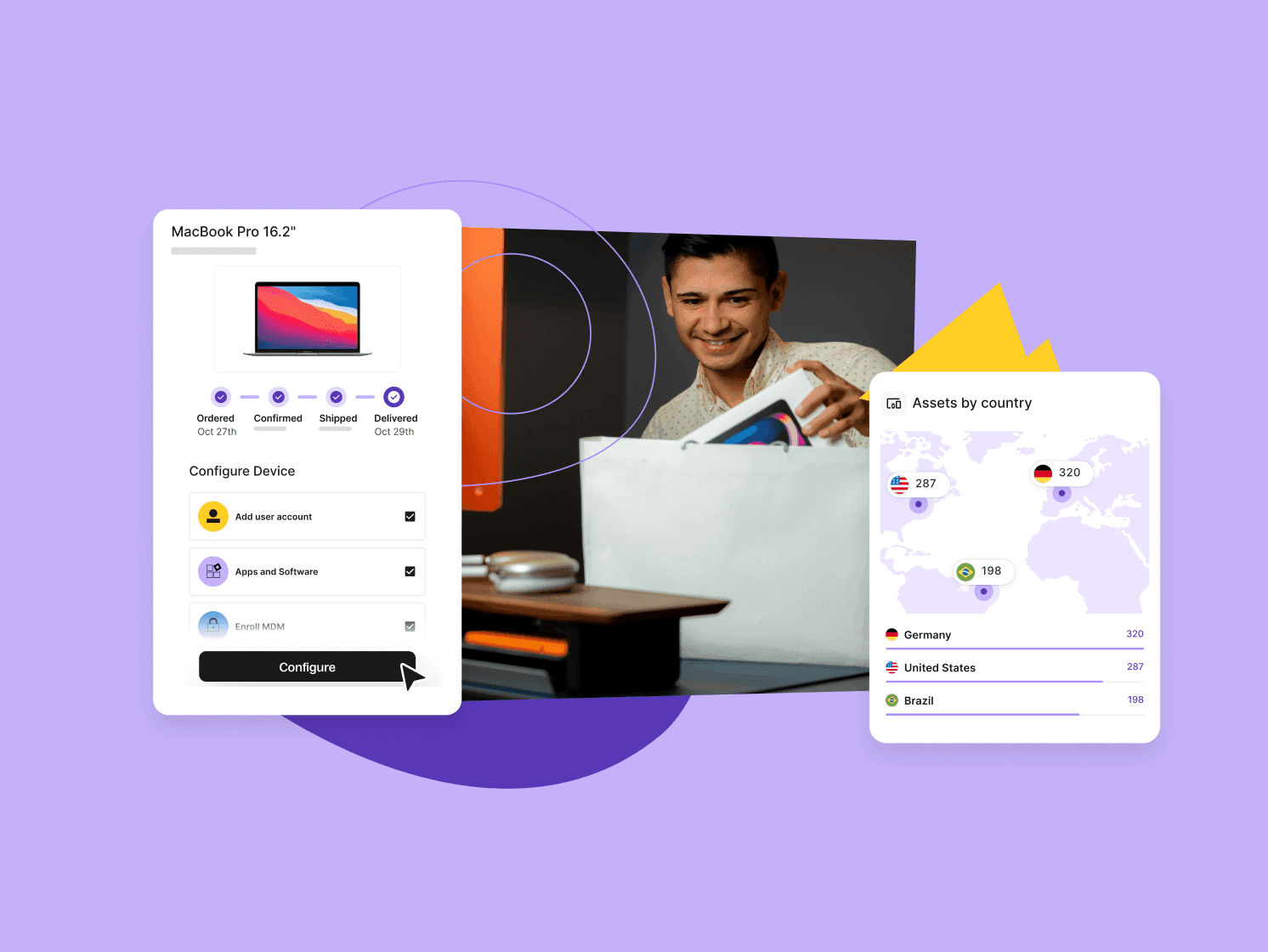
Deel IT helps organizations automate IT setup from a single platform by managing device provisioning, application delivery, security, and lifecycle workflows, helping finance and accounting teams control access to the systems they rely on every day.
Finance and accounting teams operate under tighter security and compliance requirements than almost any other function. The tools they use, the data they access, and the devices they work on all carry elevated risk, and gaps in IT setup can create security, compliance, and audit issues that extend well beyond day-to-day productivity.
This checklist covers every IT action required to set up a finance or accounting employee correctly: from device provisioning and access controls through to the security configurations and compliance requirements that auditors will eventually ask about.
Step 1. Device provisioning and hardware setup
Finance employees routinely access financial records, payroll data, budgets, and other sensitive business information. Before a device is issued, it should be provisioned, secured, and configured to meet both operational and compliance requirements. To ensure the device is ready for use:
☐ Order the device with finance-appropriate specifications (sufficient RAM and storage for financial modelling tools, accounting platforms, and data-heavy workflows)
☐ Confirm the delivery address and employee start date before placing the order
☐ Apply a standard finance configuration during provisioning, including the approved OS version, required applications, and baseline security settings
☐ Verify the device is enrolled in, or configured for, Mobile Device Management (MDM) as part of provisioning
☐ Confirm full-disk encryption is enabled before the device is shipped
☐ Verify the device is expected to arrive before the employee's start date
Read: Why New Hires Start Without Equipment — and How to Fix It
Step 2. Endpoint security configuration
Finance employees routinely work with sensitive financial data and business-critical systems. Before a device is issued, IT should confirm that security controls, device management policies, and recovery capabilities are in place to help protect company data and support compliance requirements. To establish a consistent security baseline:
☐ Confirm the device is enrolled in and reporting to the endpoint management platform
☐ Verify full-disk encryption is enabled, and recovery keys are stored according to company policy
☐ Confirm the device firewall is enabled and configured according to the approved security baseline
☐ Verify endpoint protection software (EDR/antivirus) is installed, active, and reporting to the central management console
☐ Confirm automatic operating system and security updates are enabled and configured according to company policy
☐ Verify screen lock, password, and authentication requirements are configured according to company security standards
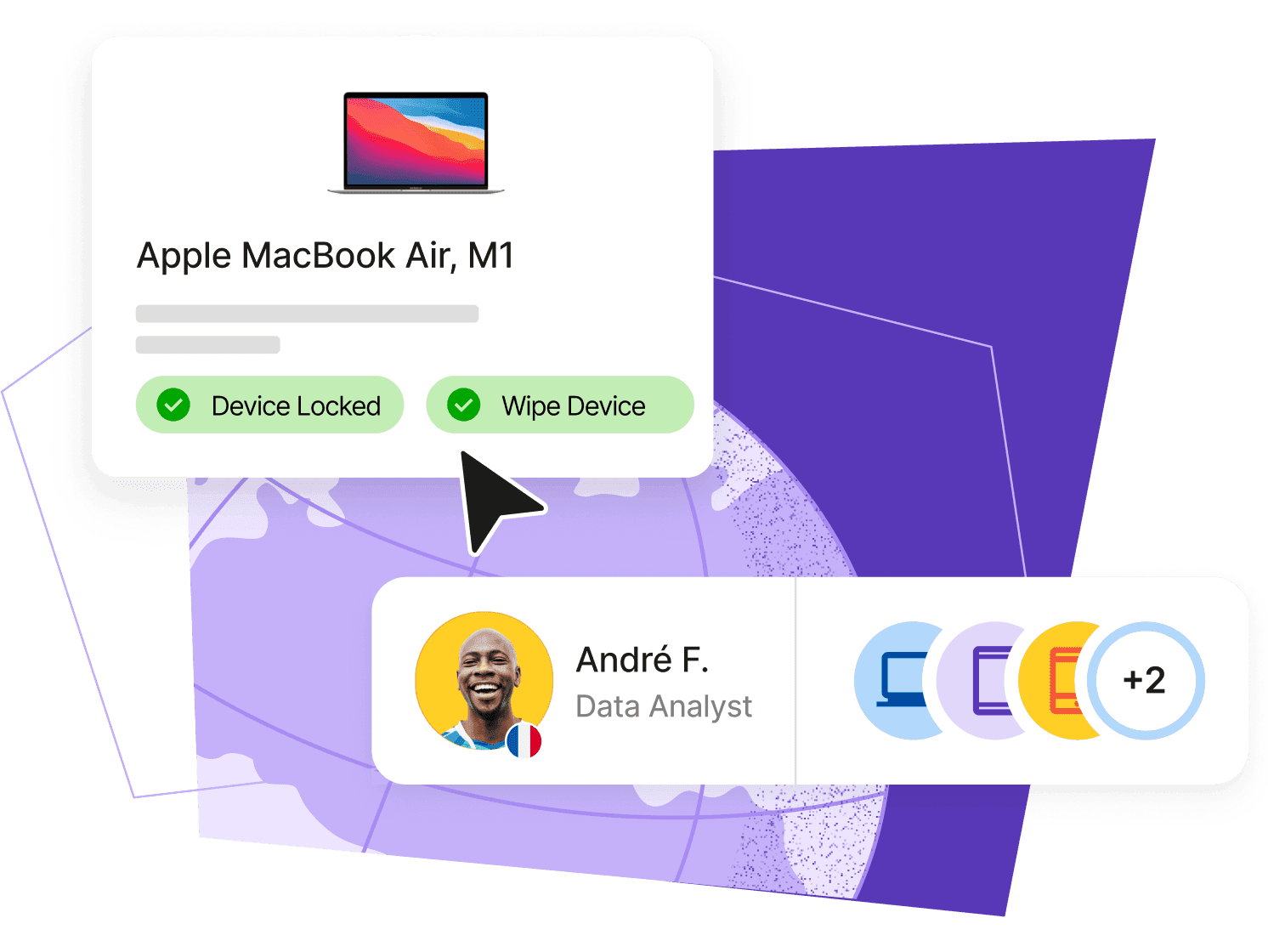
☐ Confirm remote lock and device wipe capabilities are available through the endpoint management platform
☐ Verify the device is reporting a compliant status in the endpoint management dashboard
Read: How to Improve IT Compliance With Automated Device Management
Step 3. Identity, access, and authentication
Finance employees need access to a specific and tightly controlled set of systems. Access should be provisioned based on role, not requested ad hoc after the employee starts. Every access grant should be logged, and every authentication method should meet the security standards required for financial data. You need to:
☐ Create the employee's account in the identity provider and confirm Single Sign-On (SSO) is enforced across all connected applications
☐ Enforce Multi-Factor Authentication (MFA) on all accounts, with no exceptions for finance roles
☐ Apply Role-Based Access Control (RBAC) to provision access only to the systems required for this specific role
☐ Confirm access to core finance systems (ERP, accounting platform, payroll, banking portals) is provisioned and tested before the start date
☐ Confirm access to sensitive data stores (financial records, audit files, board reporting) is restricted to named individuals with documented approval
☐ Verify no shared credentials or shared logins are in use for any finance system
☐ Log all access grants with timestamps, approver names, and role justification
Read: IAM Best Practices for IT Teams
Step 4. Application provisioning and SaaS access
Finance teams typically use a concentrated set of SaaS tools — ERP systems, accounting platforms, expense management, FP&A tools, and payroll. Each one carries financial or sensitive data, and each one needs to be provisioned correctly, not handed over informally. You will need to:
☐ Confirm the full list of applications required for this role before the start date
☐ Provision all required applications through the identity provider—not via direct account creation
☐ Assign the correct license tier for each application (view-only vs. edit vs. admin access)
☐ Confirm the employee does not have admin rights on any finance application unless the role explicitly requires it
☐ Verify that all provisioned applications are covered by SSO and MFA
☐ Document all application access grants in a central system of record
☐ Confirm no legacy or shadow IT applications are in use for finance workflows
Find out: How Deel IT Handles Identity and Access Management
Step 5. Data access controls and file permissions
Access to financial data must follow the principle of least privilege. Finance employees should be able to access what their role requires, and nothing beyond that. File permissions and data access controls are often set up inconsistently and rarely reviewed, which creates both security and audit risk.
☐ Confirm the employee's access to shared drives and file storage is scoped to their role and team
☐ Verify that sensitive financial folders (board packs, audit files, payroll data, banking credentials) are restricted to named individuals with documented approval
☐ Confirm no broad "finance team" folder permissions exist that grant access beyond what individual roles require
☐ Enable audit logging on all file storage systems used by the finance team
☐ Confirm that external sharing is disabled by default on all finance-related file storage
☐ Verify that data classification labels are applied to sensitive financial documents where the platform supports it
Read: 7 Ways Company Data Can Be Exposed When Employees Leave
Step 6. Compliance and regulatory configuration
Finance teams are subject to regulatory requirements that go beyond standard IT policy: SOX, GDPR, PCI-DSS, and local financial regulations all carry specific IT obligations. These configurations must be in place before the employee starts, not retrofitted before an audit. Here are the key steps you’ll need to take:
☐ Confirm the device and all provisioned applications meet the compliance requirements applicable to this employee's location and role
☐ Enable audit logging on all finance systems so access events, data exports, and configuration changes are captured
☐ Confirm data residency requirements are met for all cloud applications used by the finance team
☐ Verify that the employee has completed required compliance training (data handling, acceptable use, and security awareness) before accessing finance systems
☐ Confirm that password policies meet the minimum standard required by applicable frameworks (length, complexity, and rotation)
☐ Document the compliance configuration applied to this employee's setup for audit purposes
Read: Cybersecurity Frameworks: A Complete List for IT Teams
Step 7. Offboarding readiness
Every finance employee setup should be built with offboarding in mind. The controls that protect financial data during employment are the same ones that prevent exposure when someone leaves. Offboarding readiness is not a separate process; it is a property of how access and devices are set up from day one. Make sure you:
☐ Confirm all access grants are documented in a central system so they can be revoked in a single coordinated action at departure
☐ Verify that device enrollment in MDM is active and that remote wipe is available for this device
☐ Confirm that no finance system credentials are stored locally on the device (password managers, browser-saved credentials, or local keychains)
☐ Verify that the employee has no personal accounts connected to finance systems (for example, personal email used for application login or personal cloud storage linked to finance files)
☐ Confirm that a documented offboarding checklist exists and that IT is notified automatically when a finance employee's departure is confirmed
☐ Verify that certified data erasure is performed on the device at return, with documentation retained for audit purposes
Download: Employee Offboarding Checklist Template
Secure your finance teams with Deel IT
Finance teams can't afford a slow start or a security gap. When devices arrive late, access is provisioned inconsistently, or offboarding leaves accounts open, the exposure isn't just operational; it's a compliance and audit liability.
Deel IT gives IT teams a single platform to manage devices, access, security, and support throughout the employee lifecycle, with every action logged and traceable.
Here is what Deel IT covers for finance teams:
Global device procurement across 130+ countries: Source, configure, and ship pre-imaged hardware to any finance hire — encryption enabled, MDM enrolled, and finance-standard image applied before the device leaves the warehouse
MDM enrollment at provisioning, not at first login: Every device is enrolled and policy-enforced before it reaches the employee — no setup window, no unmanaged devices in the fleet
Role-based access provisioning tied to your HRIS: Access to ERP, accounting platforms, payroll, and financial data stores is granted automatically based on role, with SSO and MFA enforced across every application from day one.
Automated deprovisioning the moment employment ends: When a finance employee departs, access is revoked across connected systems, reducing the risk of unauthorized access, orphaned accounts, and compliance gaps
Endpoint protection across the full fleet: Continuous policy enforcement, real-time compliance visibility, and remote lock and wipe available for every enrolled device — regardless of where the employee is located
Certified data erasure with audit documentation: Returned devices can be wiped to a certified standard, with documentation retained so you can demonstrate compliance when auditors ask
24/7 global IT support: Finance employees working across time zones get live IT support whenever they need it — access issues, device problems, and application troubleshooting are resolved without waiting for business hours
Book a demo to see how Deel IT sets up and secures finance and accounting teams from day one.
Deel IT
Procure, deliver, manage, and secure devices anywhere

FAQs
Why must finance devices be pre-configured before they arrive?
Finance employees handle sensitive financial data from day one, so devices must ship with MDM enrollment, full-disk encryption, and baseline security already applied—not after first login. When endpoint protection, firewall, automatic OS patches, and remote wipe are active before arrival, the employee starts securely without setup delays.
What endpoint security configurations are non-negotiable for finance roles?
Finance devices require endpoint protection (EDR/antivirus) deployed and reporting, OS firewall enabled, automatic security patch updates configured, USB ports disabled, and screen lock with a five-minute idle timeout. Remote lock and wipe capability must also be tested and active before first use.
Why can't finance employees use shared credentials or informal access grants?
Shared credentials eliminate the audit trail—you can't prove who accessed what data or when, which violates SOX, GDPR, and PCI-DSS compliance requirements. Every access grant must be logged with timestamps, approver names, and role justification so auditors can trace financial data access.
What happens to compliance if access provisioning slips to day one?
Informal access workarounds create gaps in audit logging and often leave residual access open when employees change roles or leave. When access is provisioned at hire based on role with SSO and MFA enforced, every event is logged and traceable—which is what audits expect.
Dr Kristine Lennie holds a PhD in Mathematical Biology and loves learning, research and content creation. She had written academic, creative and industry-related content and enjoys exploring new topics and ideas. She is passionate about helping create a truly global workforce, where employers and employees are not limited by borders to achieve success.