Article
1 min read
How to Build the Right IT Setup for Remote Engineers: A Practical Checklist
IT & device management

Author
Dr Kristine Lennie
Last Update
July 03, 2026

Table of Contents
Step 1. Device procurement and pre-configuration
Step 2. Endpoint security and MDM configuration
Step 3. Identity setup and access provisioning
Step 4. Core engineering tools and application access
Step 5. Development environment and local tooling
Step 6. Security and compliance requirements for engineers
Step 7. Communication, collaboration, and support setup
Step 8. Offboarding preparation: set it up at the start
IT that scales with your engineering team: how Deel IT helps
Key takeaways
Remote engineers depend on powerful, correctly configured devices to do their jobs. High-performance hardware, development tools, source code access, cloud infrastructure, and security controls all need to be ready before day one, because a single missing dependency can prevent engineers from contributing altogether.
Getting remote engineers productive from day one requires treating onboarding as a coordinated IT workflow rather than a series of individual setup tasks, with devices, identity, development tools, security, and support prepared in the right sequence before the first login.
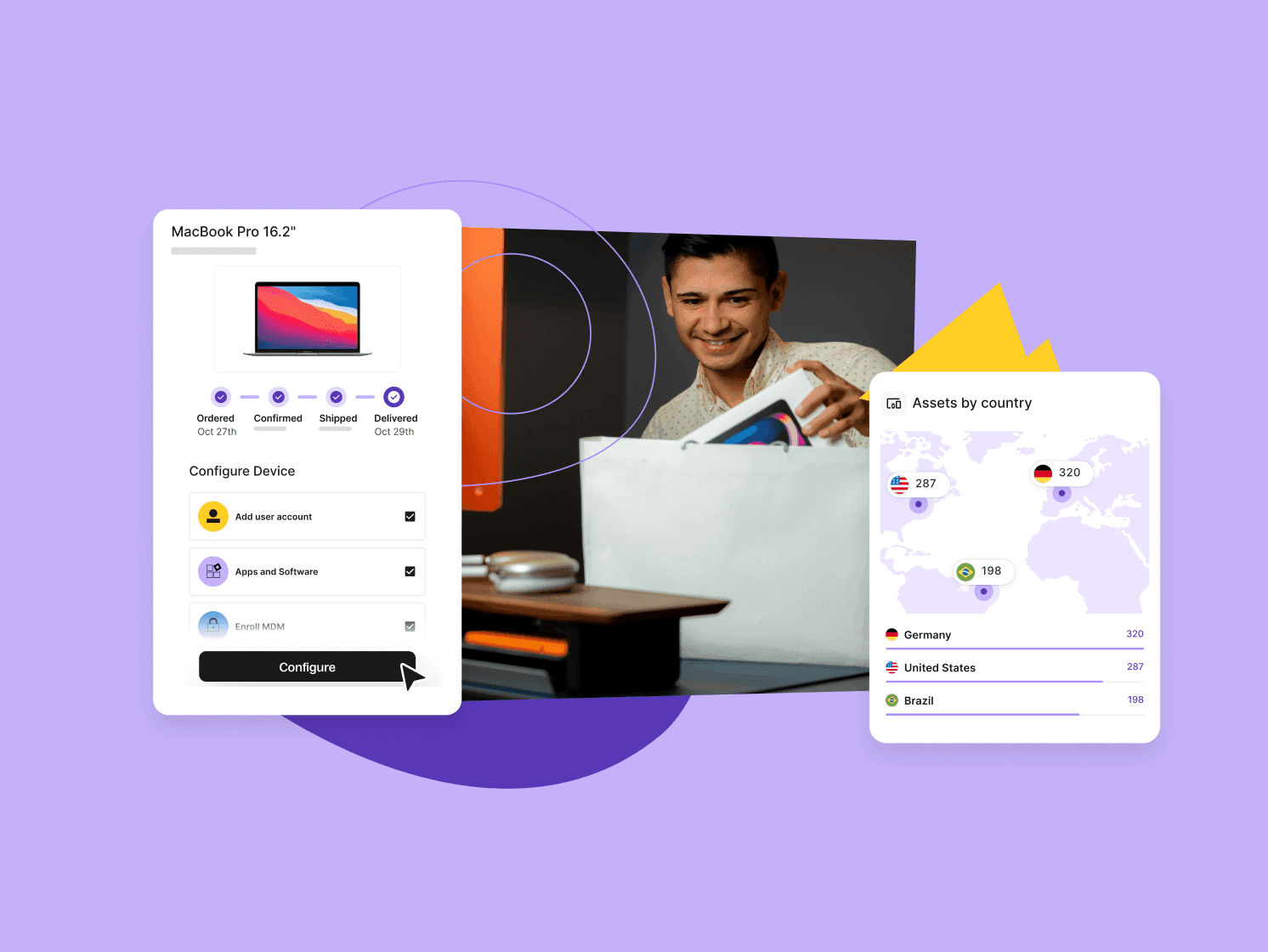
Deel IT helps organizations automate IT setup from a single platform with a global device catalog that includes high-performance hardware for engineering teams, alongside application delivery, security, and lifecycle workflows, so every new hire is ready to work from day one.
Remote engineers are more dependent on their IT setup than almost any other role. A missing tool, an unenrolled device, or a delayed access grant doesn't just slow them down: it stops them from working entirely. Without a structured onboarding process, delays and configuration gaps can leave engineers blocked before they write a single line of code
This checklist covers every stage of the IT setup process for remote engineers: from device procurement and endpoint configuration through identity, access, and the tools engineers actually need to do their jobs.
Step 1. Device procurement and pre-configuration
Before a remote engineer can do anything, they need hardware that arrives on time, configured correctly, and ready to use. This step covers everything that should happen before the device leaves the warehouse:
☐ Confirm device specifications match the engineer's role — RAM, storage, and OS requirements for development workloads differ from standard business use
☐ Select the correct keyboard layout, power adapter, and regional compliance requirements for the engineer's country
☐ Pre-configure the device with the approved OS build and baseline configuration before shipping
☐ Enroll the device in Mobile Device Management (MDM) at provisioning, not after the first login
☐ Confirm shipping timeline against the engineer's start date, with a buffer for customs or carrier delays
☐ Log the device in the asset register with serial number, assigned user, country, and expected delivery date
Discover the top 7 reasons why new hires start without the right tools.
Step 2. Endpoint security and MDM configuration
A device that isn't managed from the start creates unnecessary security and compliance risk. As part of provisioning, IT should ensure the device is enrolled in or configured for MDM before it reaches the engineer. Key steps include:
☐ Confirm MDM enrollment completed at provisioning, not pending first-login self-enrollment
☐ Apply full-disk encryption (FileVault for macOS, BitLocker for Windows) before the device ships
☐ Push baseline security policy: screen lock timeout, password requirements, automatic OS update enforcement
☐ Configure remote lock and remote wipe capability, and confirm it is active before the device is delivered
☐ Apply certificate-based authentication where required by your security policy
☐ Verify the device appears in the MDM console as enrolled and policy-compliant before the engineer's start date
Read: How to Improve IT Compliance With Automated Device Management
Step 3. Identity setup and access provisioning
Identity is the foundation on which everything else depends. Single Sign-On (SSO) and Multi-Factor Authentication (MFA) should be configured before the engineer's first login to ensure access is secure, consistent, and available from day one. You will need to:
☐ Create the engineer's account in the identity provider (Okta, Google Workspace, Azure AD, or equivalent)
☐ Assign the engineer to the correct SSO groups based on their role and team
☐ Enforce MFA on the account before first login using an approved authentication method (authenticator app, hardware key, or equivalent)
☐ Apply Role-Based Access Control (RBAC) to ensure access reflects the engineer's actual role, not a generic template
☐ Confirm the engineer's account is linked to the correct directory group for automated app provisioning
☐ Document the access grants made at hire in the system of record for audit purposes
Read: IAM Best Practices for IT Teams
Step 4. Core engineering tools and application access
Engineers need a specific set of tools from day one: version control, CI/CD, cloud infrastructure access, and communication platforms. Provisioning these after the engineer starts creates immediate productivity loss. Make sure you:
☐ Grant access to the source code repository (GitHub, GitLab, Bitbucket) with the correct team and permission level
☐ Provision access to the CI/CD pipeline (Jenkins, GitHub Actions, CircleCI, or equivalent)
☐ Set up cloud platform access (AWS, GCP, Azure) with least-privilege roles — no admin access by default
☐ Provision the engineer's account in the project management tool (Jira, Linear, Notion, or equivalent)
☐ Configure access to the internal documentation platform (Confluence, Notion, or equivalent)
☐ Add the engineer to the correct Slack or Teams channels: engineering team, on-call rotation, incident response
☐ Provision access to the password manager and confirm the engineer is enrolled before day one
☐ Confirm all SaaS licenses are assigned and active, not pending approval
Here is how to manage SaaS and application licensing at scale.
Step 5. Development environment and local tooling
Application access is not the same as a working development environment. Engineers need their local environment configured and validated before they can contribute. This step is often skipped in standard IT checklists and includes the following:
☐ Confirm the package manager is installed and configured (Homebrew for macOS, apt/yum for Linux, Chocolatey for Windows)
☐ Install and configure the required language runtimes and version managers (nvm, pyenv, rbenv, or equivalent)
☐ Set up the approved IDE or code editor with the team's standard extensions and configuration
☐ Configure SSH key generation and confirm the public key is added to the relevant repositories and servers
☐ Set up VPN access and confirm the engineer can connect to the internal infrastructure from their location
☐ Validate that the local development environment can build and run the codebase — not just that tools are installed
☐ Confirm access to any internal APIs, staging environments, or sandboxes the engineer needs for their first sprint
Step 6. Security and compliance requirements for engineers
Engineering roles often involve access to technical systems and development resources that require additional security oversight. Establishing the right controls from the start helps protect company data, infrastructure, and intellectual property while ensuring access remains appropriate to the engineer's role. Make sure you:
☐ Confirm the engineer has completed the required security awareness training before access to engineering systems is granted
☐ Confirm the engineer has read and signed the acceptable use policy and data handling policy
☐ Apply endpoint protection (EDR/antivirus) and confirm it is active and reporting to the central console
☐ Confirm the engineer's device is covered by the endpoint management policy and appears in the compliance dashboard
☐ Review and document which production systems the engineer has access to — this becomes the baseline for access reviews
☐ Confirm the engineer is enrolled in the on-call or incident response process if applicable to their role
☐ Set a calendar reminder for the 30-day access review to confirm provisioned access still matches the engineer's actual role
Download this IT Security and Compliance Checklist for Remote Workers to ensure critical security controls are in place across devices, access, and remote work environments.
Step 7. Communication, collaboration, and support setup
Remote engineers rely on communication, collaboration, and support systems just as much as technical tools. Making these resources available early helps engineers stay connected, resolve issues quickly, and participate fully in team workflows. Here is how you can help:
☐ Confirm the engineer knows how to reach IT support and what the expected response time is in their time zone
☐ Set up the IT helpdesk ticketing account and confirm the engineer can submit a request
☐ Add the engineer to the correct email distribution lists and calendar groups
☐ Confirm video conferencing is configured and tested — camera, microphone, and screen share working before the first meeting
☐ Add the engineer to the team's shared calendar and any recurring engineering ceremonies (standups, sprint planning, retrospectives)
☐ Confirm the engineer has access to the internal IT knowledge base or runbook for self-service troubleshooting
Discover the benefits of 24/7 IT support for distributed teams.
Step 8. Offboarding preparation: set it up at the start
The cleanest offboarding processes are built at onboarding. Documenting what was provisioned, where it lives, and who owns it at the start makes offboarding fast, complete, and auditable. To do so, ensure you:
☐ Record every access grant made during setup in the system of record — application, permission level, and date
☐ Log the device serial number, assigned user, and delivery address in the asset register
☐ Confirm the device is enrolled in MDM with remote wipe capability active
☐ Document which production systems and cloud environments the engineer has access to
☐ Set a reminder to review access at 90 days and at any role change — access creep starts early for engineers with broad initial provisioning
☐ Confirm the device refresh cycle is recorded so the device is flagged for review at the right time
Unsure if you have everything in place? Download this employee offboarding checklist template to help you get started.
IT that scales with your engineering team: how Deel IT helps
Remote engineers are one of the most demanding IT setups to get right. The device needs to arrive on time, pre-configured, and enrolled. Access needs to be provisioned before day one. Security policy needs to be applied before the first login. And when something breaks at 11 pm in a different time zone, someone needs to answer.
But the challenge isn't limited to engineering. Whether employees work in engineering, sales, design, HR, or another function, IT teams need a consistent way to manage devices, access, security, and support. Deel IT replaces fragmented tools and manual processes with a single platform that handles the full IT lifecycle.
Here is what Deel IT helps you do:
Global procurement across 130+ countries: Source, configure, and ship pre-imaged hardware to any new hire — keyboard layout, power adapter, regional compliance, and customs handled without engaging local resellers
MDM enrollment at provisioning: Every device ships with policy applied — encryption, screen lock, OS update enforcement, and remote wipe active before the engineer's first login, not after
Automated access provisioning tied to HRIS events: The moment a hire is confirmed, SSO groups, MFA enforcement, and RBAC assignments are triggered automatically — no manual provisioning queue
SaaS and license management: Every application assigned at onboarding is tracked, usage-monitored, and reclaimed automatically at offboarding — no orphaned licenses, no access left open
Endpoint protection across the fleet: Continuous policy enforcement, real-time compliance visibility, and remote lock and wipe across every enrolled device globally.
24/7 global IT support: Live helpdesk coverage in every time zone — so an engineer blocked at 11 pm in Singapore gets the same response as one blocked at 9 am in London
Automated offboarding: When an engineer leaves, device recovery, access revocation, and license reclamation are triggered automatically through a single coordinated workflow — reducing the risk of missed steps across systems and assets.
Book a demo to see how Deel IT handles IT setup for remote engineering teams at scale.
Deel IT
Procure, deliver, manage, and secure devices anywhere

FAQs
Why is IT setup timing so critical for remote engineers?
A missing tool, an unenrolled device, or a delayed access grant doesn't just slow remote engineers down—it stops them from working entirely. Remote engineers depend on their IT setup more than almost any other role because they can't walk to IT support or ask a colleague to share a device if something fails. When device procurement, MDM enrollment, access provisioning, and development environment setup all happen before day one, engineers are productive from their first login; when these steps slip into the first week, you've lost critical productivity time on both sides.
What should be configured on a device before it ships?
Before a device leaves the warehouse, it should be pre-imaged with the approved OS build, enrolled in MDM, and have baseline security policies applied—not pending first-login self-enrollment. This includes full-disk encryption (FileVault for macOS, BitLocker for Windows), screen lock timeout rules, password requirements, and automatic OS update enforcement, all active from day one. The device should also be logged in the asset register with serial number, assigned user, country, and expected delivery date, so you know exactly where it is in the supply chain and whether it'll arrive before the engineer's start date.
When should MDM enrollment happen, and why does it matter?
MDM enrollment must happen at provisioning, not as a post-delivery self-enrollment step—this is the baseline for security compliance. When devices ship without MDM enrollment, there's a window where they're vulnerable, and engineers may skip it entirely if it's optional. Enrollment at provisioning ensures remote lock and remote wipe capability are active before the device is ever delivered, which is critical if a device is lost in transit or needs to be recovered after the engineer leaves.
What access should be provisioned before an engineer's first day?
Before day one, engineers should have their identity provider account created (Okta, Google Workspace, Azure AD, or equivalent), assigned to the correct SSO groups, and enrolled in MFA enforcement using an authenticator app or hardware key—not SMS. They should also have access to the source code repository, CI/CD pipeline, cloud platform (AWS, GCP, Azure) with least-privilege IAM roles, project management tool, internal documentation, relevant Slack or Teams channels, password manager, and all required SaaS licenses active and assigned. When any of these steps slips on day one, engineers spend their first hours waiting for access instead of contributing to code.
Dr Kristine Lennie holds a PhD in Mathematical Biology and loves learning, research and content creation. She had written academic, creative and industry-related content and enjoys exploring new topics and ideas. She is passionate about helping create a truly global workforce, where employers and employees are not limited by borders to achieve success.