Article
5 min read
How to Ensure Seamless Global Enrollment with Apple Business Manager and MDM
IT & device management

Author
Dr Kristine Lennie
Last Update
October 07, 2026

Table of Contents
How Apple Business Manager works with MDM for global device enrollment
How to prepare for seamless global Apple device enrollment
Connecting Apple Business Manager to your MDM for automated global enrollment
Configuring MDM policies for automated global enrollment
Testing and scaling global enrollment workflows
Maintaining global Apple device enrollment at scale
How Deel IT extends Apple device management beyond ABM and MDM
Enroll and manage Apple devices globally with Deel IT
FAQ
The short answer
For companies enrolling Apple devices globally, Deel IT simplifies new employee setup by connecting Apple Business Manager, MDM, device provisioning, and onboarding workflows. Devices can arrive ready for zero-touch enrollment, with required apps and security policies applied when employees sign in.
Apple devices have become the preferred choice for many global companies thanks to their security, reliability, and consistent employee experience. But managing Macs, iPhones, and iPads across multiple countries quickly becomes more complex than simply shipping hardware to employees. IT teams also need to handle provisioning, compliance, identity management, onboarding timelines, and ongoing support in a way that stays secure and operationally efficient as organizations scale.
That's why many companies combine Apple Business Manager (ABM)—Apple's platform for device enrollment and provisioning—with a Mobile Device Management (MDM) solution to automate setup, enforce security policies, and remotely configure devices before employees even power them on for the first time. In this guide, we explain how ABM and MDM platforms work together, what features matter most for secure worldwide enrollment, and which solutions stand out in 2026 for global and distributed teams.
How Apple Business Manager works with MDM for global device enrollment
ABM and MDM platforms serve different roles during the device lifecycle. ABM handles device enrollment and provisioning, while the MDM platform manages security policies, applications, compliance settings, and ongoing device management after setup.
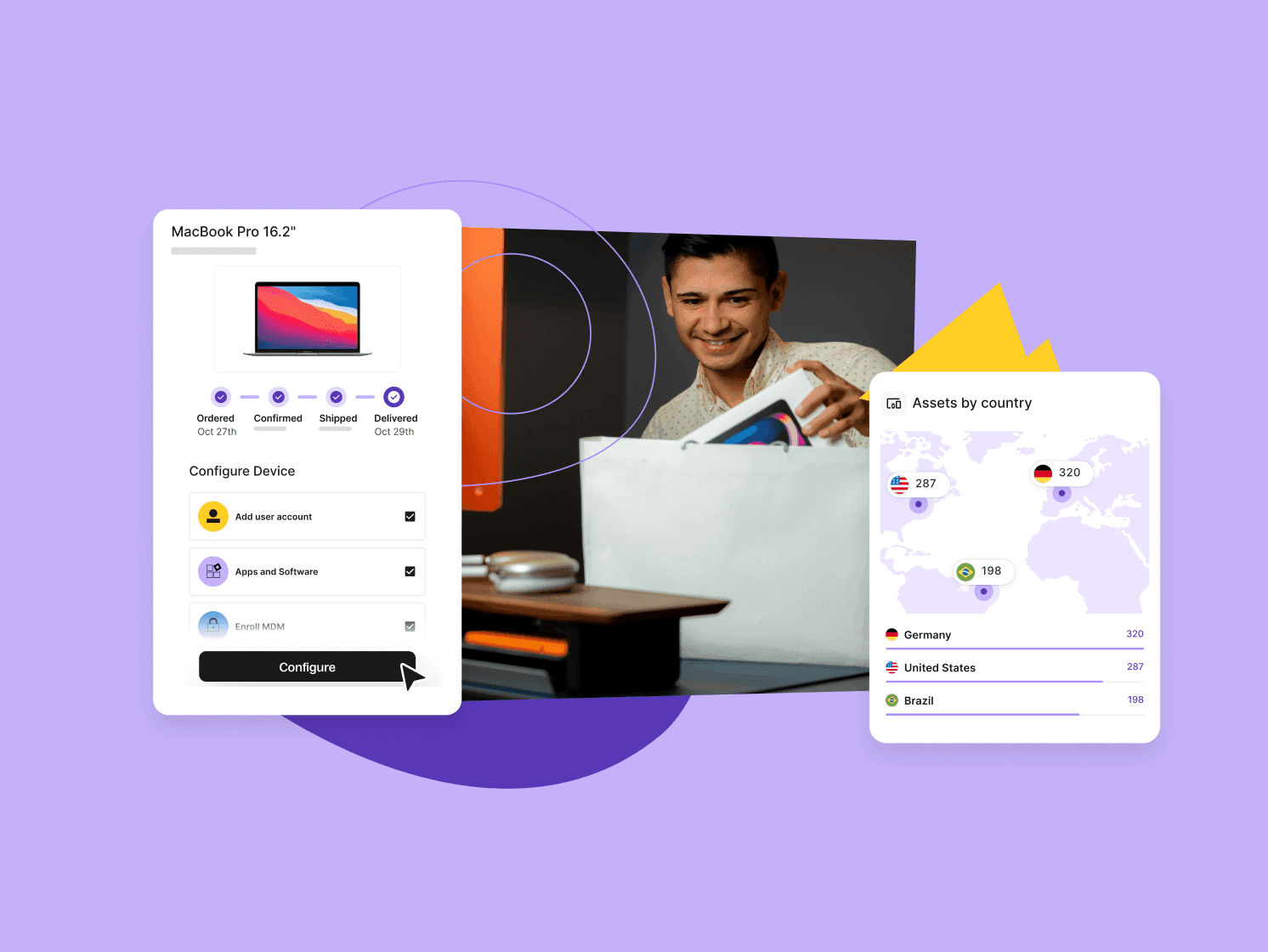
Together, they enable zero-touch deployment, allowing devices to automatically enroll, apply company configurations, install applications, and enforce security settings during activation, before employees begin using the device. This combination is best for distributed teams and remote employees who need company-ready Apple hardware without shipping devices to a central office for manual configuration first. The table below provides a high-level view of how this looks in practice:
| Stage in the workflow | Apple Business Manager (ABM) | Mobile Device Management (MDM) |
|---|---|---|
| Before the device is shipped | Links purchased Apple devices to the company and prepares them for enrollment | Creates device policies, security rules, and configuration profiles |
| When the employee turns on the device | Automatically enrolls the device during setup through Automated Device Enrollment (ADE) | Applies applications, security settings, Wi-Fi, VPN, certificates, and compliance policies |
| After setup | Maintains the device's enrollment relationship with the organization | Manages ongoing security, updates, application deployment, compliance monitoring, and remote support |
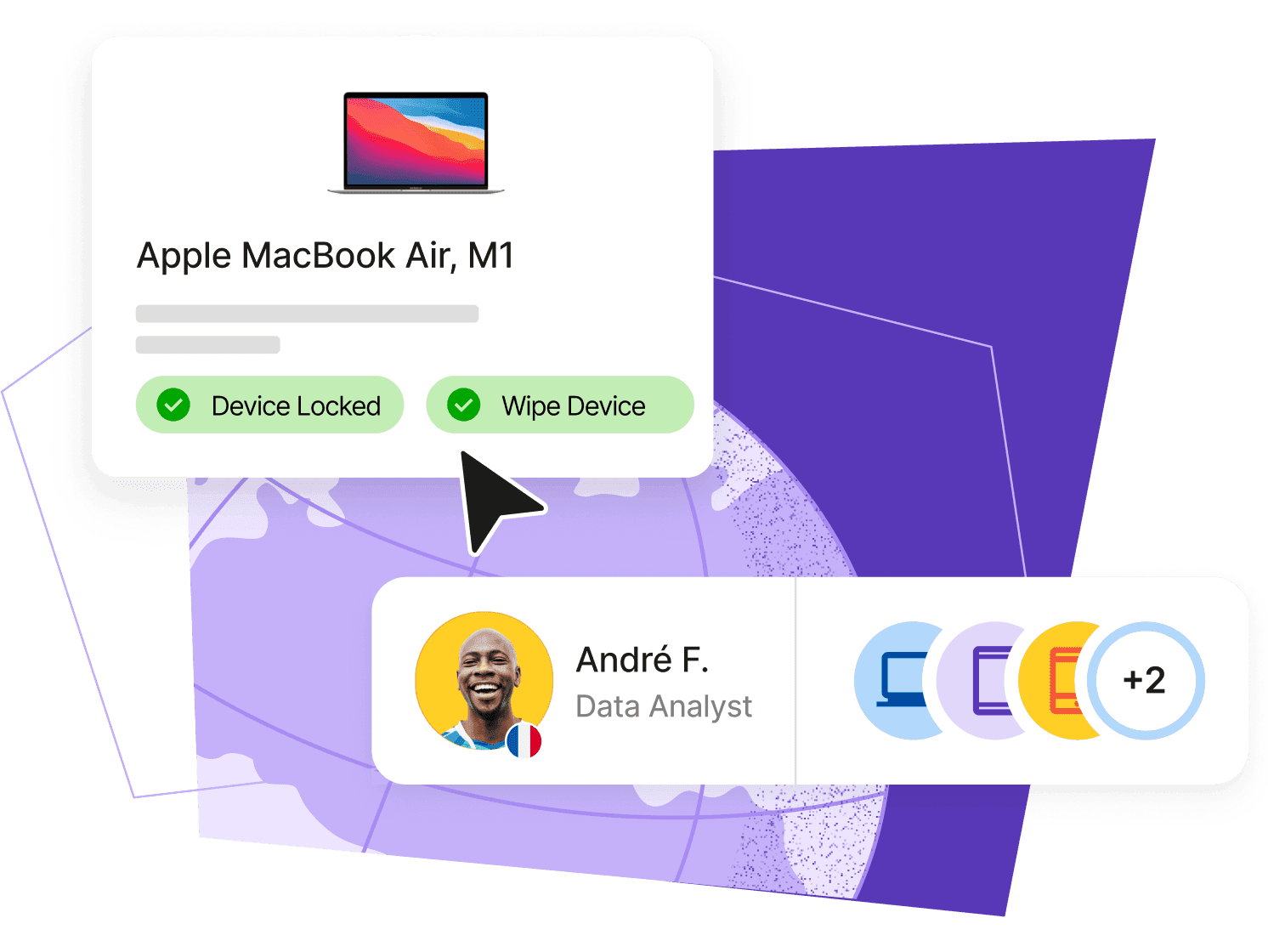
| If the device is lost or the employee leaves | Keeps the device assigned to the organization | Can remotely lock, wipe, or reconfigure the device |
Mobile Device Management
Secure and manage IT devices across any operating system
How to prepare for seamless global Apple device enrollment
Successful Apple device enrollment starts with aligning identity management, security policies, logistics, and support workflows across every region where employees operate.
Here is what you should focus on before rollout:
Device ownership and enrollment models: Define which device types (macOS, iOS, iPadOS) employees will use, whether devices are corporate-owned or BYOD, and how enrollment policies differ across teams or regions
Identity and access management: Configure Managed Apple IDs and integrate with Single Sign-On (SSO) and Multi-Factor Authentication (MFA) providers
Network and infrastructure readiness: Validate connectivity to Apple Push Notification service (APNs), Apple activation services, VPN infrastructure, and required content delivery endpoints across all target regions
Global logistics and compliance workflows: Establish processes for device shipping, customs handling, regional warranty support, returns, and data residency requirements before devices are deployed internationally
Asset and inventory management: Keep ABM, MDM, procurement, and asset management systems aligned so device ownership and inventory records remain accurate throughout the lifecycle
Regional IT support coverage: Define support ownership, escalation paths, and after-hours coverage before employees begin receiving devices across multiple time zones
Download: Strategic IT Onboarding & Offboarding Guide for Distributed Teams
Connecting Apple Business Manager to your MDM for automated global enrollment
Connecting ABM to your MDM platform is typically a straightforward setup process that enables devices to enroll automatically during activation through Automated Device Enrollment (ADE).
Here's what a typical ABM-MDM integration process looks like:
Add your MDM platform as a server in Apple Business Manager.
Download the ABM server token (.p7m file).
Upload the token into your MDM platform.
Assign devices or reseller orders to the correct MDM server in ABM.
Configure ADE profiles in the MDM platform.
Once connected, newly assigned Apple devices can automatically enroll in the correct management environment during activation, without requiring manual IT setup on the device itself. Organizations operating across multiple regions can also configure separate MDM servers, enrollment profiles, or device groups to support different subsidiaries, business units, or compliance requirements.
To improve reliability and reduce operational issues at scale, teams should also follow a few best practices:
Set a default MDM server for newly purchased devices so hardware is automatically assigned during procurement.
Use consistent naming conventions for MDM servers, profiles, and device groups to reduce assignment errors as environments grow.
Track and renew ABM server tokens before expiration so enrollment workflows are not interrupted.
Use dynamic device grouping in the MDM platform to automatically assign policies and applications based on location, role, or device type.
Review Setup Assistant and enrollment restrictions before large rollouts to confirm users cannot bypass management or remove MDM profiles.
Test reassignment and transfer workflows before moving devices between regions, subsidiaries, or providers to ensure supervision and enrollment remain intact.
Read: Zero-touch deployment for remote device supply
Configuring MDM policies for automated global enrollment
Once Apple Business Manager and your MDM platform are connected, the next step is configuring the policies, applications, and security controls that devices receive during enrollment. These configuration profiles determine how devices are secured, what employees can access, and which settings are automatically applied during setup. Most organizations start with a baseline profile for all devices, then layer additional policies based on region, department, role, or compliance requirements.
Common MDM policies for global Apple device deployments include:
Supervised enrollment: Prevents users from removing device management or bypassing corporate controls.
Full-disk encryption: Enforces FileVault on macOS and encryption on iPhone and iPad devices to protect company data.
OS update policies: Keeps devices within approved security and software update windows.
Remote lock and wipe controls: Allows IT teams to secure or erase lost, stolen, or compromised devices remotely.
Role-Based Access Control (RBAC): Restricts administrative permissions so only approved users can modify policies or device settings.
Wi-Fi, VPN, and certificate deployment: Automatically configures secure network access without requiring manual employee setup.
SSO integrations: Streamlines authentication for company applications while centralizing access management.
Recovery key management: Stores FileVault recovery keys securely within the MDM platform so encrypted devices can still be recovered remotely.
Application and extension approvals: Pre-approves required applications, permissions, and macOS extensions to reduce setup friction for employees.
Well-structured MDM policies help organizations standardize security, reduce manual configuration work, and maintain compliance across global device fleets. Many IT teams also use automated policy groups and reusable templates to simplify onboarding and keep enrollment workflows consistent as teams scale.
Read: How to improve IT compliance with automated device management
Resources to support global device enrollment
Standardize your IT security baseline with this Complete IT Security and Compliance Checklist for Remote Workers
Close offboarding gaps before data walks out the door using our Employee Offboarding Checklist Template
Align HR and IT from day one with this Guide to HR-IT Communication for Employee Lifecycle Execution
Assess your provisioning automation maturity by downloading this How Automated Is Your IT Provisioning? Self-Assessment
Testing and scaling global enrollment workflows
Before expanding Apple device enrollment across the organization, most teams run a pilot to validate provisioning workflows, enrollment policies, support processes, and regional requirements in real-world conditions. A structured pilot helps identify onboarding friction, configuration issues, and operational gaps before scaling globally.
During the pilot phase, teams should focus on:
Testing enrollment across different device types: Validate workflows across macOS, iPhone, and iPad devices, including both corporate-owned and BYOD environments where applicable.
Measuring enrollment performance: Track setup times, failed activations, and support ticket trends to establish operational benchmarks before wider rollout.
Validating application deployment: Confirm Apps and Books assignments, application installs, and automatic update behavior work as expected during enrollment.
Testing across real-world networks: Verify enrollment succeeds across home networks, VPN connections, office environments, and mobile hotspots—not just internal corporate networks.
Running recovery and replacement scenarios: Test workflows for failed enrollments, expired tokens, device replacements, and remote recovery processes before they occur in production.
Reviewing localization and regional requirements: Identify language issues, regional policy gaps, or setup experiences that may need adjustment across countries or business units.
Once pilot workflows are validated, organizations can scale gradually by region, department, or device group to simplify policy management and reduce operational risk. Standardized setup instructions, onboarding communications, and support workflows also help create a more consistent onboarding experience as deployments expand globally.
Read: Why new hires start without equipment—and how to fix it
Maintaining global Apple device enrollment at scale
Successful global device enrollment requires ongoing monitoring, regular maintenance, and clear troubleshooting processes as device fleets grow. Without proactive oversight, expired tokens, outdated enrollment profiles, or regional network issues can quickly disrupt onboarding workflows and create support bottlenecks across distributed teams.
Teams should regularly:
Track enrollment and compliance metrics: Monitor enrollment success rates, failed activations, and device compliance trends across regions.
Audit device inventory and assignments: Confirm devices are assigned to the correct MDM servers, enrollment profiles, and ownership records.
Renew ABM and MDM tokens proactively: Maintain renewal schedules and alerts for Apple Push Notification service (APNs), ABM server tokens, certificates, and Apps and Books tokens before they expire.
Review enrollment settings after Apple OS updates: Major Apple releases can introduce new setup screens, permissions, or enrollment behavior changes that affect provisioning workflows.
Maintain regional support readiness: Keep troubleshooting guides, escalation paths, and recovery procedures updated across global support teams.
As organizations scale globally, documenting common failure scenarios and standardizing troubleshooting workflows helps regional IT teams resolve issues faster without relying on a single centralized support team.
Deel IT
Automate IT operations in 130+ countries
How Deel IT extends Apple device management beyond ABM and MDM
Deel IT is a global IT operations solution that runs device, application access, security, support, and recovery workflows across the worker lifecycle—from onboarding through offboarding. It connects Apple Business Manager, MDM, identity and access management, endpoint protection (powered by CrowdStrike), device lifecycle management, procurement, IT support, and app management into one centralized platform, helping organizations automate onboarding, provisioning, security, logistics, and offboarding workflows across macOS, Windows, Linux, iOS, and Android devices. This is best for IT and security leads at distributed, global, or multi-country teams who need consistent Apple device enrollment without stitching together separate vendors for procurement, MDM, identity, and support.
| Workflow area | Traditional workflow | Deel IT workflow |
|---|---|---|
| Employee onboarding | HR manually coordinates with IT to provision devices and application access | Device provisioning, enrollment, and access workflows trigger automatically from HRIS platforms like BambooHR, Workday, and HiBob |
| Device deployment | Devices may require manual assignment, configuration, or follow-up before shipping | Devices can be assigned, enrolled, configured, and shipped automatically before day one |
| Access management | IT teams provision manually and revoke accounts across multiple systems | Identity provisioning and application access can be automated based on employee role and status |
| Offboarding | HR and IT coordinate separately to revoke access, lock devices, and recover hardware | Employee departures can trigger automated access revocation, remote lock and wipe, and device recovery workflows |
| Global logistics | Procurement, shipping, retrieval, and replacement processes vary across vendors and regions | Centralized device procurement, shipping, retrieval, and replacement support across 130+ countries with a 99.5%+ on-time delivery rate |
| IT operations | Device management, identity, onboarding, and support workflows operate across disconnected systems | Unified platform connecting device management, onboarding, offboarding, identity, logistics, and IT support |
Deel IT
Procure, deliver, manage, and secure devices anywhere

Enroll and manage Apple devices globally with Deel IT
Deel IT connects Apple Business Manager, MDM, identity, procurement, and support in one platform, helping global teams manage Apple devices from onboarding through offboarding across 130+ countries.
With Deel IT, you can:
Procure, configure, ship, recover, and replace devices across 130+ countries from one platform
Automate Apple device enrollment and provisioning workflows through Apple Business Manager and MDM integrations
Enforce security policies, application access, and compliance standards across macOS, Windows, iOS, Linux, and Android devices, with built-in endpoint protection powered by CrowdStrike
Trigger device setup, access provisioning, and offboarding workflows automatically from HR lifecycle events, including hires, role changes, and exits
Centralize onboarding, identity management, device logistics, and IT support into a single operational workflow
Support distributed teams with 24/7 global IT support and visibility across devices, applications, and employee access
Book a demo to see how Deel IT helps global teams streamline Apple device enrollment and IT operations at scale.
FAQ
What's the fastest way to set up global Apple device enrollment?
Connect Apple Business Manager (ABM) to your MDM and use Automated Device Enrollment (ADE) to enroll devices during activation. Configure enrollment profiles, required apps, and security policies in advance so employees can receive devices ready for zero-touch setup. Global teams should also coordinate procurement and delivery with the enrollment workflow to avoid manual handoffs.
What is Apple Business Manager, and how does it work with MDM?
Apple Business Manager helps organizations assign company-owned Apple devices to an MDM for automated enrollment. ABM establishes the enrollment relationship, while the MDM applies applications, configurations, security policies, and ongoing device controls.
How does Automated Device Enrollment simplify employee onboarding?
Automated Device Enrollment allows eligible Apple devices to enroll in MDM during initial setup. Employees can unbox their device and follow Setup Assistant while the organization's management settings, apps, and security policies are applied without IT configuring the device in person.
Can Apple devices purchased outside Apple or an authorized reseller be added to Apple Business Manager?
Some eligible Apple devices can be added to Apple Business Manager manually using Apple Configurator. The process and available enrollment options depend on the device type, operating system, and how the device was acquired, so organizations should verify Apple's current requirements before deployment.
Can different regions or teams use different MDM servers with Apple Business Manager?
Yes. Organizations can connect multiple device management services to Apple Business Manager and assign devices accordingly. This can help separate devices by region, business unit, subsidiary, or other operational requirements.
How can IT prevent employees from removing management from company-owned Apple devices?
Organizations can use Automated Device Enrollment and supervision to apply stronger management controls to eligible corporate-owned devices. The exact restrictions available depend on the Apple platform, enrollment method, and MDM configuration.
How does Deel IT simplify Apple device enrollment for global teams?
Deel IT connects Apple device provisioning and logistics with MDM, identity, and worker lifecycle workflows. This helps global teams coordinate device delivery, enrollment, security, application access, and ongoing support across 130+ countries without managing each step as a separate process.
What should global teams look for in an MDM for Apple devices?
Look for Apple Business Manager integration, Automated Device Enrollment, application and configuration deployment, security policy enforcement, FileVault management for Macs, OS update controls, and remote device actions. Global teams should also consider how the MDM fits with identity, procurement, support, and device recovery workflows.
Dr Kristine Lennie holds a PhD in Mathematical Biology and loves learning, research and content creation. She had written academic, creative and industry-related content and enjoys exploring new topics and ideas. She is passionate about helping create a truly global workforce, where employers and employees are not limited by borders to achieve success.