Article
3 min read
LNG and Midstream Workforce Compliance: What Operators Need
Employer of record

Author
Jemima Owen-Jones
Last Update
July 08, 2026
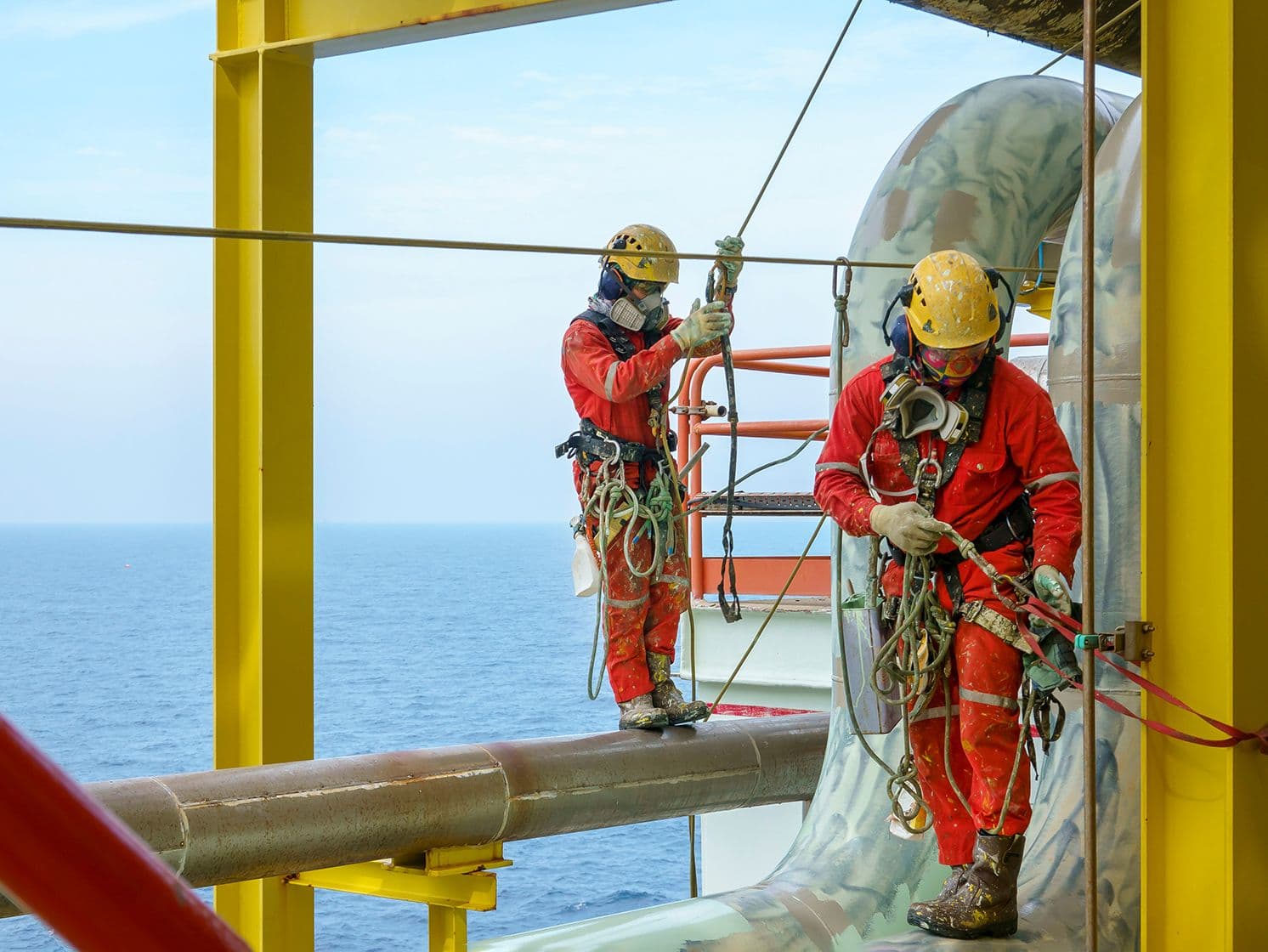
Table of Contents
What midstream and LNG workers actually do
The scale of the current build cycle
Why midstream and LNG compliance is different from upstream
The local content minefield
What the right employment structure looks like
The cost of getting it wrong
How Deel Field Services approaches this
Maintain a compliant workforce with Deel
Key takeaways
Local content quotas, fragmented EPC employment chains, and a critical gap when construction hands over to operations — midstream and LNG workforce compliance is more complex than upstream, and the cost of getting it wrong is larger.
Treat workforce infrastructure as project-critical and build it before first crew mobilization: a legal employer in-country, rotational payroll, automated local content tracking, in-house immigration, and a transition plan that retains key workers through the handover.
Most EOR providers won't touch blue-collar on-site workers because of the liability. Deel Field Services is built specifically to absorb it — covering workers' compensation, HSE compliance, and medevac alongside payroll and immigration, across 40+ countries, at a transparent fee that replaces agency markups of 40% or more.
The project is funded. The FID is signed. The EPC contractor is under contract. And then someone in HR or Operations asks the question that stops everything cold: "How do we actually employ these workers in-country?"
In upstream Oil & Gas, this problem is familiar. But in midstream and LNG — where projects are larger, longer, more internationally complex, and more politically exposed — the workforce compliance challenge is structurally different. And the cost of getting it wrong is proportionally greater.
This article breaks down what makes workforce compliance uniquely demanding in midstream and LNG projects, why the standard answers don't work, and what a compliant deployment structure actually looks like.
What midstream and LNG workers actually do
Before understanding the compliance challenge, it helps to understand who we're talking about.
Midstream workers aren't offshore drillers. They're pipeline engineers, compression technicians, processing plant operators, instrumentation specialists, SCADA systems engineers, and HSE supervisors. They work on gathering systems, gas processing plants, liquefaction trains, storage terminals, and the infrastructure that connects production to export. Their roles are highly technical, often certified to international standards, and frequently mobile across multiple project sites and jurisdictions simultaneously.
LNG projects add another layer. A major LNG development moves through distinct phases — FEED, EPC construction, commissioning, and long-term operations — each requiring a different workforce profile.
At peak construction on a large LNG terminal, you might have 5,000 to 8,000 workers on site: a mix of specialist international expats, regional technicians, and local workers employed under mandatory host-country quotas.
At the operations phase, that number drops sharply to a smaller, more specialist permanent workforce — but the compliance obligations don't.
The structural complexity of managing this workforce across phases, nationalities, and jurisdictions is what creates the compliance problem most operators don't fully anticipate until they're inside it.
The scale of the current build cycle
The timing matters. This isn't a theoretical discussion. We're in the middle of one of the largest LNG construction cycles in history, and the workforce pressure that creates is being felt right now.
US LNG exports surged from 0.5 billion cubic feet per day in 2016 to 15 billion cubic feet per day in 2025, and the US Energy Information Administration forecasts that figure rising past 18 billion cubic feet per day by 2027
Seven major projects are under active construction, set to increase US LNG peak export capacity by 75% by 2030
Globally, North American export capacity alone is on track to increase from 11.4 billion cubic feet per day at the start of 2024 to 28.7 billion cubic feet per day by 2029
Beyond the US: LNG Canada shipped its first cargo in June 2025
TotalEnergies announced the full restart of the Mozambique LNG project in January 2026, with 4,000 workers already mobilized
Qatar is executing a plan to nearly double LNG production from 77 to 142 million metric tonnes per year before 2030
Deloitte's analysis identifies workforce availability as one of three critical variables that determine whether this build cycle delivers on schedule — alongside permitting and supply chains. More than $35 billion in natural gas infrastructure spending is expected through 2027 in the US alone. None of it gets built without the people to build it.
The craft labor shortage is real and quantified. Bechtel's President of Energy has stated publicly that demand across the US Gulf Coast could exceed 40,000 skilled construction workers industry-wide — and closing that gap is "a massive industry challenge." EPC firms describe the shortage as exacerbated by an aging workforce and a shrinking pipeline of young people entering field trades.
Field Services
Power the world's workforce from rigs to renewables

Why midstream and LNG compliance is different from upstream
Operators who've managed upstream EOR before sometimes assume the same approach works in midstream and LNG. It doesn't, for several structural reasons.
The EPC model fragments employment
Upstream projects typically have a cleaner employment structure: an operator, a primary contractor, and a defined workforce. Large EPC contracts for LNG terminals break down differently — multiple tier-one contractors, dozens of subcontractors, specialist package vendors, and further layers of local subcontracting below them.
Each layer creates its own employment relationships, its own payroll structure, and its own exposure to worker misclassification in the host country. Deploying workers through a compliant EOR structure cuts through this fragmentation: one legal employer, one contract, one compliance framework, regardless of where in the EPC chain the workers sit.
The construction-to-operations transition creates a compliance gap
This is the structural risk that's unique to LNG. During construction, the EPC contractor is responsible for employment. When the project transitions to operations — usually 18–24 months before first cargo — that responsibility transfers to the operator or a dedicated O&M entity.
Workers who were employed by the EPC contractor don't automatically transition. If the operator hasn't built the employment infrastructure for the operations phase, it arrives at commissioning without a legal basis to employ the people who know the plant.
A field-ready EOR solves this by providing continuity of employment through the transition, retaining key workers under the operator's direction without requiring the operator to have established a local entity.
The technical workforce is internationally mobile
LNG process operators, rotating equipment engineers, and commissioning specialists don't typically come from one country or one region. They follow the projects. Getting them into the host country on time requires work permits, immigration management, and compliant employment contracts in markets that may have significant bureaucratic complexity.
One delayed permit delays a critical resource.
In-house immigration capability — not outsourced to a third party — is the difference between a predictable mobilization and an unpredictable one.
Process safety creates HSE obligations that most EOR providers can't absorb
Workers in LNG facilities handle hazardous materials at scale. Pre-employment medicals, gas safety training, process safety competency verification, HSE induction, and ongoing compliance with internationally recognized safety standards (ISOs, OSHA, API) are non-negotiable.
Standard EOR providers aren't structured for this. Field-ready EOR providers — those specifically built for industrial environments — build H&S training into the worker onboarding process and are structured to manage the employment obligations that industrial environments require.
The local content minefield
Every major LNG-producing market has local content requirements. Most are tightening. Few are simple to navigate.
Qatar: Qatar's Qatarization Law No. 12 of 2024, in effect from April 2025, requires private-sector employers to prioritize Qatari nationals in hiring, advertise all vacancies on the government Tawteen portal within one month of opening, and submit biannual workforce composition reports to the Ministry of Labour. Non-compliance triggers penalties of up to QAR 100,000. One crucial nuance: companies owned by QatarEnergy and those engaged in petroleum operations are exempt — but their contractors and subcontractors are not. This creates a specific compliance exposure in the EPC supply chain that a compliant EOR manages automatically
Mozambique: The TotalEnergies Mozambique LNG restart in January 2026 came with explicit local content commitment: up to 7,000 direct jobs for Mozambican nationals during construction and more than $4 billion in contracts awarded to local companies. Over 3,000 of the 4,000 workers currently mobilized are Mozambican nationals. The Eni-led Coral Norte FLNG reached FID in 2025, and ExxonMobil's Rovuma LNG lifted force majeure and is advancing toward FID in 2026. The Rovuma Basin is becoming a major supply hub — and local content compliance will determine which international contractors can work there
Canada: LNG Canada, which shipped its first cargo in June 2025, saw 99% of its 8,100 peak construction workers sourced from Canada, with a quarter from British Columbia. That outcome was the result of employment structures built around local sourcing from the outset — not imposed reactively. It's a model for what proactive local content design looks like
Nigeria: Nigeria's Petroleum Industry Act governs midstream compliance, with the Nigerian Midstream and Downstream Petroleum Regulatory Authority overseeing local content, contractor obligations, and workforce reporting. Nigeria LNG Limited operates six liquefaction facilities at Bonny Island, with floating LNG expansion in development
In each of these markets, local content compliance requires employment infrastructure that tracks ratios, generates the reports regulators expect, and alerts operators before a project breaches its quota — not after.
What the right employment structure looks like
Companies that get workforce compliance right in midstream and LNG don't treat it as an HR administrative function. They treat it as project infrastructure — built in parallel with the EPC contract, ready before first crew mobilization.
The key components are:
A legal employer in-country: Whether through an established local entity or an Employer of Record, workers need a compliant employment contract with a legal employer recognized in the host jurisdiction. Workers deployed under a home-country contract in a market where the company has no entity are legally exposed — and so is the operator
Payroll built for the project's actual workforce structure: Midstream and LNG projects typically involve a mix of day-rate contractors, salaried permanent employees, rotational workers, and local hires on different contract types. Standard payroll systems aren't designed to handle this. The payroll infrastructure needs to process hardship allowances, per-diems, multi-currency payments, and shift-based structures while maintaining full tax compliance in the host country
Local content tracking built in: Ratio monitoring needs a structured approach from day one. Deel's Compliance Hub monitors employment law changes — including local content obligations — across 150 countries, ensuring operators stay informed of regulatory shifts before they become violations. Reporting outputs for regulators should be built into the employment structure from the outset, not assembled reactively
In-house immigration for the international workforce: Work permits for rotational expats need continuous management — especially for roles where one person covers multiple project sites across jurisdictions. Outsourced immigration services introduce a handoff that creates delay. In-house capability removes it
HSE and process safety compliance: Pre-employment medicals, site safety inductions, drug testing, gas safety competency verification, and incident reporting need to be embedded in the employment structure, not bolted on separately
A transition plan from construction to operations: The EPC contractor shouldn't be the only party thinking about which workers transition at handover. Operators need to have identified key roles for the operations phase and have the employment structure ready to absorb them — before commissioning, not after

Global Hiring Impact
Recognized as a Leader on Everest Group’s PEAK Matrix®
The cost of getting it wrong
The financial math here is the same as upstream, but the numbers are larger.
A construction delay on a major LNG terminal affects the entire project economics — export contracts, offtake agreements, and financing structures that have been in place for years. A day of idle time at peak construction isn't a line item in an HR budget. It's a P&L problem that flows through to investors, lenders, and the governments who've signed PSAs expecting first cargo on schedule.
The political cost is different in LNG. Upstream projects in frontier markets can often manage reputational issues at a distance. LNG terminals are large, visible, permanent infrastructure in host communities.
Employment compliance — local content ratios, worker safety records, wage compliance — is scrutinized by community stakeholders, regulators, and civil society organizations in a way that a remote offshore platform isn't. Getting it wrong has consequences that persist through the life of the asset.
How Deel Field Services approaches this
Deel Field Services is built for the deployment complexity that midstream and LNG projects create. It operates across two tracks:
Onsite EOR covers compliant employment and complex payroll for field workers deployed to fixed, controlled client premises — handling rotational pay structures, per-diems, multi-currency payments, and the different contract structures required for expat versus local workers
Field EOR is end-to-end workforce deployment for variable operational and industrial sites: sourcing, onboarding, immigration, flights, accommodation, transport, payroll, HSE compliance, and union and labor authority engagement — under one contract and one invoice. Pricing is structured as a transparent monthly fee per worker, replacing significant agency markups with a predictable, auditable cost model. Contact the Deel Field Services team for current pricing
Field EOR is currently available across 40+ countries, including the key LNG and midstream markets in Africa — Nigeria, Angola, Mozambique, Tanzania, Algeria, Egypt, and more. The service is delivered by the Employ Africa team, which Deel acquired specifically to build operational infrastructure in these markets, not just in-country partnerships.
For companies working in the Gulf LNG markets, including Qatar and the UAE, Deel's in-house immigration capability covers the permit management requirements that Qatarization compliance demands — including the documentation, reporting, and vacancy advertising obligations that took effect under Law No. 12 of 2024.
Time Tracking
Time tracked. Payroll trusted. Nothing to reconcile.
Maintain a compliant workforce with Deel
The LNG build cycle is running. The workforce gap is real. The compliance frameworks in the markets where this work is happening — Qatar, Mozambique, Nigeria, Canada — are tightening, not loosening.
For operators and EPC contractors entering new markets, the time to build compliant employment infrastructure is before the crew arrives, not after. The wrong answer is to assume the upstream model transfers. The right answer is to treat workforce compliance as project-critical infrastructure — built in parallel with the EPC contract, ready before first mobilization, and maintained through the construction-to-operations transition.
The project doesn't wait. But with the right structure in place, neither does the workforce.
Deel Hire
Find, hire, and manage anyone, anywhere

FAQs
What is workforce compliance in LNG projects?
Workforce compliance in LNG projects refers to the full set of legal, regulatory, and contractual obligations that govern how workers are employed on LNG developments — including local content requirements (mandated ratios of host-country nationals), immigration and work permit management for international workers, payroll and tax compliance in the host country, HSE obligations, and employment contract structures that meet local labor law.
Given that LNG projects typically operate across multiple jurisdictions, involve large workforces with varied employment structures, and transition between construction and operations phases, workforce compliance is substantially more complex than in standard industrial environments.
How do local content requirements affect midstream and LNG projects?
Local content requirements mandate that a minimum proportion of workers on any project are nationals of the host country. In LNG markets, these requirements are legally enforced and often tied to project approvals or operating licenses.
Qatar's Qatarization Law (Law No. 12 of 2024), in effect from April 2025, requires private-sector employers to advertise vacancies to Qatari nationals first and submit biannual workforce composition reports.
In Mozambique, the Mozambique LNG project has committed to up to 7,000 direct jobs for Mozambican nationals during construction.
Why can't a standard EOR provider support LNG workers?
Standard EOR providers are built for remote knowledge workers in office or home-based environments. They're not structured to absorb the liability associated with on-site field workers in hazardous industrial environments — specifically workers' compensation, HSE compliance, process safety obligations, medevac coordination, and drug testing.
Most standard EOR providers decline to take on blue-collar on-site workers for this reason. Field-ready EOR providers, like Deel Field Services, are specifically structured to cover these obligations alongside payroll and immigration.
What happens to LNG workers during the transition from construction to operations?
Workers employed by the EPC contractor during construction don't automatically transfer to the operator when the project reaches commissioning. If the operator hasn't built compliant employment infrastructure for the operations phase, they arrive at handover without a legal basis to employ the workforce they need to run the plant.
A field-ready EOR can provide continuity of employment through this transition — retaining key workers under the operator's direction while managing the employment contracts, payroll, and compliance obligations — without requiring the operator to have an established local legal entity.
How does Deel Field Services support midstream and LNG projects?
Deel Field Services provides compliant employment, payroll, immigration, HSE compliance, and full mobilization logistics for field workers across 40+ countries. For midstream and LNG projects, this includes management of local content ratios and reporting, in-house work permit and visa processing for international workers, rotational payroll structures for field workers, and end-to-end crew mobilization logistics.
Field EOR pricing is structured as a transparent monthly fee per worker, replacing significant agency markups with a predictable, auditable cost model. Contact the Deel Field Services team for current pricing.
Jemima is a nomadic writer, journalist, and digital marketer with a decade of experience crafting compelling B2B content for a global audience. She is a strong advocate for equal opportunities and is dedicated to shaping the future of work. At Deel, she specializes in thought-leadership content covering global mobility, cross-border compliance, and workplace culture topics.