Article
8 min read
Run Payroll Across the US, Canada, and Mexico with Deel Payroll
Global payroll

Author
Shannon Ongaro
Last Update
October 27, 2026

Table of Contents
Why running US, Canada, and Mexico payroll on separate systems creates Finance risk
How Deel Payroll centralizes US, Canada, and Mexico on one platform
Continuous compliance across three jurisdictions
Multi-currency visibility and cost control for Finance Leaders
Deel Payroll vs. fragmented vendors
How to migrate from fragmented payroll to Deel Payroll
Consolidate Your US, Canada, and Mexico Payroll with Deel Payroll
Key takeaways
Managing US, Canada, and Mexico payroll on separate systems creates compounding compliance risk and fragmented cost visibility.
US, Canadian, and Mexican payroll each carry distinct statutory requirements that don't align on timelines, filings, or compliance authorities.
Deel Payroll consolidates all three countries on one platform, with continuous compliance and unified payroll reporting.
Finance Leaders managing employees in the US, Canada, and Mexico typically juggle two or three separate payroll systems: one for US multi-state filing, another for Canadian tax remittances, and a third for Mexico's payroll deductions, digital payroll receipts, and statutory annual obligations.
Each vendor has its own support contracts, compliance calendars, and escalation paths, which creates audit exposure and cost blind spots that only grow harder to manage as headcount in each country increases.
When a regulation changes, whether a new US state withholding requirement, a Canada Revenue Agency (CRA) contribution-rate update, or a Mexico payroll filing format revision, Finance teams tracking changes across disconnected systems absorb a disproportionate compliance burden. The labor cost alone, before accounting for the risk of a missed filing deadline, argues for consolidation.
This guide covers what makes payroll compliance in each country distinctly demanding, how Deel Payroll centralizes the three on one platform, and how Finance Leaders can migrate from fragmented vendors without disrupting a live payroll cycle.
Why running US, Canada, and Mexico payroll on separate systems creates Finance risk
Each country in North America operates a fundamentally different payroll tax and compliance regime. Managing them across disconnected vendors adds operational overhead and creates more opportunities for errors, missed filings, and audit exposure.
The three regimes don't share filing calendars, statutory rate schedules, or reporting formats, which means a compliance issue in one country is invisible to the vendors managing the other two.
US payroll complexity
The US doesn't have a single payroll rulebook. Employers filing for workers across multiple states contend with varying state income-tax withholding rates, separate state unemployment tax (SUTA) registrations per state, and federal obligations including Federal Unemployment Tax Act (FUTA) filings (Form 940) and quarterly Form 941 deposits.
Wage-and-hour rules including overtime thresholds, pay-frequency requirements, and final-paycheck timelines also differ across all 50 states. A company with employees in California, Texas, and New York is, in practice, managing three distinct compliance environments on top of its federal obligations, each with its own registration requirements and audit risk.
Year-end brings additional complexity with W-2 preparation, distribution, and SSA submission must be coordinated across every state in which employees worked, with deadlines and formatting that differ from Canada's T4 Slip or Mexico's digital payroll receipt obligations.
Deel's multi-state payroll compliance guide covers the most common pitfalls in detail, and its multi-state tax registration guide explains how employer registrations stack across jurisdictions.
Deel Payroll - US
Compliantly run payroll in all 50 states
Canada payroll complexity
Canadian employers must calculate and remit Canada Pension Plan (CPP) and Employment Insurance (EI) deductions to the Canada Revenue Agency (CRA) according to a strict remittance schedule.
The frequency at which a company remits depends on its prior year's total payroll liability. Quebec adds a separate layer entirely, as the Quebec Pension Plan (QPP) replaces CPP, the Quebec Parental Insurance Plan (QPIP) replaces EI, and Quebec operates its own tax authority (Revenu Quebec), requiring distinct registrations and RL-1 slip filings that differ from the CRA's T4 process.
Year-end deadlines differ from US timelines: Canada's T4 must be electronically filed with the CRA, and RL-1 slips with Revenu Quebec, by February of the following year. Provincial health-tax levies (such as Ontario's Employer Health Tax) and Workplace Safety and Insurance Board (WSIB) contributions add further obligations that a US-focused payroll vendor typically doesn't track.
For companies with employees across multiple provinces, the layering of federal and provincial requirements mirrors the multi-state challenge in the US, but with different bodies, rates, and forms.
Learn more: A Guide to Running Payroll in Canada
Mexico payroll complexity
Mexico's payroll compliance framework is structured around three major bodies. IMSS, the national social security institute, governs employer contributions for healthcare and social benefits.
INFONAVIT governs the mandatory 5% housing-fund contribution that employers remit on each worker's behalf. The SAT, Mexico's federal tax authority, requires each payroll disbursement to be accompanied by a CFDI 4.0 digital payroll receipt, a government-signed XML document that constitutes the legal payslip and must be generated and validated before the payment is made.
Beyond monthly obligations, Mexico mandates two statutory annual payments that don't exist in the same form elsewhere in North America: the aguinaldo, a minimum of 15 days' salary payable by December 20, and employee profit-sharing (Participacion de los Trabajadores en las Utilidades, or PTU), distributed to eligible employees by May 30. Missing either deadline triggers penalties.
A fragmented-vendor arrangement that doesn't have Mexico expertise built in typically doesn't auto-flag these obligations or coordinate their timing with US and Canadian year-end tasks running in parallel.
Guide
The Case for Global Payroll Consolidation
How Deel Payroll centralizes US, Canada, and Mexico on one platform
Finance Leaders managing payroll across all three countries through Deel work from one platform, one agreement, and one support relationship, rather than separate onboarding processes, service-level agreements, and escalation chains for three different vendors. This reduces the need for Finance to track separate vendor compliance calendars and workflows across each country.
For US-based employees, Deel Payroll - US handles multi-state tax registrations, federal deposit schedules (Forms 940 and 941), wage-and-hour rule tracking per state, and end-of-year W-2 preparation and distribution to the SSA and employees.
For Canada, the same Deel Payroll platform covers CPP/EI and QPP/QPIP deductions, CRA and Revenu Quebec remittances on the applicable schedule, T4 and RL-1 issuance, and provincial levy tracking. For Mexico, Deel ccovers IMSS and INFONAVIT contributions, SAT/CFDI digital payroll receipt generation, ISR withholding, and statutory annual payments including the aguinaldo and PTU.
Deel's payroll configuration for each country also handles year-end coordination centrally. Rather than managing separate W-2, T4, and CFDI year-end timelines across three vendor contacts, Finance teams can coordinate year-end obligations for all three countries through the Deel platform, with the key deadlines and data requirements for each country visible in one place.
This matters most in Q4, when Mexico's aguinaldo obligation, Canada's T4 filing preparation, and US W-2 deadline tracking all fall within the same six-week window.

Free Resource
Free Global Payroll Guide [With Expert Insights]
Continuous compliance across three jurisdictions
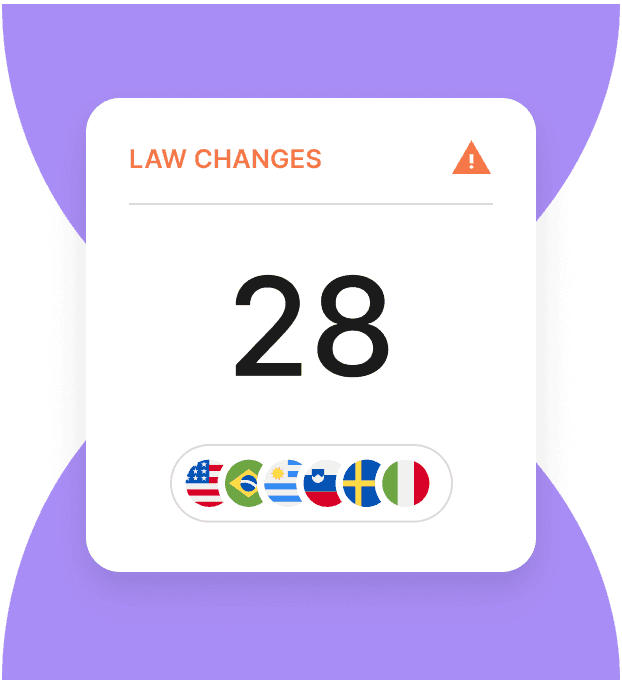
The compliance calendars for the US, Canada, and Mexico don't align, and within each country, the rules change frequently. US states update withholding rates, the CRA revises CPP/EI contribution rates annually, the SAT releases CFDI schema updates, and Mexico's statutory contribution rates for IMSS and INFONAVIT adjust each year.
Finance teams running three separate vendor relationships must independently verify that each vendor has picked up every change before the next payroll cycle runs.
Deel Payroll is designed to incorporate applicable regulatory updates into payroll workflows, reducing the manual burden on Finance and HR teams who would otherwise track changes across three separate compliance frameworks. When an obligation changes, Deel updates applicable payroll logic and workflows as regulatory requirements evolve.
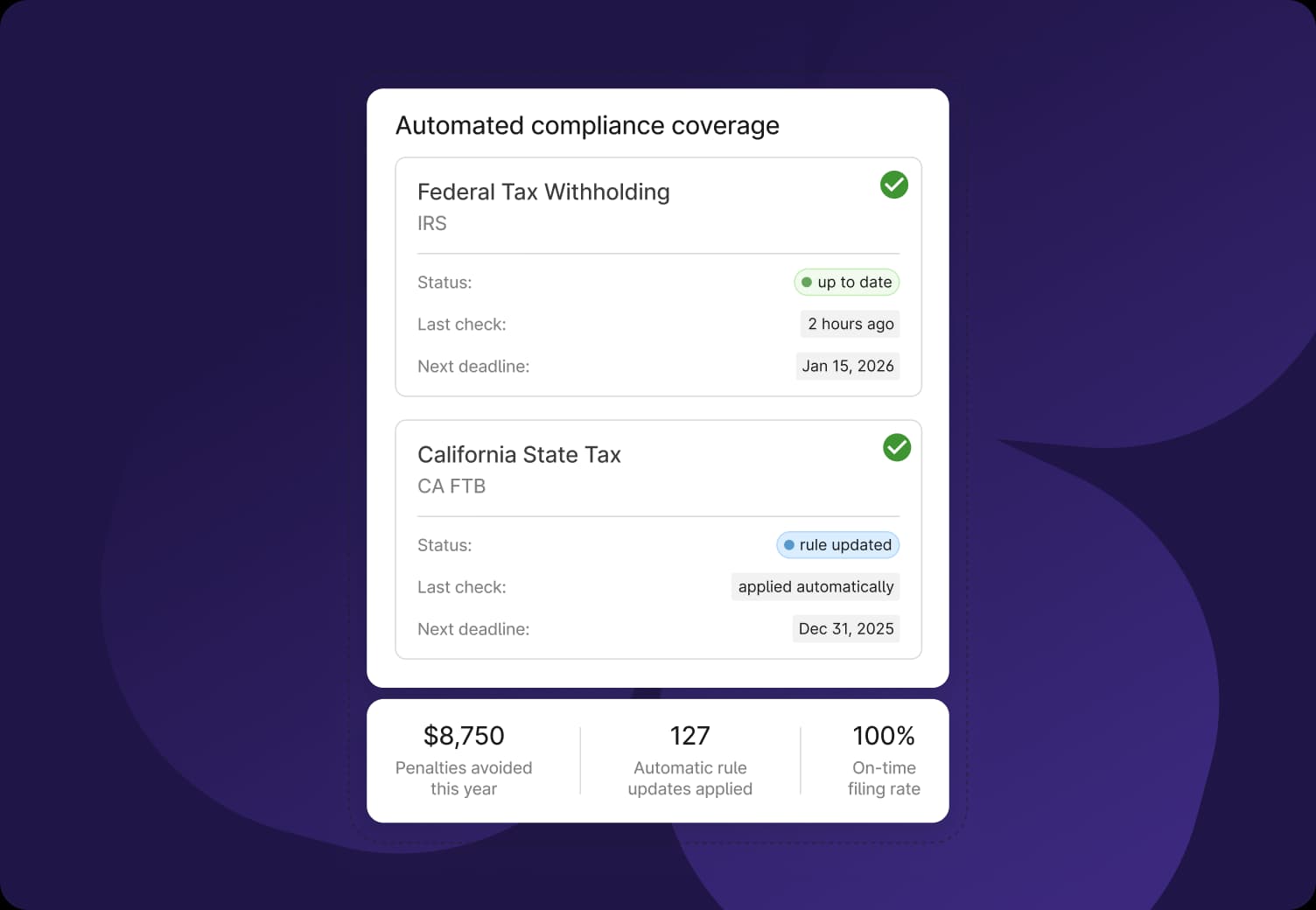
This is continuous compliance in practice: a system behavior oriented toward keeping payroll current as laws change, rather than a checklist Finance Leaders manage on their own.
For Finance Leaders, this reduces the risk of delays caused by manually maintaining contribution rates, filing schemas, or tax tables across three countries. The calculation logic and contribution schedules Deel uses in each country are maintained as requirements evolve, helping teams keep live payroll workflows current.
Deel's enterprise payroll compliance guide covers how this scales across complex multi-country configurations, including what to expect from a vendor during high-change regulatory periods.
Compliance
Unlock Continuous Compliance™ with Deel
Multi-currency visibility and cost control for Finance Leaders
Finance Leaders consolidating payroll onto a single platform gain more than operational efficiency. They gain unified cost visibility that doesn't require manually reconciling exports from three vendor portals with three different reporting schemas.
Deel Payroll supports consolidated, multi-currency payroll reporting across all three countries. Payroll runs in each country's local currency, and the platform's standardized reporting approach makes cross-country cost analysis more straightforward than reconciling exports from multiple vendors with different formatting and schemas.
Audit readiness is also improved. Consolidated payroll reporting and records are accessible through the Deel platform rather than distributed across vendor archives and export formats.
For Finance teams managing multi-entity consolidations, centralized access to payroll data reduces close-cycle reconciliation effort and makes it easier to respond to an audit request without reconstructing records from multiple systems.

With Payroll Connect, you can consolidate payroll data into Deel from all your vendors.
Foreign exchange management is another dimension of multi-country payroll that fragmented vendor setups handle inconsistently. When each country's payroll runs on a separate platform, Finance Leaders have no single view of total payroll spend across currencies before funding dates arrive. Deel Payroll's multi-currency reporting can improve visibility into cross-country payroll costs, which is useful for cash-flow planning when payroll across three countries is funded from a single treasury account.
Beyond the per-cycle view, the consolidated reporting layer also makes it easier to run accurate year-over-year cost comparisons across each country. Labor cost benchmarking and budget planning for a North American workforce rely on consistent data formats, which fragmented vendor exports rarely provide without significant manual normalization effort.
Deel Payroll vs. fragmented vendors
Fragmented payroll setups are often the path of least resistance for companies that expanded into each North American market sequentially: one provider for the US, a separate one for Canada, a local third party for Mexico. Over time, separate vendors increase reconciliation work, create compliance monitoring gaps, and leave no single party accountable for the full payroll picture. Watch the video below to learn more about Deel vs aggregator payroll models.
The comparison below maps Deel Payroll against a typical fragmented three-vendor arrangement across the criteria Finance Leaders weigh most.
| Category | Deel Payroll | Fragmented vendors |
|---|---|---|
| Payroll accuracy | Statutory payroll workflows coordinated through Deel across all three countries | Accuracy depends on each vendor's local implementation and update cadence |
| Compliance updates | Applicable compliance updates incorporated into country payroll workflows | Each vendor tracks and applies updates for their own jurisdiction independently |
| Reporting consolidation | Consolidated multi-currency payroll reporting | Separate reports per vendor with manual reconciliation required for any cross-country view |
| Year-end filings | W-2 (US), T4/RL-1 (Canada), and CFDI year-end (Mexico) coordinated through one platform | Three separate year-end workflows with three different support teams and timelines |
| Support accountability | One escalation path covering all three countries | Three separate SLAs, contacts, and escalation chains with no single owner |
| EOR vs. payroll model clarity | Deel Payroll and Deel's EOR solution are distinct, mutually exclusive employment models with clear scope boundaries | Vendor models vary and the distinction between employment model and payroll service isn't always explicit |
For a deeper look at the total cost of ownership difference between EOR and owned-entity setups, relevant for companies that haven't formalized their entity structure in Canada or Mexico, see Deel's EOR vs. entity setup TCO analysis.
Report
Discover the Total Economic Impact™ of Deel
How to migrate from fragmented payroll to Deel Payroll
Migrating three countries simultaneously is more manageable than it sounds, especially compared to running three separate transitions at different times. The most common concern Finance Leaders name when deferring a consolidation isn't the complexity of the move itself. It's the risk of disrupting payroll for employees mid-transition. The step-by-step path below is designed to validate outputs before cutting over, not after.
The key is sequencing: verifying entity and registration status in each country first, then running a parallel payroll period before cutting over.
1. Verify entity and registration status in each country. Deel Payroll is for companies paying employees through their own legal entities. Confirm the entity and registration status in each country before migration begins. For the US, that means a federal EIN and all relevant state tax registrations for states where employees work.
For Canada, a Canadian business number and applicable provincial registrations, including Quebec-specific registrations where employees are located there. For setting up an entity in Mexico, that means a valid RFC and active IMSS employer registration number.
2. Migrate employee and payroll data. Export historical payroll records, employee tax documentation, and year-to-date payroll data from each incumbent vendor. Deel's onboarding team coordinates the data migration, mapping existing pay elements including salary, commissions, benefits deductions, and statutory withholdings to Deel's payroll configuration for each country.
3. Validate outputs before go-live. Where recommended during implementation, validate Deel's calculated outputs against the outgoing providers before cutting over: gross pay, statutory deductions, and employer contributions. Discrepancies caught at this stage are considerably less costly to resolve than corrective filings after a live payroll has run.
4. Define go-live dates and cut over. Go-live dates should align with the start of a pay period in each country to avoid mid-cycle splits in statutory reporting. Since US, Canadian, and Mexican payroll cycles don't share calendars, staggering cut-over dates by country is common when a single aligned date isn't available.
5. Confirm year-end filing responsibilities. For any migration within six months of a year-end, confirm explicitly which vendor handles year-end filings: W-2, T4/RL-1, and annual CFDI submissions, for the year in which the transition occurred. Ambiguity here creates filing gaps that only surface months later. Deel's global payroll migration guide covers the full process, including how to sequence a multi-country transition without disrupting active payroll cycles.
Watch the video below to learn about switching to Deel Payroll before year-end.
Being in the US, it would be challenging for me to support our international needs without Deel, which ensures compliance everywhere...We looked at other HR and payroll platforms, but Deel is the only truly all-in-one solution for global teams.
—Sophie Karagianes,
Chief People Officer, Petvisor
Consolidate Your US, Canada, and Mexico Payroll with Deel Payroll
Managing payroll across the US, Canada, and Mexico on separate systems creates compliance blind spots, cost-reconciliation drag, and three separate accountability chains when something goes wrong.
Consolidating onto Deel Payroll gives Finance Leaders a single platform that manages statutory obligations across all three countries, keeps payroll current as regulations change, and surfaces unified reporting without manual export-and-reconcile work.
Whether you're expanding into a new North American market or untangling a vendor patchwork that's grown too complex to manage, Deel Payroll offers a centralized relationship for coordinating payroll across all three countries.
Book a demo below to see how Deel Payroll handles your multi-country payroll consolidation.
Deel Payroll
Run payroll on one platform, globally

FAQs
Can I run payroll across all three countries without a separate entity in each?
Deel Payroll is designed for companies paying employees through their own legal entities. If you don't have an entity in Mexico, Canada, or a specific US state, Deel's EOR solution covers that hiring path instead.
How does Deel handle Mexico's mandatory aguinaldo and PTU obligations?
Deel manages both statutory annual payments through its Mexico payroll integration: the aguinaldo (minimum 15 days' salary, payable by December 20) and PTU employee profit-sharing, distributed to eligible employees by May 30.
What's the difference between Deel Payroll and Deel's EOR solution for Canadian employees?
Deel Payroll is for companies with a Canadian legal entity that directly employ workers. Deel processes payroll and statutory deductions on their behalf. Under Deel's EOR solution, Deel is the legal employer in Canada, which is the right path when a company doesn't have its own Canadian entity.
How does Deel support consolidated reporting across US, Canadian, and Mexican payroll?
Deel Payroll supports consolidated, multi-currency payroll reporting across US, Canadian, and Mexican payroll, with each country's payroll running in its local currency.
How long does migrating from existing payroll providers to Deel typically take?
Migration timing varies by country, payroll complexity, data readiness, and the agreed implementation plan. Staggering US, Canadian, and Mexican cut-over dates is common when pay-period calendars don't align.
This article is provided for general informational purposes and should not be treated as legal or tax advice. Refer to the relevant local regulations in the US, Canada, and Mexico, and consult a qualified professional for guidance specific to your situation.
Shannon Ongaro is a content marketing manager and trained journalist with over a decade of experience producing content that supports franchisees, small businesses, and global enterprises. Over the years, she’s covered topics such as payroll, HR tech, workplace culture, and more. At Deel, Shannon specializes in thought leadership and global payroll content.