Article
2 min read
Time Tracking for Hospitality: Simplify Multi-Property Payroll and Reduce Manual Reconciliation
Global HR
Legal & compliance
Global payroll

Author
Jemima Owen-Jones
Last Update
August 06, 2026

Table of Contents
The pain points hospitality operations face
How Deel Time Tracking supports hospitality operations
A hospitality scenario: multi-property hotel chain
Getting started with Deel Time Tracking for global hospitality operations
Key takeaways
Hospitality properties struggle with unpredictable schedules, dispersed staff across multiple locations, and coordinating compliance rules across jurisdictions—all managed through disconnected systems (POS, time clocks, payroll).
Multi-property hospitality operations need time tracking that verifies staff location, feeds hours directly into payroll, and supports jurisdiction-specific wage and compliance rules per property.
Deel's Time Tracking feature captures hours worked across multiple properties, integrates with payroll processing, and applies jurisdiction-specific rules by location—reducing manual payroll reconciliation.
Hospitality operations run on unpredictability. Guest occupancy shifts daily. Events drive last-minute staffing changes. Your servers, bartenders, and housekeeping staff work split schedules—clocking in and out multiple times per shift.
Yet most hospitality properties still manage scheduling in spreadsheets and track time with basic punch clocks. Hours are then manually imported into payroll systems separate from POS data. The result: payroll delays and manual errors.
Tipped employee compensation adds another layer. You track wages in payroll and tips separately in your POS system. Reconciling the two during a wage audit is tedious and error-prone. Split shifts make scheduling complex. When payroll finally runs, it takes days to reconcile hours from multiple systems.
This challenge multiplies for hospitality groups operating properties across multiple countries or regions. Each jurisdiction has different compliance requirements, wage rules, and reporting obligations. Consolidating payroll across multiple locations while maintaining jurisdiction-specific compliance is manual and error-prone.
For hospitality groups managing properties across different states, keeping track of state-specific wage rules per location becomes another administrative burden.
Deel's Time Tracking simplifies this. It captures hours worked across all your properties, verifies staff location via geofencing, and feeds time data directly into payroll so you can apply state-specific wage rules automatically—reducing spreadsheet work and reconciliation time.
The pain points hospitality operations face
Hospitality labor creates unique scheduling and payroll challenges, especially at scale.
Split shifts and variable hours
A server might work breakfast service (6–10 a.m.), then return for dinner (5–10 p.m.). Housekeeping staff work staggered shifts throughout the day.
Without precise records of exact shift start and end times, payroll teams struggle to calculate pay accurately, especially when overtime, break requirements, or rest day rules apply—which vary significantly by jurisdiction.
Multi-property and multi-country compliance complexity
Hotels and hospitality chains operating properties across different countries must track hours and apply different wage rules, tax requirements, and labor law obligations per location.
Managing California overtime rules, UK Working Time Regulations, EU rest-day requirements, and APAC payroll variations simultaneously is manual and error-prone.
Consolidating payroll across multiple jurisdictions while maintaining local compliance is a persistent operational burden.
Time tracking across dispersed staff
Hospitality staff work across multiple areas—front desk, restaurant, kitchen, housekeeping. Without location-verified time records, it's difficult to know where labor is deployed or to address disputes about hours worked, especially when staff move between properties or locations within a property.
Manual payroll reconciliation
Hours tracked on punch clocks or spreadsheets must be manually imported into payroll, creating transcription errors. When additional compensation (tips in some markets, service charges, allowances, or bonuses in others) is tracked separately, adding them to payroll requires another manual step.
For multi-country operations, reconciling hours across different payroll systems and compliance calendars is exponentially more complex.
Compliance and audit risk
Different jurisdictions have different record-keeping requirements. Some require punch cards to be retained for years. Others require specific wage statement formats or tracking of particular compensation types.
Without centralized, location-verified time records, proving compliance during an audit—especially for multi-country operations—is difficult and time-consuming.
How Deel Time Tracking supports hospitality operations
Deel's Time Tracking feature works across Deel Payroll, EOR, PEO, and Contractor employment types. For hospitality, it provides:
Location-verified time tracking with geofencing
Employees clock in via the Deel mobile app, and geofencing confirms they're on site when clocking in. This creates a location-verified record of attendance, reducing buddy punching. Staff can clock in and out multiple times per day for split shifts, with each punch recorded separately.
Hours that feed directly into payroll
Hours clocked in Deel automatically flow into payroll processing. This eliminates the manual step of importing hours from a separate time-tracking system into payroll, reducing transcription errors and speeding up payroll runs.
Jurisdiction-specific wage rules by property
Configure wage rules for the jurisdictions where you operate. Deel currently provides detailed rule configuration (minimum wage, overtime thresholds, break requirements) for US states. Support for jurisdiction-specific wage and compliance rules in additional countries is coming soon. When payroll processes, hours are calculated according to the rules set for each location, reducing manual tracking across jurisdictions.
Weekly and rotating schedules
Define work schedules at the contract level and assign them to staff. The system records scheduled hours versus actual hours worked, flagging significant deviations so managers can review them.
Payroll integration across multiple employment types
Whether you employ hourly Payroll staff, EOR workers, PEO employees, or Contractors, time tracking feeds into the correct payroll system for each employment type.
Centralized audit trail for multi-country compliance
Deel maintains complete, location-verified records of all clock-in times, clock-out times, and hours worked for each employee at each property. This creates an audit trail that supports compliance with local record-keeping requirements across all jurisdictions where you operate.
Time Tracking
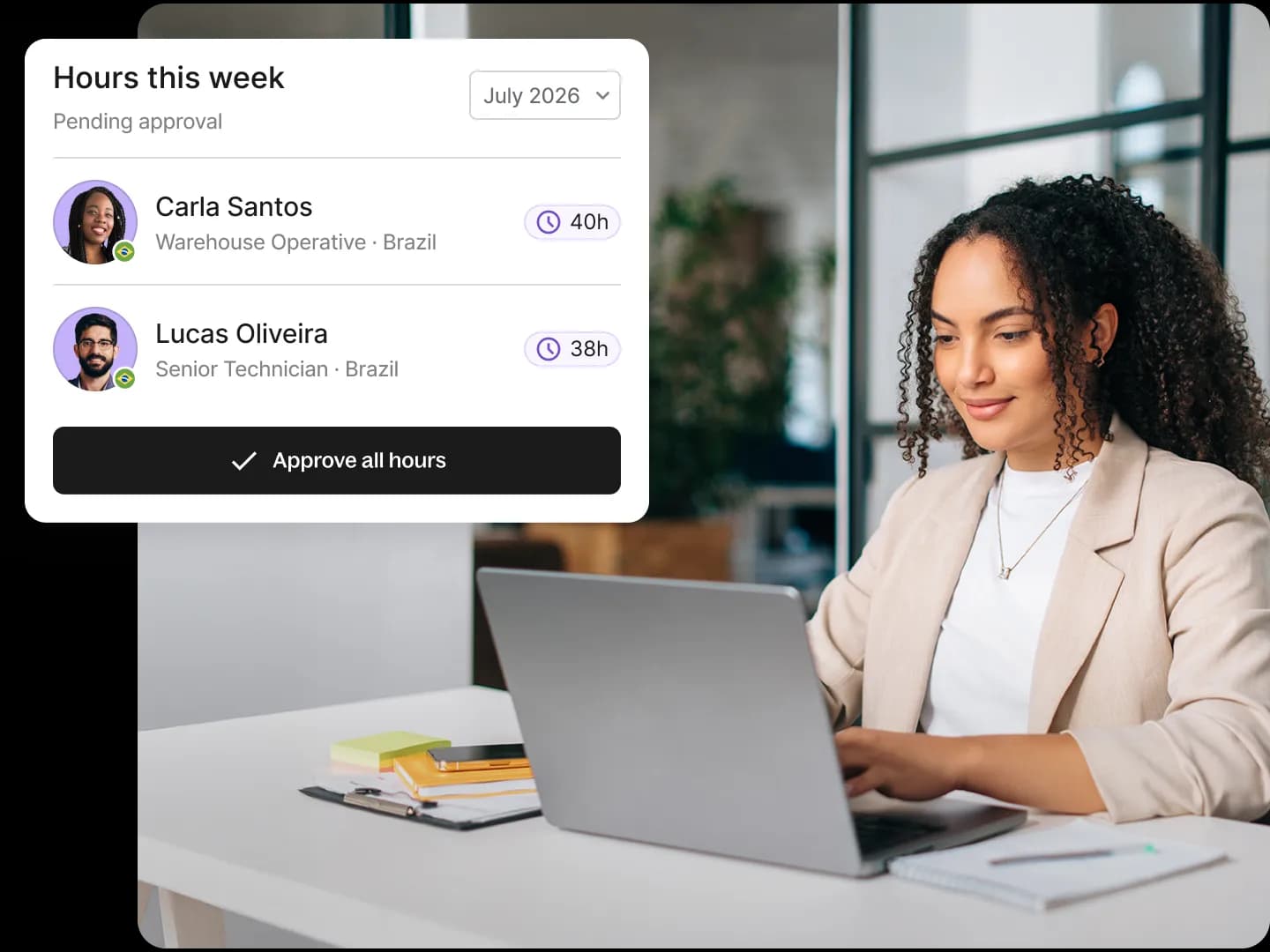
Time tracked. Payroll trusted. Nothing to reconcile.
A hospitality scenario: multi-property hotel chain
A mid-size hotel brand operates properties across three countries: two in the United States (California and New York), two in the United Kingdom, and two in Australia. Each property has 40–60 on-site staff (front desk, housekeeping, restaurant, bar).
Currently, each property manages its own time tracking via punch clocks and local payroll provider. Payroll processing takes three to seven days per property because hours must be manually pulled from punch clocks, entered into the local payroll system, and then reconciled with each country's tax and compliance requirements.
Different properties apply wage rules inconsistently.The US properties manage overtime, the UK properties must comply with Working Time Regulations, the Australian operations track award-based compensation.
Without centralized oversight, the company has no visibility into labor costs or compliance status across all properties.
Before Deel
Each property's punch-clock data had to be manually exported and imported into separate payroll systems (one for the US, one for the UK, one for Australia). Payroll was run separately per property with no centralized oversight. Hours reconciliation was manual.
During audits, the brand had to match punch records against payroll records in each country, dealing with different languages, different compliance calendars, and different record-keeping requirements.
Compliance gaps went undetected until audit time.
After Deel
Time tracking is centralized across all six properties. Staff clock in via the Deel app with geofencing verification. Hours flow directly into payroll without manual import. The US properties' state-specific wage rules are configured in the system.
For UK and Australian operations, Deel's payroll team works with you to map jurisdiction requirements while time tracking provides the verified hour records needed for accurate payroll calculation in each region.
Payroll processing time drops from three to seven days per property to one to two days across all properties.
Result
Manual data entry is eliminated, reducing transcription errors and payroll processing delays. Centralized time tracking gives global managers visibility into labor costs and compliance status across all properties and countries.
Payroll processing is faster and more consistent. When audits occur, the company has complete, location-verified records of hours worked per property in each jurisdiction, making audit defense straightforward.
Getting started with Deel Time Tracking for global hospitality operations
Rolling out time tracking across multiple properties means configuring state-specific wage rules, setting up geofencing, and training staff. Deel works with hospitality operators to:
Configure wage rules for each jurisduction where you operate
Map time tracking rules to your local payroll provider's requirements
Set up geofencing at each property
Train managers and staff on clocking in via the mobile app
Configure weekly or rotating schedules per property
Run parallel payroll during the first month to verify accuracy
Integrate payroll with your accounting system for labor cost visibility by property
Ready to simplify time tracking for your hospitality properties? Learn more about Deel's Time Tracking or book a demo below.
Deel Hire
Find, hire, and manage anyone, anywhere

More resources
FAQs
How does time tracking integrate with payroll for hospitality?
Hours clocked in Deel automatically flow into payroll calculations. State-specific wage rules are applied per property during payroll processing. This eliminates manual data entry and reduces payroll processing time regardless of whether your payroll operations are centralized globally or managed through local jurisdictions.
Can we track staff across multiple properties and countries?
Yes. Time tracking is location-aware. You can configure geofencing per property and track hours separately by location. Each property's jurisdiction-specific wage rules are applied automatically during payroll.
How do we handle compensation variations across jurisdictions?
Deel time tracking captures hours worked. Any jurisdiction-specific compensation (tips in some markets, service charges, allowances, penalty rates, or award wages in others) can be configured in your payroll system. You configure how each compensation type is calculated and reported for each jurisdiction.
How does the system handle split shifts?
Employees clock in and out multiple times per day. Each clock-in and clock-out is recorded separately with exact times, so split-shift hours are captured individually and added together during payroll processing.
Can we configure different wage rules for different properties?
For Deel Payroll, yes—currently for US states. You configure wage rules for each US state where you operate, and those rules apply when payroll processes. Jurisdiction-specific rule configuration for additional countries is coming soon. When available, your property's rules will apply during payroll processing. Configuration options may vary depending on your employment type.
How does geofencing work?
When employees clock in via the Deel mobile app, geofencing verifies they're physically on site. This creates a location-verified record at the moment of clock-in and clock-out. Geofencing works on mobile only (not web or desktop).
Can we track hours by department or position?
Time Tracking captures hours worked. If you need to track hours by department or position, you can configure that in your schedule setup or payroll settings.
How do we integrate with different payroll systems across countries?
Deel's Time Tracking feeds into Deel Payroll for countries where Deel operates. For jurisdictions outside current scope, your Deel team can discuss how verified time records integrate with local payroll providers and your existing compliance workflows.
What about seasonal or temporary staff?
Seasonal workers are added to the same time-tracking system as permanent staff. They follow the same clocking-in process, and the same state-specific wage rules apply.
How long does implementation take?
Implementation timelines vary depending on the number of properties, countries, and employment types. Your Deel team will work with you to configure jurisdiction-specific wage rules, set up geofencing, train managers and staff, integrate with your payroll systems, and run parallel payroll for verification.
What records does Deel maintain?
Deel maintains a complete record of all clock-in times, clock-out times, and hours worked for each employee at each property. This creates an audit trail that supports compliance with local record-keeping requirements in each jurisdiction.
How does this help with compliance and audits?
With centralized time records linked to payroll, you can pull documentation showing hours worked, rules applied, and how pay was calculated for any employee in any location during any time period. This supports audit defense and demonstrates compliance with local labor laws in each jurisdiction where you operate.
Jemima is a nomadic writer, journalist, and digital marketer with a decade of experience crafting compelling B2B content for a global audience. She is a strong advocate for equal opportunities and is dedicated to shaping the future of work. At Deel, she specializes in thought-leadership content covering global mobility, cross-border compliance, and workplace culture topics.