Article
19 min read
Why Global IT Breaks at Scale (And Why More Vendors Make It Worse)
IT & device management

Author
Dr Kristine Lennie
Last Update
May 05, 2026

Table of Contents
Reason #1: IT ops were built for one region and never redesigned to actually serve many
Reason #2: Every new vendor adds a new gap in the lifecycle
Reason #3: Identity and access management doesn't keep pace with org changes
Reason #4: Security and compliance operate in silos across the fleet
Reason #5: Onboarding and offboarding depend on manual coordination between HR and IT
Reason #6: IT support doesn't scale with the workforce it's supporting
Reason #7: The device refresh cycle is invisible until it becomes a crisis
The real cost of fragmented global IT
Unify your global IT to operate at scale with Deel IT
Key takeaway
Most IT stacks aren't built to scale. What holds together at 50 people actively breaks at 500, producing security gaps, compliance exposure, and an IT team that spends more time coordinating vendors than supporting the business.
Fixing fragmented global IT means replacing disconnected vendor handoffs with unified device enrollment, centralized access provisioning, and automated offboarding that works consistently across every region, not just headquarters.
Deel IT helps global companies eliminate the coordination overhead of multi-vendor IT by centralizing device management, access provisioning, and compliance workflows into a single platform, so IT teams can scale headcount across regions without scaling the number of tools they have to manage.
At 50 people, a handful of vendors, and a shared spreadsheet can hold your IT operations together. At 500, that same approach produces outages, security gaps, and an IT team spending more time coordinating tools than supporting the business. The underlying problem is simple: this type of stack wasn’t built to scale.
Many organizations naturally try to solve this by adding vendors. But every new vendor adds a new seam where things go wrong. Here are the top reasons why global IT fails at scale, and what it takes to fix them (it’s not more vendors!).
Reason #1: IT ops were built for one region and never redesigned to actually serve many
Most company IT stacks weren't designed for global distribution; they were built for a single headquarters and then stretched as the company expanded. Regional offices, international hires, and acquired entities were added on top of an architecture that was never intended to support them.
This typically results in the following operational gaps:
Procurement becomes a regional patchwork: Devices are sourced through local resellers in each country that the company operates in, with no standardized configuration, no consistent lead time, and no centralized record of what was shipped or to whom
Policy enforcement is inconsistent by geography: Endpoint management policies enforced centrally for employees in the home country might not be applied to employees in newer or smaller markets, creating uneven security and compliance across the fleet
Local compliance requirements aren't factored in: Data residency rules, device import regulations, and local labor-linked IT obligations vary by country, and a stack built for one jurisdiction might not account for them
Acquisitions layer in incompatible systems: M&A activity at enterprise scale routinely introduces legacy tools, separate identity providers, and parallel device fleets that might never be fully integrated
The result: IT operations fragment along geographic lines, creating a two-tier experience where employees in the home country receive reliable service and employees elsewhere navigate a patchwork of tools, delays, and gaps.
The solution: Global IT requires a purpose-built architecture, one that handles procurement, policy enforcement, support, and compliance as unified functions across every country, not as regional exceptions bolted onto a home-market system.
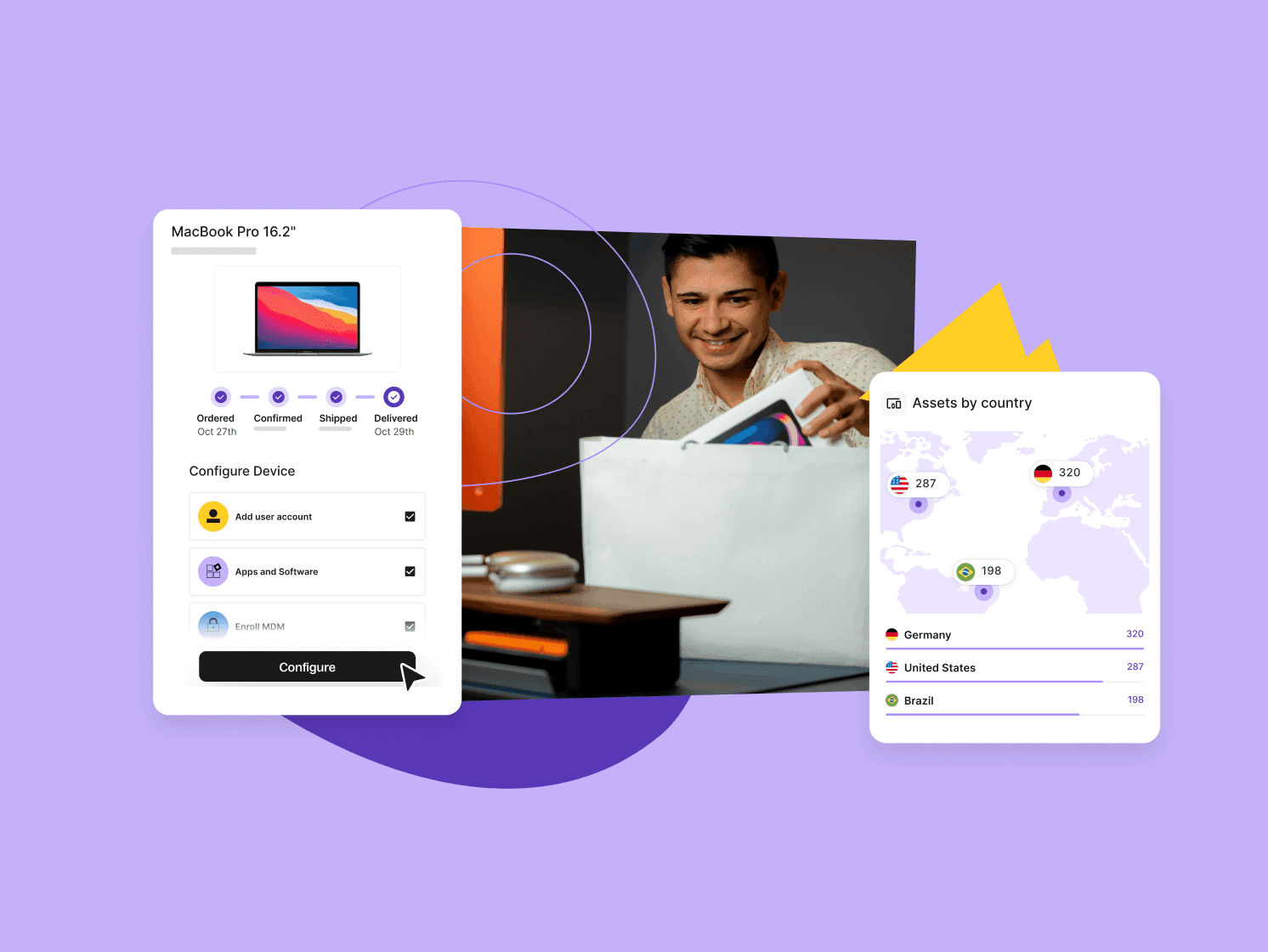
How Deel IT helps: Deel IT was built global by default: device procurement, mobile device management (MDM) enrollment, access provisioning, and 24/7 support operate consistently across 130+ countries from a single platform, with no regional resellers and no dead zones in coverage.
Guide
The World at Work in 2026: Deel IT
Reason #2: Every new vendor adds a new gap in the lifecycle
Adding a vendor to solve a specific IT problem feels like a targeted fix. However, each additional tool typically covers one slice of the lifecycle, and the gaps between tools are where security failures, onboarding delays, and compliance exposures live.
Here are the most common resulting breakdowns:
Lifecycle seams create windows of vulnerability: When device provisioning, MDM, and access are handled by separate tools, gaps between actions can leave devices unsecured or users over- or under-provisioned, creating exposure to unauthorized access and data risk
No system owns the full lifecycle record: If there is no single source of truth, reconciling systems and records during an audit or incident investigation requires manual effort across multiple platforms and increases the chance of errors
Offboarding breaks at every seam: If device recovery, access revocation, and license reclamation span multiple tools with no shared trigger, steps can be missed, leaving active accounts, unrecovered devices, and ongoing security risk
Integration maintenance becomes a second job: API connections between point tools require ongoing maintenance, and when one vendor updates their platform, downstream integrations can break, with your IT teams absorbing the cost of rebuilding
Vendor sprawl compounds at scale: Enterprise organizations can easily reach 12–18 tools, each with its own contract cycle, renewal window, and support escalation path, increasing operational overhead, fragmenting ownership, and adding unnecessary complexity
The result: Instead of creating leverage, the stack becomes increasingly fragmented as the company grows. Each new tool introduces additional coordination overhead, more points of failure, and less visibility across the lifecycle, turning scale into a source of operational risk rather than efficiency.
The solution: Reducing the number of lifecycle seams means consolidating functions: device, identity, SaaS management, and support, into platforms where data flows without manual handoffs and ownership is unambiguous.
How Deel IT helps: Deel IT eliminates the gaps between point tools by running device lifecycle, MDM, access management, application management, and 24/7 support from a single platform.
See also: What Happens When Access Is Not Revoked on Time
Reason #3: Identity and access management doesn't keep pace with org changes
At enterprise scale, the workforce is never static. People are hired, promoted, transferred, and departed continuously, often across multiple entities and regions simultaneously. When access creep/privilege creep isn't managed in real time, the result isn't just inefficiency. It's a security posture that degrades with every role change that isn't fully reflected in the access layer.
Here is what this leads to:
Provisioning a new hire is manual and reactive: Access requests are submitted, reviewed, and fulfilled by IT after the hire event, meaning new employees routinely spend their first days waiting for access to the tools they need to do their job
Role changes don't trigger access updates: When an employee moves from one team or region to another, their previous access permissions are rarely removed, and new ones are rarely scoped precisely, accumulating permissions that no longer reflect their current responsibilities but do increase risk exposure
Deprovisioning is incomplete at exit: Without automated revocation tied to the HR departure event, offboarding leaves active credentials in Single Sign-On (SSO) systems, SaaS applications, and cloud environments, sometimes for days, sometimes indefinitely
Multi-Factor Authentication (MFA) enforcement is inconsistent across the fleet: In large enterprises with mixed device fleets and multiple identity providers, MFA is often enforced in some environments and absent in others, creating exploitable inconsistency
Access reviews are point-in-time, not continuous: Annual or quarterly access reviews capture a snapshot but miss the drift that accumulates between cycles, particularly in organizations with high headcount and frequent internal mobility
The result: The enterprise access layer becomes a lagging record of who should have access rather than a live reflection of who actually does, and the gap between those two things is where breaches occur.
The solution: IAM at enterprise scale requires direct integration with the HR system of record, so that hire, role change, and departure events automatically trigger precise access actions across all connected applications and devices.
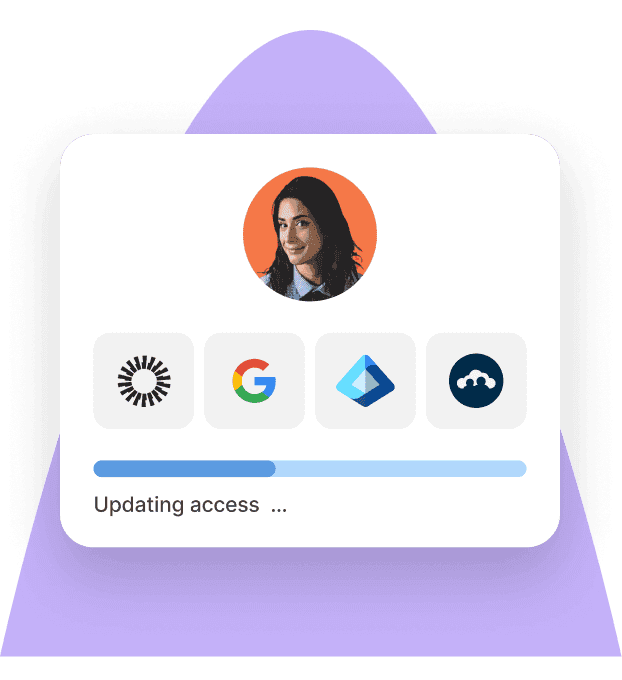
How Deel IT helps: Deel IT ties Role-Based Access Control (RBAC) directly to HRIS events: access is provisioned, updated on role change, and revoked automatically the moment an employee leaves, with SSO and MFA enforced centrally across all applications and regions.
Find out more about how Deel IT simplifies identity and access management for global teams.
Identity Access Management
Seamlessly provision device and app access for global teams
Reason #4: Security and compliance operate in silos across the fleet
Enterprise security isn't a single function: it spans endpoint configuration, access control, application permissions, and audit documentation simultaneously. When each of those functions is owned by a different tool or team, the organization can be compliant on paper in one area while exposed in another.
The resulting breakdowns typically look like the following:
Endpoint policy enforcement varies by region: Encryption standards, OS patching cadences, and security configurations that are enforced for employees in one country may be applied inconsistently for employees in newer markets or acquired entities
Compliance documentation is assembled manually: Producing audit-ready documentation requires manual extraction and reconciliation across platforms, a process that is slow, error-prone, and unscalable
Security tooling doesn't reflect the full device fleet: Devices managed through regional resellers or procured outside the central IT process can fall outside MDM coverage, creating blind spots that don't appear in security dashboards until an incident surfaces them
Incident response has no single starting point: When a security event occurs (a lost device, a credential compromise, a suspicious access pattern), response requires pulling data from multiple disconnected systems before any remediation action can be taken
Compliance frameworks are treated as separate workstreams: Organizations with obligations under SOC 2, ISO 27001, and regional data protection regulations frequently manage these as parallel workstreams, duplicating effort and creating inconsistency in the underlying controls
The result: Security posture becomes a function of which region a device is in and which tool happened to cover it, not a consistent, auditable state enforced uniformly across the enterprise.
The solution: Enterprise security requires a unified control plane—one system that enforces endpoint policy, monitors compliance status, and generates audit documentation across every device, every application, and every region without requiring manual reconciliation.
How Deel IT helps: Deel IT’s endpoint protection and MDM modules enforce encryption, OS policies, and security configurations continuously across the global fleet, with real-time compliance visibility and support for audit readiness.
See also: Complete IT Security and Compliance Checklist for Remote Workers
Reason #5: Onboarding and offboarding depend on manual coordination between HR and IT
At 50 employees, HR sends IT a Slack message when someone is hired. At 500, that process needs to be a workflow. At 5,000, it needs to be automated and auditable across every region and entity. If this isn’t the case, the result is a fragmented, manual operating model.
Here is what that means:
HR and IT operate from separate systems of record: Without direct integration, coordination relies on manual handoffs that are easy to miss at scale, and can result in delayed provisioning, missed offboarding steps, and security gaps
Device lead times aren't built into the onboarding timeline: When procurement isn't triggered automatically by a confirmed hire event, devices are ordered late, and new employees start without equipment, particularly in countries where shipping lead times are longer
Access provisioning happens reactively, not at hire: IT receives a new hire notification and begins provisioning manually, meaning the employee's first day is spent waiting, not working, while IT catches up to a hire that HR confirmed weeks earlier
Offboarding steps are completed in the wrong sequence: Without a coordinated workflow, IT and HR each complete their checklist independently, and critical steps like access revocation or device wipe are delayed because neither team knows what the other has already done
Lifecycle events across multiple entities aren't standardized: In enterprise organizations with multiple legal entities or regional subsidiaries, onboarding and offboarding processes differ by location, creating inconsistent security outcomes and compliance gaps
The result: Every hire, transfer, and departure becomes a manual coordination exercise across systems that were never designed to work together. As volume increases, delays compound, steps are missed, and inconsistencies become systemic, turning routine lifecycle events into recurring operational and security risks.
The solution: HR events (hire confirmation, role change, departure) need to automatically trigger coordinated IT actions across devices, access, and applications, with real-time visibility for all parties and no dependency on manual communication.
How Deel IT helps: Deel IT integrates directly with your HRIS, so hire, transfer, and exit events automatically trigger device provisioning, access grants, and full deprovisioning without a single manual handoff.
Download: Strategic IT Onboarding and Offboarding Guide and Guide to HR-IT Communication for Employee Lifecycle Execution
Reason #6: IT support doesn't scale with the workforce it's supporting
IT support at enterprise scale isn't just a volume problem; it's a distribution problem. As the workforce expands across regions and time zones, the gap between where employees work and where IT support is staffed widens. The result is that employees in non-headquarters time zones wait longer, escalate more, and lose more productive hours. Over time, this becomes a retention and engagement issue, not just a ticket volume problem.
The result is a support model that breaks down in the following ways:
Support coverage is time-zone-constrained: A helpdesk staffed for business hours in one geography leaves employees in other regions without live support during their working hours, increasing resolution times and eroding employee experience
Tickets are siloed from the systems they reference: When the helpdesk tool is separate from the device management platform and the identity system, support agents don't have the full context needed to resolve issues quickly, and every ticket requires cross-tool investigation before action can be taken
Escalation paths differ by region: Employees in smaller or newer markets often lack a clear escalation path for device failures or access issues, and resolution depends on who responds to an email rather than a defined SLA
Support load grows faster than headcount: As the employee base scales, IT support volume grows proportionally, but hiring support staff to match is expensive and doesn't solve the underlying structural inefficiency of disconnected systems
No unified reporting across regions: Without centralized ticketing and reporting, IT leadership has no clear view of support performance across the global fleet, making it impossible to identify systemic issues or measure resolution quality consistently
The result: Support quality becomes inconsistent across regions, high-value IT staff spend time on resolvable issues instead of strategic work, and employees in distributed locations develop workarounds that create new security gaps.
The solution: Enterprise IT support requires a globally staffed, always-on helpdesk that is natively integrated with the device and access layer, so support agents can act on issues in real time without switching platforms or waiting for cross-tool context.
How Deel IT helps: Deel IT provides 24/7 global IT support embedded directly in the same platform, managing devices, access, and applications, with centralized ticketing and availability across every region and time zone.
Read about the benefits of 24/7 IT support.
Reason #7: The device refresh cycle is invisible until it becomes a crisis
Enterprise device fleets age at different rates across regions, device classes, and employee cohorts. But without centralized lifecycle tracking, there is no proactive signal: IT discovers aging or failing hardware when employees report problems, not before. At enterprise scale, that reactive posture is expensive.
This means:
Fleet age is tracked in spreadsheets, if at all: Without a centralized device record, IT teams rely on manually maintained asset registers that quickly fall out of sync with what's actually deployed, particularly after acquisitions or periods of rapid hiring
Device refresh cycles are applied uniformly rather than by usage: Devices are replaced on a fixed annual or biennial schedule regardless of actual utilization or condition, resulting in unnecessary spend on low-use devices and delayed replacement for high-use ones
End-of-life devices stay in active use: Devices that have exceeded their refresh window continue to operate in the fleet because there is no automated flag, increasing the risk of hardware failure, OS incompatibility, and security vulnerability from unsupported configurations
Recovery at offboarding is inconsistent globally: In distributed enterprises, device recovery at exit depends on local logistics, and in regions without a clear recovery workflow, devices go unaccounted for, carrying data that was never wiped
Certified data erasure is not consistently documented: Without a central record of erasure events, organizations cannot demonstrate compliance with data protection obligations during audits, a gap that is especially acute in enterprises subject to GDPR or regional equivalents
The result: The device fleet becomes a blind spot in the organization’s infrastructure. Aging hardware remains in active use, devices are lost or unrecovered at offboarding, and compliance records are incomplete, creating compounding operational cost, security exposure, and audit risk at scale.
The solution: Device lifecycle management at enterprise scale requires a centralized system that tracks every device from procurement through recovery, flags refresh needs proactively, and generates erasure documentation automatically at offboarding.
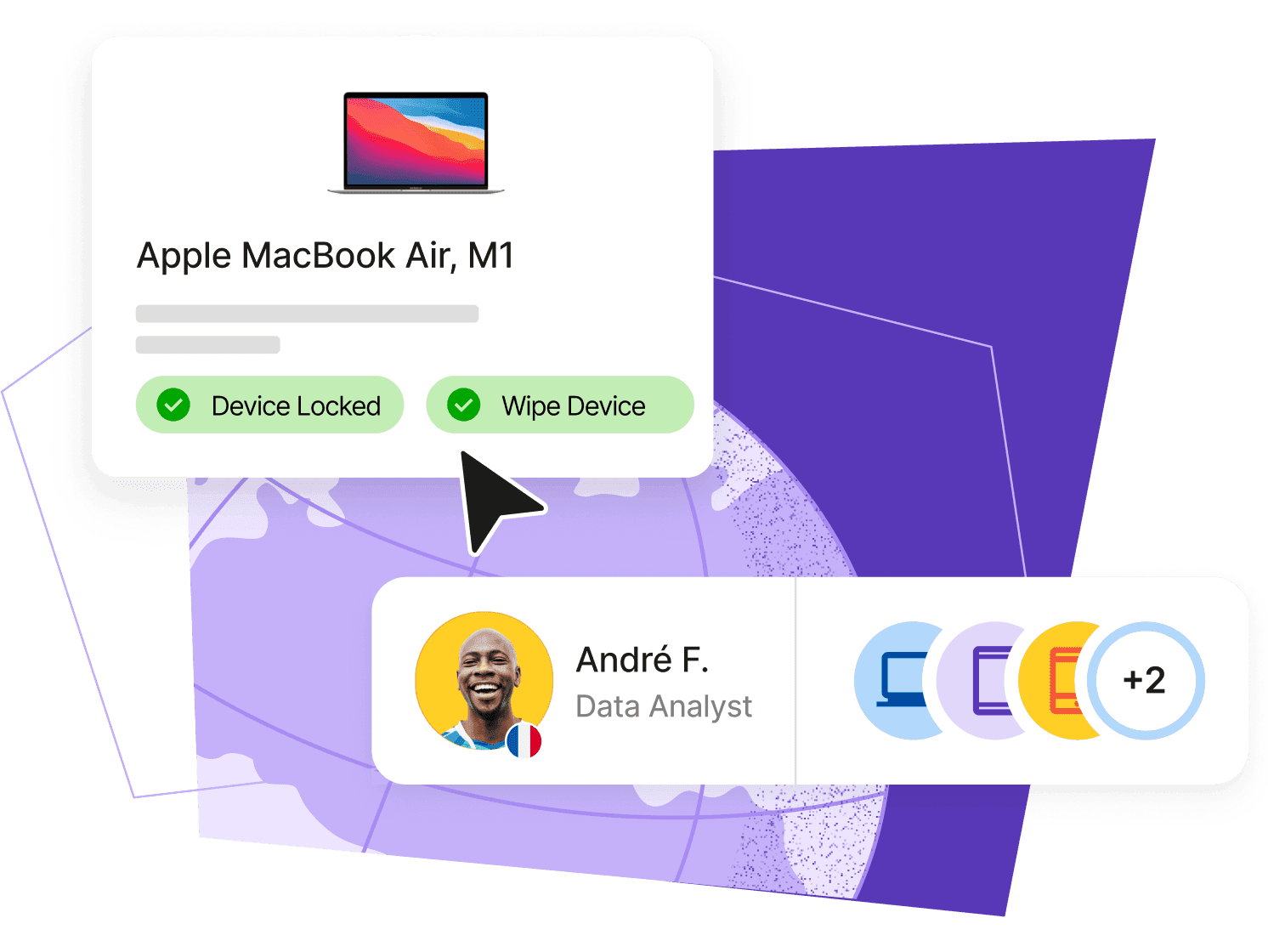
How Deel IT helps: Deel IT tracks every asset across 130+ countries in real time, with automated device health tracking and end-of-life handling, coordinating recovery at offboarding, and remote lock and data wipe.
See also: How to Create a Fair Laptop Refresh Policy
The real cost of fragmented global IT
Enterprise IT fragmentation is a structural liability that quickly compounds across every region, headcount milestone, and audit cycle. At the SMB scale, a misaligned tool or a manual handoff might cost a few hours. At enterprise scale, the same gaps cost hundreds of thousands in lost productivity, security exposure, and compliance risk across dozens of countries.
Here is why:
Onboarding delays multiplied across regions: A single delayed device or missing access credential costs one employee a productive first week, multiplied across 1,000+ onboarding events per year, that becomes a measurable business cost
Security incidents without a single source of truth: When device state, access records, and application permissions live in separate systems, there is no unified view, and no reliable way to respond when something goes wrong
Compliance exposure across multiple frameworks: Enterprise organizations operating across regions typically carry obligations under SOC 2, ISO 27001, GDPR, and local data protection laws simultaneously
IT headcount growing to manage tools, not outcomes: When the stack is fragmented, IT teams hire to manage vendor relationships and reconcile data, not to deliver better employee experiences or improve security posture
One invoice becoming dozens: The financial overhead of managing 8–15 separate vendor contracts, renewal cycles, and cost centers is rarely visible until someone does the math
Unify your global IT to operate at scale with Deel IT
Every tool you add to close a gap opens a new one. At enterprise scale, the vendor count stops being a measure of IT capability and starts being a measure of the coordination overhead your team is absorbing. The organizations that scale global IT successfully don't add tools; they consolidate the lifecycle into systems that operate without manual handoffs.
Deel IT is built specifically for global scale, bringing devices, access, security, and support into a single system that operates consistently across regions and the entire employee lifecycle.
Here's what Deel IT replaces across the enterprise IT stack:
Global device catalog and procurement across 130+ countries: Choose from 240+ devices and accessories, with pre-configured hardware shipped directly to employees worldwide, with customs, duties, and local logistics fully managed
MDM enrollment at provisioning: Encryption, OS configuration, and security baselines are applied to all devices before they reach the employee
Lifecycle-aware identity and access management: Role-based access is provisioned on hire, updated on role change, and revoked when an employment record closes — with SSO and MFA applied across integrated applications
End-to-end HR–IT lifecycle automation: Hire, transfer, and departure events in your HRIS trigger coordinated device and access workflows automatically, reducing manual handoffs between HR and IT
Centralized SaaS and license management: Applications are assigned, tracked, and reclaimed from a single system, with visibility into usage to help reduce unnecessary license spend
Unified endpoint visibility and compliance monitoring: Real-time insight into device status, continuous policy enforcement, and audit-ready reporting across your global fleet
24/7 global IT support built into the platform: Always-on support across time zones, with agents able to view device and access context in a single system to resolve issues more efficiently
Certified device recovery and data erasure at offboarding: Structured recovery workflows with certified erasure and documentation to support compliance requirements
Enterprise IT doesn't break because the team isn't capable. It breaks because the architecture was never designed to hold together at scale. Deel IT gives you the architecture.
Deel IT
Automate IT operations in 130+ countries
FAQs
What are the signs that your IT infrastructure isn't built to scale?
Common indicators include IT teams spending more time coordinating between vendors than resolving employee issues, inconsistent device enrollment across regions, and manual offboarding processes that leave access gaps. Security incidents and compliance failures often increase as headcount grows because the underlying systems were designed for smaller, centralized teams.
Why does adding more IT vendors make scaling harder, not easier?
Each additional vendor introduces a separate handoff point, contract, and workflow that someone on your IT team has to manage. As headcount grows, the coordination overhead compounds, meaning IT staff capacity gets absorbed by vendor management rather than strategic work or employee support.
What does fragmented global IT actually cost a company?
The costs show up in a few places: slower onboarding that delays productivity for new hires, security exposure from inconsistent access controls or delayed offboarding, and compliance risk when device and access policies aren't enforced uniformly across regions. There's also a less visible cost in IT team burnout from repetitive manual coordination.
What does unified IT management look like at scale?
A unified approach means device enrollment, access provisioning, and offboarding run through a single system with consistent policies regardless of where an employee is located. Instead of IT teams manually coordinating across vendors for each new hire or departure, those workflows are automated and centrally tracked, reducing both errors and the time to complete them.
Dr Kristine Lennie holds a PhD in Mathematical Biology and loves learning, research and content creation. She had written academic, creative and industry-related content and enjoys exploring new topics and ideas. She is passionate about helping create a truly global workforce, where employers and employees are not limited by borders to achieve success.