
Global Work Glossary
- Results for ""
Table of Contents
What is expression anomaly detection?
How expression anomaly detection works
How expression anomaly detection is used in hiring and onboarding
Warning signs that expression anomaly detection flags
Expression anomaly detection vs. related fraud detection tools
Key facts
Detect deepfakes and hiring fraud with Deel Security
FAQ
What is expression anomaly detection?
What is expression anomaly detection?
Expression anomaly detection is a technique that analyzes facial movements in video to identify patterns that fall outside the range of normal human expression. Organizations use it to flag possible deepfakes, spoofed recordings, or candidate impersonation fraud during remote interviews and onboarding identity checks.
How expression anomaly detection works
When someone appears on video, their face produces a continuous stream of signals: blinking rate, lip movement, micro-expressions, and the timing between them. Expression anomaly detection models compare these signals against expected human behavior and raise a flag when the patterns differ significantly from what a live, uncoached person would produce.
Computer vision models break a video stream into individual frames and track facial landmarks to measure how expression elements change over time. Anomalies might include an irregular blinking rate, lip movements that don't match the audio, or micro-expressions that are absent or mechanically repeated.
The technique doesn't replace a human reviewer: it generates a risk signal that security or human resources (HR) teams use to decide whether they need additional verification. No single indicator is conclusive on its own, so systems combine multiple signals to calculate a risk score.
How expression anomaly detection is used in hiring and onboarding
Remote video interviews are a common target for deepfake attempts and impersonation. Organizations apply expression anomaly detection to live or recorded video sessions to identify candidates who may not be who they claim to be.
When a flag appears, security or HR teams typically request an additional verification step, such as a liveness detection check or a live call with a person who can observe the candidate directly. Post-hire, organizations can apply the same signals during onboarding identity checks and periodic re-verification for high-risk roles.
Warning signs that expression anomaly detection flags
Expression anomaly detection looks for several specific patterns in a video session:
Blinking that is unusually infrequent, perfectly regular, or absent
Lip movements that don't align with the spoken audio
Micro-expressions that appear in an unnaturally short window or not at all
Facial muscle movement that is limited or inconsistent across the session
Sudden changes in skin texture or lighting at the face boundary, which may indicate a rendered overlay
Poor connection quality or video compression could produce similar patterns, so systems weigh these signals alongside other fraud indicators before flagging a session.
Expression anomaly detection vs. related fraud detection tools
Expression anomaly detection is one of several video fraud detection techniques. Each focuses on a different aspect of the same problem:
Frame-by-frame analysis: the broader analytical method that breaks video into individual images for inspection. Expression anomaly detection uses this method to track how facial behavior changes between frames.
Liveness detection: confirms a person is physically present rather than a photo or replay. It may not catch a live deepfake rendering that expression anomaly detection could flag.
Deepfake detection: identifies artificial intelligence (AI)-generated video content. Expression anomaly detection contributes to this but covers a narrower set of behavioral signals.
Video spoofing: the broader category of presenting a fraudulent video stream. Expression anomaly detection addresses one class of spoofing attempts.
Proxy interview detection: identifies when a different person answers on behalf of a candidate. It uses expression and behavioral signals alongside other checks, so the two techniques overlap.
Key facts
Here are some key facts about how expression anomaly detection works, the risks it addresses, and how organizations use it.
Expression anomaly detection examines facial behavior over time, not just a single frame.
It is one layer in a broader fraud detection stack alongside biometric verification and document checks.
Human analysts review flags from the system before taking any action against a candidate or worker.
Poor video quality, compression artifacts, or slow network connections could produce signals that resemble anomalies, so context matters.
Organizations apply it at the interview stage and at onboarding identity verification checkpoints.
Detect deepfakes and hiring fraud with Deel Security
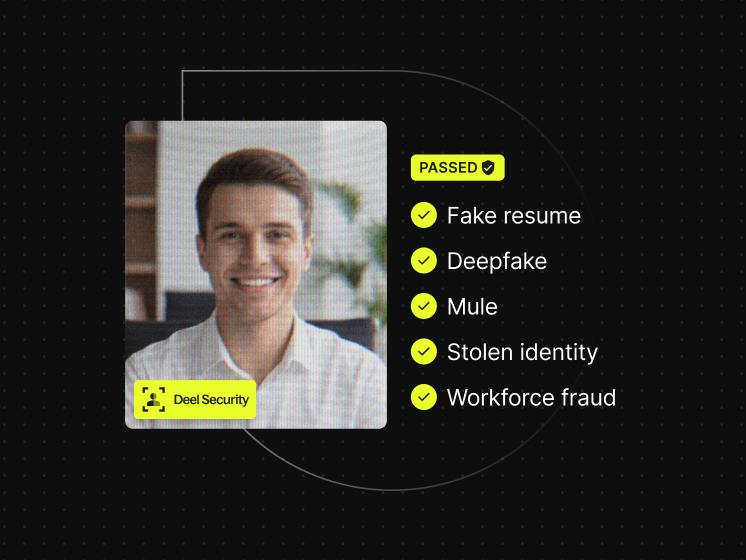
Unusual facial expressions or movements can be signs of deepfake manipulation during video interviews. Deel Security helps businesses detect deepfakes, candidate impersonation, and fake identities throughout hiring, onboarding, and ongoing employment.
Deel Security examines audio and visual signals during interviews to flag potential deepfakes and impersonation attempts. Deel's fraud experts review every high-risk alert, providing hiring teams with clear findings to support their decisions. Integration with your existing applicant tracking system (ATS) keeps identity fraud detection within your recruitment workflows.
Book a demo to see how Deel Security helps protect your hiring process from deepfakes and identity fraud.
Deel Security
Hire real people, keep fraud out from hiring to offboarding
FAQ
What signals does expression anomaly detection look for?
It looks for facial patterns that differ from normal human behavior in video, including irregular blinking, lip movements that don't match the audio, and micro-expressions that are absent or mechanically repeated. Systems combine these signals into a risk score rather than using any single one individually.
Can expression anomaly detection produce false positives?
Yes. Poor video quality, low bandwidth, or compression artifacts could generate signals that resemble genuine anomalies. Reviewers check flags against other fraud indicators before drawing any conclusion.
How does expression anomaly detection differ from liveness detection?
Expression anomaly detection goes deeper than liveness detection. Liveness detection confirms a live person is on camera, but it doesn't check whether that person's movements follow natural human patterns. Expression anomaly detection fills that gap, which means it can flag a real-time deepfake render that passed the liveness step.
Where in the hiring process is expression anomaly detection applied?
Organizations most commonly apply it during remote video interviews and during the identity verification steps at onboarding. Those that run ongoing monitoring for high-risk roles may apply it beyond the initial hire.
This entry is for informational purposes only and is not a substitute for legal or technical advice from qualified advisers.