
Article
10 min read
ATS vs CRM: What's the Difference for Recruiting Teams?
Global HR

Author
Ellie Merryweather
Last Update
March 31, 2026

Table of Contents
ATS vs. CRM in recruiting
How an ATS fits into the hiring process
What a recruiting CRM does for talent acquisition
How ATS and CRM think about candidates differently
Do you need an ATS, a CRM, or a broader talent strategy?
How an ATS and CRM work together in a modern recruiting tech stack
How to choose: ATS vs CRM evaluation checklist
Support the entire candidate journey with Deel’s ATS
Key takeaways
1. An applicant tracking system (ATS) manages the active hiring process from application to offer, while a recruiting candidate relationship management (CRM) platform is a space to nurture candidates and build talent pools.
2. An ATS and a recruiting CRM work best when connected: the CRM builds and warms pipeline, and the ATS takes over once a candidate is ready to apply.
3. When your ATS connects directly to your HRIS, candidate data flows automatically into employee records at the point of hire. This workflow gives HR, finance, and compliance teams access to the same data from day one.
Successful recruiting depends heavily on the processes and systems behind it, and ATS and CRM platforms are just two of the tools you might use to make great hires.
They're also two of the most commonly confused technologies, as both systems store candidate data and both touch your recruiting workflow. Software vendors also routinely use the same terms, such as "talent pipeline," "candidate database," or "engagement tools," to describe systems meant for fundamentally different jobs.
To clear up the confusion, this guide defines each platform with a side-by-side companion and a decision tree that will route you to the platform your recruiting team needs. Spoiler: You might need both.
ATS vs. CRM in recruiting
An applicant tracking system or ATS is a system of record for applications and hiring workflow, managing everything from the moment a candidate applies to the moment they're hired.
A candidate relationship management system or recruiting CRM is a platform that helps you build pools of top talent and nurture relationships with a pipeline of current or potential candidates.
Here’s how ATS vs. CRM platforms compare.
| ATS | CRM | |
|---|---|---|
| Best for | Structured hiring process management | Proactive sourcing and relationship management across your entire talent pool |
| Primary purpose | Manage applications and hiring workflow | Build talent pools and nurture candidate relationships |
| Primary users | Recruiters, hiring managers, TA ops | Sourcers, recruiters, employer brand teams |
| Starts when … | A candidate applies for a role | A candidate shows interest — at an event, through a referral, or via outreach |
| Core workflows | Job posting, application intake, screening, interview coordination, offers | Talent pool building, segmentation, outreach campaigns, re-engagement |
| Typical metrics | Time-to-fill, stage conversion, hiring velocity | Reply rate, talent pool growth, reactivation rate, event-to-interview conversion |
How an ATS fits into the hiring process
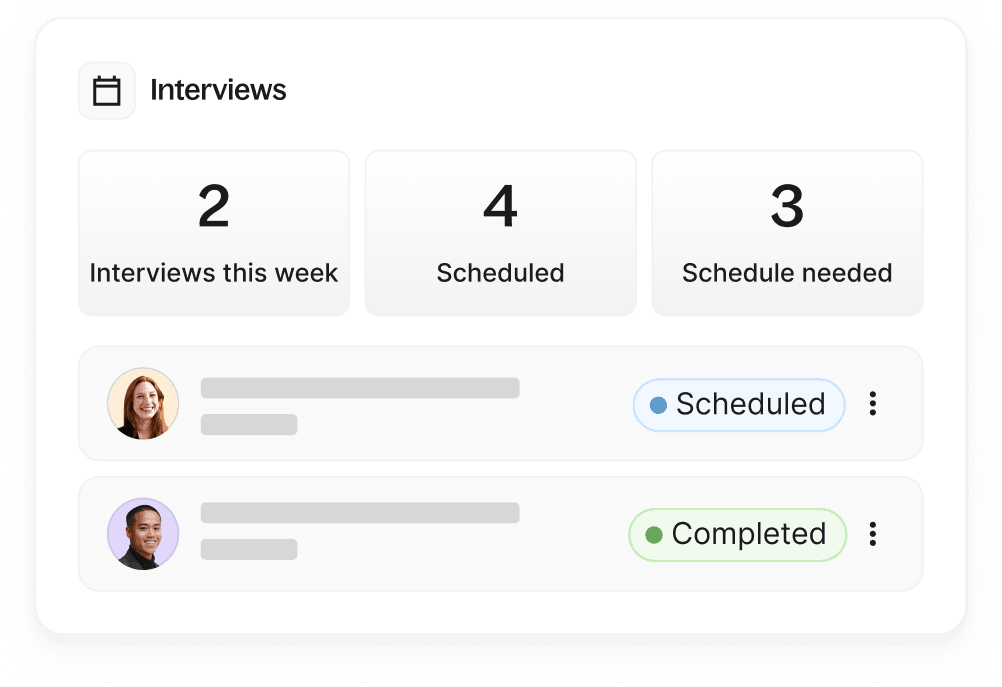
An ATS is the operational backbone of your hiring team, acting as a system that keeps your recruiters and your hiring managers working in the same direction in their quest to find exceptional candidates. Core workflows include:
- Requisitions and approvals: Before a job goes live, the right stakeholders sign off on headcount, job title, and compensation. The ATS creates a paper trail and keeps everything tied to a specific req.
- Job posting distribution: Instead of managing listings manually, your ATS pushes them to multiple channels at once, such as LinkedIn, Indeed, your careers page, and any niche boards.
- Application intake and parsing: The ATS captures every resume and restructures it as needed before attaching it to the right req for visibility.
- Screening and interview coordination: Recruiters filter applicants then move them through the various stages of the hiring funnel.
- Offers and onboarding: The ATS tracks candidate progress up until the point of making an offer. The right platform then hands over the new hire data directly to your onboarding system.
Deel HR
Where ATS data matters most
ATS data keeps your hiring process accountable and improvable, delivering:
- Compliance and auditability: You’ll store an auditable record of every hiring decision, which is critical in regulated industries or any organization that needs to demonstrate fair and consistent hiring practices.
- Funnel reporting: You’ll learn exactly where candidates drop off and how long roles sit in each stage to understand where the process slows down.
- Hiring manager visibility: You’ll gain real-time pipeline status without chasing recruiters for updates.
What a recruiting CRM does for talent acquisition
Where an ATS manages candidates who are actively engaged in your hiring process, a recruiting CRM encompasses everyone else. Its goal is staying connected to people who’ve previously applied or expressed interest in a role or have simply caught your attention during sourcing. Core workflows include:
- Talent pool building: You’ll capture leads from multiple sources, such as referrals, event signups, inbound interest, and outreach, then store them in a searchable, actionable database.
- Segmentation: You’ll organize your talent pool by skills, location, seniority, or interests, so you can reach the right people for the right roles without starting from scratch each time.
- Campaign outreach: You’ll run email sequences or share relevant content that keep candidates warm.
- Re-engagement for future roles: You can tap candidates who've already shown interest in your organization. The aim is to move passive talent closer to an application rather than rebuilding your pipeline from zero.
When a recruiting CRM creates the most value
A CRM leans into the human element of recruiting, focused heavily on treating candidates as people and building relationships with them.
- High-growth hiring when you’re scaling fast: You’ll have a head start on every role by keeping warm talent ready to activate.
- Hard-to-fill roles: You’ll cultivate relationships with hard-to-reach candidates over time to fill niche or senior positions.
- Evergreen pipelines: You can hire repeatedly for regular roles, including sales, support, nursing, and engineering, from a standing pool of pre-vetted, engaged talent.
- Employer brand and community recruiting: You might turn interest from talent communities and events into actual hires.
Complementary reading:
Find out why an integrated HRIS and ATS are essential for scaling recruitment
When a recruiting CRM creates the most value
A CRM leans into the human element of recruiting, focused heavily on treating candidates as people and building relationships with them.
- High-growth hiring when you’re scaling fast: You’ll have a head start on every role by keeping warm talent ready to activate.
- Hard-to-fill roles: You’ll cultivate relationships with hard-to-reach candidates over time to fill niche or senior positions.
- Evergreen pipelines: You can hire repeatedly for regular roles, including sales, support, nursing, and engineering, from a standing pool of pre-vetted, engaged talent.
- Employer brand and community recruiting: You might turn interest from talent communities and events into actual hires.
How ATS and CRM think about candidates differently
An ATS and a recruiting CRM reflect two different ways of viewing candidates. Here’s how each system supports your recruitment methods.
Pipeline stage: applicants vs prospects
- An ATS manages applicants who are in process for a specific req. You’re actively assessing them as they move through defined stages such as screening, interview, and offer, with structured feedback tied to that role.
- A recruiting CRM focuses on the full spectrum of potential employees, including prospects who haven’t applied yet through to silver medalists who reached final stages but weren’t selected. The right platform keeps those relationships active so you can engage (or re-engage) strong talent when the right role opens.
Data model: job-first vs relationship-first
- An ATS ties each candidate record to a specific role and stage. The profile exists within that hiring workflow, and every record update reflects movement toward a hiring decision for that role.
- A recruiting CRM ties each record to segments and past touchpoints. The profile sits independently of any single opening, so you can understand a candidate’s interests and history over time, not just how their status maps against one job.
Success metrics: efficiency vs engagement
ATS metrics focus on process efficiency:
- Time-to-fill: How long it takes to move from approved req to accepted offer
- Stage conversion: The percentage of candidates who progress from one hiring stage to the next
- Hiring velocity: The speed at which candidates move through the interview pipeline once in process
CRM metrics focus on engagement and pipeline strength:
- Reply rate: The proportion of prospects who respond to outreach or campaigns
- Talent pool growth: How your database of segmented prospects expands over time
- Reactivation rate: The percentage of previously engaged candidates who re-enter the process for a new role
- Event-to-interview conversion: How often event attendees or community members progress to a formal interview
Free guide
Interview Guide and Checklist for Hiring Managers
Do you need an ATS, a CRM, or a broader talent strategy?
HR.com’s Future of Recruitment Technologies report finds that 78% of organizations use an applicant tracking system, while only 21% use a candidate relationship management platform. But there’s also an argument for needing both types of technology. Use this decision tree to make sense of how each system could fit into your tech stack.
If you’re building a structured hiring operation, start with an ATS
An ATS is the operational foundation of any recruiting team, giving everyone from recruiters to hiring managers a shared system of record. It's the most widely adopted recruiting technology for good reason; it handles the full hiring lifecycle from job posting through to offer. You'll feel the impact immediately if:
- Most candidates apply directly to posted jobs
- Your hiring managers need structured workflows and clear reporting on open reqs
- You want auditability and consistency across every role you hire for
If you’re investing in proactive sourcing, a CRM can add value
A CRM becomes worth considering when relationship-building and pipeline nurturing are a significant part of your recruitment strategy. It's a layer some teams add on top of their core systems, and tends to add value when:
- Sourcing takes up a meaningful share of recruiter time
- You run events, communities, or referral programs at scale
- You want structured nurture campaigns tied to segmented talent pools
If you’re scaling your talent strategy, bring sourcing and hiring together
For teams expanding into new markets or relying on external agencies to fill specialist roles,
Talent is a dedicated sourcing layer built to work alongside Deel's ATS. From one central workspace, you’ll post job requisitions, connect with pre-vetted partners, and sign agency agreements, before hiring and onboarding the best talent. It keeps sourcing and hiring in one tightly connected workflow. This approach tends to suit teams where:
- You're hiring across multiple countries or unfamiliar talent markets
- You work with one or more external recruitment agencies
- You want sourcing, compliance, and hiring in a single workflow, with key insights into pipeline health and the overall candidate experience
How an ATS and CRM work together in a modern recruiting tech stack
An ATS and a recruiting CRM serve different purposes, but both depend on one thing: your ATS and your HRIS being properly connected. When candidate data flows automatically into employee records at the point of hire, downstream processes such as onboarding and payroll can start without delay. If you wish to layer a CRM on top of that foundation, here’s how it works.
Example of an integrated ATS and CRM from first touch to hire
- A candidate joins your talent network (CRM): Someone signs up at an event, responds to outreach, or joins your careers community. Their profile sits in the CRM, where you track interests and past conversations.
- You send targeted outreach and stay in touch (CRM): Your team sends role updates, event invites, or tailored messages based on the candidate’s background. Each of their replies or engagement is recorded in the CRM, building context over time.
- The candidate applies for an open role (ATS): When the timing is right, the candidate submits an application. Their profile now connects to a specific req in the ATS, where you can begin their evaluation.
- Hiring managers review and interview (ATS): Recruiters move the candidate through screening and interviews. Feedback, scorecards, and stage updates stay tied to that job.
- You continue nurturing silver medalists (CRM): If the candidate reaches the final stages but isn’t selected, their updated status flows back into the CRM. You can re-engage them later for a better-fit role without starting from zero.
Common integration challenges (and how to overcome them)
Even with both systems in place, issues can crop up if you don’t clearly define data and responsibilities for each.
Challenge 1: Duplicate profiles and conflicting sources of truth
Without strong matching rules, the same person can exist more than once across systems. One record may live in the CRM from an event, while another appears in the ATS when they apply. Recruiters then work with incomplete information or outdated notes.
Solution: Define which system holds the primary candidate profile and configure automated duplicate detection so records merge instead of multiply.
Challenge 2: Unclear ownership across teams
Sourcing teams often work in the CRM while recruiters focus on the ATS. But if no one owns the transition point between the two, follow-ups can stall and silver medalists never return to nurture campaigns.
Solution: Document who manages each stage of the journey and what happens when a profile moves from relationship-building to formal evaluation.
Challenge 3: Broken attribution from campaign to hire
If engagement data doesn’t transfer into the ATS, reporting loses context. A candidate who first responded to a targeted outreach may appear as a generic applicant source.
Solution: Make sure source data travels with the profile so you can connect hires back to the outreach or event that influenced them.
Connect hiring to employment with a powerful ATS and HRIS combination
If an ATS and CRM manage the journey to hire, an HRIS manages what happens after.
When your ATS integrates with your HRIS, or if they're part of the same platform, candidate data flows seamlessly into employee records at the point of hire. Personal details, role information, compensation, and start dates move across automatically, so HR teams gain immediate visibility into new starters. Finance and compliance teams can also work from the same structured data from day one.
For a deeper look at how ATS and HRIS systems integrate, read our detailed guide.
Deel's HRIS

How to choose: ATS vs CRM evaluation checklist
Once you know which platform you need, these questions will help you evaluate the right software partner for your team.
Data and integration
- What's the system of record for candidate profile data?
- How do you handle duplicate matching and merge rules?
- What data flows bidirectionally between ATS and CRM?
- How does your platform integrate with our existing HRIS?
- Can we attribute hires to specific campaigns or nurture journeys?
Reporting and analytics
- What recruiting metrics does the platform track out of the box?
- Can we build custom reports across both pipeline and engagement data?
- How do you report on sourcing channel performance?
AI and automation
- What's automated, and what still requires manual input?
- How do the AI recruiting features handle candidate scoring or matching?
- Can we use AI in our hiring processes to automate nurture sequences based on candidate behavior or profile data?
Implementation and migration
- How long does implementation typically take for a team our size?
- How do you handle data migration from our current system?
- What does onboarding support look like after go-live?
Pricing and contracts
- How is pricing structured? By seat, by hire, or by usage?
- What's included in the base package versus add-ons?
- What does the contract renewal process look like?
Support the entire candidate journey with Deel’s ATS
Deel's ATS brings the entire candidate-to-hire journey into one connected system, available as a module within Deel HR.
- AI-powered sourcing and screening: Generate job descriptions, source candidates from internal talent pools and external sources, and let AI screen and score applicants automatically, so your team focuses on hiring the right people, faster.
- Smart candidate scoring to filter out fake candidates: AI evaluates and ranks applicants against role requirements, so strong candidates rise to the top and low-quality or fraudulent applications don't slow your process down.
- Seamless candidate-to-employee transition: When a candidate accepts an offer, new hire data flows automatically into Deel's HRIS, kicking off onboarding, payroll, and HR without duplicate data entry or manual handoffs.
- Built-in hiring analytics: Track time-to-hire, candidate-to-offer ratios, offer acceptance rates, and source performance from one configurable dashboard, so every hiring decision is backed by real data.
- Compliant global hiring across 150+ countries: Custom permissions, GDPR safeguards, and built-in local labor law compliance keep your process consistent and risk-free wherever you hire.
Ready to bring your hiring process together in one place? Check out [Deel's ATS[(https://www.deel.com/solutions/hire/ats/) or book a demo.
FAQs
Is a recruiting CRM the same as a sales CRM?
No, a recruiting CRM and a sales CRM both manage relationships, but they serve different purposes. A recruiting CRM builds and nurtures candidate relationships to support hiring. A sales CRM manages business prospects to drive revenue. The workflows, metrics, and data models reflect those different purposes.
Can an ATS replace a CRM?
No, an ATS can’t replace a CRM because they handle different aspects of a hiring strategy. An ATS manages candidates who are actively applying, while a CRM manages relationships with people who aren't ready to apply yet. The two systems complement each other rather than compete.
What is a talent CRM?
A talent CRM is another name for a recruiting CRM — it’s a platform for managing candidate relationships outside of an active hiring process. Think of it as your long-game hiring tool: it keeps promising candidates warm and connected to your organization until the right role comes along.
What teams use a CRM in recruiting?
Sourcing, talent acquisition, and employer brand teams all frequently use a CRM in recruiting. It's particularly valuable in organizations with high-volume hiring or roles that are hard to fill. If managing passive candidate relationships is a core part of your recruitment strategy, a CRM is what you're looking for.
What’s the difference between sourcing tools and a recruiting CRM?
The main difference between sourcing tools and a recruiting CRM is where they fit in your workflow. Sourcing tools help you find candidates, while recruiting CRMs help you manage and nurture them.
Ellie Merryweather is a content marketing manager with a decade of experience in tech, leadership, startups, and the creative industries. A long-time remote worker, she's passionate about WFH productivity hacks and fostering company culture across globally distributed teams. She also writes and speaks on the ethical implementation of AI, advocating for transparency, fairness, and human oversight in emerging technologies to ensure innovation benefits both businesses and society.


