Article
6 min read
What Is Candidate Submission Follow-Up? How to Stop Losing Top Talent to Delayed Responses
Global HR
Global hiring

Author
Jemima Owen-Jones
Last Update
October 28, 2026

Table of Contents
What is candidate submission follow-up?
Submissions disappear into a review black hole
Nobody owns the follow-up
Strong candidates accept other offers while your company delays
Why follow-up speed matters for candidates, agencies, and employers
Who should own candidate follow-up
How Deel's ATS keeps submissions moving
How Deel's Talent helps teams find the right candidates
A checklist for teams managing candidate submissions
Manage candidate submissions with Deel's ATS and Talent
Key takeaways
Candidate submissions stall when your org has no agreed review deadline and no designated follow-up owner.
Employers that miss the 20-day placement window most candidates expect are nearly twice as likely to see revenue losses.
Deel helps teams track submitted candidates and manage follow-up so they can act before top candidates accept competing offers.
Delayed reviews cost talent acquisition teams more than time. By the time your team finally reviews a submitted shortlist, one of those candidates may have already accepted a competing offer, and the placement fee disappears with them.
This pattern repeats across recruiting agencies and in-house talent acquisition teams every week. The candidates were qualified, the submission was professional, and the job was real. What failed was the follow-up process, or the absence of one.
In a market where 80% of candidates expect placement within 20 days and nearly 40% expect it in under ten, firms that consistently miss the 20-day mark are nearly twice as likely to see revenue losses, per Bullhorn's GRID 2025 Industry Trends Report.
This guide explains what candidate submission follow-up is, where it breaks down, who should own it, and how Deel's ATS and Talent sourcing gives recruitment and talent acquisition teams the tools and resources to keep hiring pipelines moving from first submission to final decision.
What is candidate submission follow-up?
Candidate submission follow-up is the structured process of tracking, communicating about, and advancing submitted candidates after a recruiter or talent acquisition team presents profiles to the internal hiring manager for review.
The process involves three parties:
the recruiter or agency that submits candidates
the hiring manager who must review and respond
the candidates themselves, who are waiting for a signal about whether to stay engaged
A healthy follow-up loop has a clear rhythm: the submitting party confirms receipt, sets an agreed review deadline with the hiring manager, follows up at that deadline, collects structured feedback, and keeps candidates informed at each stage.
When this loop functions well, candidates stay informed, and hiring managers remain accountable. When it breaks down, the consequences ripple across all three parties and directly affect candidate experience and hiring outcomes.
When the follow-up loop breaks
A healthy submission loop depends on three parties:
The agency that submits
The hiring manager that reviews
The candidate who waits for a signal
When no review deadline is set and no one owns the follow-up, candidates are the first to pay the price, often by accepting another offer before the recruiter or hiring manager responds.
Submissions disappear into a review black hole
The most common failure in candidate submission follow-up is not poor communication but the absence of any agreed structure for communication.
Most engagements begin without a defined timeline for candidate review. Recruiters submit profiles with a note along the lines of "let me know your thoughts," then wait. Without a stated deadline, the hiring manager has no external pressure to prioritize. Other tasks fill the week. The submission sits in an inbox or an applicant tracking system (ATS) queue. Days become weeks.
The candidate "black hole," the phenomenon where submitted candidates hear nothing from the hiring side, is the top complaint from job seekers in the hiring process. It erodes trust and drives candidates to pursue roles where communication is cleaner. It also makes it impossible for the submitting recruiter to know whether candidates are still available.
The black hole does not begin with bad intentions on the hiring manager's side. Agencies that submit candidates without securing a firm response deadline have, in practice, accepted an open-ended timeline. Submissions have nothing pulling them toward a decision without a built-in urgency mechanism: a clear review window, a status check, and a named follow-up owner.
Nobody owns the follow-up
Even when agencies recognize the black hole problem, follow-up often does not happen because no one has been explicitly assigned to make it happen.
The account manager who holds the relationship with the hiring manager is the natural candidate for this role. They have the standing, the context, and the relationship to prompt action. In practice, though, account managers in many agencies are measured on new business development, not on pipeline velocity. Chasing a two-week-old submission feels like maintenance rather than growth, so it slips down the priority list.
In in-house talent acquisition functions, responsibility is often unclear between the recruiter and the hiring manager. A recruiter submits candidate profiles and waits. The hiring manager is running a team, attending back-to-back meetings, and reviewing submissions when a window opens, which may be later than the recruiter intended.
Whether responsibility is unclear at an agency or within an in-house team, no one has been made explicitly responsible for prompting the next step. It is not on anyone's calendar and not tracked anywhere.
Strong candidates accept other offers while your company delays
The cost of slow candidate review is direct and measurable. Top candidates are interviewing with multiple companies at the same time, and they are not holding out indefinitely for feedback from any single company.
Bullhorn's GRID 2025 Industry Trends Report, which surveyed more than 1,500 recruitment professionals globally, found that 80% of candidates want placement within 20 days, and 39% expect it in under ten. Revenue winners are 21% more likely to meet the 20-day threshold, and nearly half of firms that lost revenue in 2024 exceeded it.
The arithmetic is straightforward for any staffing agency. Every day a strong candidate sits unreviewed is another day that candidate is actively exploring other opportunities. Competing agencies with more disciplined review timelines, or companies who respond within the week, can take a shared candidate from submission to offer while your hiring manager is still deciding when to look at the profiles. Strong candidates commonly pursue several opportunities at once, so placement success depends on how quickly the entire pipeline responds once the right person is found.
Why follow-up speed matters for candidates, agencies, and employers
The consequences of delayed candidate review extend across every party in the hiring process.
Candidates who submit to a role or are presented by a recruiter expect some structure in return. When weeks pass without a status update, the most common response is not patient waiting. Candidates disengage from roles where they do not hear back, and they share their experiences. A company that consistently delays candidate reviews damages its employer brand before it has even decided whether to extend an offer.
When a placement falls through, agencies lose the fee. Over time, they also lose the trust of the hiring company and candidates. An agency that repeatedly presents strong candidates who accept other offers before the hiring company reviews them looks ineffective, even when the actual problem lies entirely on the employer’s side. Companies that do not land their preferred candidates become harder to retain and harder to reference.
Employers absorb the cost in restarted searches and extended time-to-hire. Firms that engage candidates consistently throughout the hiring cycle are twice as likely to see revenue growth. Every round of submissions that expires without a decision means re-briefing the agency and re-evaluating a new shortlist. The employer brand damage compounds across hiring cycles as the same unresponsive pattern becomes known in the market.
Who should own candidate follow-up
Every submission process needs one named person whose job it is to prompt the next action. That ownership must be established before the first candidate is ever submitted.
In agency recruiting, the account manager is the right owner. They hold the relationship with the employing company, have the authority to set expectations, and the standing to apply measured pressure when a review is overdue. Effective account managers treat the agreed response window as a firm commitment. They establish a specific review deadline at the time of submission and follow up on that date, not days later when the deadline has already passed.
In in-house talent acquisition functions, the equivalent role belongs to the recruiter or talent partner assigned to the role. They own the communication channel with the hiring manager and are responsible for ensuring that submitted candidates receive a structured response within the agreed window. Where no formal service level agreement (SLA) exists, the recruiter's immediate task is to negotiate one before the next submission cycle begins.
The smart approach to working with global recruitment partners treats follow-up accountability as a structural requirement, not a conversational agreement. Whoever owns the hiring-manager relationship should log the response deadline at submission, set a calendar prompt for follow-up, and escalate to a manager if the deadline passes without a response.
How Deel's ATS keeps submissions moving
Candidate submission follow-up breaks down when there is no agreed deadline, no ownership record, and no centralized view of which candidates have and haven't been reviewed. Deel's ATS is designed to solve exactly this problem, giving recruitment and talent acquisition teams the infrastructure to manage submissions with the same visibility they apply to any other business-critical workflow.
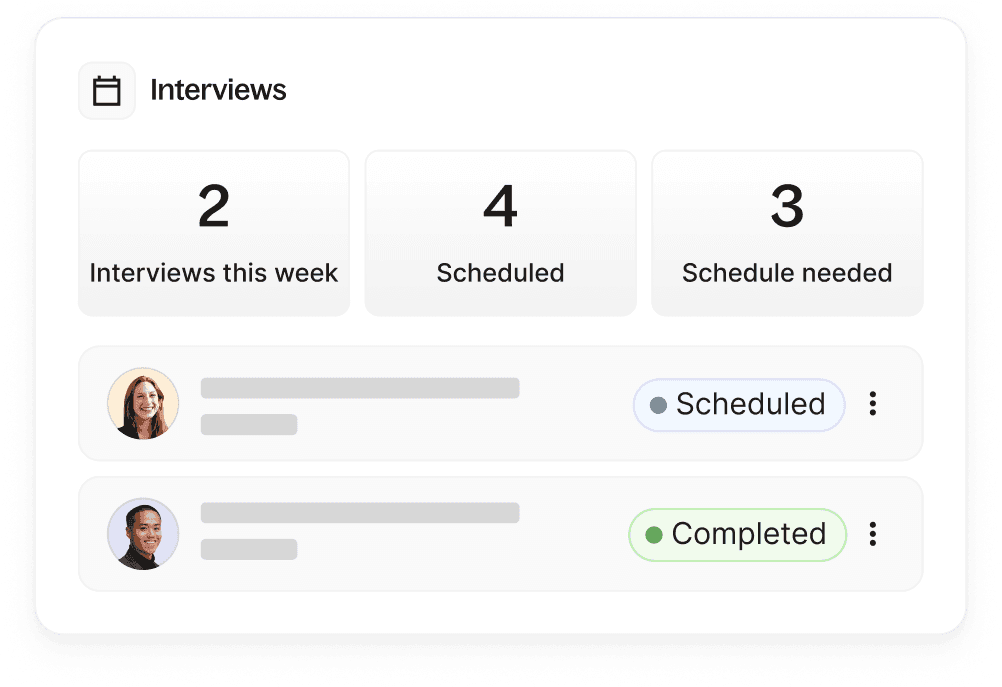
Rather than relying on email threads and individual memory to track who has reviewed which profiles, the system centralizes candidate records so teams can monitor where each submission stands in the hiring process. Submissions that need attention become visible to the team before the situation escalates.
Automated notifications help keep the process moving. When a submission is overdue for a response, the system can alert the responsible team member to follow up, reducing the need for manual nudges across every open submission.
For teams evaluating their current ATS setup, the buyer's guide to applicant tracking systems covers the criteria that distinguish a genuinely useful system from one that just creates more overhead. And for anyone navigating outdated assumptions about what an ATS can do, the common ATS myths for recruiters addresses the most frequent ones directly.
Deel HR
Hire and recruit faster, with less effort
How Deel's Talent helps teams find the right candidates
The submission follow-up problem does not always begin when a hiring manager delays reviewing a candidate. Sometimes it begins when the submitted candidate was not the right fit, and your company’s silence reflects a mismatch rather than a delay.
Deel's Talent sourcing addresses this earlier in the process. It gives recruitment and talent acquisition teams access to a searchable candidate database to help source well-matched talent for the hiring manager’s vacancy, with search criteria including location, experience level, and language. Submitting candidates who closely match the role requirements may make it easier for hiring managers to evaluate and respond, which can reduce unnecessary feedback cycles.
Stronger initial matches can reduce the likelihood of a hiring team deferring a review because the profiles feel misaligned. Combined with AI-assisted talent acquisition practices that help teams move faster on sourcing, Deel's Talent can help agencies improve submission quality upstream, before the follow-up problem has a chance to start.
Speed and match quality
Bullhorn's GRID 2025 research found that firms engaging candidates consistently throughout the hiring cycle are twice as likely to see revenue growth. Faster reviews and better-matched submissions both contribute to closing the gap between submission and placement.
Talent
Find top talent, hire globally

A checklist for teams managing candidate submissions
Whether you're leading a staffing agency, managing an in-house talent acquisition function, or building a recruitment process from scratch, these steps prevent candidate submissions from stalling.
Set a response SLA before submitting. Agree on a specific review deadline, typically three to five business days from submission, and confirm it in writing. Don't submit profiles without one.
Name one follow-up owner. Assign a single person responsible for prompting the next action: the account manager in an agency context, or the recruiter or talent partner in an in-house function.
Log every submission in your ATS. Track candidate status centrally, not in email threads. A candidate sitting at "submitted" beyond the agreed review window should be visible to the whole team, not buried in one person's inbox.
Review aging submissions weekly. Build a standing check for any candidate who hasn't advanced in five or more business days. This is the team-level safety net for submissions that have slipped through individually.
Keep candidates informed at every stage. Let candidates know their current status and when to expect the next update, even when that update is "we're still waiting for feedback from the hiring team." A candidate who knows their status stays engaged.
Debrief after each placement cycle. Track which hiring teams consistently delay reviews and negotiate a stricter SLA for future engagements, or escalate to a senior relationship manager.
Manage candidate submissions with Deel's ATS and Talent
Losing top candidates to slow reviews is one of the most preventable outcomes in recruiting. The fix is a process change, supported by tools that make accountability visible and follow-up consistent.
Deel's ATS helps teams centralize submission tracking and manage follow-up consistently. And with Deel's Talent, you can source candidates from a vetted database to help teams build well-matched shortlists from the start.
Book a demo below to see how Deel's ATS and Talent support recruitment teams in building more accountable hiring pipelines.
Live Demo
Get a live walkthrough of the Deel platform
FAQs
How long should hiring teams take to respond to a candidate submission?
Three to five business days is a reasonable standard for most hiring situations. Setting a specific response deadline at the time of submission and confirming it in writing gives both parties a shared expectation to work from.
Who is responsible for following up after a candidate is submitted?
In agency recruiting, this is the account manager. In an in-house talent acquisition function, it's the recruiter or talent partner assigned to the role. Ownership must be named explicitly before the first submission goes out, not assumed after the fact.
Can an ATS remind hiring teams to review submitted candidates?
Yes. A well-configured applicant tracking system can send automated notifications to alert the responsible team member when a submission needs follow-up, reducing the need for manual prompting across every open role.
How do I filter a candidate database by region, seniority, or language?
Deel's Talent includes candidate search capabilities with criteria such as location, experience level, and language to help teams source profiles that match your requirements before submission.
What should a candidate submission follow-up checklist include?
At minimum: a pre-agreed response deadline, a named follow-up owner, centralized tracking in your ATS, a weekly review of aging submissions, and regular candidate status updates, even when the hiring manager hasn't responded yet.
This article is provided for general informational purposes only and should not be treated as legal or HR advice. Consult a qualified professional for guidance specific to your hiring situation.
Jemima is a nomadic writer, journalist, and digital marketer with a decade of experience crafting compelling B2B content for a global audience. She is a strong advocate for equal opportunities and is dedicated to shaping the future of work. At Deel, she specializes in thought-leadership content covering global mobility, cross-border compliance, and workplace culture topics.