
Article
15 min read
The Definitive Guide to Choosing Benefits Platforms for Global Startups
Global HR

Author
Shannon Ongaro
Last Update
December 05, 2025

Table of Contents
Why benefits platforms matter for global startups
Key criteria to evaluate benefits platforms for startups hiring worldwide
How to assess global compliance and risk management
Integration with HR, Payroll, and Existing Systems
Customization and flexibility for diverse workforces
User experience and employee engagement
Understanding transparent pricing and cost structures
Step-by-step process to choose the right benefits platform
Overview of leading benefits platforms for global startups
Best practices for implementing a benefits platform across borders
Measuring success: Key metrics to track post-implementation
Explore Deel’s benefits options for startups

Explore this topic with AI
Key takeaways
- The right global benefits platform lets startups hire and retain worldwide by centralizing enrollment, eligibility, and localized offerings in one system.
- Prioritize vendors with automated statutory compliance, strong HR/payroll integrations, transparent pricing, and a self-serve UX that scales as you add countries.
- Deel stands out by unifying global hiring, payroll, and benefits across 150+ countries with payroll-native deductions, real-time compliance updates, and lean-team-friendly automation.
Choosing the best employee benefits platforms for startups hiring worldwide comes down to one thing: confidence at scale. A modern benefits platform centralizes eligibility, enrollment, and compliance across countries so you can hire fast, retain top talent, and stay audit-ready.
Local labor laws, tax rules, and statutory benefits vary by jurisdiction and change often. Platforms with built-in compliance automation reduce risk while meeting rising employee expectations for flexible, localized benefits.
For example, Deel supports global hiring, onboarding, payroll, and benefits with automated compliance controls, making international benefits administration far more manageable for lean teams.
Why benefits platforms matter for global startups
An employee benefits platform is a cloud-based system that centralizes the administration, tracking, and reporting of global perks, healthcare, retirement, and compliance tasks. For startups scaling internationally, these systems do three critical jobs: keep you compliant in every country, simplify processes as headcount grows, and reinforce your employer brand.
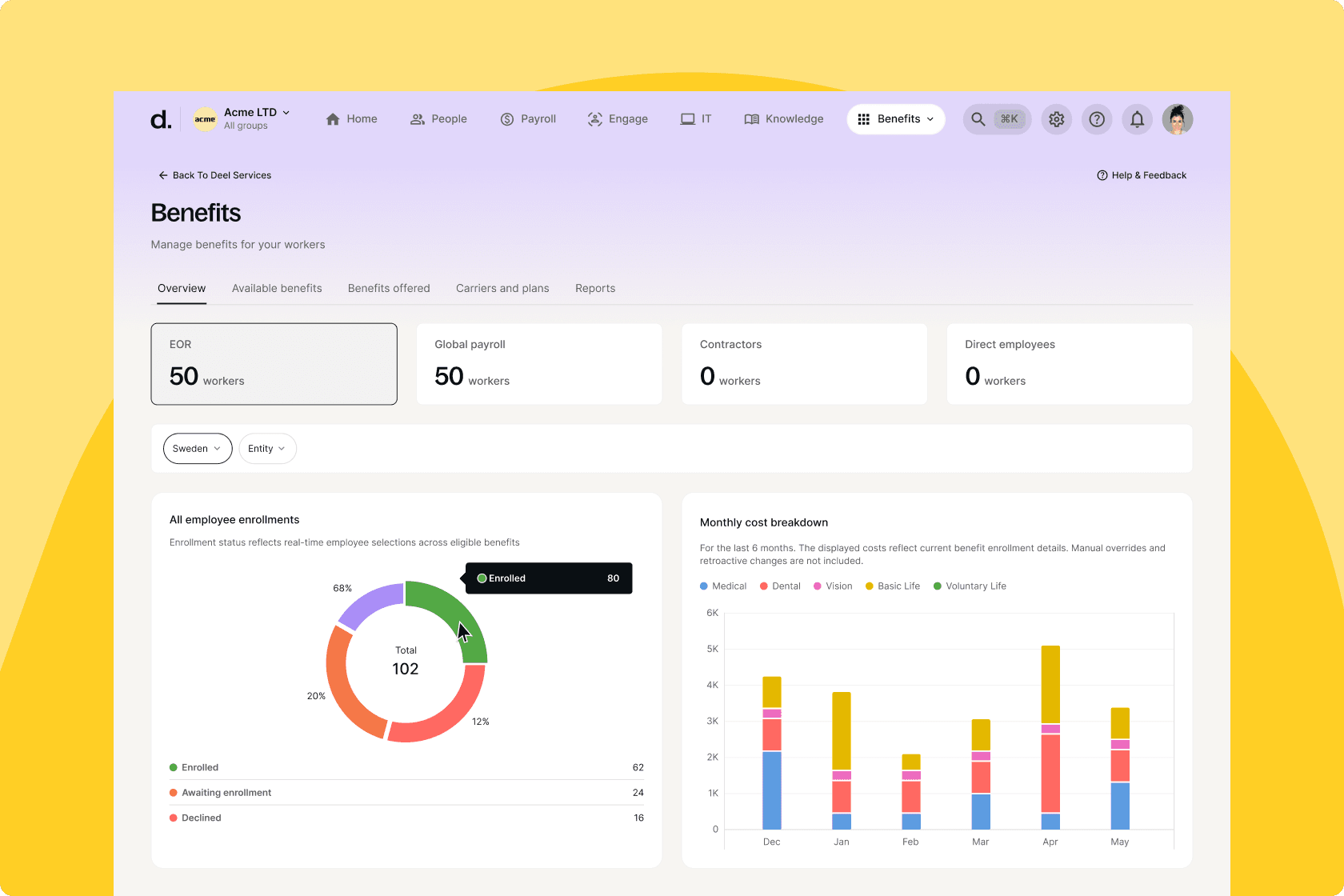
Strategically, the right platform turns a complex, country-by-country patchwork into a single operating model. This helps you offer competitive, localized benefits and satisfy statutory requirements as you expand, which improves hiring velocity and retention.
Key criteria to evaluate benefits platforms for startups hiring worldwide
When comparing global HR platforms for international benefits administration, focus on coverage, compliance, cost predictability, usability, and scalability.
| Criteria | What to verify | Why it matters |
|---|---|---|
| Global compliance features | Statutory benefits, tax withholdings, documentation, local contracts | Reduces legal risk and ensures adherence to country-specific rules |
| Integration capabilities | HRIS, payroll, accounting, identity, collaboration tools | Eliminates double entry and improves data accuracy |
| Customization options | Country-level plans, stipends, eligibility rules, life events | Delivers localized, equitable offerings at scale |
| User experience | Simple enrollment, clear dashboards, mobile access | Drives participation and reduces support tickets |
| Pricing transparency | Clear per-employee or bundled fees with no hidden add-ons | Enables budgeting and predictable scaling |
| Scalability | Coverage across current and future countries, multi-entity support | Supports expansion without re-platforming |
Compliance automation refers to automated tools and workflows that ensure benefits administration follows local employment laws and tax rules in each country. Platforms like Deel implement this through localized contracts, statutory configurations, and real-time updates to requirements across 150+ countries, streamlining hiring and onboarding for distributed teams.
Compliance

How to assess global compliance and risk management
Global compliance means following the distinct labor, tax, and benefits regulations in every jurisdiction where employees are based. For risk-ready operations, verify the platform:
- Automates country-specific tax withholdings, statutory benefits, and required documentation
- Supports compliant practices in all planned hire locations (and can add new ones quickly)
- Monitors regulatory changes and updates workflows without manual intervention
- Produces audit-friendly logs and localized reports
Well-designed global benefits platforms help companies scale confidently while ensuring local regulatory compliance and reduce admin burden with automated workflows and dynamic updates as rules change.
Integration with HR, Payroll, and Existing Systems
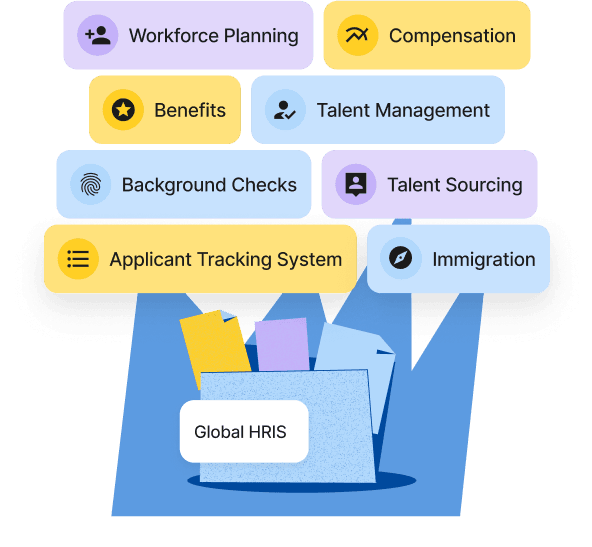
Integration is the capability for a benefits platform to exchange data seamlessly with HR information systems (HRIS), payroll, accounting, identity, communications, and insurance carriers. Top systems connect HRIS/ERP, payroll, retirement, and health insurance to keep employee data synchronized and processes streamlined.
Common integrations to look for:
- HRIS/HR, like Deel HR
- Payroll and accounting: Native payroll or APIs with accounting tools
- Collaboration and identity: Slack, SSO/SCIM, IT provisioning
- Insurance and retirement: Carrier feeds, EDI, multi-currency support
Deel pairs global benefits administration with 24/7 support, PEO options, and native integrations that reduce manual work for distributed teams.
Deel HR
Customization and flexibility for diverse workforces
Customization is the ability to tailor benefits by region, employee type (contractor vs. full-time), seniority, or team preference. For global startups, flexibility is essential to deliver equitable, localized value without multiplying admin overhead.
Practical ways to personalize:
- Stipends or flexible benefits budgets by country or persona
- Automated enrollment and changes for qualifying life events
- Regionally adapted perks and wellness options with local vendors
- Configurable eligibility rules, waiting periods, and renewals
Market leaders also offer configurable, branded stipends with custom values and expiration settings, enabling cohesive programs across countries. Flexibility ensures startups can scale offerings as headcount grows or shifts geographically.
User experience and employee engagement
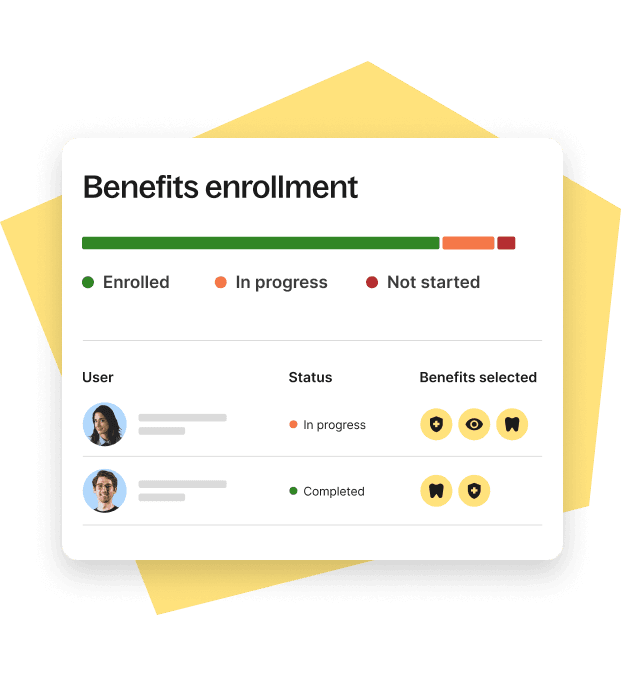
A strong benefits UX means easy self-service enrollment, clear dashboards, and responsive mobile access. When employees understand their total package and can act without friction, participation rises and HR support tickets fall.
Look for:
- Total compensation statements and localized plan summaries
- Interactive onboarding with guided enrollments
- Self-service changes for life events
- Multilingual support and local currencies
- Accessible support (chat, email, knowledge base)
Understanding transparent pricing and cost structures
Transparent pricing means clear, upfront costs with no hidden fees or surprise add-ons. For startups, cost predictability is vital to model runway and headcount growth.
Common models:
- Per-employee, per-month (PEPM)
- Pay-per-use or transactional fees for specific services
- Bundled HR/benefits/payroll packages
Prioritize vendors with simple, scalable pricing and clear inclusions; avoid opaque add-ons that make total costs hard to project.
Benefits Administration
Step-by-step process to choose the right benefits platform
- Align on scope and goals
- Compare capabilities and shortlist
- Test usability with real workflows
- Validate compliance coverage
- Model total cost of ownership
- Check references
- Decide, pilot, and roll out
Assess your startup’s unique benefits needs
Survey employees to learn what they value and document statutory must-haves per country. Separate must-have vs. nice-to-have features, including flexibility, ease of use, and global coverage.
Research and compare platform features
Create a comparison table scoring platforms on compliance automation, system integrations, customization/localization, and analytics/reporting. Use vendor documentation and independent reviews for initial vetting.
Request demos and evaluate usability
Invite HR, finance, IT, and a few employees to live demos. Score onboarding steps, mobile responsiveness, admin workload, and employee self-service. Speed of implementation matters—self-service enrollment models can be live in weeks, accelerating time-to-value.
Live Demo
Get a live walkthrough of the Deel platform

Consider scalability for future growth
Confirm that adding countries, entities, plans, and employees won’t require migrations or manual reconfiguration. Favor solutions that automate compliance updates as you scale.
See also: A Guide on How to Scale Global HR
Validate platform reputation and customer feedback
Seek unbiased reviews, ask for references in your target countries, and prioritize providers with a proven track record supporting startups with similar footprints and growth plans.
Leading Global Hiring Platform

Overview of leading benefits platforms for global startups
| Platform | Global reach | Integrations | Pricing approach | Best for |
|---|---|---|---|---|
| Deel | 150+ countries, owned entities and trusted partners | HRIS, payroll, accounting, Slack, APIs + in-platform HR, payroll, IT, immigration, EOR, contractor management, and more | Transparent PEPM; global bundles available | Local or global companies of all sizes |
| Gusto | Strongest in US | Payroll, time, benefits carriers (US), HR tools | Tiered plans + add-ons | US-focused small businesses |
| BambooHR | Global HRIS with basic benefits | HR, ATS, time, payroll partners | Modular pricing | SMBs building HR foundations |
| Workday | Enterprise-grade global HR/finance | Broad ERP/HR integrations | Enterprise licensing | Complex, multi-entity enterprises |
| Forma | Flexible perks and wellness focus | HRIS, carriers, wallets | Program-based fees | Customizable, choice-driven benefits |
Deel
Deel is a unified global HR, Payroll, and Compliance platform for every way companies manage and pay teams.
-
Hiring, onboarding, payroll, and compliant benefits administration across 150+ countries with real-time reporting and localized workflows.
-
Payroll-native benefits management: set up plans, run enrollment, and have pre-/post-tax deductions sync automatically into Deel Payroll with accurate payslips and full audit trails.
-
US benefits admin built directly into payroll, including integrations with major medical, dental, vision, and other carriers to reduce manual work and system-switching.
-
Supports pre-tax programs and compliance needs like HSA/FSA, DCFSA, and commuter benefits, with configurable eligibility, tiers, and employer contributions.
-
Streamlined open enrollment (OE) and qualifying life event (QLE) workflows with approval controls, so HR can manage changes end-to-end in one place.
-
Guided, modern employee enrollment experience with clear plan summaries and step-by-step selection to drive participation and reduce confusion.
-
One global source of truth for HR and Finance: real-time visibility into benefits adoption, costs, and exceptions to speed up reconciliations and month-end close.
-
Works across Deel Payroll, PEO, and EOR worker types, and lets you keep your broker while Deel centralizes setup, enrollment, carrier connectivity, and payroll sync.
Gusto
- User-friendly HR and payroll with health insurance brokerage and engagement tools
- Best for US-based or single-country operations at early stages
BambooHR
- Intuitive HRIS with core HR, performance, and basic benefits administration
- Suited to small and mid-sized teams establishing foundational HR workflows
Workday
- Enterprise HR, payroll, benefits, and financials under one cloud platform with advanced analytics and controls
- Powerful but often more complex and costly for early-stage startups
Forma
- Emphasizes flexible, personalized benefits and wellness stipends with strong automation
- Attractive for startups prioritizing choice-driven programs and employee experience
Best practices for implementing a benefits platform across borders
- Start with a pilot in one or two countries; phase rollout by region or entity
- Localize communications (language, currency, cultural norms) and provide concise training resources
- Establish clear SLAs for support, change management, and renewals
- Collect feedback early and iterate plan design based on usage and sentiment
- Maintain an ongoing compliance calendar for audits, filings, and documentation
Measuring success: Key metrics to track post-implementation
Track:
- Enrollment and participation rates by country and program
- Employee satisfaction (CSAT/eNPS) and qualitative feedback
- Benefits utilization and cost per employee
- Admin time saved, ticket volume, and time-to-enroll
Leading platforms provide reporting on participation trends, forecasting, and wellness ROI to help optimize spend and experience.
Explore Deel’s benefits options for startups
Global startups need a platform that turns complex, country-by-country benefits into one compliant, automated system. In this guide, you learned how to evaluate coverage, compliance, integrations, pricing, and UX—plus how to run a structured selection process.
Deel combines international benefits administration, owned entities, and automated compliance worldwide so you can scale with confidence.
Explore how global benefits work in one place with Deel employee benefits software, or book a live walkthrough to see the workflows end-to-end.
FAQs
What business outcomes can a global benefits platform deliver for a startup?
A global benefits platform helps startups attract and retain talent, streamline HR operations, ensure compliance in every country, and strengthen their employer brand.
How do benefits platforms ensure compliance across multiple countries?
They use automated compliance engines that track local labor, tax, and benefits laws, managing documentation and mandatory contributions per location.
What core features are essential in a benefits platform for a global startup?
Automated compliance, HR/payroll integrations, multi-currency support, self-service enrollment, real-time reporting, and localized benefits options.
How long does it typically take to implement a global benefits platform?
Timelines vary by provider and scope, but many platforms can launch in a few weeks with streamlined, self-service onboarding.
How can startups encourage high employee adoption of benefits programs?
Clear communication, an intuitive self-service portal, and regular feedback collection help refine offerings by country and persona.
Shannon Ongaro is a content marketing manager and trained journalist with over a decade of experience producing content that supports franchisees, small businesses, and global enterprises. Over the years, she’s covered topics such as payroll, HR tech, workplace culture, and more. At Deel, Shannon specializes in thought leadership and global payroll content.


