Article
6 min read
Compliance as Infrastructure: How EOR Protects Data Center Hiring Uptime, Cost, and Timelines
Employer of record
Global hiring
Legal & compliance
Global HR

Author
Jemima Owen-Jones
Last Update
August 03, 2026

Table of Contents
Why 24/7 operations create distinct employment compliance obligations
The SLA connection: how non-compliant staffing becomes an operational risk
What a field EOR does differently for shift-based hiring
The cost argument: compliance as a financial control
Evaluating EOR versus direct employment for data center operations
Building a compliant global shift workforce: a practical framework
How Deel supports data center hiring and compliance globally
Support compliant shift staffing with Deel
Key takeaways
Data center uptime SLAs are staffing problems first: 24/7 shift rotations trigger distinct legal obligations in every country, and a single non-compliant contract can generate unplanned overtime liability, regulator fines, and project delays.
Shift work compliance is not uniform: night-work caps, mandatory rest intervals, and collective bargaining frameworks vary sharply across the US, EU, APAC, and LATAM. A single global shift policy cannot meet every region's requirements.
Hiring with Deel's on-site EOR solution places legal-employer responsibilities, including locally compliant contracts, payroll, statutory contributions, and benefits, with Deel, so data center operators can stand up compliant shift coverage without waiting to establish a local entity.
This article is provided for general informational purposes and should not be treated as legal or HR advice. Employment laws vary by jurisdiction and change over time. Consult a qualified legal or HR professional for guidance specific to your situation and markets.
Data center operators know the math: uptime is the product, and every minute of downtime costs. Enterprises are losing $8,851 per minute during severe outages, and your investors expect four- and five-nines SLAs as standard.
You've invested millions in redundant power paths and automated failover—because hardware failures are predictable and manageable. But there's one variable most facilities have gotten wrong: the human layer.
When a monitoring system catches an anomaly at 3 AM, your shift team is the last line of defense. Yet staffing shortages remain one of the top operational risks for data centers worldwide, directly affecting uptime and resilience.
As your expansion moves into Germany, Singapore, Brazil, and beyond, the problem compounds: shift regulations, fatigue rules, night-work premiums, and collective bargaining thresholds differ sharply by country.
Many HR teams discover this the hard way—after scheduling violations create compliance gaps that put SLAs at actual risk. This isn't just legal exposure. It's operational exposure.
Having supported 40,000+ organizations across industries as they scale globally, we've seen that successful companies treat employment compliance the same way they treat power redundancy: as operational infrastructure, not a compliance checkbox.
This article explains how to build that infrastructure into your contracts, payroll, scheduling, and monitoring systems from day one—so your shift coverage stays reliable, your SLAs stay protected, and your growth doesn't trigger compliance crises.
Why 24/7 operations create distinct employment compliance obligations
Most employment law is designed around a standard workday. The moment an operation runs three shifts, the rule set changes materially.
Shift workers are not simply employees who work different hours. Depending on the jurisdiction, rotating schedules trigger:
Night-work premiums and medical surveillance. In Germany, workers performing more than two hours of work between 11 PM and 6 AM qualify as night workers under the Arbeitszeitgesetz (ArbZG) and are entitled to occupational health examinations at the employer's expense, plus appropriate compensation through pay supplements or compensatory time off.
Mandatory rest intervals between shifts. Germany's ArbZG requires a minimum of 11 consecutive hours of uninterrupted rest between shifts. An employee finishing at 11 PM cannot legally start again before 10 AM the next morning. Violations carry fines of up to 15,000 euros per incident, with criminal prosecution for willful, health-endangering breaches.
Caps on consecutive night-shift extensions. Under ArbZG Section 6, night workers in Germany are limited to an average of eight hours per 24-hour period calculated over one calendar month or four weeks. This shorter averaging window for night workers (compared to the six-month window for standard daytime workers under Section 3) requires employers to more frequently adjust schedules to maintain compliance.
Weekly hours limits and opt-out rules. The UK's Working Time Regulations 1998 cap the average working week at 48 hours, with an individual opt-out available. This retained rule requires active tracking and documentation when teams schedule shifts.
Award and enterprise agreement obligations. In Australia, shift obligations often flow from modern awards and enterprise agreements rather than a single statute, meaning the applicable rules depend on the employee's specific classification and industry.
Collective bargaining frameworks. In France, Deel's EOR employees are employed under the Convention collective de branche des salaries en portage salarial, which governs salary, bonuses, working hours, overtime uplifts, and restrictions including limits on Sunday work. These are not terms the client negotiates. They are the conditions of employment under that structure.
The practical implication is that a single "global shift policy" cannot satisfy all of these frameworks simultaneously. The 4-on/4-off, 12-hour schedule common at hyperscale campuses supporting AI workloads is legal in some markets and requires specific structural accommodations in others.
Field Services
Deploy onsite workers compliantly in days

The SLA connection: how non-compliant staffing becomes an operational risk
Data center operators often treat employment compliance as a legal problem for HR or legal teams to handle. The operational consequences are more direct than that framing suggests.
Consider what happens when a shift team in Germany has not been given the required 11-hour rest period. The facility has three options:
violate the law and run the shift anyway
pull the worker from the schedule with no replacement
scramble to cover with a supervisor or out-of-rotation colleague
All three options carry costs. The first creates regulatory exposure. The second and third create exactly the kind of understaffed overnight coverage that precedes a human-error incident, a category that Uptime Institute research identifies as a factor in approximately 39% of data center incidents.
The cost structure compounds when operations expand across multiple markets simultaneously. Each new market introduces a new compliance surface:
| Market | Key shift compliance consideration |
|---|---|
| United States | Federal FLSA overtime rules, while state-level meal and rest-break requirements vary |
| Germany | ArbZG night-worker rules, an 11-hour minimum rest period between shifts, and AÜG assignment limits of 18 months |
| United Kingdom | Working Time Regulations, a 48-hour weekly average, and individual opt-out documentation |
| Singapore | Employment Act limits on overtime hours and additional protections for non-exempt workers |
| Australia | Modern award and enterprise agreement obligations by industry and classification |
| Brazil | CLT provisions on night work premiums, mandatory rest, and medical checks at onboarding |
| France | Portage salarial collective agreement governing hours, overtime uplifts, and Sunday work restrictions |
Managing this matrix through a combination of local counsel, country-by-country policy updates, and manual contract drafting is possible, but it is slow and prone to errors at the pace hyperscale expansion requires. A facility that needs to stand up a new market in three to four weeks does not have time to commission a fresh legal review for every employment contract.
The 39% human-error factor
According to Uptime Institute's 2025 Annual Outage Analysis, nearly 40% of organizations have suffered a major outage caused by human error over the past three years, with 85% of those incidents stemming from staff failing to follow established procedures or from flaws in the procedures themselves.
Time Tracking
Time tracked. Payroll trusted. Nothing to reconcile.
What a field EOR does differently for shift-based hiring
An Employer of Record is the legal employer of a worker in their country of residence. The EOR signs the employment contract, handles payroll and applicable tax filings, administers statutory benefits, and manages its allocated legal-employer obligations under local employment law.
The client organization directs the worker's day-to-day tasks, and remains responsible for day-to-day supervision, lawful scheduling, time approvals, and workplace obligations assigned to it.
For data center operators, the operative difference is where the legal-employer responsibility sits. When the EOR holds the employment contract in a given country, the relevant EOR entity manages legal-employer requirements for workers in that market, including local contract and payroll treatment. The client must still operate schedules, approve time, and manage the workplace in line with local requirements and the EOR's guidance.
This matters for data center hiring for several specific reasons.
Speed to coverage: Onboarding timelines vary by country and depend on completed documentation, signed agreements, required checks, deposits, payroll cutoffs, and any immigration requirements. Deel can often onboard eligible workers in days once prerequisites are complete, compared with the longer process of establishing an employing entity. Confirm the current estimate for each target market with Deel before setting a start date
Local entity coverage across key markets: Deel has dedicated owned entities in major data center markets, including the US, Germany, the UK, Singapore, Australia, India, and Brazil. Deel enables hiring across 150+ countries through a combination of Deel-owned entities and trusted partners. A local-entity EOR arrangement differs from co-employment because Deel acts as the legal employer rather than sharing employer status with the client, as a PEO arrangement would. The applicable employing entity and delivery model should be confirmed for each engagement
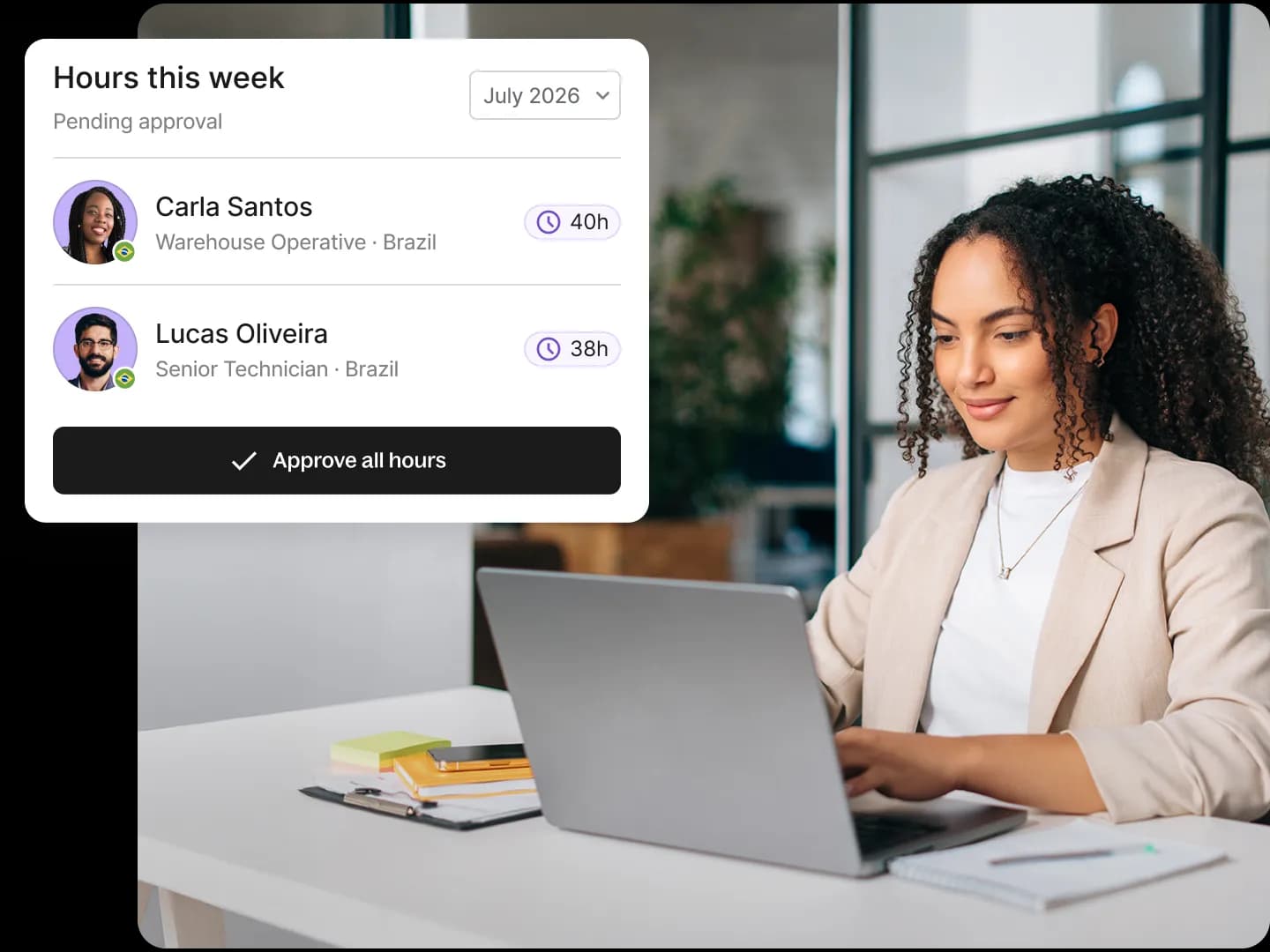
Contract and payroll treatment for shift workers: Deel supports hourly EOR agreements and time tracking in eligible countries. Submitted hours can be reviewed for overtime, night, weekend, and holiday treatment, with applicable rates processed according to local requirements. Deel reflects applicable employment terms in the local contract and supports the required payroll treatment. The client remains responsible for operating a compliant schedule; Deel's Time Tracking feature helps enforce accurate submission and approval of working-time records in line with local rules.
Germany-specific structural consideration: German EOR employment through Deel operates under the AÜG temporary-worker framework, which generally limits an assignment to 18 consecutive months. Before that point, Deel reviews the available continuation path, which may include direct employment by the client or a transfer to another eligible Deel EOR entity, subject to the facts and current legal requirements. Planning should begin well before month 18
Compliance
Unlock Continuous Compliance™ with Deel
The cost argument: compliance as a financial control
HR teams at hyperscale operators sometimes encounter resistance when making the case for EOR investment. The framing that tends to land with operations and finance is cost certainty rather than risk avoidance.
The EOR model adds a predictable service fee and centralizes many employment-administration costs, but wages, overtime, statutory contributions, benefits, and liabilities arising from client-controlled scheduling or workplace practices can still vary. The more important comparison is against the three categories of exposure that non-compliant shift staffing generates:
Overtime liability: In markets where rest-period violations lead to mandatory compensatory time off, including Germany and France, unpaid compensation can accumulate until an audit or employee complaint reveals it. The exposure compounds across a multi-hundred-person shift workforce.
Regulatory fines: Germany's ArbZG sets administrative fines at up to €15,000 per violation, with criminal exposure for willful health-endangering breaches. France and Brazil enforce similar working-time protections through administrative and criminal penalties, though the specific mechanisms and amounts vary by jurisdiction. A single facility audit can produce multiple violations across dozens of workers.
Entity setup costs avoided: Setting up a legal entity in a new market typically requires substantial elapsed time (often several months) and significant legal and registration costs, depending on the jurisdiction and corporate structure required, making it impractical for testing a market or ramping small on-site teams.
For enterprise procurement teams running multi-market facility portfolios, replacing that mix of variable exposures with a structured employment service supports the kind of financial modeling that infrastructure investments require.
Evaluating EOR versus direct employment for data center operations
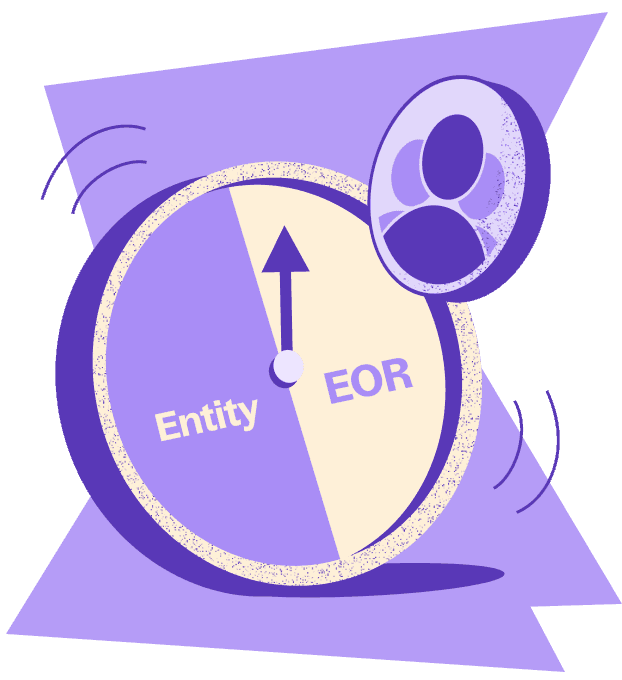
Not every market and every hire is best served by an EOR. The decision depends on headcount scale, duration, and the existing entity footprint of the operator.
An EOR is typically the right model when:
The facility is in a new market where the operator has no existing legal entity
The ramp-up timeline does not allow for entity setup, which typically takes 12 or more weeks in most jurisdictions
The operation is testing a market before committing to a permanent footprint
Headcount per market is too low to justify the overhead of a local HR and payroll infrastructure
The operator needs multi-market consistency in employment contracts, payroll processing, and compliance tracking
Direct employment through a local entity generally becomes the better option when:
Headcount and long-term commitment are high enough that the cost and control benefits of an owned entity outweigh setup and ongoing administration. The break-even point varies by country, compensation, benefits, and entity costs
The operator requires full control over benefits design, contract terms, and termination procedures beyond what a standard EOR agreement provides
Local works council or collective bargaining obligations make the EOR structure complex enough to require a parallel entity anyway
For operators running a global facility portfolio, the practical answer is usually a hybrid: direct employment in the largest, most established markets, and EOR in markets where scale, speed, or legal complexity makes the entity model premature.
Global Hiring Toolkit
EOR vs. Entity Calculator
Building a compliant global shift workforce: a practical framework
The following framework offers a practical sequence for building multi-market shift teams without accumulating compliance exposure.
Step 1: Define the shift model before hiring begins
The legal obligations that attach to shift work are triggered by the schedule design itself. Before opening requisitions in a new market, confirm:
Whether the planned shift length and rotation pattern (for example, 4-on/4-off, 3x8-hour, or 2x12-hour) creates night-worker status under local law
What mandatory rest intervals apply between shifts
Whether the schedule triggers overtime calculation thresholds in that jurisdiction
What documentation requirements attach to night-work arrangements
In Germany, an employee finishing a 10-hour night shift at 6 AM cannot legally return to work before 5 PM the same day under the 11-hour rest requirement. A 4-on/4-off, 12-hour model requires specific structuring to remain compliant.
Step 2: Map compliance obligations by country
Build a compliance matrix for each market in the facility portfolio. Include:
Night-work definition (hours window and minimum daily exposure threshold)
Maximum daily hours, both standard and permitted extension
Minimum rest between shifts
Night-shift premium or compensatory time-off entitlement
Sunday and public holiday restrictions
Collective agreement applicability
Step 3: Choose the employment model by market
Apply the EOR vs. entity framework above to each market. Where EOR is appropriate, confirm which entity will employ the worker, whether delivery is through an owned entity or an EOR partner, and how responsibilities are allocated in the service agreement. Distinguish an EOR arrangement from labor staffing or recruitment services.
Step 4: Confirm hourly contract support and time-tracking capability
For shift roles, hourly employment contracts are often more accurate than salaried contracts. Verify that the EOR platform supports hourly agreements in the relevant markets and can capture working time and support review and payroll processing of applicable overtime, night-work, weekend, and holiday rates. Confirm country availability and whether calculations require manual review.
Deel's Time Tracking feature supports shift compliance by enabling employees to submit, edit, and delete shifts or timesheets for manager approval. The system records shifts in 24-hour format with breaks according to country-specific policies, sends notifications when shifts are approved or denied, uses forecasted shifts to prefill scheduled work and reduce manual entry, enforces deadlines for submission and approval, and escalates reviews to skip-level managers if the direct manager is unavailable. This ensures all hours worked, including overtime and meal periods, are captured and approved in line with applicable policies and laws.
Step 5: Build in ongoing compliance monitoring
Employment law changes. Working-time rules and enforcement guidance can evolve in any market, so teams should review schedules and payroll treatment regularly with local experts. Implement time-tracking discipline through submission deadlines, manager approvals, and escalation rules to ensure no hours slip through without review. A compliance framework that is accurate at the point of hire requires ongoing review as the workforce and regulatory environment change, supported by audit trails that document all shift submissions and approvals.

Guide
Expand your global HR strategy
How Deel supports data center hiring and compliance globally
Deel's Employer of Record solution covers 150+ countries through a combination of owned entities and trusted partners. Deel has owned-entity coverage in 130+ countries, including all the major data center expansion markets. The employment contract, payroll processing, statutory contributions, and benefit administration are managed through the applicable Deel-owned entity or trusted EOR partner, depending on the country and worker requirements.
For data center operators, the practical output is:
Locally tailored employment agreements for eligible shift and hourly workers, based on country requirements and the role and schedule information supplied by the client
Time Tracking that enforces compliant shift recording in 24-hour format with breaks, manager approval workflows with skip-level escalation, submission and approval deadlines, and forecasted-shift prefill to reduce manual entry
Payroll processing that supports applicable country-specific overtime, night-work, weekend, and holiday treatment, subject to accurate time records from Deel's Time Tracking and country-specific workflows
Onboarding that can often be completed in days once country-specific prerequisites are met, rather than waiting to establish an employing entity
Consistent reporting for multi-market shift workforces across jurisdictions, with audit trails of all shift submissions and approvals
As a facility scales, Deel can support a move from hiring through Deel's EOR solution to employing workers directly through the operator's own entity, supporting coordinated offboarding and onboarding through Deel Payroll and aligned contract and payroll-data migration workflows where available. The legal steps and employee communications vary by country. Learn more about global expansion with an EOR.
Support compliant shift staffing with Deel
Running a data center at four- or five-nines uptime is an engineering problem with a staffing dependency. The power and cooling infrastructure can be built to redundancy specifications, but the shift team that responds at 3 AM needs to be there, legally employed, and free from a rest-period violation incurred the previous shift.
Compliance with local working-time law is not an HR administration task to be deferred until the next audit cycle. It is an operational control that must work before the facility goes live to protect coverage when teams face operational pressure.
Hiring with Deel's on-site EOR solution gives operators locally informed contracts, payroll, and compliance frameworks from day one. Deel's Time Tracking feature ensures shift submissions, approvals, and records remain compliant with local rest-period and overtime rules as the facility operates. Operators must still manage schedules, workplace safety, and staffing coverage in accordance with local rules.
Deel supports that work across every market where a facility needs 24/7 coverage. Book a demo below to see how Deel's EOR and Time Tracking solutions support compliant shift staffing for critical infrastructure operations globally.
Deel Hire
Find, hire, and manage anyone, anywhere

FAQs
Can an EOR support hourly or shift-based employment contracts, not just salaried roles?
Deel supports hourly EOR agreements and time tracking in eligible countries. Applicable overtime, night-work, weekend, and holiday treatment is reviewed and processed according to local requirements. Because availability and workflows vary by country, hiring teams should confirm support in each target market before hiring.
Does using an EOR in Germany create any long-term restrictions on the employment relationship?
Germany's AUG framework, which governs Deel's EOR structure in that market, generally limits an assignment to 18 consecutive months. Deel reviews the available continuation options before month 18, which may include direct hire by the client or transfer to another eligible Deel EOR entity. Confirm the current Germany process with Deel before hiring.
What is the difference between an EOR and a staffing agency for data center hiring?
A staffing agency generally recruits or supplies workers under a staffing arrangement. With Deel's EOR solution, the client identifies the worker, Deel is the legal employer, and the client directs day-to-day work, subject to the agreed allocation of responsibilities. The key distinction is legal employer status and the permanence of the employment relationship.
How quickly can Deel onboard a new shift worker in a new market?
Timelines vary by country and depend on signed agreements, complete employee information, deposits, required checks, payroll cutoffs, and immigration needs. Deel can often complete EOR onboarding in days after prerequisites are satisfied. Confirm the current estimate for each target market with Deel before setting a start date.
Is an EOR appropriate if we already have a legal entity in a market?
If the entity is authorized and operationally ready to employ and run payroll, direct employment may offer greater control and can be more economical at sufficient scale. EOR is most useful when the existing entity was established for non-employer purposes, when it is dormant, or when expanding direct payroll to a new role type is more complex than using EOR.
Related Deel resources
Jemima is a nomadic writer, journalist, and digital marketer with a decade of experience crafting compelling B2B content for a global audience. She is a strong advocate for equal opportunities and is dedicated to shaping the future of work. At Deel, she specializes in thought-leadership content covering global mobility, cross-border compliance, and workplace culture topics.