Article
7 min read
Global Overtime Laws by Country: What Every HR and Payroll Leader Needs to Know
Global payroll
Legal & compliance

Author
Shannon Ongaro
Last Update
July 14, 2026

Table of Contents
What "overtime" actually means across borders
Overtime rules by country
The exemption problem
Overtime non-compliance: Penalties and liabilities
The contractor misclassification nexus
Why manual tracking doesn't scale
How Deel handles global overtime compliance
Summary reference table
Simplify overtime management with Deel
Key takeaways
Overtime thresholds, premium rates, and exemptions differ significantly by country (and sometimes by region, sector, or collective bargaining agreement within a country)
Misclassifying an employee as exempt or salaried is one of the most common sources of retroactive overtime liability in cross-border teams
Automated, jurisdiction-aware payroll infrastructure like Deel is the only scalable alternative to manual tracking across a distributed global workforce
Disclaimer: This article is provided for general informational purposes and should not be treated as legal or HR advice. Overtime laws change frequently and vary by jurisdiction, sector, and collective bargaining agreement. Consult qualified local legal counsel before making compliance decisions for your workforce.
Overtime looks like a payroll line item until you get it wrong in the wrong jurisdiction, at which point it becomes a back-pay order, a government audit, or a fine that runs to six figures.
For HR and payroll leaders managing teams across multiple jurisdictions, the challenge is that every country has built its own framework, with its own thresholds, its own multipliers, its own exemption tests, and its own enforcement teeth.
What's standard and compliant in the United States doesn't hold in Germany, Brazil, or South Korea.
A salaried employee who is legitimately exempt from overtime under US federal law may be entitled to mandatory premium pay under Brazilian labor code.
A CBA covering a German workforce may set overtime terms the payroll team has never encountered. And in some jurisdictions, getting this wrong doesn't just create civil liability but can also create criminal exposure for the employer.
The frameworks below cover thresholds, multipliers, exemptions, and enforcement across more than 20 countries, providing enough country-specific grounding for payroll and HR leaders to ask the right questions before the labor inspector does.
This is not a substitute for local legal counsel, but it is the foundation that makes that counsel productive.
What "overtime" actually means across borders
In most labor law frameworks, overtime is work performed beyond a defined threshold (daily, weekly, or both) that triggers a premium payment above the employee's regular rate. But the details of that definition vary significantly:
The threshold: Some countries set a daily limit (Japan: 8 hours), some set a weekly limit (US: 40 hours), and some set both (Canada's British Columbia: 8 hours/day and 40 hours/week, whichever is triggered first)
The multiplier: The US standard of 1.5x (time-and-a-half) is neither universal nor the highest. Mexico's first tier sits at 2x, and subsequent hours go to 3x
The base: What counts as the "regular rate" for calculating overtime varies. Some jurisdictions include bonuses in the base rate calculation, while others use only base salary
The exemptions: Who is legally exempt from overtime entitlements differs enormously between jurisdictions and is one of the most frequent sources of misclassification liability
Understanding each country's framework on all four dimensions is the baseline requirement for compliant payroll in any distributed team.
Overtime rules by country
United States
The Fair Labor Standards Act (FLSA) sets the federal overtime standard: non-exempt employees are entitled to 1.5x their regular rate for all hours worked beyond 40 per week. The current salary threshold for the white-collar exemption (executive, administrative, and professional employees) is $684 per week ($35,568 per year).
Key nuance: "Salaried" does not equal "exempt." Employees must meet both a salary-level test and a duties test to qualify as exempt. Misclassifying a non-exempt employee as exempt is the single most common federal wage violation, and it compounds across every pay period the worker was misclassified.
State law often exceeds the federal standard. California imposes daily overtime (over 8 hours/day) in addition to weekly overtime. Employers with multi-state workforces should review overtime rules by state rather than relying on the federal minimum.
Canada
Canadian overtime law operates at the provincial level, with federal standards applying only to federally regulated industries (banking, telecommunications, interprovincial transport):
| Province/Jurisdiction | OT threshold | OT rate |
|---|---|---|
| Ontario | 44 hours/week | 1.5x |
| British Columbia | 8 hours/day or 40 hours/week | 1.5x (daily and weekly triggers) |
| Alberta | 8 hours/day or 44 hours/week | 1.5x |
| Federal (regulated industries) | 8 hours/day or 40 hours/week | 1.5x |
British Columbia and Alberta both carry daily overtime triggers that catch companies running US-style "flexible week" models. Time off in lieu is permitted in most provinces with written agreement.
United Kingdom
The UK's Working Time Regulations 1998 cap working time at 48 hours per week, averaged over a 17-week reference period. Workers can opt out of this limit with a signed agreement, but the opt-out must be voluntary and revocable.
There is no statutory overtime premium rate in the UK. Employers are legally free to set their own overtime rate (including paying nothing extra beyond regular pay), provided the worker's average hourly rate across all hours worked remains at or above the National Minimum Wage. In practice, most employers pay a contractual overtime rate, which may be specified in individual contracts or CBAs.
Germany
Germany's Working Hours Act (Arbeitszeitgesetz) sets a standard working day of 8 hours, extendable to 10 hours provided the average over 6 calendar months or 24 weeks does not exceed 8 hours per day. Sunday and public holiday work is generally prohibited.
Overtime beyond 8 hours per day (and up to 10 hours) is permitted, but there is no statutory overtime premium rate. When paid, the customary rate is 125% of the regular rate, but this is typically set by collective bargaining agreement rather than statute.
Practical implication for global teams: German employees covered by a CBA may have overtime terms significantly different from the default. Any payroll setup that doesn't account for the specific CBA applicable to an employee's role and sector will produce systematic errors.
CBA compliance tip
In Germany, France, Poland, and the Netherlands, collective bargaining agreements can override statutory overtime defaults. Always verify the applicable CBA for each employee's sector before configuring payroll.
France
France's 35-hour workweek is one of the best-known labor standards in the world and also one of the most frequently misunderstood. Hours beyond 35 per week are overtime:
Hours 36-43: 125% of the regular hourly rate (25% premium)
Hours 44 and above: 150% of the regular hourly rate (50% premium)
Annual overtime is capped at 220 hours (the "contingent annuel") unless a CBA or company agreement extends this. Overtime hours above the threshold reduce an employee's legal work quota for the following year.
French labor law enforcement carries real consequences: violations of the Labour Code can result in civil back-pay liability and administrative sanctions. Where systematic overtime underpayment involves falsifying hours on payslips or otherwise concealing employment — the specific offense of travail dissimulé — it can also trigger criminal charges under Article L. 8224-1, carrying up to 3 years' imprisonment and a €45,000 fine (€225,000 for corporate entities). Employers should treat French overtime compliance as a legal exposure issue, not merely an HR one.
Netherlands
The standard workweek in the Netherlands is 40 hours. There is no statutory overtime premium multiplier, with rates governed by collective bargaining agreement or employment contract. This makes the Netherlands appear simple on the surface, but the absence of a fixed statutory rate means employers need to verify the applicable CBA for each employee's sector.
A notable exemption: employees earning more than three times the statutory minimum wage are not subject to the Working Hours Act at all, which removes overtime entitlements entirely for high earners.
Spain
Spain's Workers' Statute (Estatuto de los Trabajadores) sets a 40-hour standard workweek and caps voluntary overtime at 80 hours per year (Article 35.2). The statutory floor for overtime pay is simply the value of the ordinary hour — no premium is mandated by law.
In practice, a premium of 25%–75% (commonly landing around 75%, i.e., 175% of the base rate) is set by collective bargaining agreement rather than by statute, so the applicable CBA must be checked for the actual rate in force.
Employers may instead compensate overtime with paid time off. Absent a different CBA ratio, the legal default is a minimum 1:1 equivalent (one hour of rest per overtime hour), to be taken within four months of the overtime being worked, not tied to the calendar year.
Overtime worked on nights, Sundays, or public holidays above the 80-hour cap carries additional premium requirements set by CBA.
Brazil
Brazil's Consolidation of Labor Laws (CLT) sets a maximum of 44 working hours per week, with a hard daily cap of 8 hours. Overtime is capped at two additional hours per day.
Premium rates:
Regular overtime: 150% of the regular rate (50% premium)
Sundays and public holidays: 200% of the regular rate (100% premium)
Time off in lieu is permitted under a written agreement, but the TOIL arrangement must provide the employee with at least as favorable a position as payment at the applicable premium rate. Brazil has no salaried exemption equivalent to the FLSA white-collar exemption, and all employees are entitled to overtime protection regardless of job title.
The most common misclassification error for US companies entering Brazil is assuming that "manager" titles or senior job designations create overtime exemptions. They do not, unless the role meets a narrow statutory carve-out requiring actual authority to hire and fire.
Mexico
Mexico's Federal Labor Law (Ley Federal del Trabajo) sets a standard workweek of 48 hours for 2026, with overtime paid at premium rates that escalate sharply:
First nine hours of weekly overtime: 200% of the regular hourly rate (double time)
Any subsequent overtime hours: 300% of the regular hourly rate (triple time)
Public holiday work is also paid at 300%. Time off in lieu is not permitted. All overtime in Mexico must be compensated in cash. Mexico does not permit a salaried exemption structure comparable to the FLSA, and the high multipliers make systematic overtime a significant payroll cost driver.
Note for 2026 planning: A reform published in the Diario Oficial de la Federación on 1 May 2026 is phasing the standard workweek down from 48 to 40 hours between 2026 and 2030, with the 9-hour double-pay threshold rising in step (to 12 hours by 2030). Payroll teams with a Mexico presence should track the phase-in schedule rather than treat 48/9 as fixed.
South Korea
South Korea's Labor Standards Act sets a 40-hour standard workweek (8 hours/day, Monday through Friday), with a hard cap at 52 hours per week (40 standard + 12 overtime). All overtime must be approved in writing.
Overtime premium: 150% of the average regular hourly rate (50% premium), applicable to extended hours, weekend work, public holidays, and night work (between 10 pm and 6 am).
Article 110 of the Labor Standards Act provides for fines up to KRW 20,000,000 (approximately USD 15,000) or imprisonment up to 2 years for willful violations of working-hours standards. South Korea's 52-hour cap is actively enforced.
Japan
Japan's Labor Standards Act sets a 40-hour standard workweek and 8-hour standard workday. Any overtime requires a written agreement between the employer and a majority employee representative, known as the "36 Agreement" (saburoku kyotei), named for Article 36 of the Act. Without this agreement, any work beyond 40 hours per week is illegal, regardless of whether the employee consents.
Annual overtime cap: 360 hours per year (or 720 hours per year under special circumstances with an extended agreement).
Premium rates:
Regular overtime: 125% of the regular hourly rate
Overtime exceeding 60 hours/month: 150% of the regular hourly rate (applicable to all companies as of April 2023, following extension from large enterprises to SMEs)
Night work (10 pm-6 am): 125% of the regular hourly rate
Weekend and public holiday work: 135% of the regular hourly rate
The 36 Agreement is a common compliance gap for foreign companies entering Japan. Many assume a signed employment contract is sufficient, but without the 36 Agreement on file with the local Labor Standards Inspection Office, overtime cannot legally be assigned.
Japan compliance alert
The 36 Agreement (Article 36, Labor Standards Act) must be filed with the local Labor Standards Inspection Office before any overtime can be assigned. A signed employment contract alone is not sufficient.
Australia
Australia's Fair Work Act 2009 sets 38 ordinary hours per week as the baseline for full-time employees. Modern Awards set overtime rates for most award-covered employees:
First 2 hours of overtime: 150% of the ordinary time rate
Overtime beyond 2 hours: 200% of the ordinary time rate
Sunday and public holiday work: typically 200%
Award-free employees (primarily professional and managerial roles above a certain salary threshold) have overtime terms set by individual contracts.
India
India's overtime framework moved to a new statutory basis on 21 November 2025, when the four central Labour Codes — most relevantly the Code on Wages, 2019 and the Occupational Safety, Health and Working Conditions (OSH) Code, 2020 — took effect and substantially superseded the Factories Act 1948 at the central level (the Factories Act continues to operate transitionally alongside state rules during rollout).
The core thresholds carried over unchanged: a 9-hour/day, 48-hour/week cap, with overtime paid at double the ordinary rate (200%) and total daily hours (including overtime) capped at 12. One figure did change: the quarterly overtime cap rose from 50 hours (under the old Factories Act) to 125 hours under the OSH Code.
Non-factory workers remain governed by state-specific Shops and Establishments Acts, which vary — some states set a 40-hour week, others align with the 48-hour central standard.
Philippines
The Philippines' Labor Code requires overtime pay at 125% of the regular hourly rate for work beyond 8 hours per day. Night shift work (10 pm-6 am) adds an additional 10% premium to the base rate, and if night work is also overtime, both premiums stack.
Singapore
Singapore's Employment Act sets two separate salary thresholds for statutory overtime coverage under Part IV: workmen (manual labor roles) earning up to SGD 4,500/month, and non-workmen (office/clerical roles) earning up to SGD 2,600/month.
Managers, executives, and employees above these thresholds are covered by the Act's general provisions but not by its overtime, hours-of-work, or rest-day protections.
For covered employees, overtime is triggered after 8 hours per day or 44 hours per week and paid at 1.5x the basic rate of pay, with monthly overtime capped at 72 hours.
United Arab Emirates
The UAE's Labour Law (Federal Decree-Law No. 33 of 2021) sets standard working hours at 8 hours per day or 48 hours per week, reduced by 2 hours per day during Ramadan.
Overtime premium:
Standard overtime: 125% of the basic hourly rate (25% premium)
Night work (10 pm-4 am), weekly rest days, and public holidays: 150% of the basic hourly rate (50% premium)
Daily overtime is capped at 2 hours per day, and total working hours (including overtime) may not exceed 144 hours over any rolling three-week period. Overtime is calculated on basic salary only — housing and other allowances are excluded from the base.
Saudi Arabia
Saudi Arabia's Labour Law sets a 40-hour standard workweek (8 hours/day), reduced to 35 hours during Ramadan. Overtime is paid at 150% of the regular rate (50% premium). During Ramadan, the reduced standard hours mean that overtime triggers earlier in the day.
South Africa
South Africa's Basic Conditions of Employment Act (BCEA) sets a 45-hour standard workweek. Overtime is capped at 10 hours per week.
Premium rates:
Standard overtime: 150% of the employee's wage
Sunday work: 200% (or time off equivalent)
Public holiday work: the greater of double-time or the daily wage
Senior management and employees earning above the BCEA earnings threshold are exempt from overtime provisions. This threshold is adjusted periodically by the Department of Employment and Labour — most recently to R269,600.90 per year (R22,466.74/month), effective 1 May 2026 — so it should be confirmed against the current gazette rather than treated as fixed.
Nigeria
Nigeria's Labour Act does not fix a statutory workweek or overtime premium — standard hours (commonly 8/day, 40-48/week) and overtime pay are left to the individual employment contract, collective bargaining agreement, or an Industrial Wages Board order where no bargaining structure exists.
In practice, market norms tend toward 125% of the regular rate for standard overtime and 150% for rest-day or public-holiday work, but neither figure is a legal minimum — employers should verify the applicable contract or CBA rather than assume a floor.
Poland
Poland's Labour Code (Kodeks pracy) caps weekly working time at 40 hours, with a maximum average of 48 hours over a reference period. Annual overtime is capped at 150 hours unless a CBA sets a higher limit (maximum 416 hours).
Overtime premium:
Overtime on weekdays: 150% of the regular rate
Overtime on Sundays, public holidays, and night shifts: 200% of the regular rate
The exemption problem
Every country's overtime regime includes exemption categories (classes of worker who are not entitled to overtime pay). These are the most frequent source of compliance failures in global teams, because:
Exemption categories don't transfer. A worker exempt under FLSA white-collar rules is not automatically exempt under equivalent tests in other jurisdictions. The duties test, salary test, and job-title requirements differ.
"Manager" is not a universal exemption. In Brazil, the managerial exemption is narrow and requires actual authority over hiring and firing. In Japan, a "managerial position" (kanrishoku) requires genuine independence from statutory working-time rules. A title alone is insufficient, and misclassification in this area is actively audited.
Salaried does not mean exempt in most countries. The US model of treating salary as a proxy for exempt status is not the international standard. Most countries tie overtime entitlement to hours worked, regardless of pay structure.
The practical risk is that, when a company applies US-style exemption logic to employees in Brazil, Japan, or South Korea, it creates a liability that compounds backward with each pay period. Labor audits often reach back several years, and the combined back-pay, interest, and penalty exposure can be substantial.
Overtime non-compliance: Penalties and liabilities
Overtime non-compliance is not uniformly enforced, but the consequences where enforcement is active are severe enough to warrant treating this as a material business risk.
Back-pay liability is the universal baseline. Most jurisdictions allow employees to claim back-pay for underpaid overtime going back between 2 and 5 years depending on the statute of limitations. In a distributed team with dozens of employees, the aggregated liability from systematic under-payment can quickly exceed the cost of infrastructure investment.
Fines and penalties vary widely:
South Korea: up to KRW 20,000,000 (~USD 15,000) per violation, or imprisonment up to 2 years
Brazil: fines calculated per affected employee, escalating with repeat violations. The Ministry of Labour runs active, data-driven audits
UAE: labor-law violation fines were substantially increased under Federal Decree-Law No. 9/2024 (effective August 2024). General violations, including wage and overtime non-payment, now carry fines in the AED 100,000–1,000,000 range per violation, multiplied by the number of workers affected up to an AED 10 million ceiling
Australia: standard contraventions of the Fair Work Act reach up to AUD 93,900 per violation for an individual or AUD 469,500 for a larger corporate entity; "serious contraventions" (conduct found to be knowing or reckless) carry a materially higher ceiling of up to AUD 4,695,000 for a corporate entity, or three times the underpayment amount, whichever is greater
Criminal liability exists in France (concealment offenses tied to systematic underpayment, i.e. travail dissimulé) and South Korea (Article 110 imprisonment provision for willful working-hours violations). For companies with operations in these jurisdictions, overtime compliance is a legal risk issue, not solely a payroll one.
Small technical violations are typically resolved through back-pay with no additional penalty. Systematic violations (patterns affecting multiple employees over multiple periods) attract the maximum sanctions. The risk model therefore favors automated, audit-trail-generating payroll infrastructure over manual tracking.
Statute of limitations by region
Back-pay claims can reach back two to five years depending on jurisdiction. Brazil allows five-year claims; Australia's Fair Work Act allows six years for underpayment claims. In a team of 50 employees, even a small systematic miscalculation can accumulate into a material liability over multiple years.
The contractor misclassification nexus
Misclassifying an employee as an independent contractor creates overtime liability in addition to the worker status liability. When a worker who should be classified as an employee is treated as a contractor:
The employer has likely never tracked their hours
No overtime premium has been paid for any hour beyond the local threshold
The look-back period for that retroactive liability can be several years
This is a common expansion pattern: companies enter a new market by engaging local contractors, those contractors work extended hours on project delivery, and the working relationship eventually looks to a labor authority like employment. Remediation then includes not just reclassification but back-pay for overtime never calculated.
The risk of contractor misclassification is highest in jurisdictions with a strong presumption of employment (Brazil, Argentina, and France among them) and where the economic dependency of the contractor on a single client is treated as evidence of an employment relationship.
Why manual tracking doesn't scale
Managing overtime across a distributed team through spreadsheets, manual submissions, and jurisdiction-specific HR notes is a process that degrades as headcount increases.
A single missed threshold in a single country is a manageable error. The same process applied across 20 countries with 10 employees each produces 200 potential error vectors per pay period, and any one of them can be the seed of a labor audit.
The specific failure modes:
Threshold drift: As pay cycles change (monthly in most of Europe, bi-weekly in North America), the mapping of daily and weekly overtime thresholds to payroll calculations requires manual reconciliation that is error-prone at scale
CBA updates: Collective bargaining agreements are renegotiated periodically. Germany's sector CBAs can change overtime rates and annual caps. Poland's employer-level agreements can expand the annual overtime cap beyond the statutory default. Manual payroll processes rarely have a reliable mechanism for capturing these updates
Base-rate changes: Overtime premiums are calculated as multiples of the regular rate. Any change in base pay (a raise, a currency conversion, or a benefits reclassification) that doesn't propagate correctly into the overtime calculation produces systematic errors that compound through the pay cycle
Audit trail gaps: Most labor authority audits begin with a request for time records and corresponding payroll calculations. Manual systems that don't produce a clean audit trail of hours, overtime threshold, premium calculation, and payment cannot demonstrate compliance even when the payments were correct
These are not edge cases but rather predictable system-level failures that occur at a rate proportional to team size and geographic distribution. The global payroll compliance checklist for any distributed team should include a question about whether the payroll infrastructure can produce a per-country, per-employee overtime audit trail on demand.
Time Tracking
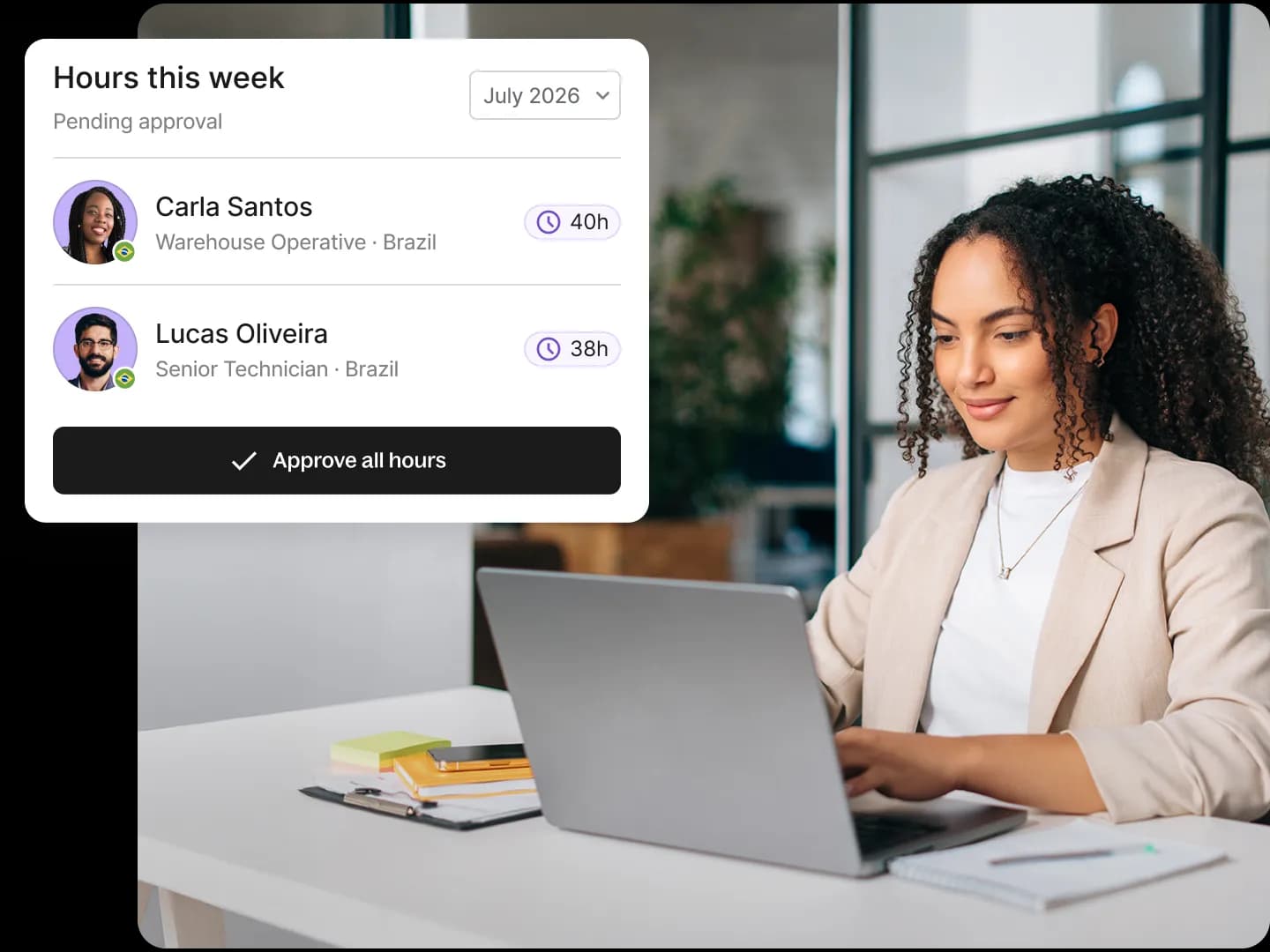
Time tracked. Payroll trusted. Nothing to reconcile.
How Deel handles global overtime compliance
Deel Payroll calculates overtime by jurisdiction, applying each country's threshold, multiplier structure, and applicable exemptions to payroll runs without requiring manual configuration per pay cycle. When hiring with Deel's EOR solution, Deel's local legal entities apply the correct local overtime rules directly, with compliant documentation maintained as part of the employment record.
Key capabilities include:
Time and attendance: Hours are captured, approved, and synced into payroll automatically, reducing reconciliation effort and supporting compliant pay
Automated overtime calculation: Thresholds and premium rates are configured per country and updated when regulations change, rather than maintained in employer-side spreadsheets
Exemption flagging: Roles flagged as exempt are tracked against local exemption criteria, preventing the accumulating liability of assumed-but-unverified exempt status
Audit trail generation: Every overtime calculation produces a documented record of hours, threshold, multiplier, and payment in precisely the format that responds to labor authority requests
EOR coverage for complex jurisdictions: For markets like Japan (where the 36 Agreement must be on file), Brazil (where the managerial exemption requires verification), and South Korea (where criminal liability exposure makes documentation especially important), Deel's EOR solution places the compliance obligation on a local entity with jurisdiction-specific expertise
Deel does not replace local legal counsel, particularly for CBA interpretation, but it removes the systematic operational risk of running distributed payroll through manual processes.
Summary reference table
| Country | Standard weekly hours | OT trigger | Standard OT premium | Cap and notes |
|---|---|---|---|---|
| United States | 40 hrs | >40 hrs/week | 1.5x | Daily OT in some states (e.g., California) |
| Canada | Varies by province | 40-44 hrs/week | 1.5x | Daily triggers in BC and Alberta |
| United Kingdom | 40 hrs | No fixed threshold | None statutory (NMW floor) | 48-hr cap with opt-out |
| Germany | 40 hrs (8/day) | >8 hrs/day | 1.25x (typical, not statutory) | Max 10 hrs/day; Sunday prohibited |
| France | 35 hrs | >35 hrs/week | 1.25x (hrs 36-43), 1.5x (44+) | 220-hr annual cap |
| Netherlands | 40 hrs | CBA-dependent | None statutory | High earners exempt from Working Hours Act |
| Spain | 40 hrs | >40 hrs/week | None statutory (CBA typically sets 100%–175%) | 80-hr annual cap |
| Brazil | 44 hrs | >44 hrs/week | 1.5x (regular), 2x (Sunday/holiday) | Max 2 hrs OT/day |
| Mexico | 48 hrs (phasing to 40 hrs by 2030) | >48 hrs/week | 2x (first 9 hrs), 3x (above) | No TOIL; public holidays at 3x; thresholds shift annually under 2026-2030 reform |
| South Korea | 40 hrs | >40 hrs/week | 1.5x | 52-hr weekly cap; criminal liability for violations |
| Japan | 40 hrs | >40 hrs/week | 1.25x (regular), 1.5x (>60 hrs/month) | 360-hr annual cap; 36 Agreement required |
| Australia | 38 hrs | >38 hrs/week | 1.5x (first 2 hrs), 2x (above) | Award-specific; managerial roles by contract |
| India | 48 hrs (factory) | >48 hrs/week | 2x | Code on Wages/OSH Code (2025); 125-hr quarterly cap; state law varies for office workers |
| Philippines | 8 hrs/day | >8 hrs/day | 1.25x | Night differential stacks with OT premium |
| Singapore | 44 hrs | >44 hrs/week | 1.5x | Dual threshold: workmen ≤SGD 4,500/mo, non-workmen ≤SGD 2,600/mo; 72-hr monthly OT cap |
| UAE | 48 hrs | >48 hrs/week | 1.25x (regular), 1.5x (10pm-4am/rest day/holidays) | Max 2 hrs/day OT; 144 hrs per 3-week cap |
| Saudi Arabia | 40 hrs | >40 hrs/week | 1.5x | 35-hr week during Ramadan |
| South Africa | 45 hrs | >45 hrs/week | 1.5x (regular), 2x (Sunday) | 10-hr weekly OT cap; senior staff exempt above earnings threshold (R269,600.90/yr as of May 2026, adjusted periodically) |
| Nigeria | 40-48 hrs (contractual) | Contract/CBA-defined | Not statutory; ~1.25x is common practice | No statutory OT rate — set by contract, CBA, or Wages Board |
| Poland | 40 hrs | >40 hrs/week | 1.5x (weekday), 2x (Sunday/holiday) | 150-hr annual cap (CBA may extend to 416 hrs) |
Simplify overtime management with Deel
Running a global workforce without jurisdiction-specific overtime infrastructure is a liability that accumulates silently until a labor audit or employee complaint surfaces it.
The countries covered here represent dozens of distinct threshold, multiplier, and enforcement combinations, and the gap between "we pay overtime" and "we pay overtime correctly in every jurisdiction" is where back-pay liability lives.
Deel manages overtime calculations across jurisdictions with the kind of automated, audit-ready approach that manual tracking cannot match at scale.
Teams that span multiple countries and rely on spreadsheets or per-country manual processes for overtime compliance carry a gap worth closing before a regulator does it for them. Book a demo below to see how Deel handles overtime compliance across your specific markets.
Deel Payroll
Run payroll on one platform, globally

FAQs
Is overtime calculated weekly or daily, and does it matter which?
It depends on the jurisdiction. The US uses a weekly basis under the FLSA (40 hours/week), but California layers in a daily threshold (8 hours/day) that can trigger overtime even if the weekly total is under 40. Australia, Germany, and Japan apply daily working time limits alongside weekly ones. Using only a weekly basis in a jurisdiction with daily rules will result in underpayments.
Do salaried employees have the right to overtime pay outside the US?
In most countries, yes. Salaried status does not create an automatic exemption from overtime entitlement. Brazil, France, Germany, South Korea, and Japan all have statutory overtime protections that apply to salaried employees unless specific statutory exemption criteria are met. Companies should not import US exemption logic into non-US employment relationships.
What are the most common triggers for an overtime audit?
The most frequent trigger is an employee complaint (current or former) to the relevant labor authority. Other triggers include sector-wide inspections (retail, hospitality, healthcare), regulatory cross-referencing during social contribution audits, and third-party union complaints. Audits initiated by a complaint typically review all employees in a similar classification, not just the complainant.
How far back can employees claim unpaid overtime?
Limitation periods vary significantly: three years (or six for willful violations) under the US FLSA, up to five years in France, three years in Germany, six years in the UK, six years in Australia under the Fair Work Act, and three years in Brazil. An employee departing on poor terms in any of these jurisdictions may file a claim covering the full limitation period.
Can overtime pay be built into an annual salary?
Some jurisdictions allow it under specific conditions. The UK permits contractual overtime arrangements as long as total compensation meets minimum wage for all hours worked. France allows a forfait heures or forfait jours regime for qualifying employees, but this requires a formal written agreement. The UAE explicitly prohibits embedding overtime into annual salary and requires it to appear as a separate payment.
What is the risk of getting overtime wrong in South Korea?
South Korea carries the highest statutory criminal exposure in this guide. Article 110 of the Labor Standards Act provides for fines up to KRW 20,000,000 (approximately $15,000 USD) and imprisonment up to two years for violations of the 52-hour cap. Most other jurisdictions impose civil and administrative penalties rather than criminal sanctions, but the financial exposure from multi-year back-pay claims can be substantial regardless.
Explore more Deel compliance resources
Shannon Ongaro is a content marketing manager and trained journalist with over a decade of experience producing content that supports franchisees, small businesses, and global enterprises. Over the years, she’s covered topics such as payroll, HR tech, workplace culture, and more. At Deel, Shannon specializes in thought leadership and global payroll content.