
Article
6 min read
How Deel's ATS Closes the Gap Between Recruitment and Onboarding (And Why It's Important)
Global HR

Author
Ellie Merryweather
Last Update
April 06, 2026

Key takeaways
1. Gaps appear in your hiring and onboarding when you manage processes with separate systems.
2. These breakdowns slow down hiring, impact productivity, and affect the candidate experience — ultimately damaging your employer brand.
3. Deel’s ATS can provide the missing link and directly connect applicant tracking with your HRIS for a more unified system.
It’s the moment your team has been working toward for weeks. The candidate has accepted, the offer letter has been signed, and the news has been announced on the company Slack.
Before you have a chance to celebrate, the scramble starts. Someone has to manually move the candidate data into the HRIS, another person has to trigger the onboarding workflow, and yet another person has to send the candidate the paperwork.
And somewhere in that handoff, things go wrong. Nothing’s ready for the candidate’s first day, and you have to message them to apologize and push back the start date.
Why does this gap in the hiring process exist in the first place? This article explores where the disconnect comes from, what it costs your business, and what it looks like when hiring and onboarding are genuinely connected.
The gap nobody talks about
The issue comes down to your processes. When recruitment and onboarding live in separate systems, the handoff between them is manual by default.
And manual means slow, inconsistent, and error-prone.
Issues first start to appear in your data workflows. HR must copy all the candidate’s information into your HRIS by hand, which creates small inconsistencies straight away. A typo here, a missing field there. Sometimes duplicate records.
Once the data’s in your system, someone needs to trigger the onboarding workflow. This depends on everyone having a clear sense of who owns the next step and when it needs to happen. When your system doesn’t provide a clear way to manage handoff, the workflow gets triggered late — and sometimes not at all.
All these errors and delays show up in your onboarding process. Either you keep adjusting the timeline to give your team a chance to catch up and fix all the mistakes. Or the new hire arrives for their first day without system access, equipment, or a clear plan.
These issues aren’t limited to the onboarding phase. All the different people involved continue to rely on mismatched systems as the employee settles into their role. This leads to months of checking, chasing, and correcting details.
Simply put, the gap exists because recruiting and onboarding tools aren’t built to talk to each other, so humans must take over. And that’s when things break.

What the fragmentation actually costs your business
Gaps create real issues for your company that extend well beyond individual hires. The impact of disconnected hiring and onboarding processes ripples across departments and compound over time. Left unchecked, they can start to affect overall business performance.
Here’s where you tend to see that impact:
-
Timing and efficiency: Every manual handoff slows down hiring and onboarding processes and creates extra work for all the team members involved
-
Bottlenecks: Sometimes issues force you to pause the hiring process altogether. For instance, remote hiring teams may struggle to communicate via the system and have to wait for a verbal approval from a manager in a different time zone, causing them to lose 24 hours
-
Productivity: Delays also mean essential positions remain vacant for longer and new hires spend their first days waiting and clarifying details instead of beginning work
-
Candidate experience: Bumpy onboarding processes give applicants a poor first impression of your company and make it harder for them to settle into the role. 54% of people said a bad experience would make them lose trust in the company
-
Employer brand: Employees are likely to talk to their network about a poor onboarding experience. Their feedback may reach other candidates who were considering a role at your organization or moving through your pipeline, causing them to pull out
-
Compliance risk: Missing, incorrect, or incomplete files can lead to legal issues. For example, businesses might incur penalties for failing to transfer candidate records securely per local data protection laws
What a unified hiring system looks like
When your Applicant Tracking System (ATS) and HRIS are the same, there are no gaps. The process simply keeps moving from workforce planning to hiring and eventually to onboarding.
Below is the journey your team would take when you synchronize hiring and onboarding tasks with Deel’s ATS:
Deel HR
Step 1. Workforce planning
Someone resigns from your company, or you identify a skills gap. With AI insights from Deel’s Workforce Planning tool, you’ve already anticipated this scenario and prepared for it in advance. You approve the role you’ve outlined, and the data flows directly into a job requisition in your ATS.
Deel also gives you real-time visibility into global salary benchmarks and your headcount budget. You can use these insights to set a fair and competitive salary for the role.
Step 2. Job posting and candidate sourcing
AI helps generate a job description based on the role you’ve defined. It tailors the description to the role and location, so it reflects your requirements rather than a generic template. Within minutes, you have a compliant listing ready to publish to LinkedIn.
Step 3. Candidate screening
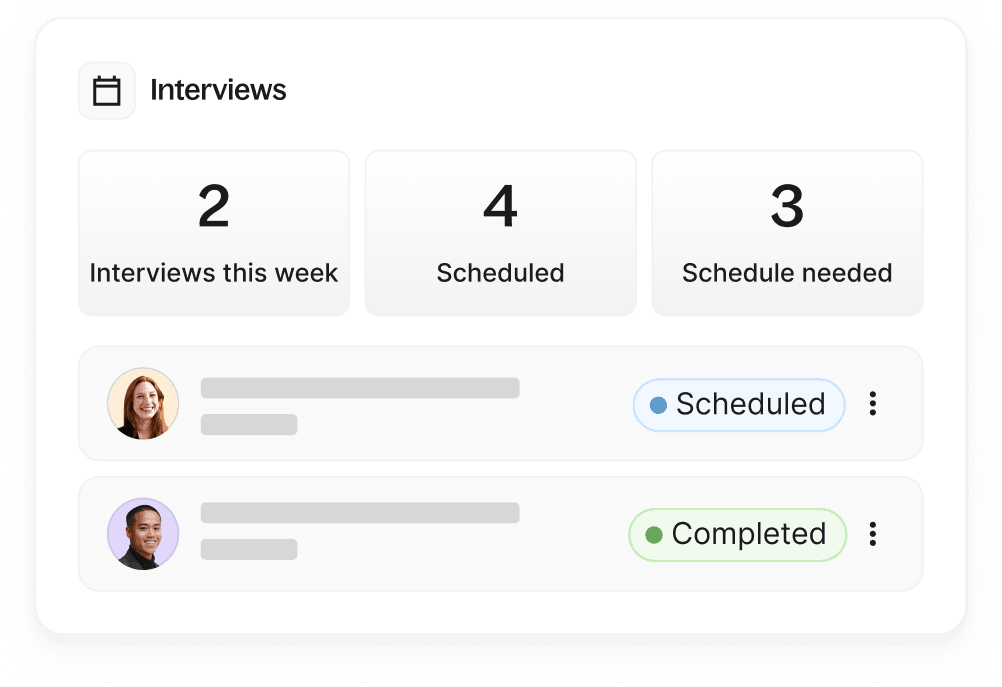
Candidates start applying for the position. As their application data flows into Deel’s system, our powerful AI tools automatically screen and score them based on the criteria you identified in the HRIS. Meanwhile, your team can focus on interviewing the top contenders with the benefit of increased visibility into the hiring pipeline.
Step 4. Offer and preboarding
Everyone reviews the notes and scores in the ATS and agrees on a candidate. You make them an offer.
Once they accept, Deel’s ATS automatically creates a worker record in your HRIS. You can also use the system to generate a compliant contract based on the job description and candidate data. In the minutes it takes to handle these tasks, the system automatically checks all the relevant databases to accelerate background check completion.
If needed, Deel’s global solution also offers visa, immigration, and relocation support for international teams.
Step 5. Onboarding and orientation
Deel’s onboarding, payroll, and benefits enrollment processes kick off immediately to shorten time from offer to start date — with no manual trigger necessary.
- Global payroll automatically calculates salaries, taxes, and deductions and transfers payments for employees in the next cycle
- New hires are invited to review and enroll in relevant benefits through a self-service process
- All the forms are generated and sent for signatures to reduce paperwork for new employees on the first day
- Centralized applicant onboarding documentation makes it easier for teams to track candidate progress, even remotely
- The HRIS provisions IT equipment and delivers it to employees ahead of their start date
The connected hiring and onboarding experience
A connected system means the hiring and onboarding process runs cleanly from one step to the next.
We’ve seen the benefits for your company. Now let’s explore what that feels like for the people actually going through the processes.
For the candidate stage
The application process sets the tone early. Candidates can easily apply for open positions via LinkedIn and other job boards and get a feel for your company culture from the customized description. Once they’ve sent the application, they receive timely updates, so they’re never left wondering about their status or chasing after information.
Impressed by the experience, the candidate accepts the position as soon as it’s offered to them. They immediately move to the onboarding phase. While they’re introduced to new team members, it doesn’t feel like they’re being handed off between departments because everyone is working from the same information and there are clear next steps.
An invite to join the company system arrives shortly after. The candidate finds the paperwork and the compliance steps easy to understand and completes them quickly. They were nervous before, after several negative past hiring experiences, but now they can finally let themselves get excited about the new role.
For the onboarding stage
The first weeks at your company are about getting oriented rather than catching up on basic paperwork, reinforcing new hires’ positive impression of your organization.
Day one is strictly about introducing the worker to the team. Employees already have access to the system and all the equipment they need so they don’t have to worry about following up with IT. Better yet, everyone is prepared for their arrival and doesn’t ask them repeat questions or keep them waiting.
The following days maintain this early momentum by helping new hires settle into their role. They can join real work immediately whether that’s meetings, tasks, or projects. Every passing day confirms their decision to accept the role was the right one and they urge some former colleagues to apply as soon as they see an open position at your company.
Why Deel HR customers should think twice before using a standalone ATS
You may be questioning whether to extend your HRIS or add a new ATS tool to your stack. If you’re an existing Deel customer, here’s why keeping everything within one system is the best choice.
-
Minimal setup: Adding ATS to Deel isn’t a new implementation — it’s activating a module on infrastructure you already have. You don’t have to prepare for a long rollout process with the possibility of confusion and delays
-
Less IT involvement: There are no new integrations to build or maintain. This reduces the burden on your IT team, minimizes manual data entry during hiring, and prevents candidate data loss during handoff
-
Familiar processes: The same employee data, workflows, and compliance logic you’ve been using in your HRIS extend to your ATS. You don’t have to introduce your company to a new system or train your team how to use it from scratch
-
Smarter tools: Every module you add to Deel HR makes our AI-powered system more intelligent. The ATS and HRIS share hiring data to give you more powerful insights about workforce planning, compensation, and performance — and make more informed strategic decisions over time
By comparison, a standalone ATS requires someone to maintain the integration with your HRIS. That connection is fragile, more open to issues, and still doesn’t eliminate manual steps at the seams.
Deel's HRIS

Bring your hiring process together with Deel’s ATS
Gaps between recruitment and onboarding create friction at a critical moment. They slow down hiring, introduce risk, and leave new hires with a poor first impression.
When you remove those gaps, hiring becomes a smooth, continuous process. And that shift shows up quickly. Teams move faster, new employees settle in sooner, and hiring truly reflects your company culture.
Closing gaps doesn’t require another tool. Teams already using Deel’s HRIS can simply activate our ATS as a module and extend the system you already rely on. Hiring will run on the same data, workflows, and compliance logic before, with no extra integrations to manage.
Want to remove the friction from hiring? Book a demo with the Deel team to see our ATS in action and talk about adding it to an existing plan.
Live Demo
Get a live walkthrough of the Deel platform

Ellie Merryweather is a content marketing manager with a decade of experience in tech, leadership, startups, and the creative industries. A long-time remote worker, she's passionate about WFH productivity hacks and fostering company culture across globally distributed teams. She also writes and speaks on the ethical implementation of AI, advocating for transparency, fairness, and human oversight in emerging technologies to ensure innovation benefits both businesses and society.


