Article
5 min read
How to Hire a Worker in Illinois: A Step-by-Step Guide for Employers
US payroll
PEO

Author
Shannon Ongaro
Last Update
September 16, 2026

Table of Contents
Illinois employment law basics
Illinois payroll taxes
Worker classification in Illinois
How to choose the right hiring model for Illinois
Managing Illinois workers after hire
Hire and pay Illinois workers with Deel
Key takeaways
Illinois layered employment law (state wage rules, Chicago and Cook County local ordinances, and mandatory workers' compensation) makes hiring more complex than in most US states.
Illinois applies an ABC test that presumes employee status by default, raising the bar for independent contractor classification compared to federal standards.
Deel supports hiring, payroll, and worker management in Illinois and across all 50 US states.
This article is provided for general informational purposes and should not be treated as legal, tax, or professional advice. Consult a qualified professional for guidance specific to your situation.
Illinois ranks among the country's most worker-protective states. Its at-will employment baseline coexists with a dense layer of state wage, anti-discrimination, and pay-equity laws.
If your hire works in or around Chicago, a separate municipal ordinance layer adds further requirements. If you don't have a US entity, you need an employer of record to hire in Illinois.
This guide walks through every decision point (employment law basics, payroll tax obligations, worker classification rules, and hiring-model options) so you can make your first Illinois hire compliantly, regardless of where your business is incorporated.
Illinois employment law basics
Understanding Illinois employment law before your first hire protects you from liability that can compound quickly. Here's what every employer needs to know.
At-will employment
Illinois is an at-will state, meaning either party can end the employment relationship at any time, for any lawful reason, without advance notice. Practical exceptions exist. Written employment contracts, implied promises in offer letters, and public-policy exceptions can all limit at-will termination, so legal review of any offer language is advisable before you commit it to writing.
Illinois Minimum Wage Law
The statewide minimum wage is $15.00 per hour. Chicago employers must pay at least $17.05 per hour, and a separate Cook County ordinance sets a $15.40 hourly minimum for workers in unincorporated areas. Some Cook County municipalities have opted out of the county ordinance, so confirm local applicability before your first pay run. Tipped worker rules differ from these base rates. For a full breakdown of Illinois employment and labor laws, including wage schedules and exemptions, consult the Illinois Department of Labor (IDOL).
Illinois Wage Payment and Collection Act
This law governs how and when employees must be paid. Employers must pay wages at least semi-monthly and deliver final paychecks by the next regular payday following separation. Violations can result in penalties and interest. The IDOL employer resources page covers current requirements.
Illinois Human Rights Act
Illinois law requires employers to comply with broad anti-discrimination protections covering race, color, religion, sex, national origin, ancestry, age, marital status, disability, military status, sexual orientation, gender identity, and pregnancy status, among other categories. The thresholds for coverage are lower than federal law in several respects.
Illinois Equal Pay Act
Illinois prohibits asking job candidates about their salary history during the hiring process. Separately, employers with 100 or more Illinois employees must obtain an Equal Pay Registration Certificate (EPRC) and submit pay, demographic, and workforce data to IDOL. These are distinct obligations: the salary history ban applies to all employers regardless of size, while the EPRC requirement applies only to those at the 100-employee threshold.
Federal FMLA
Illinois doesn't have a general state family and medical leave law for private-sector employers. Federal FMLA applies to private employers with 50 or more employees, providing eligible workers up to 12 weeks of unpaid, job-protected leave. Illinois does have narrower leave statutes (including leave for crime victims, school visitation, and organ donation) that apply separately.
Guide
Step-by-Step Guide to US Payroll
Illinois payroll taxes
Illinois payroll taxes are employer-administered at both the federal and state level. Here's what you're responsible for before the first paycheck clears.
Federal FICA and FUTA
All Illinois employers must withhold and match Social Security (6.2% each, up to the annual wage base) and Medicare (1.45% each, with an additional 0.9% employer withholding on wages exceeding $200,000). Federal Unemployment Tax (FUTA) is employer-paid at 6.0% on the first $7,000 of each employee's wages, effectively 0.6% after the state tax credit. Full details are in IRS Publication 15.
Illinois income tax withholding
The Illinois Department of Revenue sets a flat withholding rate of 4.95% on all taxable wages after allowances. Unlike progressive-rate states, there are no brackets. The same percentage applies regardless of earnings level. Employers file Form IL-941 quarterly through MyTax Illinois and issue W-2s by January 31 of the following year.
Illinois State Unemployment Insurance (SUI)
SUI is an employer-paid tax administered by the Illinois Department of Employment Security (IDES). For 2026, the new-employer standard rate is 3.350%, applied to the first $14,250 of each employee's wages. After three years of claims history, IDES assigns an experience-based rate. For a full breakdown of Illinois-specific payroll tax calculations and filing schedules, see our Illinois payroll tax guide. Register with IDES within 30 days of hiring your first Illinois employee and file quarterly using Form UI-3/40 through MyTax Illinois.
New-hire reporting
All Illinois employers must report new hires to the IDES New Hire Directory within 20 days of the employee's first day of work. Reports include the employee's name, home address, Social Security number, and start date, plus the employer's Federal Employer Identification Number. You can submit the report online at ides.illinois.gov.
Compliance
Unlock Continuous Compliance™ with Deel
Worker classification in Illinois
Getting classification right before you bring someone on is far less expensive than correcting it after a state audit or lawsuit. Illinois applies both federal and state tests.
Federal standards
The IRS and Department of Labor each apply their own classification framework. The IRS uses a multi-factor behavioral and financial control analysis (sometimes called the "common law" test). The DOL uses an "economic reality" test focused on whether the worker is economically dependent on the employer. Federal standards govern federal tax and wage-and-hour obligations.
Illinois ABC test
For state unemployment insurance and certain wage-law purposes, Illinois applies an ABC test that presumes worker status is "employee" unless the employer can establish all three prongs:
(A) the worker is free from the employer's control and direction
(B) the work performed is outside the usual course of the company's business
(C) the worker is customarily engaged in an independently established trade, occupation, or business
You must satisfy all three prongs to classify a worker as an independent contractor. As the Deel misclassification guide explains, this is a more demanding standard than the federal test. Many workers who would pass the federal analysis fail the ABC test's "B" prong.
Illinois Employee Classification Act penalties
Misclassification under Illinois law can expose an employer to back wages and benefits owed to the misclassified worker, payroll tax liabilities for the unpaid period, and civil penalties from both IDOL and IDES. The Illinois Workers' Compensation Commission also investigates classification issues, since workers' compensation coverage is mandatory for employees. The financial exposure from a single misclassified worker can be substantial, particularly when penalties, interest, and back taxes are calculated together.
Practical guidance
If you're uncertain whether a working arrangement qualifies as independent contractor engagement, consult legal counsel before the first invoice. The cost of a classification review is orders of magnitude lower than the cost of a misclassification finding.
How to choose the right hiring model for Illinois
Before you choose a hiring path, answer four questions:
Does your company have a US legal entity registered to do business in Illinois?
Is this a long-term, full-time role or a defined-scope project?
How large is the team you're building: one person, a small group, or a department?
Do you have in-house HR and payroll infrastructure, or will you need external support?
Your answers point toward one of four models. Each works well in the right situation.
Direct hire
How it works: Your company hires the employee directly, runs payroll through your own registered Illinois entity, and takes on full employer-of-record responsibilities. That includes tax withholding, SUI contributions, benefits, and compliance with all applicable Illinois and local ordinances.
When it works best: Direct hire is the right path for companies that already have an Illinois entity, a payroll infrastructure, and experienced HR or legal support. It's also typically the most cost-efficient model at scale once the compliance infrastructure is in place.
Deel solution: Deel Payroll - US supports payroll processing and applicable federal and state payroll tax filings for direct-hire employees in Illinois and across the US, while your company remains the legal employer and approves payroll inputs.
Employer of record (EOR)
How it works: A third-party EOR, like Deel, becomes the legal employer of your Illinois worker on paper. The EOR runs payroll, handles tax withholding and filing, provides benefits, and ensures compliance with Illinois employment law. You direct the worker's day-to-day activities as the client company.
When it works best: EOR can provide a faster route to hiring in Illinois than establishing and registering your own entity, subject to worker onboarding and compliance checks. It's the right path when your company doesn't have a US entity or doesn't want to set one up for one or a small number of roles. For more on when EOR makes sense, see the pros and cons of employer of record hiring and the EOR vs. PEO comparison.
Deel solution: Deel's EOR solution supports hiring Illinois employees without establishing your own US entity, including payroll, benefits administration, workers' compensation, and compliance with applicable state and local employment requirements.
Professional employer organization (PEO)
How it works: In a PEO arrangement, Deel and your company enter a co-employment relationship. Deel supports payroll, benefits, and HR administration, while your company remains the worksite employer and directs employees' day-to-day work. Unlike an EOR, a PEO arrangement requires that your company already has (or establishes) a US legal entity.
When it works best: PEO is well-suited to growing companies with a US entity that want to outsource HR administration, access PEO-sponsored benefits plans, and reduce the compliance burden of operating in multiple states simultaneously.
Deel solution: Deel's PEO solution provides co-employment services in Illinois, supporting payroll tax filings, unemployment insurance, workers' compensation, and HR administration while your team focuses on running the business.
Independent contractor engagement
How it works: For a properly classified independent contractor, the client generally does not withhold employee payroll taxes or provide employee benefits. The contractor invoices you and manages their own taxes.
When it works best: Contractor engagement is appropriate for defined, project-scope work where the worker genuinely operates an independent business and satisfies all three prongs of the Illinois ABC test. It is not an appropriate substitute for an employee role structured as a contractor relationship to avoid employer costs. That is precisely what Illinois's misclassification framework targets.
Deel solution: Deel's Contractor solution supports contractor agreements, payments, W-9 collection, and applicable 1099 issuance for US-based independent contractors, centralizing agreements, payment records, and tax documentation in one place.
Deel Hire
Planning to expand into the US?
Managing Illinois workers after hire
Bringing an employee on board is the beginning, not the end, of your compliance obligations. Here's what to manage on an ongoing basis.
Benefits administration
Under the Affordable Care Act, employers with 50 or more full-time equivalent employees are Applicable Large Employers (ALEs) and must offer qualifying health coverage to full-time employees. Chicago employers are also subject to the Chicago Paid Leave Ordinance, which requires employers to provide paid leave to covered employees. Deel Benefits supports benefits enrollment and health plan administration for eligible US employees, including those in Illinois.
IT provisioning and device management
Equipping a new Illinois hire (whether remote or hybrid) with the right hardware from day one reduces security risk and onboarding friction. Deel IT manages device procurement, configuration, and shipping to employees wherever they're located, along with device retrieval when the employment ends.
Mobility support
If your Illinois hire is a non-citizen worker, or if you're relocating a foreign national to Illinois, immigration compliance is a distinct requirement layered on top of standard employment obligations. Deel Mobility supports work authorization processes for eligible workers, including several US visa and work-permit routes.
HRIS and time-tracking integration
Managing attendance, time off, and performance data across a growing team requires a system of record that keeps Illinois-specific accruals and leave policies accurate. Deel HR is the workforce lifecycle system, built on an HRIS foundation that centralizes employment records, time off, and workforce data and connects with payroll workflows.
Hire and pay Illinois workers with Deel
Deel brings compliant hiring, payroll, benefits, and worker management together into one platform. You can start where you need to, and scale without re-implementing, whether you're hiring one independent contractor, a handful of employees, or expanding an enterprise into additional states.
Book a demo below to see how Deel can support your workforce management in Illinois and beyond.
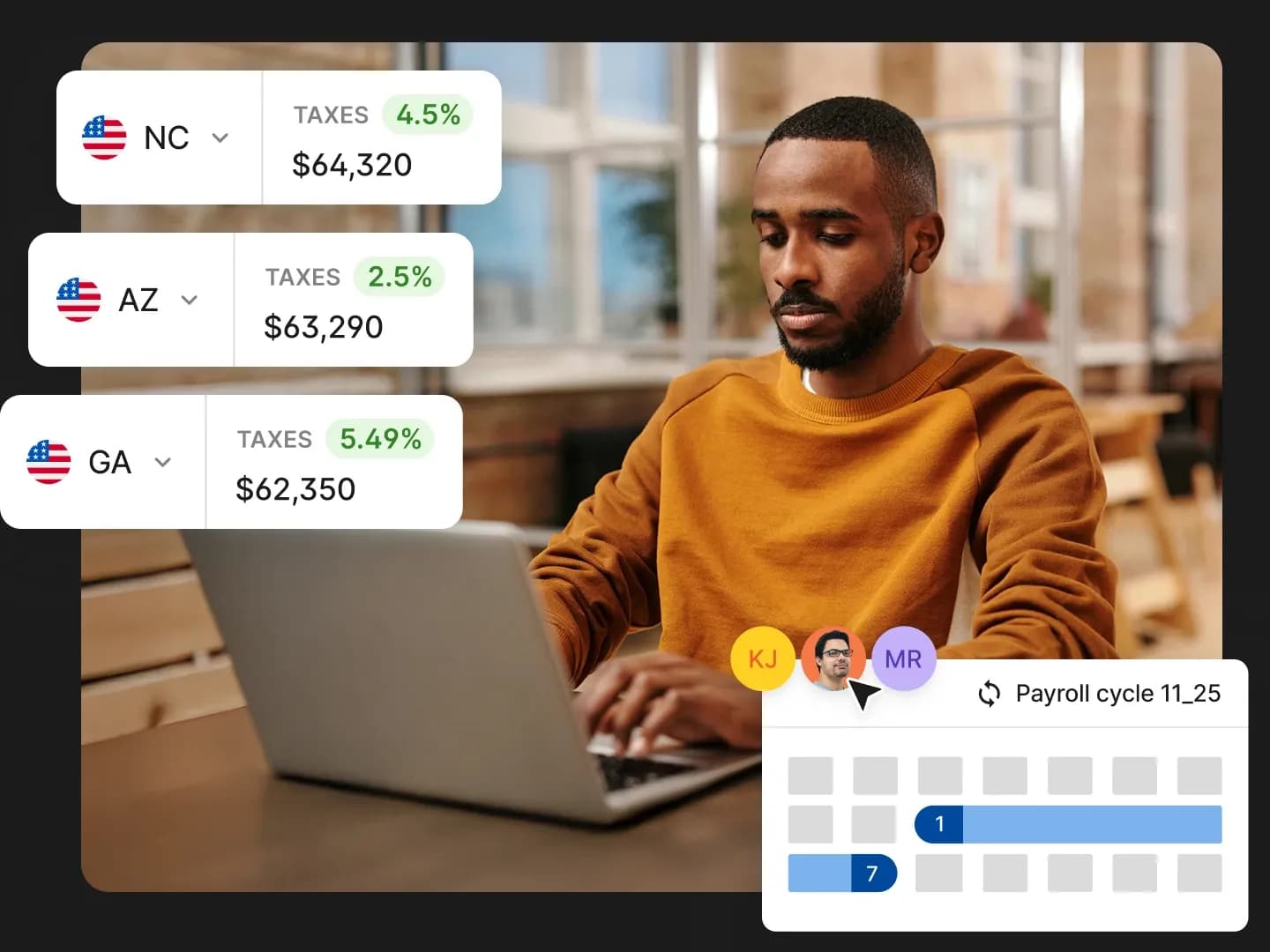
Deel Payroll - US
Stay compliant, save time, and pay your US team with confidence
FAQs
Does Illinois require workers' compensation insurance for all employers?
Yes. Illinois requires virtually all employers to carry workers' compensation insurance, regardless of company size. Coverage must be in place before any employee begins work. The Illinois Workers' Compensation Commission (IWCC) oversees compliance and enforcement.
How does new-hire reporting work in Illinois?
Employers must report every new hire to the IDES New Hire Directory within 20 days of the employee's first day on payroll. You can submit reports online through ides.illinois.gov. Reports must include the employee's name, address, Social Security number, and start date, along with the employer's Federal Employer Identification Number.
Can a foreign company hire Illinois workers without a US entity?
Yes, through an employer of record (EOR). A foreign company without a US entity can use Deel's EOR solution, through which the EOR serves as the legal employer in Illinois and handles payroll, tax filings, benefits, and applicable employment compliance. The foreign company directs the worker's activities.
What is the difference between a PEO and an EOR for Illinois hiring?
An EOR serves as the sole legal employer of your Illinois workers and does not require you to have a US entity. A PEO enters a co-employment arrangement with your existing US entity, sharing administrative and HR responsibilities. EOR is typically the faster path for companies entering the US market. PEO is better suited to established US employers looking to streamline HR administration and access pooled benefits pricing.
Shannon Ongaro is a content marketing manager and trained journalist with over a decade of experience producing content that supports franchisees, small businesses, and global enterprises. Over the years, she’s covered topics such as payroll, HR tech, workplace culture, and more. At Deel, Shannon specializes in thought leadership and global payroll content.