
Article
17 min read
The Ultimate Guide to Performance Management Frameworks for Rapidly Scaling Companies
Global HR

Author
Lorelei Trisca
Last Update
December 17, 2025
Table of Contents
What is a performance management framework?
Key performance management frameworks for growth
Building a scalable performance management framework
Key challenges and best practices for scaling organizations
Regardless of your chosen framework, drive performance with Engage
Key takeaways
- High-growth companies need a performance management structure that keeps pace without slowing them down.
- A well-run system aligns everyone to company priorities, raises engagement through clear expectations and coaching, improves retention by linking growth, feedback, and recognition, and enables fair, consistent decisions on pay, promotion, and mobility.
- Technology is a force multiplier for scalability, transparency, and compliance. It standardizes workflows, reduces manual effort, and gives leaders real-time visibility into goal progress, feedback, and talent decisions—especially important for global teams.
As headcount climbs from 50 to 500, informal performance reviews and ad-hoc goals quickly break down. A scalable performance management framework gives growing companies a single operating system for clarity, accountability, and development. In practice, that means connecting strategy to team objectives, building continuous feedback into the flow of work, and using technology to automate workflows and measurement.
Learn how to choose the right framework for your organization and integrate it with your HR tech stack, so you maintain alignment, fairness, and speed as you scale globally.
What is a performance management framework?
A performance management framework is a continuous process that involves setting expectations, assessing performance, and developing employees to align individual roles with company objectives. When done well, it streamlines performance measurement, improves talent management, and fuels employee development.
Who does what in a performance management framework:
- HR designs the framework, calibrates standards, and enables tools and training.
- Managers set goals, coach continuously, and make fair, data-driven decisions.
- Employees co-create goals, seek feedback, and own their development.
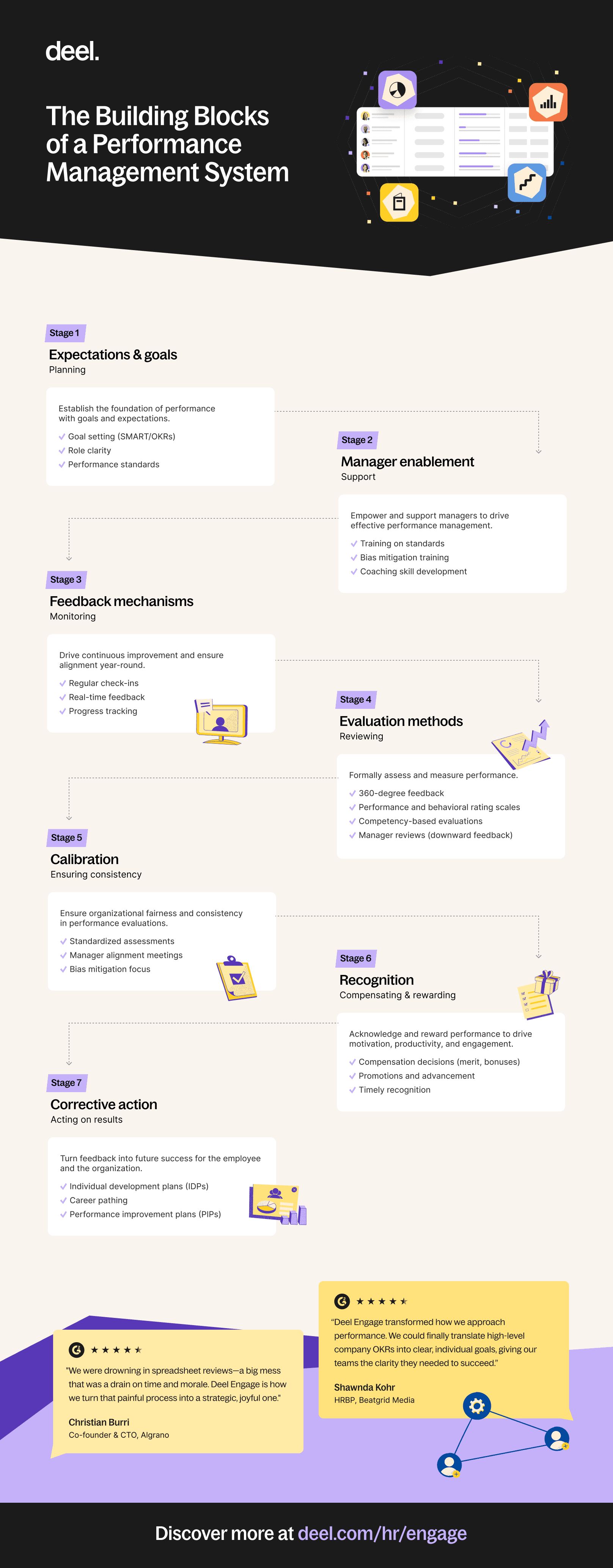
A simple performance cycle most scaling companies can adopt would look like this:
- Plan: set company, team, and individual goals; define success metrics
- Align: communicate expectations and role contributions
- Execute: track progress and remove blockers
- Coach: enable continuous feedback and quarterly check-ins
- Review: evaluate outcomes, behaviors, and impact
- Develop: connect insights to learning, growth, and rewards
- Improve: iterate the process with data and feedback
Benefits at scale include clearer goal alignment, more objective evaluations, and consistent development pathways across role families.
Key performance management frameworks for growth
HR leaders typically adopt one of several proven approaches, or a hybrid, to balance goal alignment with continuous feedback.
| Framework | What it is | Strengths | Best when | Company examples |
|---|---|---|---|---|
| OKRs | Ambitious objectives paired with measurable key results to drive focus and transparency | Cross-functional goal alignment, innovation, outcome focus | Fast-changing environments; product and platform teams | Popularized in scaling tech companies, especially Google |
| MBO (Management by objectives) | Individual objectives aligned to business goals; performance evaluated on achievement | Clear accountability, straightforward measurement | Results-driven roles (sales, delivery, consulting) | Intel historically |
| Continuous performance | Ongoing check-ins and frequent feedback instead of annual reviews | Agility, coaching culture, real-time course correction | Remote/distributed teams; rapid iteration | Adobe, Deloitte, GE, Spotify |
| Traditional annual reviews | Once-a-year formal appraisals assessing results and behaviors against predefined expectations | Comprehensive documentation, compliance, clear year-end decisions | Stable environments; compliance-heavy or hierarchical orgs | Common in established enterprises |
| 360-degree feedback | Multirater assessments that gather input from peers, direct reports, managers, and self | Reduces bias; provides rounded insights | Org cultures that value collaboration, self-awareness, and development | Popularized by Netflix |
| Competency-based framework | Role- and level-based competencies with behavioral indicators to assess skills and behaviors | Encourages development and consistency in role expectations | Orgs investing in upskilling, internal mobility, or leadership development | Common in enterprises with defined career frameworks |
Objectives and key results (OKRs)
OKRs are a goal-setting framework that combines ambitious goals (objectives) with measurable outcomes (key results) to promote alignment, transparency, and innovation.
Scaling tech companies embraced OKRs to keep teams focused on outcomes and maintain strategic clarity as complexity grew; the approach’s emphasis on visibility and cadence makes it well suited to rapid growth.
Company-wide dashboards that roll up objective and key result progress help leaders spot bottlenecks early, a capability common in modern platforms such as the dashboards described in PeopleGoal’s guide to performance software.
Set OKRs using the goals module in Engage. Connect company, team, and individual goals so progress, blockers, and results are visible in one place.

Goals dashboard on Engage
Management by objectives (MBO)
MBO is a performance approach where employees set specific individual objectives aligned to business goals and are evaluated on their achievement. This framework works especially well in results-driven environments (e.g., sales or consulting) where accountability and measurable outputs are paramount.
Intel embedded MBO principles during expansion to preserve clarity and focus. Compared with OKRs, MBO tends to be more individual and output-focused, while OKRs emphasize cross-functional alignment, stretch, and learning.
Continuous performance management
Continuous performance management replaces annual reviews with frequent, informal check-ins and ongoing feedback, supporting agility and engagement.
Companies such as Adobe (its “Check-in” model), Deloitte (quarterly snapshots), GE, and Spotify popularized this shift to get more accurate, real-time feedback and reduce attrition while moving faster.
The model is especially effective for remote and rapidly changing teams. Digital check-in tools typically include lightweight agendas, note-taking, action tracking, and pulse surveys.
Traditional annual performance reviews
In a traditional annual review model, employees and managers complete a formal appraisal once per year, often tied directly to compensation and promotion decisions. The cadence provides comprehensive documentation and predictability for planning cycles, which can be valuable in stable or compliance-driven environments.
However, without interim check-ins, feedback can be delayed and less actionable. Many growing companies modernize this model by adding mid-year reviews, quarterly goals, or continuous feedback to reduce recency bias and improve coaching while retaining the year-end decision point.
360-degree feedback
360-degree feedback gathers performance input from multiple sources—peers, direct reports, managers, and self—through multirater assessments. It’s often used as input for reviews or development planning and works best in org cultures that value collaboration, self-awareness, and growth.
Strengths of this approach include reduced bias and more rounded insights, while limitations include the time required and the potential for emotionally charged feedback if not well-facilitated.
Many companies pair 360s with OKRs or MBO to broaden perspective during coaching, calibration, and promotion discussions.

Peer nomination in Engage
Competency-based performance management
A competency-based framework evaluates employees on observable behaviors and role-critical skills using a competency matrix tied to roles and levels, with clear behavioral indicators.
This framework is especially effective for organizations investing in upskilling, internal mobility, and leadership development.
Strengths of this framework include encouraging development and creating consistency in role expectations, while limitations include the need for a robust, well-defined competency library and ongoing maintenance.

Building a scalable performance management framework
Use this practical blueprint as you deploy your performance management framework and iterate as you grow.
Follow this implementation checklist:
- Codify company goals and success metrics: Transparent, shared goals give people meaning and purpose, which boosts engagement and performance. Translate strategy into measurable objectives at the company, team, and role level. Example SMART goal: “Increase gross retention from 88% to 92% by Q4 by launching two customer education programs and a renewal playbook.”
- Choose and pilot your chosen framework (or hybrid of multiple frameworks): Match the framework to your company’s operating model and culture. For example, OKRs for cross-functional, product, and platform work, MBO for sales, account management, and project delivery, and continuous models for remote, agile, or R&D-heavy teams. Start with one framework, pilot with a representative group, and adapt. Many high-growth firms blend methods. For example, Spotify pairs agile team rituals with lightweight performance practices to maintain speed.
- Stand up feedback and review cadences: Institutionalize two-way, ongoing feedback that complements your framework. Combine informal tools (weekly one-on-ones, recognition, shout-outs) with structured inputs (quarterly snapshots, project debriefs, pulse surveys). Adobe, Microsoft, and Netflix embed peer and cross-functional reviews to capture impact beyond the org chart.
- Enable technology, automation, and analytics: Move from manual templates to automated platforms to save time and improve data quality. Performance management software features such as workflow automation, dashboards, and analytics materially increase adoption and insight
- Link outcomes to learning and career paths: Performance without growth stalls engagement. Link feedback to coaching, learning pathways, and transparent promotion criteria. Employee development is the continuous process of building skills and creating new opportunities—not just fixing weaknesses. 6 Iterate with data and employee input: Measure clarity, usability, and fairness, and collect qualitative feedback through surveys and debriefs. Then iterate based on outcomes, employee input, and shifting business needs. Treat the performance management program like any product in continuous improvement.
Key challenges and best practices for scaling organizations
As your company grows from a tight-knit team of 50 to a more complex structure of 500, your performance management approach must stretch to accommodate new dynamics—without losing clarity, fairness, or momentum. Here's how the key challenges evolve with scale—and how to get ahead of them.
1. Siloed teams and unclear expectations
The challenge: At 50 people, it’s easy to keep everyone aligned through informal conversations. But as functions expand and reporting lines multiply, teams begin operating in silos, with different interpretations of what good performance looks like.
Best practices:
- Introduce a consistent goal-setting framework (e.g., OKRs or MBOs) that links team goals to company strategy.
- Use competency frameworks to align role expectations and performance standards across teams.
- Train managers to cascade priorities clearly, so employees know how their work supports broader goals.
2. Inconsistent feedback and sparse documentation
The challenge: Smaller teams rely on informal feedback loops. But in a growing org, verbal check-ins get lost, and performance narratives become hard to track, especially for compensation or promotion decisions.
Best practices:
- Adopt continuous performance tools with built-in feedback and tracking to create a documented feedback trail.
- Encourage a culture of ongoing feedback, not just formal reviews.
- Include self-assessments and peer feedback to enrich performance perspectives.
3. Manager capability gaps and uneven calibration
The challenge: Rapid headcount growth often means promoting managers early. Without training, they may struggle to give feedback, handle difficult conversations, or evaluate performance fairly.
Best practices:
- Provide manager enablement programs focused on coaching, feedback, and bias reduction.
- Use performance calibration sessions to align ratings and normalize expectations across teams.
- Embed clear rating definitions and examples in templates to guide consistency.
4. Tool sprawl and data fragmentation
The challenge: Different teams may adopt their own tools for goals, feedback, or reviews, leading to inconsistent data, duplicated work, and limited visibility.
Best practices:
- Choose a scalable performance management system that integrates with your HRIS and supports global teams.
- Centralize templates, rating systems, and documentation in a shared platform to reduce friction.
- Use analytics to identify performance trends, bias, or risk signals as you scale.
The bottom line: Start simple, but scalable. Whether you're using OKRs, 360s, or a hybrid model, choose a performance management framework that brings structure without rigidity—and that evolves alongside your business.
Deel HR

Regardless of your chosen framework, drive performance with Engage
Engage enables organizations to centralize every stage of the performance management process, regardless of their chosen frameworks:
- Set and track goals with clarity and consistency
- Gather feedback from peers, direct reports, and leaders in one place
- Link feedback to company competencies, career frameworks, and values for more objective evaluations
- Calibrate ratings easily across teams to ensure fairness
- Gain holistic insights into skills, strengths, and development needs
- Link feedback to learning courses and programs for a culture of continuous improvement
Engage transformed how we approach performance. We could finally translate high-level company OKRs into clear, individual goals, giving our teams the clarity they needed to succeed.
—Shawnda Kohr,
HRBP, Beatgrid Media
Engage connects seamlessly with Deel’s broader HR ecosystem, from Compensation Management and Workforce Planning to the Deel HRIS. Together, they give you an integrated platform for planning, measuring, rewarding, and developing your workforce.
Ready to turn performance reviews into a strategic advantage? Get in touch to see how Engage will empower your HR and leadership teams to keep your teams growing together.
FAQs
When should we upgrade from manual systems to performance management software?
Manual systems like spreadsheets and standalone templates work in the earliest stages, but they quickly break down as you scale. You should consider upgrading once tracking, sharing, and analyzing reviews becomes inefficient or inconsistent, often around the 50+ employee mark. At that point, you begin to need:
- Formal records that survive personnel changes
- Consistent workflows across teams
- Real‑time visibility into goals and feedback
- Reporting and analytics to inform decisions
Upgrading sooner rather than later prevents painful migrations later and supports a growing, distributed workforce.
How do we align individual goals with organizational objectives?
Alignment happens when goals are cascaded systematically. Use a framework like OKRs or similar goal models to translate high‑level company objectives into team and individual priorities. Manage these within one system so everybody sees the connection between their work and the business’s direction, and leadership can measure progress in real time.
Can we combine frameworks (e.g., OKRs with annual reviews)?
Yes. In fact, a hybrid model often works best in scaling organizations. Many companies pair OKRs for alignment and agility with annual or semi‑annual reviews for compensation and promotion decisions. This approach keeps work nimble while retaining structured evaluation where it matters most.
How do we maintain alignment across departments or locations as we grow?
As your org expands, alignment cannot rely on hallway conversations. Use published company OKRs, shared dashboards, and regular cross‑functional reviews (monthly or quarterly) to spotlight interdependencies. Clear ownership, transparent timelines, and documented decisions keep teams rowing in the same direction.
How do we maintain consistency across growing teams without becoming overly bureaucratic?
Consistency doesn’t mean rigidity. Standardize your frameworks and metric libraries by role, document the process clearly, and train managers on expectations. At the same time, allow limited team‑level customization so front‑line contexts are respected. This keeps the system predictable without being top‑heavy.
What is HR’s role vs. a manager’s role in performance management?
HR’s role: Design the system, define the framework, enable tools, ensure fairness, and monitor quality. HR also trains managers and maintains consistency.
Manager’s role: Set and coach on goals continuously, use feedback as a development tool, and make talent decisions rooted in documented performance conversations.
What key features should performance management software include?
Deel’s robust performance management software includes:
- Goal tracking and visibility
- Automated review workflows
- Actionable analytics and dashboards
- Seamless connections with HRIS, payroll, L&D, and comp planning
- Mobile access for anywhere feedback and check‑ins
- Enterprise‑grade security for global compliance and trust
These features support distributed teams and future growth.
How do we know when the current performance framework no longer fits?
Signal loss is the clearest indicator that your current framework no longer fits: missed goals, low review completion rates, inconsistent ratings across teams, or feedback that the process feels confusing or slow. When you begin spending more time explaining the process than driving outcomes, it’s time to revisit your framework.
What are common inflection points as companies scale (e.g., 100, 250, 500 people)?
At ~50 employees: Time to formalize goals, check‑ins, and basic review cycles.
At ~250 employees: Add calibration processes and begin building out competency libraries.
At ~500 employees: Integrate performance with compensation planning, career paths, and global compliance as data and visibility needs deepen.
How should we set goals for roles where outcomes are hard to quantify?
Not all roles are output‑driven. In these areas, blend quantitative metrics (like quality, timeliness, throughput) with behavioral and competency indicators that reflect role expectations. Break goals into project milestones or evidence‑based achievements to create clarity in less tangible areas.
What health metrics should we track for our performance program?
To ensure your performance program remains effective, track:
- Completion rates for goals and reviews
- On‑time check‑in frequency
- Distribution of ratings (to spot bias or misalignment)
- Calibration adjustments and consistency scores
- Goal attainment rates
- Engagement scores tied to the review experience
- Manager and employee satisfaction with the process
These metrics help you refine your framework, not just evaluate employees.
Lorelei Trisca is a content marketing manager passionate about everything AI and the future of work. She is always on the hunt for the latest HR trends, fresh statistics, and academic and real-life best practices. She aims to spread the word about creating better employee experiences and helping others grow in their careers.


