Article
4 min read
What Is Skills-Based Hiring? How to Vet Candidates When AI Writes Their CVs
Global HR
AI
Global hiring

Author
Jemima Owen-Jones
Last Update
October 21, 2026

Table of Contents
What is skills-based hiring?
Why AI-generated CVs are making candidate screening harder
Why traditional screening methods can't keep up
What a skills test actually measures
How to build a skills-first hiring process
Skills testing vs. AI resume detection tools
Hire skills-first with Deel's ATS and Talent
Key takeaways
AI writing tools have made CV screening an unreliable measure of real candidate ability.
Skills tests show what candidates can actually do in role-relevant tasks, not what they claim on paper.
Deel’s ATS organizes candidates through structured pipeline stages and moves them to a skills check before interview. Deel's Talent provides access to a broader pool of vetted candidates, so you start with less cold outreach.
Recruiters now face the same problem. Candidates look the same on paper. AI writing tools make a polished, keyword-rich CV easy to create. Any applicant who reads the job description can produce a CV that matches every requirement. But the CV does not show whether the candidate can do the work.
The problem is getting worse. In LinkedIn’s 2025 Future of Recruiting report, 73% of talent acquisition professionals agree that AI will fundamentally change how organizations hire. Your pipeline now holds more applications that are hard to tell apart. If you screen harder on the same criteria, you get the same result.
This guide is for recruiters, talent leaders, and hiring managers who spend hours reviewing CVs that look alike. It explains skills-based hiring. This method judges candidates on what they can show they can do, not on what they claim. We explain why this approach fixes a problem that keyword filters and CV reviews cannot fix. Then we show you how to build a process that brings real signal back to your pipeline. Deel’s ATS helps you run that process. It flags inconsistencies in CVs and keeps every decision with your team. Deel Talent connects you with vetted candidates who are actively looking for work.
What is skills-based hiring?
Skills-based hiring is an approach to candidate evaluation that prioritizes demonstrated ability over credentials, job titles, or years of experience. Where a CV offers a candidate's self-reported account of their past, skills-based hiring asks candidates to show their work, through structured assessments, role-specific tasks, or take-home projects scored against objective criteria.
The concept isn't new, but its urgency is. SHRM's 2026 Skills-First Movement report found that over one-third of organizations (34%) now often or almost always use skills-first strategies in hiring. Among those that don't, more than half said they're interested in adopting them.
This shift reflects a broader recognition that what you can do matters more than where you went to school. Skills-based hiring is also the foundation for a more structured approach to assessing employee skills and competencies, the capability-mapping work that determines what your next hire needs to demonstrate to succeed.
Why AI-generated CVs are making candidate screening harder
AI-powered writing tools have made high-quality CV production trivially easy. A candidate with a prompt and the job description in front of them can produce a convincingly tailored application in minutes. The output often passes keyword filters, mirrors the role's language, and reads as confidently competent, even for positions the applicant isn't qualified for.
This creates two connected screening problems:
Rising application volume. When the barrier to a credible application drops, more people apply, including many who would have self-filtered before AI tools lowered the effort threshold.
Degrading signal quality. Keyword-matching and credential scanning gave recruiters something to work with. When every CV uses the same optimized language, those signals flatten out.
Consider the scale. SHRM's 2025 Talent Trends report found that more than three-quarters of organizations that hired for new roles in the past year reported difficulty finding qualified candidates, and over one in four said those roles now require skills that didn't exist at the company before. AI hasn't just made CVs easier to write. It's also made them harder to trust. Over 80% of HR professionals agreed that AI will change which skills are considered valuable, while the same technology is degrading the tools most teams use to fill roles.
Talent
Find top talent, hire globally

Why traditional screening methods can't keep up
Traditional screening works on the assumption that a CV is a useful proxy for ability. It's never been a perfect proxy, but it's been close enough to function as a first filter. Most candidates with irrelevant backgrounds don't apply, and those who do at least have a plausible claim to the role.
AI has disrupted that assumption. When any applicant can tailor their CV to match a job description precisely, keyword-based screening no longer discriminates between strong and weak candidates. It filters for writing-tool proficiency, not job competence. The filter still runs; it's just measuring the wrong thing.
The problem compounds at volume. A recruiting team reviewing 200 applications that all read roughly the same isn't in a better position than one reviewing 200 clearly differentiated applications. They're doing more work to arrive at the same level of uncertainty.
Choosing a good applicant tracking system matters here, but only when it supports a structured assessment process. If you're evaluating which ATS is right for your team, look for one that connects resume parsing to a skills-validation stage, not just one that makes CV review faster.
The structural fix isn't to screen harder on CVs. It's to move the filter downstream, from what the application says to what the candidate can show.
What a skills test actually measures
A skills test measures demonstrated performance on tasks directly relevant to the job. Done well, it bypasses the resume entirely. A candidate's ability to write clean code, handle a complex customer scenario, or prioritize a workload under pressure doesn't depend on what their CV claims.
According to LinkedIn's research, 93% of talent acquisition professionals believe accurately assessing a candidate's skills is crucial for improving quality of hire. That's near-consensus. Implementing accurate skills assessments consistently is the harder challenge.
What makes a skills test useful isn't just that it asks candidates to do something. It's that it asks them to do something specific, scored against consistent criteria. Role-specific tasks, structured take-home projects, and live problem-solving exercises all work well. Generic reasoning tests and personality assessments work less well because they measure proxies for performance rather than performance itself.
A good assessment starts with a skills matrix that maps the actual competencies the role requires. Build the test from that map, and you're measuring whether candidates can do the specific job, not whether they score well on benchmarks that correlate loosely with success across any role.
The data supports this approach. SHRM found that organizations using project-based assessments during hiring were significantly more likely to report low turnover (46% vs. 34%) compared to those that don't. The assessment isn't just a filter. It's also a predictor of fit.
The business case for skills assessment
SHRM research found that 85% of HR professionals say their organization would be more likely to regard a candidate as meeting job requirements if there was a reliable way to assess their skills, even without a college degree.
How to build a skills-first hiring process
Building a skills-first process doesn't require a dedicated assessment platform or a large HR team. It requires a clear sequence: define what the role demands, test for it early, score results consistently, and advance only candidates who've passed.
Step 1: Define the required skills for the role
Start with the job, not the job market. Identify the two or three capabilities that separate a strong hire from a mediocre one, and build those into both the job description and the assessment criteria. A skills gap analysis is useful here. It maps the distance between your current team's capability and what the next hire needs to deliver.
Step 2: Deploy a role-specific assessment
Match the test to the actual work. A sales role gets a scenario-based exercise. An engineering role gets a code challenge. A content role gets a writing brief. Keep it short enough that qualified candidates complete it, but specific enough that it separates people who can do the work from people who can describe doing it.
Step 3: Score objectively
Establish a scoring rubric before you see any submissions. Criteria-based scoring applied consistently is more predictive than an overall impression of the candidate, and it's far less vulnerable to the CV-quality problem that triggered this challenge in the first place. When two reviewers evaluate the same submission independently and reach similar conclusions, you have a reliable signal.
Step 4: Interview only vetted candidates
Use the interview to go deeper on what the assessment revealed, not to re-run screening through verbal questions. A candidate who passed a written diagnostic is worth a structured conversation about how they approached it. The interview becomes a productive discussion between people who both know the candidate has already demonstrated baseline capability.
LinkedIn data shows that companies with the most skills-based searches are 12% more likely to make a quality hire, compared to those that prioritize credentials over capabilities in their search and assessment workflows.
Deel HR
Hire and recruit faster, with less effort
Skills testing vs. AI resume detection tools
As AI-generated CVs have become more common, a parallel market of detection tools has emerged, promising to flag machine-written applications. It's worth understanding what these tools do, and why they're not a substitute for skills-based hiring.
AI detection tools analyze text for patterns associated with AI generation: phrase consistency, statistical language distributions, tone evenness. They can flag applications that look machine-generated. The problem is that this is a fundamentally adversarial dynamic. As detection tools improve, AI writing tools adapt to avoid detection. As writing tools produce more human-sounding output, detection tools generate more false positives. Neither side reaches a stable outcome.
The two approaches differ in what they measure and the evidence they produce:
| Factor | AI resume detection tools | Skills-based hiring |
|---|---|---|
| What it measures | Whether text looks AI-generated | Whether the candidate can do the job |
| False positive risk | High (strong human writers can be flagged) | Low (task performance is direct evidence) |
| Arms race dynamics | Tools and detection co-evolve continuously | Task performance is not gameable at scale |
| Hiring quality outcome | Filters for writing behavior | Filters for job performance directly |
| Scalability | Applies to CV text only | Works across any role with defined competencies |
Unlike detection tools, which assess whether text looks machine-written, skills tests assess whether a candidate can do the job. The second question is the one hiring teams have always cared about. AI has made it more urgent to answer directly rather than infer it from a CV.
Hire skills-first with Deel's ATS and Talent
AI-polished CVs are already the norm. Screening pipelines that rely on keyword matching and resume review will continue to degrade in reliability as generation tools improve. Skills-based hiring restores the signal, and the right platform makes it operational without rebuilding everything from scratch.
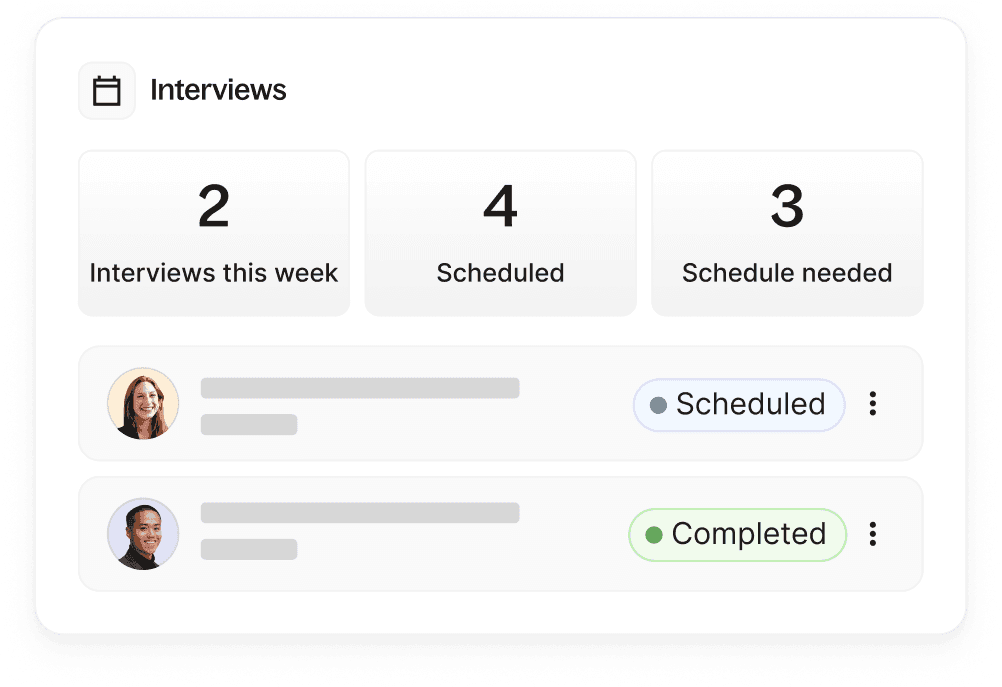
For recruiting workflows, the Deel's ATS helps teams organize candidates through structured pipeline stages, defining competency requirements and moving applicants toward a structured skills-validation step before interview.
The Talent module adds a sourcing dimension, giving teams access to a broader candidate network and reducing the cold-outreach work that skills-first processes require at the top of the funnel. Rather than starting with a completely cold pool, teams can work from candidates with verified profiles.
Whether you're comparing ATS platforms for an SMB or startup or scaling hiring across multiple countries and employment models, Deel connects recruiting workflows in Deel HR with the hiring paths coordinated through Deel Hire, helping teams move from candidate selection to onboarding without rebuilding their processes.
Skills-first hiring is a practical response to screening problems that AI-generated CVs have made more acute. The tools exist, and the process is straightforward. Book a demo below to see how Deel can help.
Live Demo
Get a live walkthrough of the Deel platform
FAQs
Can skills tests reduce bias in hiring?
Structured, criteria-based assessments evaluated before reviewing a candidate's background reduce the influence of factors like institution name, job-title formatting, and writing quality on screening decisions. They're not a complete solution to hiring bias, but they shift evaluation toward demonstrated performance rather than proxy signals.
What types of roles work best for skills-based hiring?
Skills-based hiring works across most roles where performance can be directly observed: technical roles (engineering, data, finance), content and communications, sales, customer success, and operations. It's harder to apply to senior executive roles where demonstrated judgment over time matters more than a single assessment can capture.
How do I set up skills tests without a dedicated assessment team?
Identify the two or three tasks a strong candidate would complete in their first 30 days, and ask applicants to complete one of them. A clear brief, a scoring rubric, and a defined time limit are enough to run a functional assessment.
Does skills-based hiring slow down the hiring process?
It adds one step upfront, but it typically reduces total time by cutting down on interviews with candidates who screen well on paper but perform poorly in role. Candidates who reach the interview stage have already demonstrated baseline capability, so conversations move further, faster.
How does the ATS module in Deel HR support a skills-first screening workflow?
The ATS module in Deel HR helps recruiting teams organize candidate pipelines and manage progression through defined hiring stages, within the same connected platform that handles contracts, onboarding, and payroll once a hire is made.
This article is provided for general informational purposes and should not be treated as HR or legal advice. Consult a qualified HR professional for guidance specific to your situation.
Jemima is a nomadic writer, journalist, and digital marketer with a decade of experience crafting compelling B2B content for a global audience. She is a strong advocate for equal opportunities and is dedicated to shaping the future of work. At Deel, she specializes in thought-leadership content covering global mobility, cross-border compliance, and workplace culture topics.