
Article
10 min read
Why ATS and HRIS Integration is Key for Scaling Recruitment
Global HR

Author
Ellie Merryweather
Last Update
March 31, 2026

Key takeaways
- Businesses are not satisfied with disconnected ATS and HRIS systems, as it slows down the hiring and onboarding process.
- Companies moving towards fully integrated HR ecosystems are getting roughly twice the return on investment (ROI).
- With an integrated solution, companies are able to streamline and scale recruitment with a small HR team.
Regina is super excited to join your company as a data engineer.
She took a few hours over the weekend and sent you all the details to get the offer letter. She spent the following week reading all about your upcoming data programs through the company's blog and podcast.
She is all set to hit the ground running on day one.
Then, reality hits.
Instead of diving into data architecture, Regina spends her first 40 hours stuck in a loop. Re-entering the same information she provided for her offer letter, replying to redundant confirmation emails, and waiting for HR to manually port her data into the HRIS. Just because she isn't ‘in the system’ yet, she can’t even request access to her coding environment.
All this delay and friction for one reason: your Applicant tracking system (ATS) and Human Resources Information System (HRIS) are operating in silos.
Companies lose days of new-hire productivity, valuable time of HR, and a chance to make a good first impression due to this gap in their tech stack.
In this guide, we’ll cover how integrating ATS and HRIS can streamline your recruitment and onboarding process.
Understanding HRIS and ATS
First, let’s understand how ATS and HRIS differ and where they will need to overlap to improve candidate experience.
What is ATS?
An applicant tracking software (ATS) is HR software that enables businesses to automate the hiring process. It helps businesses in organizing the candidate data, shortlisting resumes, and conducting all hiring-related tasks.
What is HRIS?
A Human Resource Information System (HRIS) is a platform that helps companies to store, organize, and manage all workers’ (employees, contractors, or freelancers) data. This centralized database is then used to run different HR processes.
Deel HR
What are the differences between HRIS and ATS (and where they must overlap)
Both ATS and HRIS support different stages of the recruitment journey.
An ATS manages the pre-hire phase, requiring candidate engagement and candidate relationship management by:
-
Posting job openings
-
Storing candidate information
-
Shortlisting candidates by resume parsing
-
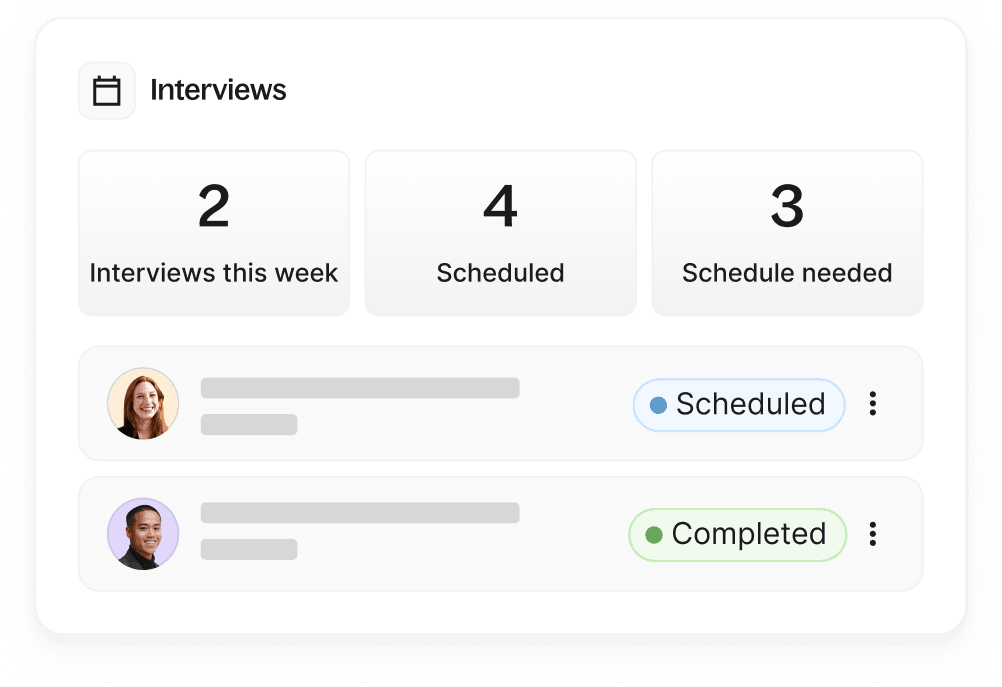
Scheduling interviews
-
Sending regular updates to candidates
-
Generating offer letters
-
Conducting candidate feedback surveys.
On the other hand, an HRIS handles the post-offer stage, when a candidate becomes an employee.
HRIS typically handles:
-
Onboarding
-
Payroll
-
Compliance
-
Benefits administration
-
Employee records
A candidate becomes an employee only when their data is migrated from ATS to HRIS. This integration is often missing for many organizations, requiring manual data entry from HR teams.
Key new-hire details (identification information, job role, compensation, benefits, and background verification status, etc.) are initially captured in the ATS. Each of these details must be accurately transferred to HRIS to trigger the onboarding of a new employee.
Once the ATS-to-HRIS data migration is complete, a new employee profile appears in the company system. Only then can they request access to internal tools and get into the actual work setup.
Benefits of integrating HRIS and ATS in recruitment management
As recruitment becomes more complex, multiple scattered HR tools create more problems than solutions. In fact, 82% of organizations feel that a standalone ATS is not enough to meet the evolving needs of talent acquisition. Companies want integrated, end-to-end, and strategic HR solutions that support all phases of the recruitment process.
Here’s how your organization can improve the recruitment strategy by integrating an ATS and HRIS solution:
1. Proactive candidate communication
Sending an offer letter from ATS doesn’t end the recruitment cycle. 44% of candidates receive multiple job offers, and they might still be evaluating whether to join your company. This is where an automated ATS-HRIS sync makes all the difference.
Once candidate data is synced from the ATS to the HRIS, the HRIS system can automatically trigger the preboarding workflow — right at offer acceptance, or even before.
A strong preboarding workflow includes:
-
Welcome emails and delivery of company swag
-
Document upload links
-
Policy handbooks
-
Benefits explanation
-
Manager and team introduction
-
Growth roadmap
-
Day one agenda
-
Onboarding buddy assignment
This proactive communication engages candidates early on and reduces the chances of candidate ghosting. As a result, you create a strong recruitment pipeline with higher offer-to-join ratios.
2. Automated candidate management and tracking
Much of post-offer recruitment management involves repetitive tracking and follow-up tasks, such as
-
Checking offer acceptance
-
Following up on documents
-
Initiating background checks
-
Triggering preboarding workflows.
All of these tasks can be automated through a well-configured ATS-HRIS integration. Once a candidate’s offer letter is generated in the ATS, their data can be automatically synced to the HRIS through the integration.
As soon as the candidate information is available in the HRIS, a predefined workflow can trigger each step without manual intervention. As a result, hiring managers can spend time on more strategic tasks such as filling critical roles or building an employer brand that attracts top candidates.
The need for this shift in HR’s role in hiring from administrative to strategic is already being recognized. Gartner's Report on Trends in Talent Acquisition captures this well: “As AI and automation take on more of the low-complexity work, recruiters’ ability to deliver on high-complexity hiring becomes more critical. Recruiters today must advise on talent strategy and role design to meet hard-to-find, in-demand skill needs while also possessing the skills to build long-term relationships with hard-to-access prospects.”
Deel's HRIS

3. Efficient HR operations
Without an integration, HR must manually upload candidate data from the ATS to the HRIS. While it may look like a single data entry task in isolation, the number of such entries eventually adds up. HR staff are currently spending up to 57% of their time on administrative tasks, including manual data entry.
This operational inefficiency wastes HR's productive time and increases hiring costs. EY found that the average cost of such manual data entry by an HR professional is $4.86 per instance. So, if you have an average of 1200 hires per year, this data migration from ATS to HRIS alone would cost $5,832 (1200*4.86).
Now, that is the cost of data entry alone. There are other manual follow-ups by HR for documentation, preboarding, and onboarding. All those also add up to the hiring costs.
Integrating ATS and HRIS cuts hiring administrative tasks and improves HR operations. So, HR spends less time on data entry/administrative tasks and more time on decisions that actually shape the workforce.
4. Timely employee onboarding
Almost every third employee has second thoughts during onboarding. Showing up on day one and not existing in the HRIS system is a bad sign for the new hire already. Everything gets delayed with it: access, tools, and onboarding.
Automated migration of the candidate data from ATS to HRIS will trigger timely onboarding of the new hire. As a result, some of the tech setup could be initiated before their day one itself. IT teams can procure laptops in advance and set appropriate access levels for different tools based on the role.
As the base setup is already done, HRIS can trigger role-specific onboarding, reducing time-to-productivity.
For example, Laura Czajkowski, a Community Director, appreciated the structured onboarding at Percone where she got enough information in the preboarding phase and timely access to tools. She said she knew exactly what she had to do right from day one.
Comprehensive materials sent ahead of time—including videos to watch and detailed guides about what to expect. They started me on a Tuesday (not Monday!) for a gentle 4-day first week.
Clear checklist and structured onboarding sessions without meeting overload. Dedicated buddy system for that crucial human connection in remote work. Phased access to tools and information—delivered exactly when needed, preventing overwhelm. On my first morning, I knew exactly what I was doing and where I needed to be.
—Laura Czajkowski,
Community Director
Integrating ATS and HRIS is one of the first steps to streamlining onboarding and ensuring new hire excitement doesn't die down in repetitive paperwork.
5. Advanced recruitment metrics tracking
ATS does provide recruitment metrics like average time-to-hire and offer acceptance rates. But these metrics alone are not enough to track the success of your recruitment strategy. You need more advanced metrics, such as quality-of-hire, new-hire retention rate, and offer-to-joining conversion rate, to truly understand whether your recruitment methods are effective.
Unfortunately, 80% of organizations do not track crucial metrics, such as quality of hire. One reason they cannot calculate this metric is disconnected systems.
Disconnected systems prevent you from tracking a new hire's journey from the application stage to employment.
Integrating ATS and HRIS provides a continuous data trail of new hires’ journey for measuring new-hire performance metrics, attrition rate, and more. This data helps you identify the count of bad hires and optimize future recruitment strategies.
6. Simplified compliance management
Hiring teams are dealing with increasing compliance requirements. 91% of HR professionals say employment law has only gotten more and more complex over the last 5 years. This regulatory complexity is continuously adding more tasks to their to-do list.
Many of these tasks can be automated by ATS-HRIS integration. As soon as a candidate accepts an offer and their data migrates from ATS to HRIS, preboarding/onboarding workflows with the below compliance tasks can be triggered:
-
Trigger background checks after selection
-
Collecting mandatory documents
-
Gathering signatures on contracts
-
Getting consent from new hires on their data storage
-
Taking acknowledgment of company policies
On top of that, an automated data transition from ATS to HRIS also helps you maintain audit-ready employee records without manual data entry.
With every one in three companies missing at least one regulatory requirement, automation is necessary to simplify compliance management.
Selecting the right HRIS and ATS for your organization
Having a basic ATS and HRIS setup just helps you run the typical HR processes.
But to scale a business, you need solutions that optimize the processes, not just run it.
Beyond your basic features and costing, here is a checklist to choose the right ATS and HRIS for your business:
-
Complete or integrated suite: Do the ATS and HRIS come together in a single platform? If these are standalone systems, can they be integrated together for efficient operations?
-
AI and automation: Does it offer advanced AI features that help you scale recruitment without adding more team members?
-
Mobile experience: Does it provide mobile app support to improve employee experience?
-
Global compliance: Is it capable of handling global compliance to prevent regulatory fines?
Deel HR
Case study: How Beatgrid scaled global HR with one integrated HR platform and a single-person team
Beatgrid Media, a fast-growing ad-tech company, was expanding into five new locations. With every new location added, the HR complexity was also increasing. Their HR processes and data were getting scattered across multiple tools.
Soon, Shawnda Kohr, the company's HRBP, realized the need for a better HR solution to manage global hiring and day-to-day operations.
She needed everything in one place. That's where Deel came in.
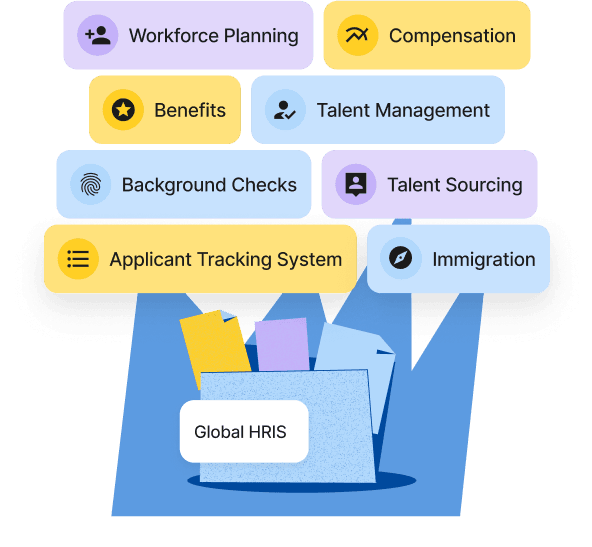
Deel brought all her required functionalities (hiring, payroll, global compliance, workforce management, HR operations, performance management, and support) into one integrated platform.
Result: Beatgrid was able to build a compliant and scalable people function with just Shawnda as their only HR lead.
Without Deel, I'd need to hire three full-time specialists: one for payroll, one for compliance, and one for HR support. Deel saves us their salaries and over 500 hours of manual work every single month.
—Shawnda Kohr,
HRBP, Beatgrid Media
Scale your recruitment efforts with Deel
ATS helps teams hire global talent faster by bringing the entire candidate-to-hire journey into one system.
Designed to scale, Deel AI fastens candidate sourcing, job description generation, and candidate screening so teams can scale hiring efforts without building a large team.
With ATS, you can
-
Generate and manage all job posts in one centralized portal
-
Screen candidates faster with AI capabilities
-
Schedule interviews without manual follow-ups
-
Send offer letters as soon as the candidate clears all stages
-
Track recruitment metrics to improve hiring strategy
Beyond hiring, Deel provides a complete HR suite with HRIS, payroll, benefits, L&D, performance management, employee mobility, and IT support. Built to scale with your organization, we makes compliant, scalable global hiring simple across 150+ countries.
Book a demo to see how ATS can help you build a complete, integrated solution to scale recruitment efforts.
Live Demo
Get a live walkthrough of the Deel platform

Ellie Merryweather is a content marketing manager with a decade of experience in tech, leadership, startups, and the creative industries. A long-time remote worker, she's passionate about WFH productivity hacks and fostering company culture across globally distributed teams. She also writes and speaks on the ethical implementation of AI, advocating for transparency, fairness, and human oversight in emerging technologies to ensure innovation benefits both businesses and society.


