Article
7 min read
Manual work stops here. Meet Akai by Deel.
AI
Deel news

Author
Deel Team
Last Update
September 02, 2026
Every day, ops teams spend hours on work that should run automatically. Akai by Deel fixes that—built inside Deel, proven across 100% of our ops teams. 91,000+ hours saved every single month. Now it's yours.
In complex businesses, there's always been a ceiling. You automate a few steps, then hit a wall.
The result? Skilled ops professionals spend hours every day on work that should run automatically, with humans in control when it matters.
Akai by Deel breaks through that ceiling. Whatever your team does manually, Akai can do it automatically. Its interconnected system of agents learns your workflows, automates every step, and gets smarter with every run—auditably, on any system.
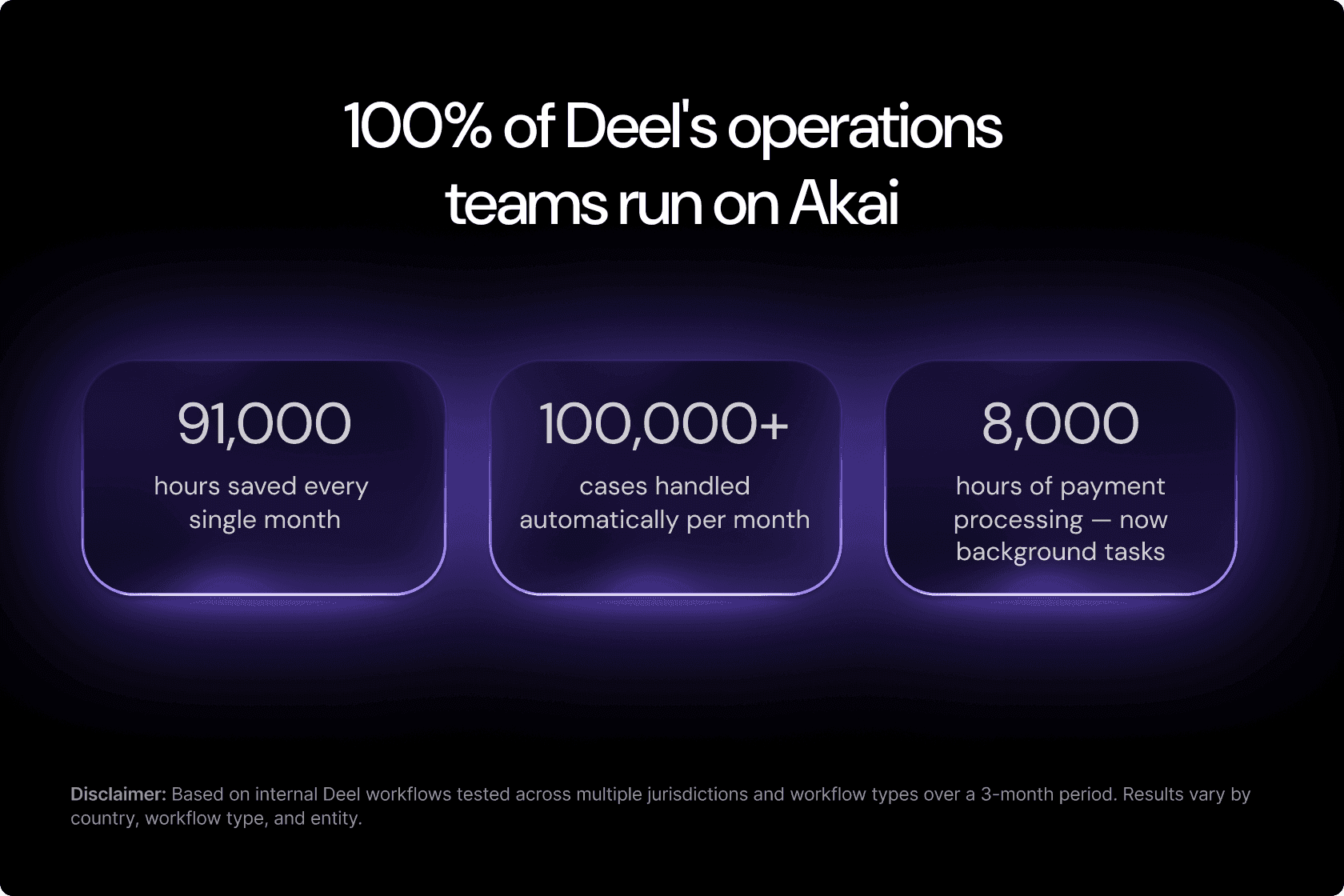
We built it to solve our own problem first. Today, thousands of workflows are already running across 100% of Deel's operations teams—Finance, Tax, Treasury, Benefits, and HR. The impact has been fundamental:
100,000+ cases handled automatically every month
Over 91,000 hours saved every single month
8,000+ hours of payment processing—now background tasks
Reconciliation that took 20+ days—now done in minutes
100% automation in areas we couldn't reach through years of coding
Every team is now creating agents with no tech support. No developers. No IT tickets. Just the people who know the work, building and running it themselves.
That's what Akai can be for you, too. With built-in voice, transactions across any payment method, and the ability to process and analyse any document or dataset—out of the box. Your first agents could be running by tomorrow.
Your team, supercharged.
Ops teams are stuck in manual mode, and it's time to change
Ops teams process payments across multiple portals, file compliance submissions, and keep data in sync across systems that don't talk to each other. At scale, it's relentless—and most of it still happens manually.
The work isn't going away. Compliance filings, payout batches, payroll cycles. These happen on a fixed schedule, at growing volume, with real consequences if something is missed or wrong. For ops teams at scale, the question isn't whether to do it. It's how to do it reliably without it consuming the team.
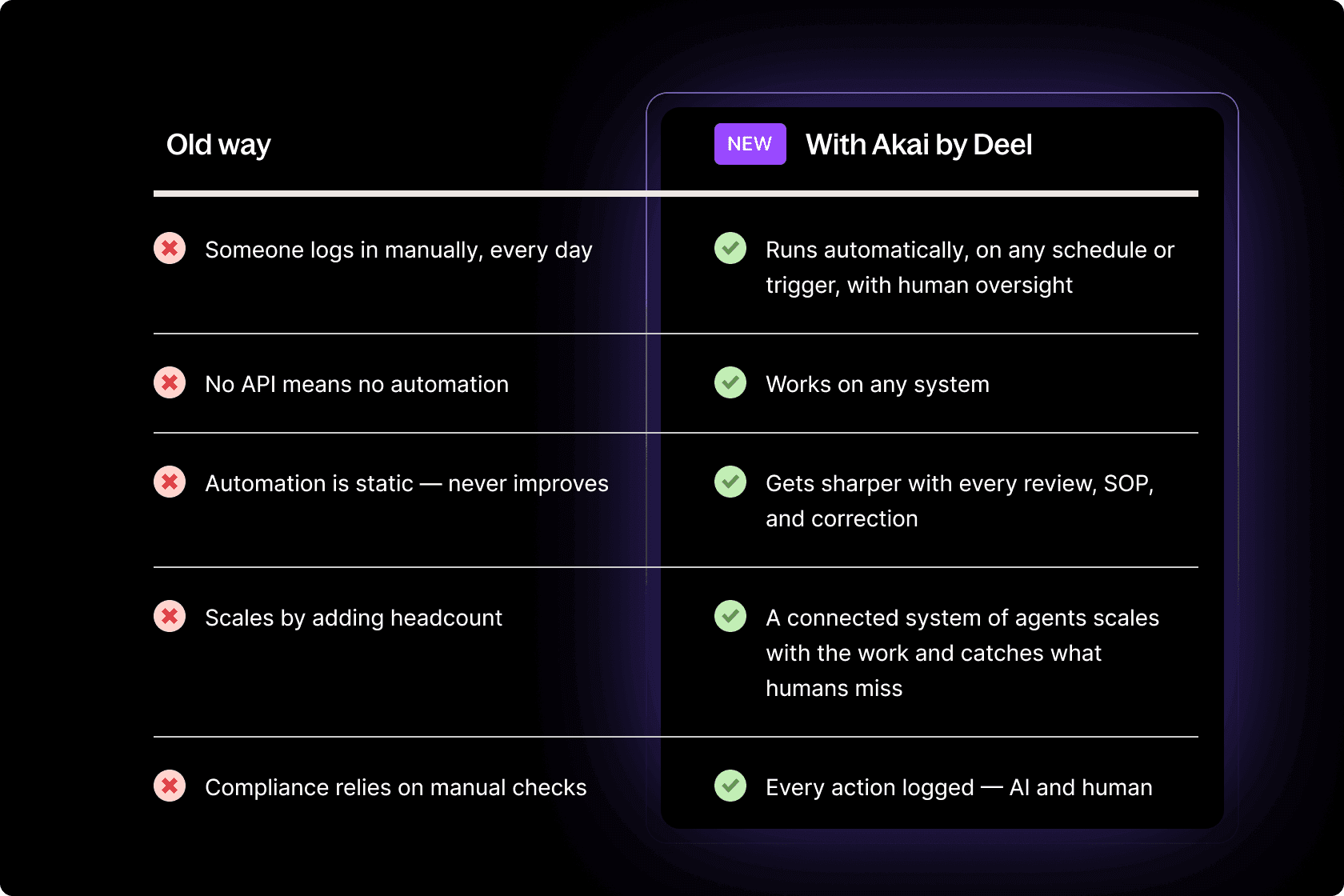
Traditional tools can't touch the portals and government platforms that ops teams actually live in. AI browser agents produce variable results you can't always audit—a real problem when compliance is on the line. The existing options don't solve that. Keep doing it manually or wait months for an IT-led integration project that may never come.
What ops teams actually need is automation they can build themselves, that runs on any system, learns from every run, and keeps humans in control.
Akai by Deel: A new operating standard
Akai by Deel is the agent platform built for operations. It builds a brain inside your organization—an interconnected system of agents that learns your workflows, automates every step, and gets smarter with every run, on any system.
It's fast to set up and won't break when a portal changes. The people who know your workflows—your ops leads, finance directors, compliance managers—build and own the automations directly. No tickets. No backlogs.
What this means for your business:
Scale without adding headcount. Deploy as many agents as the work demands. Handle more volume, more complexity, more markets—without growing your team.
Catch everything. Miss nothing. At scale, human accuracy has limits. Akai surfaces anomalies, exceptions, and patterns before they become problems—every single run.
An operation that compounds over time. Every workflow your team runs makes Akai smarter. The longer it runs, the more capable your entire operation becomes.
We were managing client onboarding, employee setup, and invoices manually. As the company grew, it was eating more and more of our week. I built my first Akai agent in under an hour and got back over three hours a week. That repetitive work just stopped. Now I can focus on the work that actually moves the business forward.
—Frankie Limmer,
Operations Manager, Ostberg Sinclair & Co
Three steps to full automation with Akai
Getting your first agents running takes hours, not months:
-
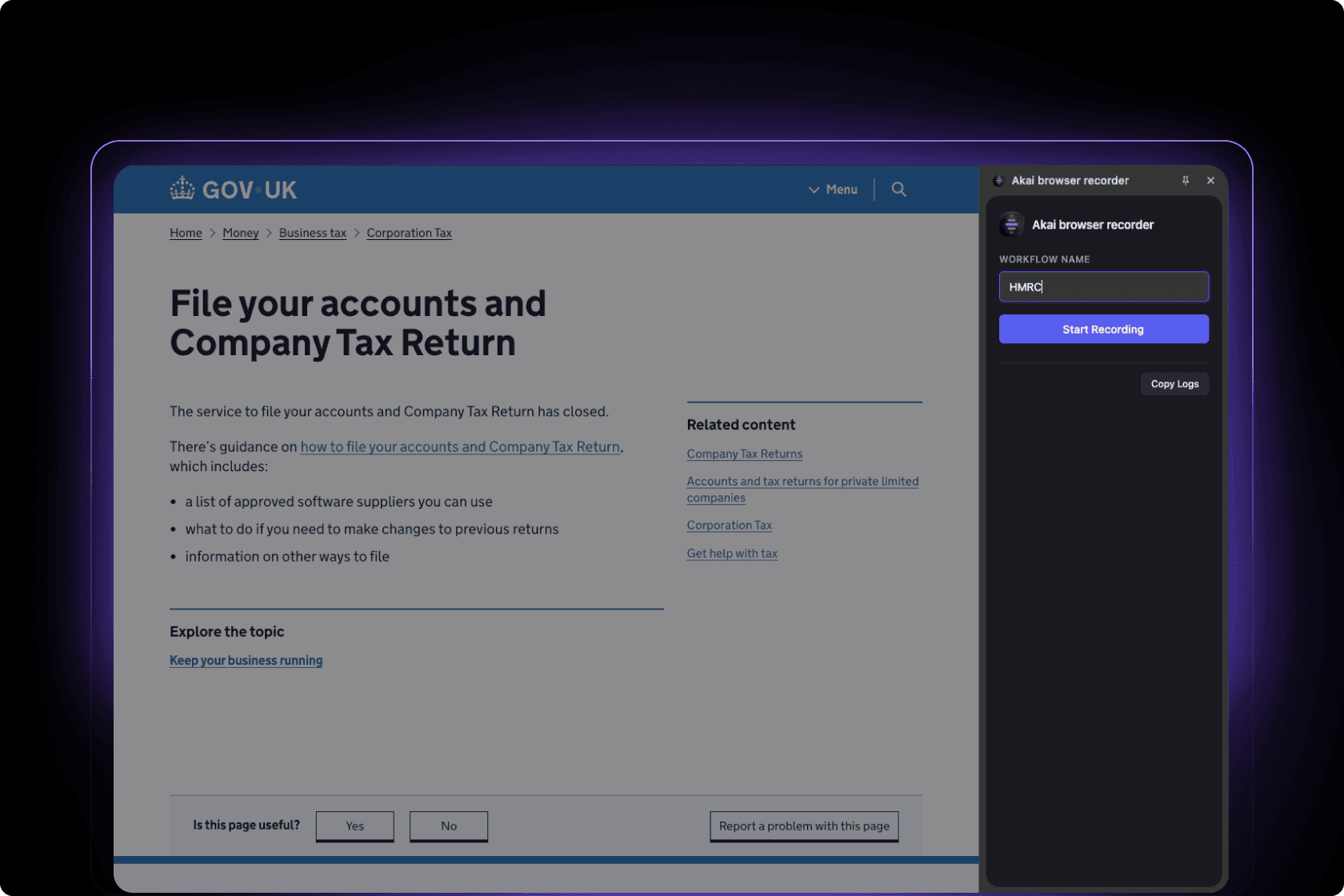
Step 1: Show Akai your workflow. Walk through it once—or describe what you want in plain language. Akai maps every step, learns your systems, builds the connectors, and creates the workflow automatically.
-
Step 2: Review, approve, and connect. Your team reviews every step before anything runs. Akai connects each workflow to the others—so agents don't work in isolation, they work as a system.
-
Step 3: Run it, and watch it improve. Akai deploys as many agents as the work demands—each running end-to-end, fully logged and human-reviewed. Every run accumulates your team's playbooks. Every new workflow makes the whole system smarter.
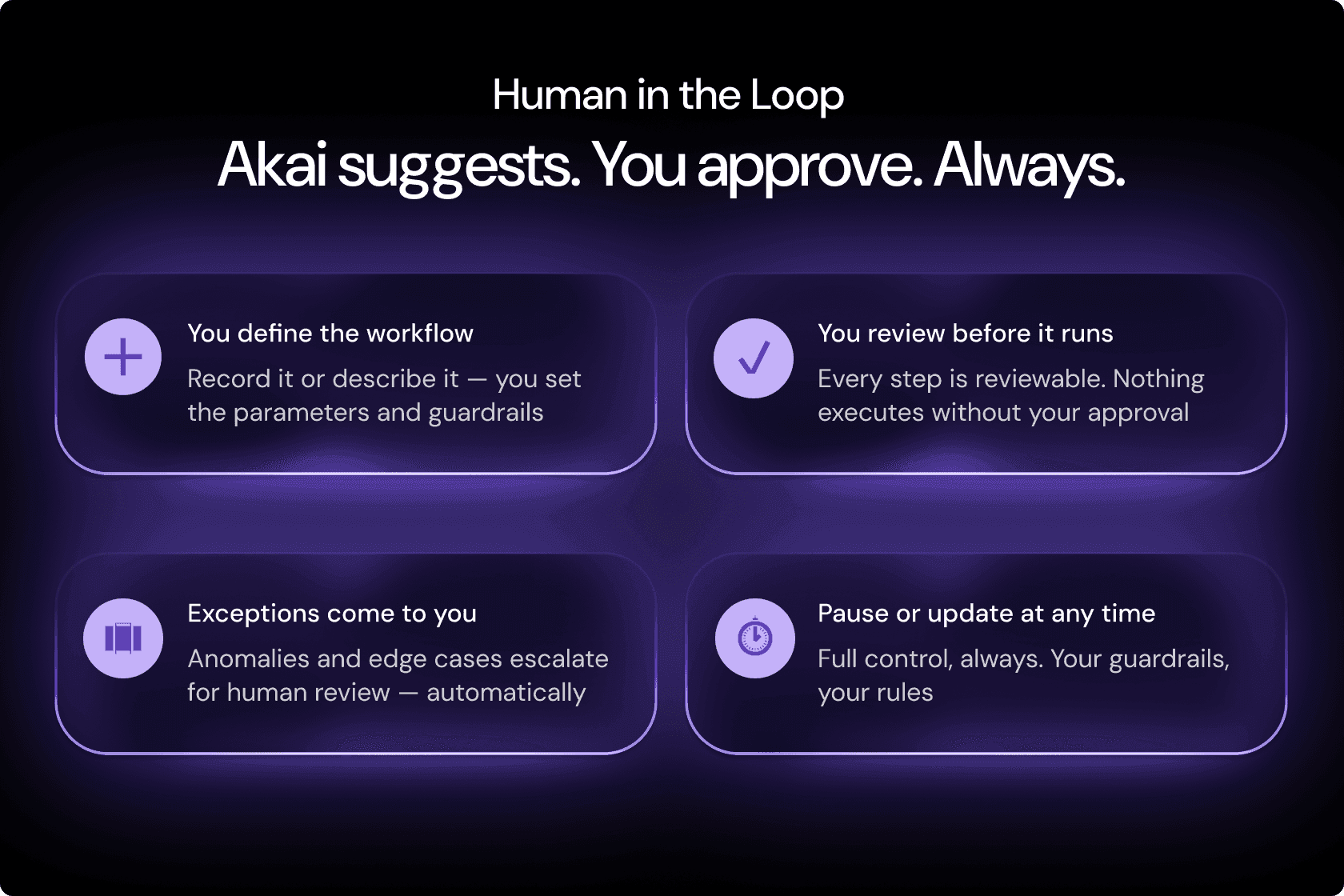
Automation doesn't mean handing over control. At every stage, you define what runs, review what Akai builds, and step in when it matters.
See how Deel does it.
Akai didn't start as a product. It started as an ops challenge—and became the solution all of our teams depend on for internal workflows.
80 hours a month. Now 30 minutes.
As Deel scaled globally, certain workflows grew too complex and high-volume to handle manually. For one Benefits team, a recurring consolidation process across multiple entities was consuming 80 hours a month. With Akai, it runs automatically in the background in just 30 minutes.
"It can take our manual, repetitive tasks with a clear process and automate them." — Team Lead, Benefits, Deel
340 entities. 120 jurisdictions. Now a background task.
Every compliance cycle, Deel's Global Corporate Services team had to manually navigate 120 national registries—retrieving, naming, and filing roughly 3,000 documents across 340 legal entities. 170 hours of work, every time. Akai turned it into a single trigger.
"170 hours of manual registry navigation becomes something you initiate with a trigger and run in the background. That's not just time saved—it means the team stays on critical projects without having to choose between compliance readiness and everything else. Automate the manual work, and suddenly that team becomes a strategic asset, not just a cost center." — Senior Global Corporate Services Specialist, Deel
Thousands of hours. Automated.
Running payroll for Deel's workforce spans multiple countries, currencies, and processing systems. Akai now handles the full workflow—from pulling inputs and preparing data to processing in local payroll software. The team focuses on review and judgment, not execution.
"Payroll cycles don't wait. Every cycle, we were manually pulling inputs, formatting data, logging into local systems across multiple countries. Akai took that entire process off the team's plate. We now focus on the edge cases that actually need human judgment. The rest runs by itself." — Business Operations Manager, Payroll Strategy, Deel
What makes Akai different
No code. Owned by ops.
The people who run the workflow own the automation. No IT tickets, no waiting. If your team can do it manually, Akai can do it automatically.
Record once. Akai handles the rest—on any system.
Walk through it once. Akai maps every step, learns your systems, builds the connectors, and creates the workflows automatically. It then deploys as many agents as the work demands, each running end-to-end, fully logged and human reviewed. No connector marketplace dependency. No integration backlog. If it exists on the web, Akai can work with it.
Not just automations. A connected system of agents.
Akai doesn't build one-off automations. It builds an interconnected system of agents—each one aware of the others, sharing context, and getting smarter as a network. The longer it runs, the more it understands your entire operation.
Gets sharper with every run.
Most automation tools run a task and forget it. Akai accumulates context across every workflow—retaining patterns, playbooks, and case history your team establishes. It catches what humans miss, surfacing anomalies and exceptions before they become problems.
Compliance and security, built in from day one.
Encrypted secrets vault, zero-knowledge credential storage, human-in-the-loop, full audit trail. Tested across 100+ countries, GDPR compliant, and built for the regulatory environments ops teams operate in. Akai never trains on your data.
Not a pilot, but proven at Deel.
Akai was tested at scale across 100% of Deel's operations teams before any external customer touched it. Over 91,000 hours saved every single month. 100,000+ cases automated. Reconciliation that took 20+ days—now done in minutes. You get the result, not the experiment.
We had 1,300 expense reimbursements coming in every day. Our existing automation handled 78% of them—the rest sat in a manual queue. We deployed Akai as a second layer. It read context, asked for clarification instead of rejecting, and learned from every cycle. We're now at 90% and still improving.
—Fernando Domínguez,
Associate Operations Director, Deel
Built for the teams that need it most
Akai works for any ops team that runs repetitive, high-volume workflows across any system. A few verticals where it’s already making the biggest impact:
Cross-border payments & PSPs: Process payout batches across multiple banking portals without daily manual logins. Automate FX reconciliation and settlement reports on a schedule.
Tax & regulatory compliance: File government portal submissions on time, every time. Scale filing volume without scaling headcount.
Logistics & supply chain: Automate data entry across customs portals, carrier booking systems, and warehouse platforms that don’t connect. Bridge fragmented ops stacks post-acquisition without waiting for an integration project.
Ready to deploy your first agents?
We’re working hands-on with a select group of ops teams to get their highest-priority workflows automated, fast. Early access teams get dedicated onboarding and are first in line as we build.