
Article
11 min read
Applicant Tracking Systems for Startups: What to Look for as You Scale
Global HR

Author
Ellie Merryweather
Last Update
March 31, 2026

Key takeaways
1. Fragmented tools and manual processes create a hiring bottleneck that startups can't outgrow. Spreadsheets and disconnected systems might work for the first ten hires, but as headcount grows, broken handoffs between recruiting, HR, and payroll compound into costly "org drag", and top candidates go to faster competitors.
2. A startup-friendly ATS needs to do more than track resumes. The right platform combines AI-powered automation, real-time hiring analytics, seamless candidate-to-employee transition, and built-in global compliance — all in one place that scales with the business.
3. Deel's ATS is the all-in-one solution built for scaling startups. It connects hiring directly to onboarding, payroll, and compliance across 150+ countries, with AI tools, native HRIS integration, and zero manual data re-entry, so startups never need to switch platforms as they grow.
Your first five hires feel manageable. Email threads, shared spreadsheets, a calendar invite here and there — it works. But by hire fifteen, the cracks appear. Candidates fall through the gaps. Feedback gets buried in inboxes. Onboarding stalls because no one transferred the data. By hire thirty, you're slowing down and fighting bottlenecks, making hiring much harder than it needs to be.
This is where an applicant tracking system (ATS) comes in, helping companies manage job postings, candidate pipelines, interviews, and hiring workflows in one place. An ATS centralizes recruiting, automates manual tasks, and creates a structured process as teams grow.
Startups in particular need one that scales globally, connects hiring to HR, and eliminates operational drag. The right ATS is the connective tissue between finding talent and turning that talent into productive, compliant, onboarded employees.
Why startups need an ATS earlier than they think
1. Manual hiring doesn't scale
With ten job postings, you might be able to manage hiring in your inbox. At twenty, that approach starts to fail. Spreadsheets can't tell you where a candidate dropped off. Email threads can't surface the best applicant from a pile of 80.
Relying on manual decision-making and email-based coordination creates a bottleneck that prevents you from moving at the speed of the market. As your volume grows, the lack of a structured orchestration layer leads to "org drag" and a higher probability of losing top-tier talent to faster competitors.
Deel HR
2. Fragmented tools create hidden costs
Many startups run a separate ATS alongside a disconnected HRIS. The result? Data gets re-entered manually, offer letters are recreated from scratch, and onboarding is delayed by days while HR teams chase down information that already exists in another system.
These broken handoffs between recruiting, HR, and payroll are more than just administrative nuisances. They are significant points of failure that increase operational risk and duplication of effort. Hiring shouldn't end at "offer accepted." Every extra handoff between systems is a cost that compounds as you scale, making a connected platform a financial imperative.
Complementary reading:
Discover why having a connected HRIS and ATS is crucial for scaling recruitment, and what that looks like with Deel.
3. Candidate experience and employer branding are strategic necessities
For startups competing against larger companies for global talent, the hiring experience is a core part of the pitch. Slow communication, disorganized interviews, and unclear timelines usually signal how your company operates internally — a frustrating red flag for candidates.
A structured, AI-powered ATS delivers a consistent, professional candidate experience that reflects well on your brand, ensuring that global talent receives a premium, localized experience regardless of their location. By embedding compliance and speed into the very front door of your employment process, you prove to candidates that your organization is a stable, global-ready workplace.
What makes an ATS startup-friendly?
The best ATS platforms for startups are built around four core capabilities. Here's what to look for.
1. AI-powered hiring that saves lean teams time
Startups don't have recruiting teams of ten. They have founders wearing five hats, or a single HR manager handling everything from job posts to payroll. AI-powered hiring tools give lean teams the leverage to move fast without sacrificing quality.
The right ATS should automate the work that slows you down:
- AI-generated job descriptions: Get role-ready job posts in minutes, not hours, with consistent quality and faster time-to-post.
- Automated candidate screening and scoring: Surface the best-fit candidates automatically, reducing bias with structured evaluation criteria.
- Interview scheduling: Integrate directly with Google or Microsoft calendars to eliminate back-and-forth and keep candidates moving through the pipeline.
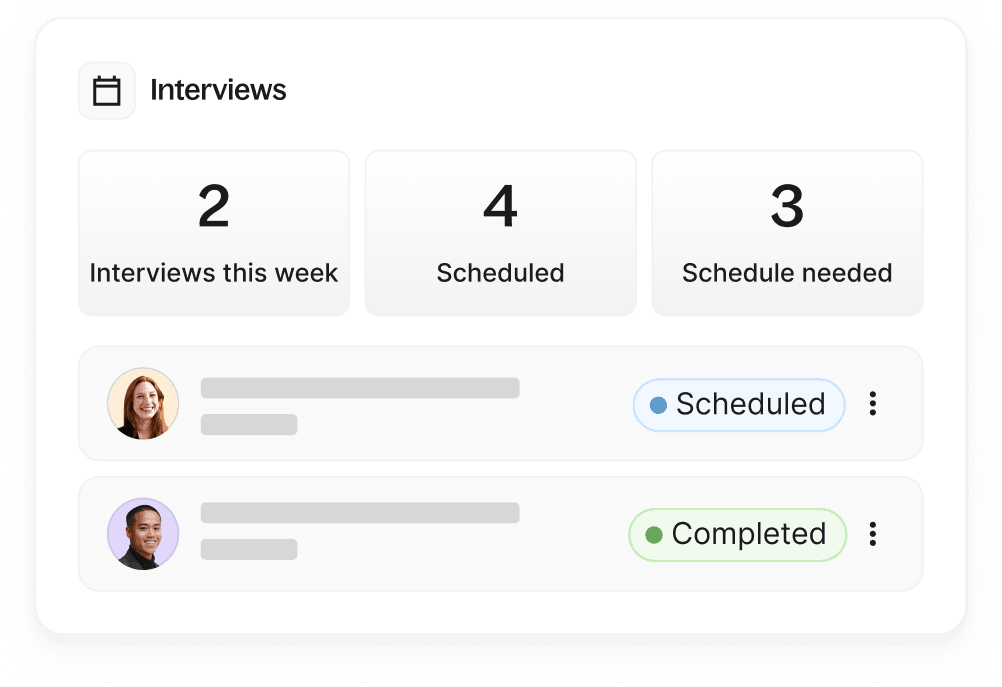
- Centralized pipeline management: Manage all jobs and candidates from a single dashboard, with full visibility into status, feedback, and next steps.
AI-powered ATS tools help startups reduce manual recruiting tasks by automating job descriptions, candidate screening, and interview scheduling, allowing small teams to hire faster without adding headcount.
2. Seamless candidate-to-employee transition
This is the differentiator most startups don't think about until it's too late. Most ATS platforms stop at the offer. The candidate accepts, and then someone has to manually transfer their data into the HR system, set up onboarding, and trigger payroll. It's slow, error-prone, and completely avoidable.
The best platforms for startups — like Deel's ATS — connect hiring directly to the rest of the worker lifecycle:
- Approved headcount flows directly into job requisitions
- Once an offer is approved, a worker record is created automatically in the HRIS
- Onboarding begins instantly, with no manual data re-entry
- Payroll and compliance are activated from the same platform
Startups shouldn't rebuild employee data twice, and hiring should flow directly into HR. No information lost, no double work, and no delays.
Complementary reading:
How Deel's ATS Closes the Gap Between Recruitment and Onboarding (And Why It's Important)
3. Built-in analytics to make smarter hiring decisions
Most startups hire reactively. A role opens, the team scrambles, and whoever gets hired feels like a win. But without data, you can't improve. You keep making the same sourcing mistakes, losing candidates at the same funnel stage, and wondering why time-to-hire keeps creeping up.
A startup-friendly ATS gives you visibility into what's actually happening:
- Candidate-to-offer ratio
- Offer acceptance rate
- Average time-to-hire
- Funnel drop-off by stage
- Source quality comparison — which channels produce the best candidates?
ATS analytics give startups visibility into hiring performance, helping them identify bottlenecks, improve offer acceptance rates, and prioritize high-performing talent sources. Data-driven hiring helps founders avoid overpaying, hiring too slowly, or repeating sourcing mistakes that cost time and money.
4. Global hiring and compliance from day one
Modern startups hire across borders from early on. That means contractors and employees in multiple countries, remote-first team structures, and a patchwork of local labor laws to navigate.
Without a compliance-first ATS design, the risks are real:
- Worker misclassification
- GDPR violations and data retention failures
- Non-compliant job posts
- Employment contracts that don't meet local requirements
A compliance-ready ATS protects scaling companies through built-in permissions and approval workflows, work classification awareness, secure candidate data handling, and standardized applications that meet equal employment requirements. When connected to global HR infrastructure like Deel, hiring can flow directly into compliant onboarding, payroll, and contracts across 150+ countries.
Free guide
Interview Guide and Checklist for Hiring Managers
ATS vs. spreadsheets: What's the real cost?
The operational gap between manual hiring tools and a modern ATS widens fast as your team grows:
| Spreadsheets & Email | Modern ATS (e.g. Deel HR) |
|---|---|
| Manual resume sorting | AI-powered screening and scoring |
| Email scheduling back-and-forth | Integrated Google & Microsoft calendar tools |
| Re-entering data across systems | Automatic HR and payroll sync |
| No hiring analytics | Real-time dashboards and funnel insights |
| High compliance risk | Built-in GDPR safeguards and compliant job posts |
| Offer accepted = process ends | Offer approved = onboarding begins instantly |
When should a startup implement an ATS?
You should implement an ATS when:
- You're hiring more than two or three roles simultaneously
- Candidates are slipping through the cracks
- Onboarding requires manual data entry after every offer
- You're hiring across multiple countries or employment types
- Time-to-hire is increasing without a clear reason why
For most startups, this happens somewhere between ten and twenty employees — but fast-scaling companies benefit from getting there earlier. The cost of building bad hiring habits is higher than the cost of an ATS.
How to choose the right ATS for your startup
Use this checklist when evaluating your options:
- Does it integrate with your HRIS — or is it a standalone tool that creates more manual work?
- Does it support global hiring, including contracts, local labor laws, and cross-border compliance?
- Does it automate manual tasks — or just track resumes?
- Does it scale from ten to two hundred employees without requiring a platform switch?
- Does it reduce your total cost of ownership by replacing multiple tools with one?
The best ATS for fast-growing startups combines AI-powered recruiting, centralized workflows, real-time analytics, global hiring support, and direct integration with HR and payroll — in a single platform that scales with you.
Useful resource:
Buying HR software for the first time? Download our guide: First HR Software Implementation: A Go-To-Guide
The future of startup hiring: Unified, AI-powered, global
The next generation of ATS platforms offers a fundamental shift in how hiring connects to the rest of the business. Leading platforms are moving toward unified workforce management — where AI reduces recruiter workload, hiring connects directly to HR and payroll, real-time intelligence informs every decision, and distributed teams are supported by default.
For startups building global teams, this is the infrastructure that lets you grow without breaking.
Deel’s ATS is built to scale with your organization as you grow, whether you’re hiring 10 employees or 1,000. We offer:
- An ATS built to work directly with your HRIS, leaving no gaps between hiring and onboarding.
- AI tools to save your team's time, with automations that keep even the most hectic hiring periods running smoothly
- Built-in analytics for insights at a glance, without needing to be a data scientist
- Compliance at every level, supporting your hiring efforts both at home and abroad
Book your 30-minute demo to see how it works and how Deel can help your startup to hire anyone, anywhere, anytime.
Live Demo
Get a live walkthrough of the Deel platform

FAQs
What is the best ATS for startups?
The best ATS for startups automates sourcing and screening, integrates directly with HR and payroll systems, and supports global compliance. Startups benefit most from unified platforms that connect hiring to onboarding without manual data transfer.
When should a startup get an ATS?
A startup should adopt an ATS once hiring becomes recurring or multi-role, typically between ten and twenty employees, or earlier for fast-scaling companies.
Do startups need AI in their ATS?
AI features help lean teams automate job descriptions, candidate screening, and scheduling, reducing time-to-hire without expanding recruiting headcount.
Can an ATS help with global hiring?
Yes. Some ATS platforms support global compliance, employment classification, and secure data management — critical for remote-first startups hiring across multiple countries.
What hiring metrics should startups track in an ATS?
Startups should track time-to-hire, candidate-to-offer ratio, offer acceptance rate, source of hire, and funnel drop-off rates. These insights help founders identify inefficiencies and build stronger hiring processes over time.
Can an ATS reduce hiring bias?
Yes. Structured applications, standardized interview feedback forms, and AI-assisted scoring help reduce unconscious bias by evaluating candidates consistently against defined criteria.
Ellie Merryweather is a content marketing manager with a decade of experience in tech, leadership, startups, and the creative industries. A long-time remote worker, she's passionate about WFH productivity hacks and fostering company culture across globally distributed teams. She also writes and speaks on the ethical implementation of AI, advocating for transparency, fairness, and human oversight in emerging technologies to ensure innovation benefits both businesses and society.


