Article
2 min read
Build a Year-Long Performance Record with Instant Feedback
Deel news
Global HR

Author
Lorelei Trisca
Last Update
November 18, 2026
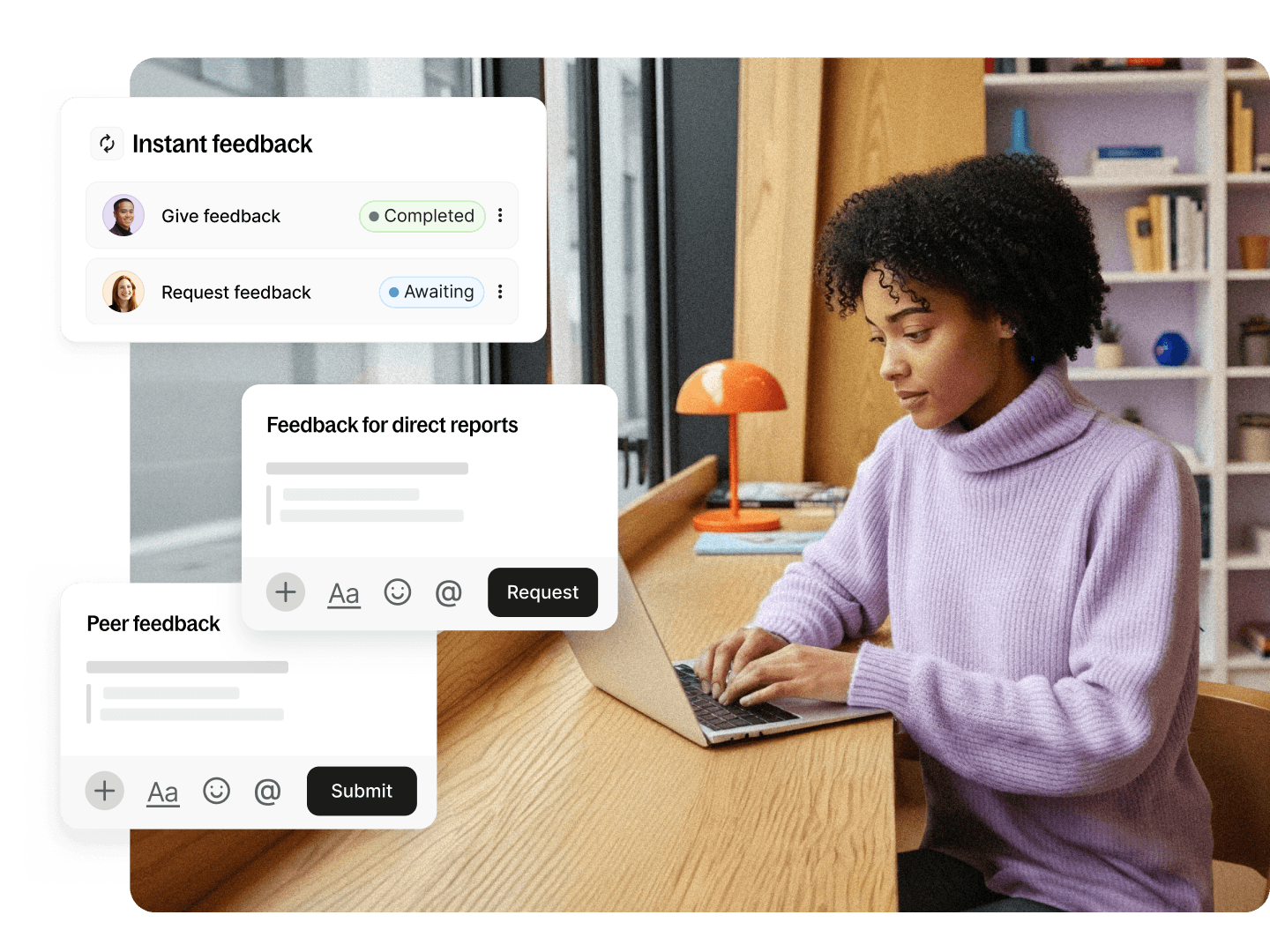
Table of Contents
Recency bias is not a manager problem
Why the cycle itself produces the problem
What "continuous" actually requires to work
Feedback that never reaches the review didn't happen. Instant feedback changes this
Better review quality and decision making
Instant feedback is connected to your system of record
Feedback has a shelf life. Something specific and useful happens in March. A colleague handles a difficult client conversation unusually well, or lets a deadline slip in a way that costs the team. In the moment, it's concrete. Anyone who saw it could describe exactly what happened and why it mattered.
By November, it's a vague impression. By the time it reaches a review form, it's an adjective.
This is the quiet failure at the center of most performance processes, and it gets misdiagnosed constantly.
Recency bias is not a manager problem
When review ratings skew toward the last few weeks, the usual response is training. Teach managers about cognitive bias. Remind them to consider the whole period. Add a line to the guidance document.
It doesn't work, and it was never going to, because the request is impossible. You're asking someone to accurately recall and weigh eleven months of another person's work, across dozens of projects, while also doing their own job and writing ten other reviews in the same fortnight.
Nobody can do that. What people do instead is retrieve what's available, which is recent and emotionally vivid, and build an assessment from it. That's how memory works.
So rather than being a flaw in your managers, regency bias is the result of a process that asks for evidence it never collected.
Why the cycle itself produces the problem
Annual and semi-annual reviews concentrate all the evaluation into a single window. That design has three consequences, and they compound:
Everything rides on recall. The evidence has to come from memory because there's no other source. Whatever wasn't memorable didn't happen, as far as the review is concerned.
The stakes distort the message. Because feedback only arrives at review time, it arrives attached to a rating and often a compensation decision. High-stakes moments are where people get vague, hedge, and soften the exact coaching someone needed to hear.
Coaching gets postponed into irrelevance. The useful moment to tell someone how a client meeting went is that afternoon, while they still remember what they chose to do and why. Bringing this up ten months later can no longer count as coaching. Rather, it's a verdict about something the worker can barely picture.
Companies notice this and often reach for more frequent cycles: quarterly instead of annual. It helps at the margins and solves nothing at the core, because the underlying flaw isn't frequency. It's that evidence is being generated at evaluation time rather than captured as the work happens.
What "continuous" actually requires to work
Continuous feedback is a well-worn phrase, and most implementations of it quietly stall out. The ones that survive a real workweek share four properties:
Low enough friction to survive a busy Tuesday. If giving feedback takes more than a minute, it loses to everything else on someone's calendar, not because people don't care, but because feedback has no deadline and everything competing with it does.
Built into the flow of work. The moment to share an observation is right after the work happens, wherever teams already collaborate. If that's Slack, feedback has to work natively in Slack rather than inside a separate portal people have to remember to open later.
Multidirectional. Feedback that only travels downward from managers gives a narrow, incomplete picture. Peer-to-peer catches what managers don't see. Upward feedback surfaces blind spots managers rarely hear about. Cross-team feedback captures the collaboration quality that never shows up in an OKR tracker.
Configurable to your culture. Who can see what, whether requests can be anonymous, and which prompts people receive aren't minor settings. They determine whether people feel safe being honest, and the right configuration looks very different at a 60-person startup than at a 600-person company with works councils.
Feedback that never reaches the review didn't happen. Instant feedback changes this
Plenty of point solutions check those four boxes, yet HR teams still end up right back where they started. Here's why: Feedback that doesn't surface at the moment of evaluation is feedback that didn't happen.
You can run a perfectly good continuous feedback practice all year, generate hundreds of useful observations, and still have managers writing reviews from memory, because the feedback lives in one system and the review happens in another. Someone would have to go and find it, export it, read it, and carry it across. In a fortnight when they're writing ten reviews, they won't.
When we built Instant feedback in Deel HR, we took a deliberate stand against treating feedback as an isolated pulse tool or an unsearchable archive. We designed it as a continuous signal layer that feeds directly into performance decisions:
Captured where work happens: People can share or request feedback directly inside Deel or in Slack, turning quick observations into structured records without breaking focus.
Decoupled from the review calendar: Managers and peers can log coaching moments, wins, and developmental notes year-round, lowering the temperature of feedback so people actually act on it.
Surfaced automatically when cycles open: In Deel HR, every piece of instant feedback appears automatically inside the reviewer's context window when a review cycle begins, right alongside the person's goals, competency expectations, and learning progress. Managers don't have to go looking for evidence; it's already waiting when they open the form.
That single architectural connection changes what the preceding year was for. The feedback given in March isn't a nice gesture that evaporated, it's part of the record the November review is built from.
Better review quality and decision making
Connecting continuous feedback to the evaluation moment shifts two things immediately:
Reviews get easier to finish. Managers start from real, dated evidence rather than a blinking cursor on a blank form. Chasing managers to submit reviews is one of the most thankless jobs in HR, and much of that resistance comes down to avoiding a task they don't have the material for.
Reviews get more defensible. A rating backed by specific, multi-source observations holds up differently in a calibration session, and in a 1:1 conversation when someone disagrees with their score. It drives more consistent, criteria-based evaluations across teams because decisions are anchored in documented behavior rather than recent impressions.
It's worth being clear-eyed here: no software makes performance evaluation fair on its own. Fairness comes from processes that humans design, calibrate, and scrutinize. What a continuous record does is remove one well-documented source of distortion: relying solely on whatever happened recently enough to remember. That's a meaningful structural upgrade, even if it isn't a silver bullet.
Instant feedback is connected to your system of record
Instant feedback is part of Deel HR’s talent management suite. Because it runs on the same core worker records as your org structure, contracts, goals, compensation, and review history, there are no brittle integrations to maintain and no data silos to reconcile.
That connection is the whole point. Feedback isn't being collected just to sit in an HR dashboard; it's captured because it's one of the core inputs to how someone is coached, evaluated, developed, and ultimately rewarded—all within one connected system.
Give feedback when it matters. See it where it counts.
About the author
Lorelei Trisca is a Product Marketing Manager at Deel passionate about the future of work and global talent. She drives go-to-market strategy, product launches, and global campaigns, while championing client enablement and product adoption to help teams get more value from the tools they use every day.