Article
3 min read
How to Fix a PTO Policy That Isn't Built for Global Teams
Global HR

Author
Ellen Simmonds
Last Update
August 21, 2026

Key takeaways
Rewriting the words in a PTO policy doesn't fix the operational problems a distributed team creates.
Only 32% of organizations take a proactive approach to employment law compliance, according to HR.com.
Deel connects PTO compliance, tracking, approval routing, and payroll by default, turning policy language into a system that enforces itself.
The ability to hire and work remotely has transformed the working world, adding skills and expertise to each distributed team without the obvious restrictions of a local talent pool. But alongside all the advantages of building global teams, managing their paid time off (PTO) can be chaotic.
PTO policies are the type of HR documentation that don’t change regularly. And this approach has largely worked for organizations with a single office in a single timezone. But as soon as you expand to a distributed global model, PTO becomes complicated. In particular:
Compliance gaps open up against local minimums, exposing the company to legal risk
Approvals stall across timezones, leaving requests unanswered for days
Contractors and employees have different PTO terms, breeding resentment across regions
Payroll errors turn into liability the moment an employee leaves
This guide covers how to refresh a PTO policy for modern global team management, with a focus on the systems built to enforce it.
Redesigning a PTO policy goes beyond simple language tweaks
It's easy for HR teams to rush in and start changing the words in a PTO policy before doing anything else. After all, the policy is a key piece of documentation between your employees and the HR team, and may even carry contractual weight in an employment dispute.
But writing (or updating) your PTO policy should be the final step that follows significant planning and systems design. The following four points decide whether that policy holds up once it meets a distributed team.
Compliance decisions shouldn't depend on individual judgment
A policy that relies on someone in HR remembering the right accrual rule for the right country will eventually fail, no matter how well-intentioned that person is. Local labor laws set their own minimums, carryover limits, and accrual formulas, and those rules change independently of each other. The moment compliance depends on one person's memory rather than the process itself, the company carries risk it can't see.
Strangely, 61% of respondents said they feel confident their organization is fully compliant. But confidence won’t survive a regulator looking closely. And HR.com's State of Legal and Compliance 2026 survey found only 32% of organizations take a proactive approach to employment law compliance.
Deel HR
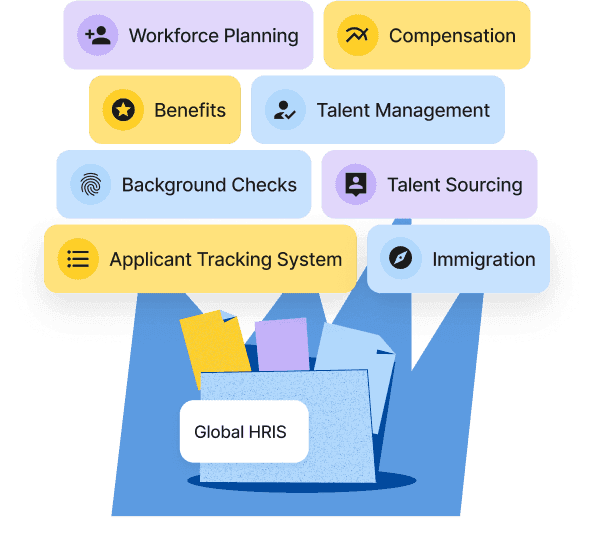
One place for simplified, smarter global HR
Every decision-maker needs one shared source of truth
Spreadsheets create multiple versions of the same fact. HR updates one file, a manager checks another, and payroll works from whatever was last exported. Each person believes they're looking at the current balance, and each is wrong in a slightly different way.
A shared source of truth removes the guesswork entirely. A manager approving time off in Berlin should see the same balance, at the same moment, as HR reviewing that same employee's record in a different timezone. Once everyone works from one record instead of several, disagreements about what someone is owed stop happening.
Approval authority should transfer, not bottleneck on one person
A request submitted at the end of one workday can remain untouched until a single manager wakes up on the other side of the world. Designing around one approver in one timezone guarantees delays the moment a team spans more than one region.
Time zone collaboration now ranks as the second-highest challenge facing distributed teams, up three points since 2023, according to We Work Remotely's State of Remote Work Report 2025. Contractors and employees add another layer to this same problem. The two worker types typically operate under different paid leave terms, and without a clear, explicit rule for who approves what, the difference reads as inconsistency rather than policy.
Time-off data and payroll data should be the same data, not two records
Treating PTO and payroll as separate processes, reconciled later, guarantees the two will eventually disagree. Someone approves a request in one system, someone else keys it into payroll days later, and the gap between those two steps is where errors live.
The financial stakes are real. The US Department of Labor's Wage and Hour Division recovered $259 million in back wages for nearly 177,000 workers in fiscal year 2025, the highest total since 2019. Time off that isn't deducted correctly builds exactly this kind of liability, particularly once an employee leaves and a final PTO payout gets calculated wrong. Treating the two records as one from the start prevents risk from accumulating.

Free guide
Scale your global benefits strategy
Why each input into your PTO system should work together
The best way to refresh your PTO policy is to start treating compliance, tracking, approval routing, and payroll as one connected system. After all, a single time off request touches four separate workflows, and if any one of them breaks, the rest follow suit.
Compliance sets the entitlement
Tracking holds the balance
Approval routing gets it in front of the right person
Payroll needs the final number the day someone leaves
Each of these systems needs a live data connection to the next, not just a shared intention to work together. Without that connection, someone must still export a balance from the tracking tool and manually key it into payroll, even once every individual system has been fixed on its own.
Illustrative example: Picture a company that redesigned its PTO policy properly, with clear categories and local compliance built in. A year later, the policy on paper looks strong, but it doesn’t reveal the approvals that are running through Slack, or the accruals being totaled by hand each month. Nor does it account for the quarterly HR and payroll team meetings to discuss any numbers that don’t line up.
What integration changes
| Workflow | Without integration | With integration |
|---|---|---|
| Compliance to tracking | HR manually updates the balance once a rule changes | The balance updates itself the moment a local rule changes |
| Tracking to approval routing | A manager checks a spreadsheet before approving a request | The approver sees the live balance the moment the request arrives |
| Approval routing to payroll | HR exports approved requests and someone re-enters them into payroll | Payroll receives the approved request directly, with the correct balance attached |
Achieve modern global PTO management with Deel
Modern PTO management needs these same four systems working together: global compliance rules, real-time tracking, approval routing, and payroll data. Disconnect any of them, and a team ends up managing individual exceptions instead of running one operation. Deel connects these by default. Here's how each piece slots together:
Compliance and tracking live in one place. Core HR holds worker profiles, time off, workflows, and compliance insights in a single system, so a policy stops being a document HR maintains separately from the tools that enforce it.
Visibility flows through the same platform. A manager in one timezone and an HR lead in another see the identical, current balance, instead of checking separate exports or waiting on someone else to confirm the numbers.
Approval routing follows the request, not the person. Requests raised through Slack or Microsoft Teams sync directly back to Deel, with the same policies and approval chains applying regardless of where someone approves them.
Payroll picks up automatically. Deel applies local tax rules and statutory requirements before payroll runs, and flags anomalies or missing data before anyone approves the cycle. Time off that's been approved doesn't need re-entering, since it's already the record payroll works from.
Your policy becomes a living system instead of a static document. For companies managing teams across timezones and employment types, this integration separates a policy that works on paper from one that scales. If your current PTO setup lives across spreadsheets, a separate HRIS, and a payroll tool that only talks to the others once a month, it's worth seeing how Deel's Global Payroll and HR work together to turn policy language into working systems.
Ready to turn your PTO policy into a system that enforces it? Book a free demo to see how Deel HR and Payroll work together to unify time-off management for every timezone and employment type you hire.
Live Demo
Get a live walkthrough of the Deel platform
FAQs
What makes a PTO policy compliant for global teams?
A compliant PTO policy tracks each employee's statutory minimum by country rather than applying one company-wide number. Requirements shift based on jurisdiction, covering accrual rules and carryover caps that vary from one market to the next. Building this logic into the tracking system removes the manual research burden from HR.
How often should companies update their PTO policy?
Companies should review PTO policy on a continuous basis rather than waiting for an annual cycle. Statutory minimums shift and distributed teams grow across new countries throughout the year. A policy tied to a tracking system flags compliance changes automatically instead of waiting for a scheduled review.
What's the difference between a PTO policy and a PTO system?
A PTO policy sets the rules for how employees earn and use time off. A PTO system enforces those rules operationally, tracking balances and routing approvals before syncing data to payroll. Policy language alone doesn't fix compliance issues or payroll errors without a system that applies it consistently.
How does payroll integration prevent PTO-related payroll errors?
Payroll integration prevents PTO-related errors by sending approved time-off data directly to payroll without manual entry. Hand-keyed data introduces the risk of missed deductions and incorrect final payouts when employees leave. Automatic syncing keeps payroll and time-off records aligned, so errors don't appear at termination.
Can contractors and employees follow the same PTO policy?
Contractors and employees typically need different PTO policies rather than one shared framework. Employees receive statutory leave entitlements based on their country, while contractor agreements rarely include paid time off at all. Applying one policy across both worker types risks misclassification and compliance issues.
Ellen Simmonds is a content marketing manager with a decade of experience in tech, leadership, startups, and the creative industries. A long-time remote worker, she's passionate about WFH productivity hacks and fostering company culture across globally distributed teams. She also writes and speaks on the ethical implementation of AI, advocating for transparency, fairness, and human oversight in emerging technologies to ensure innovation benefits both businesses and society.