Article
6 min read
Global Labor Cost Reporting for CFOs: How to Build Board-Ready Visibility
Global payroll

Author
Shannon Ongaro
Last Update
September 09, 2026

Table of Contents
Why global labor cost data is fragmented
The four data gaps that block board-ready reporting
A framework for standardizing global labor cost reporting
What a board-ready labor cost report actually includes
Common mistakes that undermine labor cost reporting credibility
How to build board-ready visibility with Deel
Key takeaways
Global teams often struggle to produce a single, timely labor cost figure when payroll data sits across multiple vendors, currencies, and pay cycles with no common format.
A repeatable standardization framework covering currency normalization, entity-level splits, workforce-type classification, and benefits and tax burden by country lets finance teams produce one consistent board view each quarter.
Deel centralizes workforce data for entities, regions, and employee types, so CFOs can build labor cost reports with standardized payroll inputs and reduced manual reconciliation.
This article is provided for general informational purposes and should not be treated as financial, legal, or HR advice. Payroll regulations, statutory contribution rates, and employer obligations vary by country and change frequently. Consult a qualified payroll compliance specialist, employment lawyer, or accountant for guidance specific to your jurisdiction.
A finance team reconciling payroll across a dozen vendors often spends more time chasing exports and matching field names each quarter than analyzing what the numbers mean.
In most cases, this is because "labor cost" means something different in each payroll system they use. Think of it as a reconciliation tax: hours the team pays every quarter just to get raw data into a comparable format.
This article covers the four gaps that create that tax, including currency conversion, entity-level splits, contractor visibility, and country-by-country benefits and tax burden. Plus, a framework for closing them and a look into how Deel removes the manual work at the source.
Why global labor cost data is fragmented
The process of global expansion is often what fragments labor data. Most global companies entered new markets one at a time, hiring through whatever local payroll vendor or employer of record was available, and layering in contractors as headcount needs shifted.
The result is a patchwork of payroll systems with no shared data model, leading to different field names, pay cycle cadences, and definitions of what counts as compensation.
Several structural factors compound the problem:
Multiple in-country vendors. A company operating in 20 countries may run payroll through six or more separate providers, each delivering data in its own format and on its own timeline.
Incompatible pay cycles. Monthly payroll in Germany, biweekly in the US, and weekly in Australia means payroll data often arrives at different times, making any snapshot of total spend an approximation at best.
No shared data model. Without a common taxonomy for what counts as base salary, employer contributions, contractor fees, or one-time payments, finance teams spend most of their time reconciling definitions before they can reconcile numbers.
Blended workforce complexity. Full-time employees, EOR workers, and independent contractors are often managed through separate systems entirely, so a unified headcount-cost view requires pulling from three or more distinct data sources.
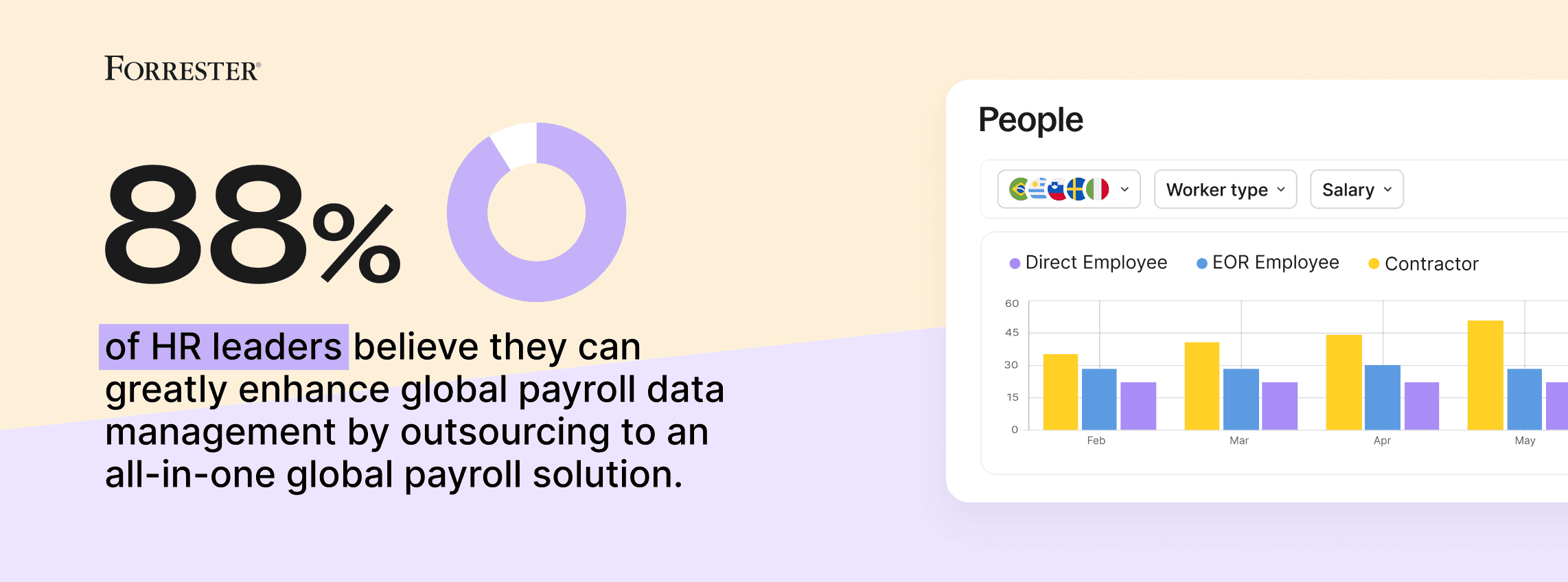
According to a Forrester study commissioned by Deel, which surveyed over 300 payroll professionals at enterprise companies, 75% of respondents said the need for different payroll vendors in each region and country adds complexity. 97% said one single payroll solution would be very valuable.
For global labor cost reporting, that fragmentation can be the reason board presentations rely on footnotes about "estimated" figures and "subject to final reconciliation."
Deel Payroll
Run payroll in Deel. Anywhere. Your way.
The four data gaps that block board-ready reporting
Fragmentation creates specific information gaps that finance teams must close before any board-ready number is possible.
Currency conversion and FX normalization
When a company's German entity reports in euros, its Singapore entity reports in Singapore dollars, and its Brazil entity reports in reais, the company must first translate those figures into a consistent reporting currency before any consolidated labor cost is meaningful. Reporting in local currencies obscures true consolidated spend and makes period-over-period comparisons almost meaningless when exchange rates shift.
The fix is a consistent base-currency standard applied at the entity level, with the FX rate locked at a defined point in the payroll cycle rather than recalculated at report time. This means establishing:
A single reporting currency (typically USD, EUR, or GBP depending on investor and board expectations)
A standardized rate-lock methodology. Many finance teams use the rate as of the last business day before payroll cutoff for each cycle.
A separate FX variance line in the board report so currency movement is visible as its own factor, distinct from actual changes in headcount or compensation
Without this discipline, a 5% increase in "labor spend" from one quarter to the next might be entirely attributable to currency movement rather than any change in the underlying workforce.
See also: How To Manage Currency Exchange Rates When Processing Payroll

Entity-level cost splits
For companies with multiple legal entities (subsidiaries, joint ventures, or registered branches), board reporting can require labor costs attributed to the correct entity. This impacts financial consolidation, intercompany accuracy, and any audit or compliance review of how costs are allocated across the group.
The challenge is that some workforce costs do not fall neatly into one entity. An employee working across two subsidiaries, a shared services function supporting multiple markets, or a contractor engaged by one entity but billing another all create attribution questions that payroll systems typically do not resolve automatically. Finance teams either carry these costs at the consolidated level (which obscures entity-level performance) or reconcile them manually each quarter (which is slow and error-prone).
A cost-center framework that assigns employees to cost centers, with percentage splits and effective dates for shared roles, is the structural fix. Independent contractor costs may require separate attribution through contractor or finance data. Finance teams can then roll up entity-level payroll data cleanly for consolidation purposes.
Contractor vs. employee spend visibility
In a blended workforce, labor cost reporting has a coverage problem: contractor spend is frequently excluded from the consolidated labor figure simply because it flows through procurement, accounts payable, or a separate contractor management system rather than through payroll. The result is a board number that understates actual workforce spend, sometimes by a material amount.
Transitioning workers from contractor to employee status typically surfaces this problem because reclassification makes contractor costs suddenly appear in the payroll line, which looks like a cost increase even when total workforce spend is unchanged.
A different approach to consider is including contractor engagement costs in the labor cost report from the start. Consider showing them in a separate workforce-type breakdown that makes the mix visible, rather than blending them into the headcount cost line. This lets the board see total workforce spend, not just the payroll subset of it.
Benefits and tax burden by country
Gross salary is a fraction of what an employee actually costs the business. A team in France costs materially more per euro of gross salary than a team in the United States, and a board that only sees gross payroll cannot see why.
Employer social security contributions, mandatory pension contributions, statutory health insurance premiums, severance reserves, and other statutory costs vary significantly by country, and in-country vendor data often omits them.
Total cost of employment (TCE) accounts for all of these: base compensation, employer social contributions, statutory benefits and allowances. Countries calculate these components against different bases, rates, and caps.
Finance teams that produce board-ready reporting capture TCE by country rather than gross payroll by country, and they show the composition of TCE so the board understands what it is looking at.

Guide
The Case for Global Payroll Consolidation
A framework for standardizing global labor cost reporting
Closing the four data gaps described above requires more than better data. It requires an operating model that finance teams run consistently each quarter. The framework has four components.
Common data dictionary. Before any numbers are aggregated, every entity should use the same field definitions: what counts as base salary, what counts as employer social contributions, what counts as a statutory payment, and how contractor fees are categorized. Without this, every consolidation exercise starts with a definitional negotiation.
Entity-first reconciliation. Aggregate from the entity level up, not from the consolidated level down. Each entity submits standardized payroll data, while contractor spend is incorporated from the relevant contractor management, procurement, or accounts payable source. State all figures in the reporting currency using the agreed FX rate, so the consolidation is arithmetic instead of interpretive.
Consistent reporting calendar. Fix the FX rate lock date, the data submission deadline for each entity, and the board report delivery date at the start of each fiscal year. Late data from one entity should not delay the entire consolidation or require a re-cut.
Five board-level KPIs. Once the data is standardized, the report tracks:
Total cost of employment (TCE) by country
Labor as a percentage of revenue by region
FX impact on payroll spend (period over period)
Headcount cost by entity
Payroll error and variance rate
These five metrics give the board the information it needs to evaluate workforce spend relative to business performance, understand the drivers of change, and ask precise questions rather than open-ended ones.
To learn more about consolidating the payroll infrastructure that feeds this framework, the guide to global payroll consolidation covers the vendor-level decisions that enable entity-first reconciliation to work in practice.

Template
Get a free payroll journal entry template
What a board-ready labor cost report actually includes
A well-structured quarterly labor cost report explains the factors behind the figures. The structure that works best has four elements.
Executive summary bridge. A single table showing quarter-over-quarter change in total labor cost, decomposed into four drivers: headcount change, average rate change, FX impact, and statutory or one-off items. This lets the board see exactly why the number moved.
Entity-level waterfall. A breakdown of total labor cost by legal entity, showing TCE rather than gross payroll. Entities with material variance from the prior quarter should carry a brief commentary explaining whether the driver is headcount, rate, FX, or statutory cost.
Workforce-type breakdown. A separate line for employee payroll costs and contractor engagement costs, by region if possible. This is the section that makes workforce mix visible to the board and avoids the mismatch between "headcount" reports and "labor cost" reports.
Variance commentary. For any entity or line that moves more than a defined threshold, a one-to-two-sentence explanation. Board members are better positioned to act on information when they understand the context, and variance commentary is what turns a reporting package into a decision-support document.
Common mistakes that undermine labor cost reporting credibility
Even teams with a solid framework in place can undermine the credibility of their board reports through a handful of recurring failures.
Late FX rate locks. If different entities use different FX rates, or if the rate is not fixed before entities submit their data, the consolidated figure will shift every time someone recalculates it, which prevents the team from finalizing the number.
The fix: If possible, lock the rate on a defined date in the reporting calendar and do not allow post-submission adjustments.
Inconsistent TCE definitions across countries. If Germany includes employer pension contributions in TCE and the US excludes them, the country-by-country comparison is misleading.
The fix: The common data dictionary must specify which cost categories are included in TCE for every jurisdiction, and finance must audit submissions for compliance.
Excluding contractor spend. A labor cost figure that excludes contractor engagement costs reports payroll costs rather than total workforce costs, and the two are not the same in a blended workforce.
The fix: Require contractor spend data from the procurement or contractor management system as part of the standard quarterly submission.
Relying on manual exports. When the global payroll consolidation process depends on finance team members manually downloading exports from multiple systems and merging them in spreadsheets, every quarter carries the risk of a version-control error, a missed update, or an incompatible format. Any one of those can produce a number the CFO cannot stand behind.
The fix: Reduce repeated manual collection through standardized reporting, integrations, APIs, or controlled exports into the finance consolidation layer.
Separately, the CFO-board relationship itself carries its own alignment risk. Research from Protiviti's Global Board Governance Survey, based on responses from more than 1,000 directors and C-suite leaders, found material perception gaps between CFOs and board members on priorities and risk.
CFOs who present labor cost data without translating it into the strategic language the board uses (growth implications, risk exposure, capital allocation context) will find that technically correct reporting still fails to land.
Guide
Get your guide to international payroll costs
How to build board-ready visibility with Deel
The structural problem with global labor cost reporting is that the data lives in too many places. Closing the gaps described above is possible when working across multiple vendors and systems, but it requires significant ongoing manual effort and process discipline. The alternative is consolidating the underlying payroll infrastructure.
Deel's unified system supports payroll in 130+ countries. Finance teams can manage supported EOR, global payroll, local payroll, and PEO payroll workflows through the Deel platform, with consolidated reporting across countries and entities.
Key capabilities include:
Multi-currency reporting with FX transparency. Finance teams can display and export consolidated payroll reports in major currencies. For EOR contracts in foreign currencies, Deel applies and shows the FX rate used at payroll cutoff, so the translation methodology is auditable rather than opaque.
Entity-level cost center attribution. Finance teams can assign employees to cost centers within entities, with percentage splits and effective dates for shared roles. This matches the framework the standardization model above requires.
Unified Gross-to-Net reports. Standardized across countries and entities, filterable by payroll cycle, and exportable as CSV, XLSX, or PDF. These reports provide standardized payroll inputs for a broader board-reporting model, which may also require contractor, revenue, and accounting data.
General Ledger export. Finance teams can transfer payroll data into accounting systems to support posting and reconciliation.
WIth Deel, you can reduce repeated manual collection and reconciliation by centralizing supported payroll and workforce data in a consistent reporting workflow, so finance teams spend less time chasing exports from multiple vendors and more time on analysis and commentary.
Talk to a Deel expert to see how Deel can unify supported payroll data and provide standardized inputs for board-ready labor-cost reporting.
Deel Payroll
Run payroll on one platform, globally

FAQs
What is total cost of employment and why does it matter for board reporting?
Total cost of employment (TCE) is the full cost of employing someone, including gross salary, employer social security contributions, mandatory pension or health contributions, statutory allowances, and severance reserves where applicable. Board reports built on gross payroll alone understate the true cost of the workforce by a material amount, particularly in markets with high statutory employer contributions.
How often should global labor costs be reported to the board?
Most boards receive labor cost reporting quarterly, aligned with the financial close cycle. Some organizations with high headcount volatility or significant workforce transformation report monthly. The cadence matters less than the consistency: the same methodology, the same data inputs, and the same FX rate methodology every period.
What is the difference between gross payroll and total labor cost?
Gross payroll is the sum of employees' gross compensation before deductions. Total labor cost adds employer-side costs such as social contributions, statutory benefits, and applicable reserves. Total labor cost is always higher than gross payroll, sometimes significantly so depending on the country.
How do multi-currency payrolls distort labor cost reporting?
When entities report in local currencies and exchange rates shift between reporting periods, a change in the consolidated labor cost figure may reflect currency movement rather than any real change in headcount or compensation.
Can contractors be included in a consolidated labor cost report?
Yes. Contractor engagement costs are part of total workforce spend, and excluding them produces a board number that understates the true cost of the workforce. Consider showing contractor costs on a separate line from employee payroll costs within the same report, so the board can see both total workforce spend and the composition of the workforce type mix.
Shannon Ongaro is a content marketing manager and trained journalist with over a decade of experience producing content that supports franchisees, small businesses, and global enterprises. Over the years, she’s covered topics such as payroll, HR tech, workplace culture, and more. At Deel, Shannon specializes in thought leadership and global payroll content.