Article
8 min read
Global Payroll Compliance Checklist for 2026: A Country-by-Country Guide
Global payroll

Author
Shannon Ongaro
Last Update
August 18, 2026

Table of Contents
Why global payroll compliance is getting harder in 2026
The global payroll compliance checklist: what every company needs
Country-by-country payroll compliance guide for 2026
5 payroll compliance mistakes global teams make (and how to avoid them)
How Deel simplifies global payroll compliance
Key takeaways
Managing payroll across multiple countries means tracking an ever-growing set of jurisdiction-specific tax codes, filing deadlines, and mandatory benefits.
A structured, country-by-country compliance checklist gives HR and finance teams the visibility they need to catch gaps before they become penalties.
Deel Payroll handles in-country compliance in 150+ countries—including automated tax filings, statutory contributions, and payslip generation—so your team isn't manually chasing regulatory updates across a dozen jurisdictions.
Running payroll for a team spread across the US, Germany, Brazil, and Singapore is a compliance challenge that compounds with every new hire, every regulatory update, and every jurisdiction you add to the map.
In 2026, the stakes are higher than ever. Governments are accelerating digital reporting mandates. Tax authorities are getting better at cross-border enforcement. Worker classification rules are tightening globally. And the cost of getting it wrong—back taxes, penalties, reputational risk, forced severance—is significant.
This guide gives HR and finance leaders a practical, country-by-country payroll compliance checklist for 2026. It covers what's new, what's consistently required across all markets, and how to build a compliance process that holds up under audit. Use it as a working reference—and as a starting point for conversations with your legal and tax advisors.
This guide is for informational purposes only and does not constitute legal, tax, or accounting advice. Consult a qualified professional for guidance specific to your jurisdiction.
Why global payroll compliance is getting harder in 2026
Payroll compliance has never been static, but the rate of change has increased materially in recent years. Here’s what’s driving the complexity in 2026:
Digital reporting mandates are expanding. Countries across Europe, Latin America, and Asia are requiring real-time or near-real-time payroll reporting to tax authorities. Brazil’s eSocial, the UK’s RTI system, and Mexico’s CFDI digital payslip requirement are well-established, but similar frameworks are now rolling out or tightening in additional markets.
Regulatory velocity is high. Over 30 countries updated payroll, employment tax, or mandatory benefits rules between 2025 and 2026. Minimum wage increases, revised social contribution rates, and new leave entitlements all create compliance obligations that need to be tracked and applied at the payroll level, not just noted in policy documents.
Worker classification risk is intensifying. The EU Platform Workers Directive, Brazil’s ongoing contractor reclassification enforcement, and continued IR35 scrutiny in the UK mean that companies hiring internationally need to be confident their workforce is correctly classified. Misclassification creates employment law exposure as well as backdated payroll tax liability.
Remote work multiplies jurisdictional exposure. An employee who lives in one country, works for a company registered in another, and occasionally works from a third creates overlapping compliance obligations that manual processes struggle to track.
Legacy tools don’t scale. Spreadsheets and single-country payroll platforms weren’t built for multi-jurisdiction compliance. Companies that haven’t consolidated their payroll infrastructure are managing the highest complexity with the least capable tooling.
The global payroll compliance checklist: what every company needs
Before going country-specific, there’s a universal compliance baseline that applies in virtually every jurisdiction. Use this as your starting checklist regardless of where you’re hiring:
Worker classification confirmed: Employee vs. contractor status is documented and defensible under local law
Employer registration complete: Legal entity or Employer of Record (EOR) relationship established in-country before payroll runs
Payroll cycle set correctly: Frequency matches local legal requirements (monthly, bi-weekly, weekly)
Statutory deductions calculated accurately: Income tax withholding, social contributions, and any local levies applied at correct rates
Mandatory benefits in place: Pension enrollment, health insurance, paid leave accruals, and any legally required allowances funded and tracked
Payslips issued on time: Format and delivery method compliant with local rules
Payroll records retained: Stored per local data retention requirements (typically 5–10 years)
Year-end filings scheduled: Tax authority reports, employee summaries, and reconciliation deadlines on the calendar
FX handling documented: If paying in local currency from a foreign entity, exchange rate policy is transparent and consistent
Hours-worked records maintained: Time worked, overtime, and breaks are recorded accurately and retained per local rules, ready for audit
This foundation doesn’t change much by country. What changes is the specific rates, deadlines, thresholds, and reporting mechanism, which is what the country-by-country section of this guide covers.

Free Resource
Free Global Payroll Guide [With Expert Insights]
Country-by-country payroll compliance guide for 2026
United States
The US combines federal-level requirements with significant state-by-state variation, making it one of the most operationally complex countries for multi-location payroll.
Employer registration: Required in every state where employees reside (not just where the company is headquartered)
Federal taxes: FICA (Social Security 6.2% + Medicare 1.45% employer match), FUTA (0.6% net after credit, on first $7,000 wages)
State unemployment (SUTA): Rates and wage bases vary widely by state
W-2 filing: Employee copies and SSA filing due January 31
ACA reporting: Forms 1094-C/1095-C required for employers with 50+ full-time equivalents
2026 note: Several states have updated state income tax rates or withholding tables—verify your payroll engine has current state tables
Guide
Step-by-Step Guide to US Payroll
United Kingdom
PAYE and RTI: All payroll submissions must be made to HMRC in real time on or before each pay date
National Insurance: Employer NICs remain a key cost. Verify correct category letters are applied (standard employees, directors, apprentices differ)
Auto-enrolment: Pension enrollment triggered at £10,000/year earnings threshold. Minimum contributions are 3% employer / 5% employee of qualifying earnings
National Living Wage: Increased in April 2026—ensure pay rates are updated for all affected workers
IR35: Off-payroll rules apply to medium/large businesses engaging contractors via intermediaries. Status determination statements (SDS) must be issued

Guide
A Complete Guide to Payroll in the UK
Germany
Lohnsteuer: Monthly wage tax submissions to Finanzamt. Tax class of the employee determines withholding rate
Social insurance: Four-pillar system—health (Krankenversicherung), pension (Rentenversicherung), unemployment (Arbeitslosenversicherung), and care (Pflegeversicherung)—split between employer and employee
Works council obligations: Any change to payroll processes, working hours, or remuneration structures may require works council consultation for companies with five or more employees
GDPR compliance: Payroll data is sensitive personal data. Processing must comply with GDPR, including lawful basis, data minimization, and retention limits
2026 note: Minimum wage increased to €13.90/hour in January 2026—verify all hourly workers are above the new threshold
Canada
CPP2: The second additional Canada Pension Plan tier (introduced 2024) is now fully phased in for 2026. Verify contributions are calculated on the correct earnings band
Quebec: Quebec employees contribute to QPP (not CPP) and QPIP (Quebec Parental Insurance Plan) rather than EI maternity benefits—separate calculations required
EI premiums: 2026 premium rates updated. Employer pays 1.4x the employee rate
T4 filing: Deadline is February 28 for prior-year T4 slips and T4 Summary
Provincial payroll taxes: Ontario Employer Health Tax (EHT) applies above $1M payroll. Manitoba Health and Education Levy and Newfoundland payroll tax also apply—check applicability by province
Australia
STP Phase 2: All employers must report salary, tax withheld, and super contributions to the ATO on or before each pay day via Single Touch Payroll
Superannuation guarantee: General SG rate of 12% will remain for 2026; SG rate for Norfolk Island will rise from 10% to 11% July 1, 2026
Fair Work Act: Modern awards set minimum pay rates and conditions for most industries. Ensure award classifications are correct for each employee role
Payslip requirement: Must be provided within one working day of payment
PAYG withholding: Tax withheld must be remitted to ATO. Frequency (weekly, monthly, quarterly) depends on total withholding amount

Guide
New to Australian payroll?
India
TDS (Section 192): Employer must deduct and remit income tax monthly. Employees choosing the new default tax regime (applicable from FY2025–26) have different slab rates
Provident Fund (PF): 12% of basic salary from both employer and employee for employees earning above ₹15,000/month basic (in-progress proposal may increase this to ₹25,000). Employer contributes an additional 3.67% to PF and 8.33% to EPS
ESI: Applies to employees earning ≤₹21,000/month. Contributions are 3.25% employer + 0.75% employee
Professional Tax: State-administered. Rates vary by state and salary slab—ensure correct state code is applied for each employee’s work location
Payslip requirements: Monthly payslips required. Must include detailed breakdowns of gross pay, deductions, and net pay
Mexico
IMSS: Employer contributions to the social security institute are multirate and cover healthcare, disability, retirement, and housing. Rates depend on worker salary and risk category
INFONAVIT: 5% of daily integrated salary contributed to worker’s housing fund
PTU (Profit Sharing): Companies must distribute 10% of taxable profit to employees by May 31 each year. Calculation methodology is prescribed
ISN (State Payroll Tax): Levied by each Mexican state at rates typically between 2–3%. Verify rate for each location where employees work
CFDI digital payslip: Electronic payslips must be generated and stamped with an SAT digital seal at every payroll run
NOM-035: Employers must identify and address psychosocial risk factors in the workplace. Documentation and annual assessments are required
Brazil
eSocial: All employment events—hiring, payroll, terminations—must be reported via the government’s eSocial digital platform in real time
FGTS: Employer contributes 8% of monthly salary to the employee’s Fundo de Garantia do Tempo de Serviço account, paid monthly
INSS: Social security contributions required from both employer and employee. Employer rates vary by company type
Décimo Terceiro (13th salary): Legally mandatory. First installment between February and November, second installment by December 20
IRRF: Income tax withheld at source under progressive table. Updated brackets apply from 2026
2026 note: Brazil continues enforcement of contractor reclassification—platforms and services companies should review engagement structures
Local Payroll / Brazil
Payroll in Brazil, simplified
Singapore
CPF: Central Provident Fund contributions vary by employee age bracket. For employees under 55, employer contributes 17% and employee contributes 20% of ordinary wages (up to OW ceiling of S$8,00/month)
Skills Development Levy (SDL): 0.25% of monthly remuneration for all employees, payable monthly to SkillsFuture Singapore
Itemised payslips: Mandatory for all employees. Must be issued within three working days of salary payment
IR21 (tax clearance): Required for foreign employees leaving Singapore—employer must notify IRAS at least one month before cessation and withhold final payment until clearance
Netherlands
Loonheffingen: Monthly payroll tax return covering wage tax and national insurance. Must be submitted and paid by the second working day of the month following the pay period
30% ruling: Qualifying expat employees may apply for a partial tax exemption on salary—HR must ensure this is correctly flagged in payroll
Works Council Act: Companies with 50 or more employees must consult the ondernemingsraad (works council) before making material changes to remuneration or working conditions
2026 minimum wage: Updated January 2026—statutory minimum applies per hour (not monthly), ensure hourly rates are compliant
Need country-specific payroll guidance?
Explore the HR and Payroll Compliance Across EMEA guide and the 2026 Payroll Compliance Checklist and Tax Law Guide for the US for deeper regional coverage.
5 payroll compliance mistakes global teams make (and how to avoid them)
1. Misclassifying employees as contractors. The financial exposure is substantial: backdated social contributions, income tax withholding arrears, and penalties, sometimes reaching years of liability. Review classification in every country where you engage non-payroll workers, particularly in Brazil, Spain, the UK, and EU member states.
2. Using a single global payroll calendar. Monthly payroll works in Germany. It doesn’t work in Mexico (bi-weekly is common) or the US (where bi-weekly or semi-monthly is standard in many industries). Running payroll on the wrong frequency can trigger wage law violations.
3. Ignoring mandatory one-off benefits. Such as the 13th month salary (Mexico, Brazil, Philippines, and others) and statutory profit sharing (Mexico). Missing them creates employee grievances and regulatory exposure.
4. Processing payroll before completing employer registration. Paying employees through an unregistered employer entity is illegal in most jurisdictions. The resolution is retroactive registration, penalties, and in some cases, forced employment formalization.
5. Manual FX calculations on cross-border payrolls. Using spot rates inconsistently or applying internal rates not aligned with central bank benchmarks creates discrepancies that trigger audit questions and employee disputes.
Deel Payroll
Run payroll in Deel. Anywhere. Your way.
How Deel simplifies global payroll compliance
The complexity described above is significant, but it’s also solvable with the right infrastructure.
Deel Payroll manages payroll compliance in 150+ countries through a combination of in-country payroll experts and automated compliance.
Deel keeps time tracking records in the same system as pay: Workers clock in and out or submit timesheets, approvals are tracked, and approved hours feed payroll.
Deel’s in-country teams handle tax filings, statutory contribution calculations, payslip generation, and digital reporting submissions locally, meaning your team isn’t manually tracking 30+ regulatory updates per year.
When compliance rules change—a new minimum wage, a revised contribution rate, an updated digital reporting requirement—Deel’s platform is updated before the effective date. You don’t need to monitor legislative feeds for each country you operate in.
For companies that want to hire in a new country before establishing a local entity, EOR (Employer of Record) absorbs employment compliance responsibility—including payroll tax, statutory benefits, and employment law obligations—under Deel’s local legal entity. It’s the fastest and lowest-risk path to compliant employment in a new market.
For companies with established entities, Deel Payroll integrates with your existing HR stack, brings multi-country payroll data into a unified dashboard, and maintains the audit trail you’ll need if a tax authority comes calling.
If your current setup has you manually tracking regulatory changes across multiple countries, that’s the gap worth closing first. Explore Deel Payroll to see how compliance is handled in the countries where your team works or a request a demo to see the Deel platform in action.
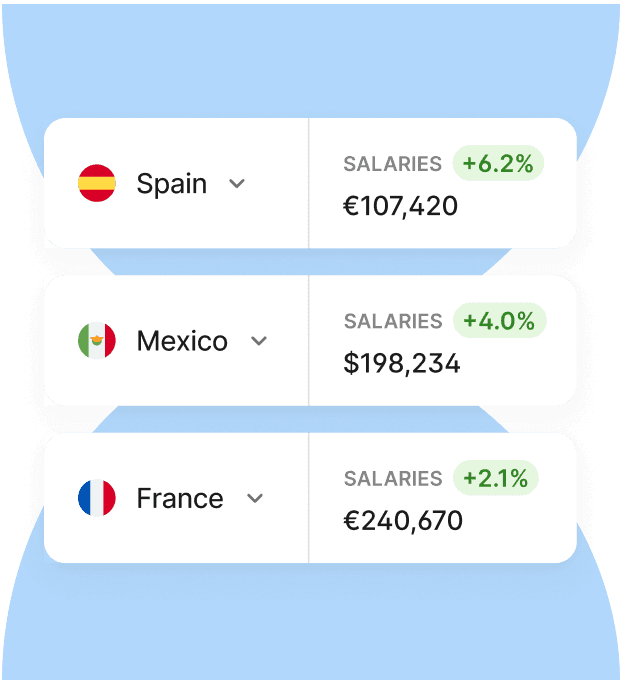
Deel Payroll
Run payroll on one platform, globally

Additional Deel resources on global payroll compliance
Shannon Ongaro is a content marketing manager and trained journalist with over a decade of experience producing content that supports franchisees, small businesses, and global enterprises. Over the years, she’s covered topics such as payroll, HR tech, workplace culture, and more. At Deel, Shannon specializes in thought leadership and global payroll content.