Article
8 min read
How to Choose a PEO: Evaluation Guide for 2026
PEO

Author
Shannon Ongaro
Last Update
August 11, 2026
Key takeaways
The right PEO measurably changes outcomes: faster growth, lower turnover, and better retirement and benefits participation, according to industry data.
Key features to look for include in-house expert support, benefits flexibility, and transparent pricing.
A structured evaluation across cost, benefits, liability, service, and exit terms shows which PEO will actually deliver that impact, including Deel's PEO.
Choosing a Professional Employer Organization (PEO) to manage your HR, payroll, and benefits is a big decision for companies of all sizes. While most PEOs offer a similar set of services on the surface—payroll processing, employee benefits, HR support— the real differences lie in the details many buyers overlook until it's too late.
The factors that will impact your experience most are often buried in the fine print: service responsiveness, platform consolidation, and reporting access, to name a few.
"There are over 500 PEOs in the United States, and I tell everybody, not every PEO was created equally," said Phillip Alvarado, Director, PEO Solutions Consulting, Deel, in our webinar on Building a Compliance-First Strategy for US Business Expansion. "There are PEOs that charge a percentage of payroll, and that can get so very expensive. There are PEOs that have so many different hidden costs that you never realize that you're paying because they hide them in taxes... and then there are PEOs that lock you in to contracts with crazy termination fees."
In this guide, we'll walk through a practical evaluation framework you can use to assess PEO providers, illustrated with how five real companies weighed the same decision.
When does a PEO make sense?
Before comparing vendors, verify that a PEO is the optimal solution for your current situation. PEOs are a fit for a wide range of company types, but particularly those that want to:
Hire and onboard quickly with built-in state-level compliance guidance
Compete for top talent by offering Fortune 500-level benefits
Avoid payroll tax errors and reduce compliance risks with expert-backed support
Don't have the bandwidth or desire to build out a full-scale HR function in-house
This could include:
US-based companies with a registered legal entity
Businesses with employees in multiple states
SMBs and mid-market companies scaling operations
Global companies hiring their first US employees
A co-employment model like a PEO gives you a direct employment relationship with your US team, while an Employer of Record (EOR) takes on that legal employment relationship on your behalf.
Companies scaling a workforce they already employ directly in the US tend to reach for a PEO. Companies hiring employees without setting up an entity there tend to reach for an EOR.
However, a PEO may not be the best fit if:
You’re looking for hiring and payroll support outside of the US
You do not currently have, or plan to have, legal entities in the US
You're hiring fewer than 5 employees (unless you’re doing a full carveout)
Guide
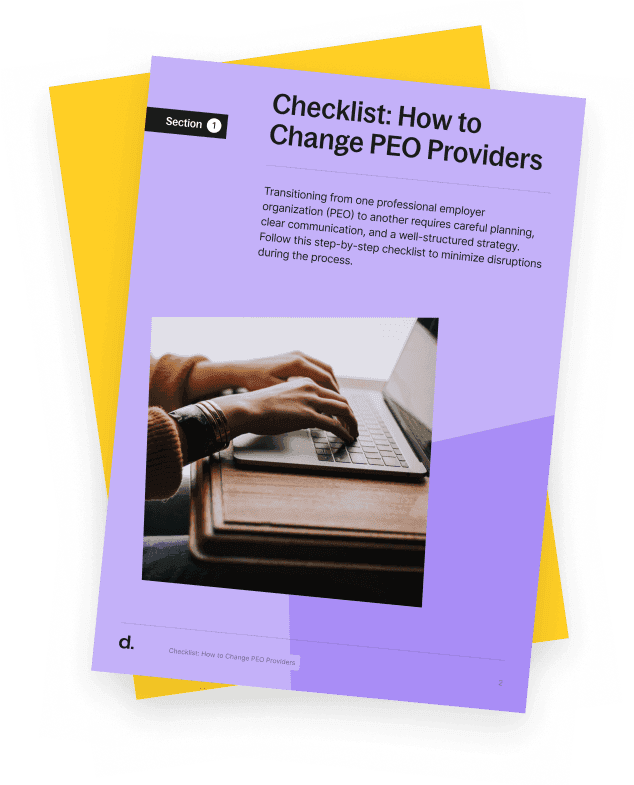
PEO Evaluation Checklist
6 criteria for evaluating PEO providers
When assessing potential PEO partners, don't just compare the service offering checkboxes. Dig into the details that will have a material impact on your business.
1. Pricing structure and transparency
PEO pricing structures vary across providers, and it's worth understanding what you're actually comparing.
Some providers charge a bundled rate that combines the admin fee with insurance premiums. Others charge a flat per-employee rate plus separate fees tied to specific events, like onboarding and implementation, off-cycle payroll runs, right-to-work verification, 401(k) plan setup and administration, physical check delivery, or correcting a benefit election or W-2.
Both approaches are common, and which one works out better for you depends on how often those events actually come up.
Some providers make this comparison harder than it needs to be, quoting a bundled number without publishing what's actually included. Deel takes the opposite approach and publishes its PEO pricing directly:
Deel's PEO pricing is $125 per employee per month, covering:
Payroll, tax, and health benefits managed by Deel
Ongoing Deel support from payroll, HR, and compliance experts
All-in-one HR without costly overhead
State registrations and compliance setup done for you
Workers' compensation coverage and compliance monitoring for business protection
When evaluating PEO pricing, ask:
Is the service fee charged as a flat per-employee-per-month (PEPM) amount or a percentage of payroll?
Are the benefit premiums broken out from the admin fee, or bundled together?
What line-item fees exist for onboarding, off-cycle payroll runs, plan changes, or corrections, and how often do they actually come up?
Is there an early termination fee, and how is it calculated?
In practice: Tough Leaf, a construction-industry procurement platform, ran three separate systems to manage its early US hires before consolidating onto one PEO. The switch cut HR expenses by 30 percent and cut the time spent on HR, payroll, and compliance in half.
We considered Rippling for our US workforce, but Deel provided more value with superior compliance management, real-time customer support, and a truly centralized system.
—Hassan Ibrahim,
Operations Manager, Tough Leaf
2. Benefits quality and flexibility
Benefits administration works roughly the same way across PEOs.
Employees enroll during an open enrollment period, as new hires, or after a qualifying life event, and review their plan options through the provider's platform.
The employer decides whether to offer benefits at all, which ones to offer beyond what's legally required, and how much to contribute, either a flat dollar amount or a percentage of the premium. Coverage is optional, so employees can decline it if they'd rather use a spouse's plan or go without.
Typical benefit categories include:
Major medical, dental, and vision plans
Retirement plans (401(k))
HSAs and FSAs
Life insurance
Short- and long-term disability
Add-ons like critical illness, hospital indemnity, and accident protection
The PEO also typically handles COBRA administration and ACA compliance on the employer's behalf.
What varies by provider is plan design (fully-insured versus self-funded), network quality, whether you're locked into the PEO's master policy or can keep your own broker, and what happens to coverage if you leave. The real test is whether a PEO can get you the kind of benefits that let you compete with much larger companies for talent, not just cover the legal minimum.
When evaluating benefits, ask:
Are the health plans fully-insured or self-funded?
Can you choose your own plans or brokers, or are you locked into the PEO's master policy?
What happens to coverage if you terminate the contract?
How many carriers and plan options are actually available, and do they vary by state?
With Deel, you can keep your existing benefits broker and workers' comp carrier and use the same platform for payroll, HR, and compliance, or hand the whole package to Deel, including EPLI and workers' comp claims.
Deel's plans run on large-group buying power that most companies this size couldn't negotiate on their own:
Medical coverage through Aetna and Kaiser Permanente across more than 60 US plans and eight international plans
Dental and vision
401(k) retirement plans
HSA and FSA accounts
Voluntary options like life insurance, short- and long-term disability, and fertility benefits
A dedicated Benefits Manager for open enrollment and ongoing questions
See also: [https://www.deel.com/blog/how-deel-is-redefining-peo-experience/](How Deel is Redefining the PEO Experience)
In practice: Before landing on one provider, ChartSquad, a healthcare services company, tried three different PEOs and found each one added friction instead of solving it: missed wage garnishments, disappearing handbooks, inconsistent PTO policies. Since consolidating its benefits administration, the company has reached 100 percent benefits plan coverage across its team. "I'm saving money with Deel, delivering better benefits, and reducing headaches," said Chris Carpenter, CEO and Founder. "It's a no-brainer."
Checklist
Employee Benefits Renewal Checklist
3. Risk sharing and compliance support
A key value proposition of a PEO is sharing employer liability and managing compliance responsibilities. Under the co-employment model, the PEO typically handles:
Payroll tax administration and state registrations
New hire filings and unemployment administration
Workers' comp coverage and claims handling
Tracking and applying federal, state, and local regulatory changes
But the level of compliance support varies between providers, and misclassification is one of the more common risks companies overlook.
See also: PEO Compliance: How a PEO Supports Multi-State Hiring
When evaluating a PEO's risk and compliance coverage, ask:
How much of the compliance admin burden do they handle — payroll taxes, workers' comp, state registrations, new hire filings?
What insurance coverages are included, such as employment practices liability (EPLI)?
How do they stay current on federal, state, and local regulatory changes?
Deel's PEO backs this with a specific set of people and services:
A dedicated HR Business Partner as the go-to for compliance and HR questions
HR and compliance guidance across all 50 states, including employee handbooks, labor law posters, and compliance with ACA, COBRA, EEOC, OSHA, FLSA, and SUI
EPLI coverage for legal protection against claims like wrongful termination, discrimination, or harassment
Initial and annual HR assessments to keep PTO, leave, and discipline policies compliant
Unemployment administration, filings, and hearings support
Equal employment opportunity reporting for companies with 15 or more employees, where EEOC obligations kick in
In practice: When Liner, a Seoul-based AI research platform, opened a small California office, the state's labor law complexity caught its HR team off guard. Moving to a single PEO replaced three outside vendors, tax and accounting firms, and legal advisors, with one system.
Deel's ability to manage payroll, HR, and compliance all in one place significantly simplified our internal processes. This is especially helpful in places like California where the local labor laws can be exceptionally complex.
—Eunyoung (Clara) Lee,
US HR Manager, Liner
4. Service and support model
The quality and responsiveness of a PEO's service team has a huge impact on your day-to-day experience. Ask about dedicated points of contact, response times, and the actual HR expertise behind the support line — not just what's promised in the sales pitch.
Speed of resolution matters more than most buyers expect going in, since HR issues rarely wait for a convenient time.
When evaluating service, ask:
Will you have a dedicated support rep, and what's the guaranteed response time?
What HR expertise sits behind that rep — can they advise on terminations, handbook updates, and leave policy, or just process paperwork?
What does implementation and onboarding actually look like, start to finish?
Deel’s support includes:
A dedicated HR Business Partner
A dedicated Onboarding Manager (OBM), who guides you from Sales to active payroll
Payroll Managers (PRMs) and HRX teams support daily HR and payroll operations
24/7 support through chat, email, and Slack
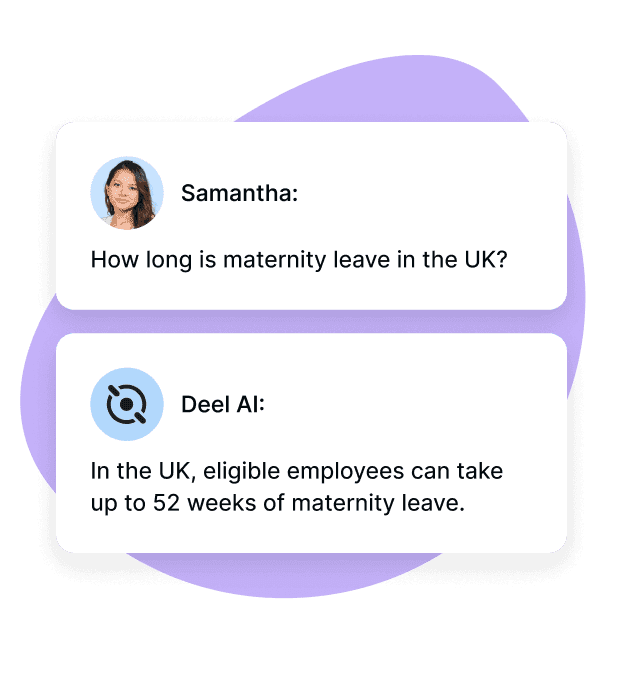
Deel AI for instant compliance answers
For Liner's HR team, the compliance win above showed up in response times, too. HR questions that used to take one to three business days to resolve through outside vendors are now typically handled within the hour. "Most questions are solved within the hour," Lee said. "The time we win back goes straight into supporting our people."
5. Reporting and technology
Visibility into workforce costs, compliance status, and HR trends is crucial for planning. Ask what's pre-built, what's customizable, and whether the platform actually consolidates your US and global data or just bolts on a dashboard.
This usually breaks down into a few areas: time tracking for hourly and salaried workers, reporting on payroll and benefits and retention, and integrations with the HRIS, ATS, accounting, or single sign-on tools you already run. Mobile access matters too, since approvals and time-off requests don't wait for someone to be at a desk.
When evaluating reporting and technology, ask:
What pre-built reports are available, and can you build custom ones?
Is reporting real-time or updated on a lag?
Can the platform integrate with your existing HRIS or finance tools via API?
Does time tracking support both hourly and salaried workers, and does it feed payroll directly?
Is there mobile access for approvals, time off, and payslips, or is everything desktop-only?
Deel's PEO covers each of these directly:
Time tracking for salaried and hourly workers, including clock-in, clock-out, and bulk timesheet management that feeds directly into payroll
Workforce reporting on payroll, benefits, retention, and other employee data, without needing a separate business intelligence tool
Integrations across several categories, from Workday, HiBob, and Ashby, to Okta, NetSuite, Carta, and more.
Deel AI, available across the platform, to answer local labor law questions, generate reports, or handle tech support instantly rather than waiting on a ticket. It's also available directly to employees for questions about payslips, time off, or company policy, which cuts down on repeat questions to HR
A mobile app for both admins and employees: admins can approve contracts, onboarding steps, and pending payments on the go, while employees can view payslips, request time off, submit expenses, and transfer funds, all with biometric login
In practice: ElevenLabs, the AI speech synthesis company, manages roughly 130 US employees on a PEO alongside the global EOR, payroll, and contractor setup it already runs on the same platform. What made the difference operationally was integration: connecting to its HR system, HiBob, and its hiring platform, Ashby, turned manual data entry into automated onboarding workflows. "The fact that we can manage all employees — EOR and PEO — in one system is a huge win," said Milly Bawden, People Partner. "The integration with HiBob has been a big game changer."
Deel AI
Get global HR insights fast with Deel AI
6. Contract terms and commitment
Finally, review the contract terms carefully, particularly around commitment length and termination. Many PEOs quietly build the most friction into this part of the agreement, and it often only becomes visible once a company tries to leave.
When evaluating contract terms, ask:
What's the minimum contract length, and is it month-to-month or auto-renewing?
How much notice is required to terminate, and are there early termination fees?
What happens to employee benefits when you terminate — can you take them with you?
Does the fee structure change if headcount drops?
From competitor frustration to Deel's PEO: Superfiliate's story
The criteria above aren't abstract. Here's how one company actually applied them.
Superfiliate, a word-of-mouth marketing platform that helps brands grow through referrals, ambassadors, influencers, and affiliates, ran two systems in parallel as its US team grew: Deel for contractor management, and another for its US employees.
Consolidating turned out to be a straightforward call once the team weighed it against the alternatives it considered. "A lot of providers offer PEO, but none of them can beat Deel's convenience, price, and onboarding support," Cloyd said. "Deel was an easy choice over Rippling and Justworks because of its superior pricing, flexibility, and platform design."
Compliance was the other driver. Every new state Superfiliate hired in used to mean new exposure. "Before Deel, hiring in a new state meant increasing our risk of compliance issues," Cloyd explained. "By ensuring we stay compliant, Deel's PEO not only saves us money but also alleviates our mental load."
Superfiliate now has employees across six states, managed through the same platform as its contractor and international workforce. That consolidation is the part Cloyd comes back to most: "Deel, for us, started as a way to pay international contractors. Now, it has become the way we pay people across the entire world. We have US payroll, PEO, health insurance benefits, and culture management, all under Deel."
Making your PEO Selection: Consider Deel's PEO
The right PEO partner unlocks more efficient, strategic growth while protecting your business from costly HR mistakes. Deel's PEO delivers on each of these fronts:
Pricing is flat and transparent, with no separate fees layered on for platform access, payroll, or benefits administration
You're backed by in-house experts, including a dedicated HR Business Partner and 24/7 support by chat, email, and Slack, rather than a shared hotline queue
You can keep your existing benefits broker and plans or move onto Deel's own plans from carriers like Aetna and Kaiser
Compliance across federal, state, and local requirements is handled as part of the service, not billed as an add-on
The bigger difference shows up outside the PEO itself. Deel's PEO runs on the same platform as Deel's global employer of record, payroll, and contractor management, so a US co-employment arrangement and an international workforce sit in one system rather than two, the way it now does for Superfiliate and ElevenLabs.
That platform also includes:
Deel Mobility for visas and relocation
Deel IT for equipment and device management
Deel AI for compliance guidance and workflow automation
Deel Services for on-the-ground local support
Deel Benefits for both US and global plans
For a company managing US and international employees and contractors together, this consolidation is itself part of the evaluation, not just a bonus. Walk through the experience below to see it for yourself.
For a side-by-side feature checklist covering the same six criteria, Deel's PEO services buyer's guide walks through it in more depth. If you need to build internal support for the decision, how to build a business case for PEO services covers the ROI argument for finance leadership.
If you've decided a PEO fits your business, Deel's PEO is one option worth evaluating on those same terms. Talk to a Deel HR expert to walk through your specific contract, benefits, and compliance questions before you decide.
PEO
Get full-service HR, payroll, and benefits for your US employees
This article is for general informational purposes and isn't legal or tax advice. Talk to a qualified advisor about your company's specific compliance obligations.
Shannon Ongaro is a content marketing manager and trained journalist with over a decade of experience producing content that supports franchisees, small businesses, and global enterprises. Over the years, she’s covered topics such as payroll, HR tech, workplace culture, and more. At Deel, Shannon specializes in thought leadership and global payroll content.