Article
5 min read
7 Best Payroll Software With Built-In Open Enrollment for HR Leaders
US payroll
PEO

Author
Shannon Ongaro
Last Update
October 15, 2026
Table of Contents
What to look for in payroll software with built-in open enrollment
1. Deel
2. ADP Workforce Now
3. Gusto
4. Paychex Flex
5. Rippling
6. Paycom
7. Paylocity
Simplify open enrollment for US employees with Deel
Key takeaways
Open enrollment and payroll in separate systems create a manual data-transfer step that consistently produces deduction errors.
The right platform depends on team size, carrier depth, and whether open enrollment elections and payroll share a single database.
Deel connects open enrollment and payroll deductions in one intelligent system. Deel Payroll runs payroll for employees in your owned entities, while Deel Benefits Admin handles plan setup, enrollment, and deductions inside that same workflow.
Open enrollment creates a predictable bottleneck for HR teams: benefit elections close, and then someone has to manually transfer election data from the enrollment system into payroll before the next pay run.
When those two systems are separate, that handoff is where errors happen. Missed deduction updates and incorrect plan-code mappings generate support tickets and erode employee trust. HR then has to spend time correcting them before or after the affected paycheck runs.
According to SHRM research on maximizing value and compliance during open enrollment, organizations that manage enrollment and payroll in disconnected systems face significant administrative overhead, particularly around reconciling benefit elections with payroll records after the enrollment window closes. Time spent on that reconciliation leaves HR with less capacity to support employees through the enrollment process itself.
Payroll software with built-in open enrollment removes that handoff. When benefit elections and payroll deductions live in the same system, a completed election updates the deduction automatically. HR does not need to export, import, or reconcile data before the first post-enrollment paycheck.
This guide evaluates seven payroll platforms with native open enrollment capabilities, covering what each does well, the team sizes they serve, and the evaluation criteria HR leaders should apply before choosing one.
What to look for in payroll software with built-in open enrollment
Not every platform that offers both payroll and benefits enrollment connects the two in the same way. The difference between a tightly integrated system and a loosely coupled pair of modules shows up most clearly during open enrollment, when the timing between elections and deductions matters.
The following criteria show how closely each platform actually connects enrollment and payroll:
Automatic deduction synchronization
The most important factor is whether benefit elections in the enrollment portal update payroll deductions automatically, with no manual step in between.
Many platforms offer both payroll and benefits modules but require HR to export election data and reimport it into payroll. That process introduces transcription errors and requires careful timing to avoid deduction gaps.
Platforms that include pre-tax and post-tax deduction handling in the payroll engine itself provide the most reliable sync, rather than appending it through a separate integration.
Employee self-service enrollment
HR leaders shouldn't be the bottleneck in the enrollment process. Platforms that give employees a self-service portal to compare plan options, add dependents, and submit elections independently keep HR out of data-entry mode and reduce input errors.
The best implementations let employees see their estimated per-paycheck contribution before making an election. This helps employees understand the paycheck impact before submitting and reduces inbound questions after the window closes.
Affordable Care Act (ACA) and Consolidated Omnibus Budget Reconciliation Act (COBRA) compliance support
For US-based teams, employer obligations under the benefits open enrollment framework and applicable law aren't optional. Under the ACA, applicable large employers must offer qualifying coverage and file Forms 1094-C and 1095-C annually.
Platforms that automate ACA tracking and support COBRA continuation administration reduce compliance overhead, particularly for teams without dedicated compliance staff.
Carrier network depth
The breadth of a platform's carrier relationships determines how much plan variety HR leaders can offer at a given price point. Platforms with broader carrier networks can surface more options for different coverage types and geographies. Narrower networks constrain what's available for employees in specific states or with specific coverage needs.
For guidance on evaluating the benefits side of this decision, see Deel's guide to how to select an employee benefits provider.
Distributed and multi-country team support
For organizations with employees across multiple US states or internationally, open enrollment capabilities vary significantly.
Most US-focused payroll platforms manage enrollment for US employees only. If a workforce includes employees in multiple countries, confirming whether the platform handles global payroll separately and what open enrollment capabilities it offers outside the US is essential before committing.
Reporting and audit trail
HR leaders need visibility into enrollment completion rates, plan distribution across the workforce, and a history of who elected what and when.
Platforms with strong enrollment reporting let HR teams monitor participation during an open window, identify employees who haven't completed elections before the deadline, and document coverage decisions for compliance and internal recordkeeping purposes.
Deel Payroll
Run payroll in Deel. Anywhere. Your way.
1. Deel
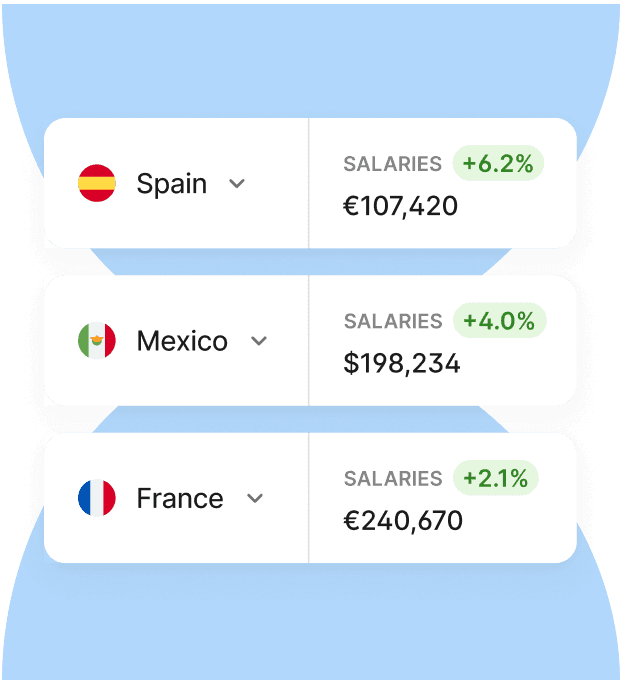
Deel Payroll and Deel Benefits Admin work together as one connected platform. Deel Payroll runs payroll for employees in your owned entities, and Deel Benefits Admin handles plan setup, enrollment, and deductions inside that same workflow. Benefits Admin is payroll-native and available to Deel Payroll customers, so your team doesn't need separate vendor portals, file feeds, or reconciliation cycles.
One workflow from plan setup to payslip
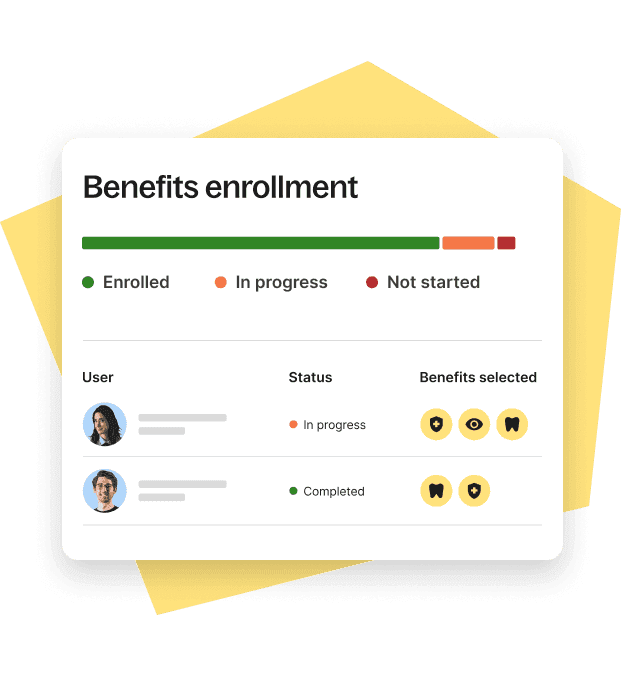
HR teams set up plans, eligibility rules, and contributions once, and built-in guardrails help prevent errors before they reach payroll. Employees complete open enrollment, new hire onboarding, and qualifying life events (QLEs) in guided flows that boost completion and cut down on HR support requests.
Benefit eligibility groups let HR apply different rules to different groups of employees. Admins can approve a QLE before it's sent to the carrier, and they can enroll an employee on their behalf when needed. Role-based permissions, effective dating, and eligibility checks create a clear audit trail and reduce manual rework along the way.
Deel sends employees a notice when enrollment starts and reminders as the window progresses. Employees view and manage their benefits in the Deel employee portal, and HR can upload plan documents and links for employees to view. HR can also pull enrollment reports that cover employees and their dependents.
Payroll-native deductions
Employee elections sync directly to payroll and apply to the correct pay period, so payslips are accurate without flat files or manual checks. This reduces the off-cycle payroll fixes that often follow enrollment. Customers can also manage their own recurring payroll deductions in Deel Payroll.
US pre-tax accuracy and compliance
US benefits rules include pre-tax treatment, IRS caps, dependent checks, and state-by-state requirements. Deel builds these into payroll workflows. Health savings account (HSA), flexible spending account (FSA), and dependent care FSA (DCFSA) elections sync with IRS limits enforced, and effective dating and eligibility rules apply before payroll runs. W-2s stay accurate and audit-ready as a result.
Deel supports medical, dental, vision, life, and supplemental plans, along with HSA and FSA plan setup and enrollment. Customers that use Deel Benefits Admin can get ACA 1095 reporting and COBRA reporting through integration partners, and Deel Compliance and its tax partner keep federal, state, and local payroll rules up to date. Benefits Admin works globally, with special focus on the US market because of its complexity.
Deel has become the way we pay people across the entire world. We have US payroll, PEO, health insurance benefits, and culture management—all under Deel.
—Andy Cloyd,
CEO and Co-founder, Superfiliate
Plan control and visibility
You keep your broker, your carriers, and your plan design, while Deel improves administration and data accuracy. Deel connects with carriers including Noyo, Kota, Cigna, and Kaiser. Dashboards show costs, adoption, and exceptions, which helps HR and Finance teams understand usage and manage one of their largest non-salary costs. Deel Benefits Marketplace will also let you browse and request quotes for local and global benefits from trusted partners.
When to consider PEO
Deel's PEO and Benefits Admin solve different problems. With Benefits Admin, you administer your own plans in Deel with payroll-native deductions. With PEO, you use co-employment under the PEO's employer identification number (EIN), with HR, payroll, and benefits bundled on the PEO's master plans.
PEO is a good fit if you want to simplify multi-state setup, payroll taxes, and workers' comp and employment practices liability insurance (EPLI), or if you want access to pooled plans. Deel's PEO also lets admins change enrollment deadlines and plan mapping, track employee elections, and view an enrollment progress report, and it includes ACA and COBRA reporting.
Best for: Organizations that use or plan to use Deel Payroll and want benefits enrollment and deductions to sync with payroll, especially those that want to keep plan control and broker strategy. Organizations that want to simplify multi-state setup, payroll taxes, workers' comp/EPLI, and pooled plans should consider PEO.
Benefits Administration
Fast, flexible global benefits
2. ADP Workforce Now
ADP Workforce Now is a payroll and HR platform for mid-size and large companies. It includes benefits administration tools for companies with many carriers and large compliance needs.
Carrier connections
ADP Workforce Now connects to many benefit carriers. These include medical, dental, vision, life, supplemental, FSA, and HSA plans. Companies with their own carrier contracts can ask ADP whether it supports those carriers.
Plan recommendation tools
The platform includes tools that help employees compare plans. The tools suggest plans based on the needs and usage history that an employee enters. This can reduce the number of plan questions that HR receives during enrollment.
ACA, COBRA, and HIPAA support
ADP tracks eligibility under the ACA employer shared responsibility provisions. It manages measurement and stability periods. It also creates Forms 1094-C and 1095-C for annual ACA reporting. The platform supports COBRA continuation administration and handles benefits data in line with HIPAA. Companies with large reporting needs can review the ACA compliance requirements to compare what each platform covers.
Who it suits
ADP Workforce Now suits large companies with many carriers, high ACA reporting volume, and large US employee groups. Smaller teams may not need this scope.
Read more: Deel vs. ADP: A Global Payroll Services Comparison
3. Gusto
Gusto is a payroll platform with HR and benefits tools for small and medium-sized businesses. Its open enrollment module is made for HR generalists who are not benefits specialists.
Benefits deduction sync
Gusto connects benefit elections to payroll. Deductions update when an employee completes enrollment. HR does not need to export or import data between systems.
Guided employee enrollment
Employees compare plans side by side in their self-service dashboard. The flow shows the estimated cost per paycheck before the employee confirms a plan. Automated reminders go out during the enrollment window. This reduces manual follow-up for HR.
ACA filing support
Gusto supports ACA tracking and provides 1094-C and 1095-C filing support for employers that have 50 or more full-time employees. ACA reporting is in the same platform as payroll and enrollment.
Who it suits
Gusto suits small and medium-sized businesses, typically with fewer than 200 employees, where HR generalists run benefits. Companies with complex multi-carrier needs or international workforces may need more than Gusto offers.
Read more: Deel vs. Gusto: A US Payroll Services Comparison
4. Paychex Flex
Paychex Flex is a cloud-based HR and payroll platform for small and mid-size US businesses. It combines payroll and benefits administration with advisory support.
Open enrollment workflows
Paychex Flex manages eligibility windows, employee notices, and election collection. Benefit changes from enrollment update payroll deductions in the same platform. HR sets up plan options, eligibility rules, and enrollment dates in the admin interface. Employees enroll through a self-service portal.
Benefits advisor access
Paychex offers access to benefits advisors. These advisors can help HR teams with plan design, carrier relationships, and compliance tasks. Teams with little benefits experience may find this support useful. Confirm which advisor services each Paychex plan includes.
State-specific compliance support
Paychex supports ACA reporting and COBRA administration. It also gives guidance on state leave and benefits rules. Small and mid-size businesses follow the same laws as large companies but often have fewer internal resources.
Who it suits
Paychex Flex suits small and mid-size US businesses that want payroll and benefits in one platform and want advisor access during enrollment. It may suit HR generalists who manage enrollment without deep benefits experience.
Read more: Deel vs Paychex: Payroll and HR Services Comparison
5. Rippling
Rippling combines HR, IT, and payroll in one platform. Rippling states that it uses a single database for these functions. Under this design, an employee’s election updates payroll deductions without a separate integration step.
Automated enrollment workflows
HR admins set enrollment windows, eligibility rules, and carrier connections in advance. Employees then use guided plan comparisons and make their elections. The platform sends automated deadline reminders during the window. This reduces manual follow-up for HR.
Real-time progress tracking
HR can see in real time which employees have submitted elections and which have not. HR does not need a report export or a coordinator to track this. This helps larger or distributed teams act before the enrollment window closes.
Deduction sync
Payroll deductions update when an employee completes their elections. HR does not wait for an integration to send data from a benefits module to payroll. Teams that run payroll soon after enrollment closes can use the updated data directly.
Who it suits
Rippling suits growing mid-size companies that want HR, IT, and payroll in one system. It also suits teams that want automated reminders and live completion data during enrollment.
Read more: Deel vs Rippling: Honest Employer of Record Service Comparison (2026)
6. Paycom
Paycom is an HR and payroll platform for mid-size businesses. It keeps payroll, benefits, time, and talent data in one database. Paycom states that this removes the integration layer between its enrollment portal and payroll.
Deduction sync
Deduction changes from open enrollment update right away because payroll and benefits share one database. HR does not need to check that election data moved between systems before the first pay run.
ACA reporting
Paycom includes ACA tools that track employee hours and manage measurement and stability periods. The tools also create 1094-C and 1095-C forms for annual filing. The ACA employer shared responsibility provisions apply to employers with 50 or more full-time employees. Many mid-size companies are above this level.
Self-service enrollment and reporting
Employees manage their own elections in the self-service portal. Elections go straight to the shared database. HR can pull enrollment completion reports without waiting for a data sync.
Who it suits
Paycom suits mid-size organizations, typically from 50 to several hundred employees, that want one HR and payroll database. It may suit teams that have had data-sync problems between benefits and payroll systems.
7. Paylocity
Paylocity is a cloud-based payroll and HR platform for mid-size companies. Its open enrollment module includes tools to communicate with employees during the enrollment window.
Enrollment automation and eligibility tracking
HR sets up the enrollment event once. The platform then manages enrollment windows, eligibility checks, and election collection. It sends automated notices and reminders as the window progresses. Eligible employees who have not finished their elections get automated follow-up.
Employee communication tools
HR can send benefits education, plan comparisons, and deadline reminders to employees in the platform. HR can target messages by enrollment status. This lets HR contact employees who have not finished and skip those who have. Teams whose employees need guidance during enrollment may find this useful.
Deduction sync
Benefit elections update payroll deductions in the same platform. No separate export step is needed. HR can run payroll after enrollment closes without a separate check between the two systems.
Who it suits
Paylocity suits mid-size HR teams that want communication and education tools in the enrollment process, plus automated completion tracking and employee follow-up.
Read more: Deel vs Paylocity: Payroll and HR Service Comparison
Open enrollment evaluation checklist for HR leaders
When comparing payroll platforms with built-in open enrollment, check each of these before committing:
Does benefit election data update payroll deductions automatically, with no manual export required?
Do employees have a self-service portal to compare plans, add dependents, and submit elections?
Does the platform automate ACA tracking, generate 1094-C/1095-C forms, and support COBRA administration?
How broad is the carrier network for medical, dental, vision, and supplemental coverage in your employees' states?
Does it support global payroll for international employees, or only US-based enrollment?
Simplify open enrollment for US employees with Deel
Keeping benefits enrollment and payroll in separate systems creates an extra data-transfer step for HR leaders: every deduction change has to move between systems, and that transfer is where errors take root. Deel brings benefits enrollment and payroll into the same environment, whether you administer your own plans or use a PEO.
For example: Airbase uses Deel to run payroll and benefitss on one platform. Payroll, taxes, and Fortune 500-level health benefits all run on the same HR data. The CEO approves payroll in 2 minutes, onboards a new hire in under 10 minutes, and needs zero HR staff.
"Deel gives my employees great benefits, keeps us compliant in every state, and costs me almost no time," says Ari Rosner, Co-Founder and CEO of Airbase.
Book a demo below to speak with an expert and see the platform in action.
Live Demo
Get a live walkthrough of the Deel platform
FAQs
What is open enrollment in payroll software?
Open enrollment in payroll software refers to a structured period during which employees can elect, change, or waive benefits coverage within the same platform that processes their payroll. When enrollment and payroll are integrated, benefit elections update deductions automatically without HR having to transfer data between systems.
How does built-in open enrollment reduce payroll errors for HR teams?
When benefit elections and payroll deductions live in separate systems, HR has to manually transfer election data after enrollment closes. Built-in enrollment eliminates that handoff: a completed election updates the payroll deduction directly, without an intermediate manual step that can introduce transcription errors or missed updates.
What's the difference between native and integrated open enrollment?
Native open enrollment means benefit elections and payroll deductions operate within a single shared database, so no data transfer is required. Integrated open enrollment connects two separate systems via an API or middleware, which can work well but introduces a sync layer that may fail, lag, or require manual intervention around enrollment close dates.
Can distributed or international teams use payroll software for open enrollment?
Most US-focused platforms (Gusto, Paychex Flex, Paycom, Paylocity) handle open enrollment for US-based employees only. Deel's benefits enrollment capabilities are specifically for US employees hired through Deel's PEO, while Deel Payroll separately handles payroll for employees of organizations' owned entities across multiple countries.
How does Deel support open enrollment for US PEO employees?
For HR leaders with eligible US employees hired through Deel's PEO, Deel manages benefits enrollment directly within the platform. Employees access self-service enrollment through their Deel profile, selecting medical, dental, vision, and voluntary benefits. Payroll deductions for elected benefits calculate automatically per pay period, and COBRA continuation coverage is administered through Navia for employees who leave the organization.
Disclaimer: This article is provided for general informational purposes and should not be treated as legal, HR, tax, or professional advice. Refer to applicable regulations and consult a qualified professional for specific guidance. The information outlined in this content is accurate at the time of publishing and is subject to change or updating. Deel does not make any representations as to the completeness or accuracy of the information on this page.
Shannon Ongaro is a content marketing manager and trained journalist with over a decade of experience producing content that supports franchisees, small businesses, and global enterprises. Over the years, she’s covered topics such as payroll, HR tech, workplace culture, and more. At Deel, Shannon specializes in thought leadership and global payroll content.