Article
7 min read
Top Visa Sponsorship Tools for Remote Employees: An HR Leader's Buyer Guide
Immigration
Global HR
Global hiring

Author
Jemima Owen-Jones
Last Update
July 15, 2026

Table of Contents
Why the old tools do not work for remote employees
The two categories of visa sponsorship tools
How EOR visa sponsorship works in practice
What to look for in a visa sponsorship tool
Common mistakes HR leaders make when selecting a tool
How Deel Mobility addresses the full picture
What to ask vendors during evaluation
Sponsor remote employee visas effortlessly with Deel
Key takeaways
Talent mobility is now a retention and expansion lever, but most companies lack the infrastructure to sponsor visas for remote employees compliantly.
Vendors built traditional immigration case management tools for in-house legal teams, not for HR leaders managing distributed workforces without a local entity in every country.
Deel Mobility combines EOR-based visa sponsorship, end-to-end case management, and global payroll in one workflow, enabling HR teams to sponsor work permits in 75+ countries without needing their own legal entities or a patchwork of additional tools and vendors.
This article is provided for general informational purposes and should not be treated as legal or immigration advice. Immigration laws and requirements change frequently and vary by jurisdiction. Consult a qualified immigration attorney or specialist for guidance specific to your situation.
When a company's best software engineer announces they want to relocate to Portugal, or a key sales hire in Singapore needs a work permit, the standard HR process has no clear path forward. The processes, tools, and knowledge bases that served domestic or even traditionally international organizations are strained by a new reality: remote work has untethered employees from offices, and with that freedom comes a serious compliance gap.
The companies winning the talent market today are not just offering remote flexibility. They are backing it up with the infrastructure to support where people actually want to live and work. That infrastructure increasingly means visa sponsorship capability. But sponsoring work visas has historically required owning a local entity in the destination country, establishing the right sponsorship licenses, and maintaining a team with deep immigration expertise. For most organizations, that is not realistic at scale.
This guide is for HR leaders evaluating their options. It explains how visa sponsorship for remote-first and distributed teams works today, walks through the categories of tools available, details the features that separate adequate from excellent, and explains where Deel Mobility fits in the picture.
Why the old tools do not work for remote employees
Vendors designed traditional immigration case management software for one specific scenario: a company with a legal entity in the destination country, working with external immigration attorneys to manage in-country sponsorship filings. These tools are effective in that scenario. They handle form automation, document storage, deadline tracking, and compliance reporting for in-house corporate immigration teams.
The problem is that the premise does not hold for most modern hiring situations. Remote employees often live (or want to live) in countries where the hiring company has no entity. The company might want to retain a valuable team member who is relocating for personal reasons. Or it may want to help an employee move to a new market to open a sales region, without the cost and delay of entity setup. In all of these cases, traditional immigration software offers no practical path forward. It can track a case, but it cannot sponsor one.
The gap is structural, not a software problem: visa sponsorship requires a legal employer in the destination country, and that is where EOR-based sponsorship provides the missing piece.
Deel Mobility
Get worldwide visas without the legwork
The two categories of visa sponsorship tools
Before comparing specific solutions, it helps to understand the two fundamentally different approaches to visa sponsorship tooling.
Category 1: Immigration case management software
These tools help companies manage the administrative workflow around visa applications, including tracking of document status, filing deadlines, compliance milestones, and applicant communications. They are software layers on top of legal processes that the company (or its law firm) still drives. Examples include INSZoom, LawLogix Edge, Envoy Global, and Imagility.
Best suited for:
Companies with existing legal entities in the destination country
Organizations that have in-house immigration counsel or a dedicated global mobility team
High-volume corporate immigration programs with established legal infrastructure
Limitations for remote teams:
Require a legal entity and sponsorship license in each destination country
Do not actually provide sponsorship (the company remains the legal sponsor and employer)
Compliance burden stays with the HR team and their law firm partners
Category 2: EOR-based visa sponsorship platforms
An Employer of Record (EOR) acts as the legal employer in the destination country on behalf of the hiring company. When an EOR platform also offers visa sponsorship, it can sponsor work permits directly, using its own entities and local legal infrastructure, without requiring the client to establish a local entity first. The sponsorship, payroll, compliance, and HR administration are all handled through one vendor relationship.
Best suited for:
Companies without a legal entity in the destination country
Remote-first or distributed teams where relocation is driven by employee preference, not office assignments
Organizations expanding into new markets and moving key employees ahead of entity setup
HR teams that want managed support rather than DIY case management
The distinction matters because these two categories solve fundamentally different problems. Choosing category 1 tooling when the situation calls for category 2 does not just result in suboptimal outcomes. The sponsorship simply does not happen.
The structural sponsorship gap
Traditional immigration software can track visa cases and manage documents — but it cannot sponsor visas. Sponsorship requires a legal employer in the destination country. If the company has no local entity there, no software layer bridges that gap. An EOR with owned entities in the destination country is the only way to sponsor without one.
How EOR visa sponsorship works in practice
For HR leaders unfamiliar with EOR-as-sponsor, the mechanics are worth explaining clearly.
When a company hires through an EOR, the EOR becomes the legal employer of the worker in the destination country. The employee's contract, payroll, and statutory benefits are managed by the EOR's local entity. The client company directs the day-to-day work but carries no direct employment obligations in that jurisdiction.
When the same EOR also holds visa sponsorship infrastructure in the destination country, it can extend that legal employer status to sponsor the employee's work permit or visa. The company does not need to:
Establish a legal entity in the destination country
Obtain a separate sponsorship license
Retain local immigration counsel directly
Manage government filings in a jurisdiction it may be unfamiliar with
From the HR leader's perspective, the workflow looks like this:
Identify the relocation need: employee moving country, or new hire requiring a work permit
Run a pre-hire eligibility check to confirm the route is viable
Open an immigration case through the platform
The EOR's immigration team handles the filing, government liaison, and compliance reporting
HR tracks progress through the case dashboard while the employee uploads documents through their applicant portal
Upon approval, the employee's local employment and payroll are handled through the same platform
This model works particularly well for companies without a local entity in the destination country, organizations in expansion mode who need to move talent ahead of entity setup, and remote-first businesses where employee relocation is employee-driven rather than company-driven.
Deel Hire
Hire employees globally with the #1 Employer of Record
What to look for in a visa sponsorship tool
Whether evaluating an immigration management platform or an EOR-based solution, the following criteria should shape the assessment.
Global coverage and entity ownership
Country coverage is the first filter. An EOR sponsor with 75+ countries for immigration support can handle most relocation scenarios. A provider covering 20 countries cannot. But raw country count is only part of the story. How a provider operates in each country matters just as much.
Some providers use an aggregator model, routing clients to third-party immigration law firms in each country without a standardized experience or consistent SLA. Others operate with in-house immigration specialists and owned entities, offering more control, consistency, and accountability. When a problem arises mid-application, knowing whether the vendor owns the infrastructure or is intermediating it makes a real difference in how quickly it gets resolved.
Pre-hire eligibility assessment
The most expensive moment to discover that a relocation will not work is after an offer has been extended. The best visa sponsorship tools include an eligibility assessment feature that lets HR teams or candidates run a soft check against visa requirements before a case is formally initiated.
This serves two functions: it avoids investing time and cost in applications that are likely to fail, and it helps HR set realistic expectations with candidates during the offer process. The feature should require no legal expertise to use and should return clear results (likely eligible, needs review, or not eligible), not just lists of requirements.
Real-time case tracking dashboard
Immigration cases involve multiple parties, many documents, and tight government deadlines. Without a centralized tracking system, HR teams are left chasing status updates across email threads and law firm portals. A proper case management dashboard should show:
Current case stage and next required action
Who owns each pending task (HR, employee, or vendor)
Document submission status and completeness
SLA indicators flagging cases at risk of delays
Audit-ready activity logs
Analytics templates covering expiry, workforce, SLA, and spend data help HR leaders report on the immigration program's health and anticipate upcoming renewals.
Self-service document upload for applicants
Requiring candidates to submit documents through HR creates unnecessary bottlenecks. The best platforms include a dedicated applicant portal where individuals can upload passports, translations, employment documentation, and supporting evidence directly. This cuts the number of document handoffs, accelerates timelines, and improves the candidate experience during what is already a stressful process.
Proactive visa renewal management
Work permits expire. When they do, employees lose the right to work and the company faces compliance risk. Strong tools build renewal workflows into the platform from day one, with automated alerts triggered well in advance of expiry (typically 90 days out) and escalation protocols if documents are not received within the renewal window.
For HR teams managing dozens or hundreds of employees with expiring permits, manual renewal tracking on spreadsheets is not a viable system. Automated renewal workflows prevent permits from expiring unnoticed.
Renewal risk is ongoing compliance risk
A work permit that expires unnoticed is an immediate compliance violation. The best tools trigger renewal workflows 90 days before expiry, escalate to HR and immigration managers if documents are not received, and maintain a real-time compliance dashboard showing every employee's current permit status.
Continuous compliance monitoring
Immigration regulations change frequently and without much notice. A visa category that was straightforward last year may require additional documentation today, or may have new salary thresholds that affect eligibility. Compliance monitoring means the platform (or its team) tracks these regulatory changes and updates clients proactively, ideally before a change affects active cases.
HRIS and payroll integration
Visa sponsorship does not live in isolation. When an employee's work permit status changes, their payroll, tax setup, and employment terms may need to change too. Platforms that integrate with existing HRIS systems and payroll eliminate duplicate data entry, reduce the risk of misalignment between HR records and actual immigration status, and create a more coherent administrative experience.
Dependent and family support
Relocating an employee almost always means relocating a family. Tools that handle only the primary applicant and require HR to manage dependent applications separately create a fragmented experience and increase the risk of delays. The best solutions coordinate dependent visa applications alongside the primary case, ideally submitting them concurrently, since staggered submissions can add weeks to the process.
Dedicated point of contact
Immigration cases require judgment calls. When a government authority requests additional evidence, or a candidate's circumstances change mid-application, a portal notification is not sufficient. An assigned immigration specialist who knows the case and can advise in real time resolves complications faster than a general support queue. Prioritize platforms that assign named case managers rather than routing all queries through a general queue.
Compliance
Unlock Continuous Compliance™ with Deel
Comparing tool categories at a glance
| Criterion | Immigration case management software | EOR-based visa sponsorship |
|---|---|---|
| Requires local entity | Yes | No |
| Provides actual sponsorship | No (company sponsors) | Yes (EOR sponsors) |
| Geographic coverage | Varies | 75+ countries for immigration |
| Compliance ownership | Shared with client | Managed by EOR |
| Payroll integration | Rarely native | Native (same platform) |
| Best for | Companies with own entities and legal teams | Companies expanding without entities, remote teams |
| Service model | Standalone software | Bundled with EOR services |
Global Hiring Toolkit
EOR vs. Entity Calculator

Common mistakes HR leaders make when selecting a tool
Choosing a case management tool when they need a sponsor. This is the most common and costly error. If the company does not have a legal entity in the destination country, no amount of case tracking software will resolve the structural sponsorship problem. Define the need precisely before evaluating tools
Over-weighting country count without checking depth. A platform claiming 100+ countries should be asked specifically: how many of those are operated through owned entities versus third-party aggregators, and what is the SLA in each? Breadth without depth creates a false sense of security
Ignoring the renewal and compliance tail. The upfront visa application gets the most attention, but the ongoing compliance obligations (renewals, reporting, legislative updates) represent a longer-term risk. Evaluate the renewal workflow and compliance monitoring capabilities as seriously as the initial application process
Not involving employees in the evaluation. The applicant experience matters. A tool that is cumbersome for the employee to navigate will create friction, delays, and negative candidate impressions at a moment when demonstrating care for their relocation matters most. Test the applicant portal experience directly
Underestimating the payroll intersection. When an employee relocates, their payroll tax obligations change, often significantly. Choosing an immigration tool that is disconnected from payroll means managing these transitions manually, which creates both a compliance risk and an administrative burden. Where possible, select a platform that manages both
Global Expansion
Looking to expand your business abroad?
How Deel Mobility addresses the full picture
Deel Mobility is Deel's dedicated mobility solution, and it operates differently from both traditional immigration case management software and basic EOR add-on services.
The solution functions as both an EOR-based visa sponsorship platform and a standalone immigration management service. For companies that do not have a local entity in the destination country, Deel's EOR infrastructure (130+ owned entities globally) can sponsor work permits directly.
For companies that do have their own entity, Deel's standalone immigration service manages the process on their behalf, acting as the immigration coordinator without requiring the client to engage a separate law firm for every jurisdiction.
Deel's immigration model is wholly owned. Clients always interact with Deel as the single point of contact. The underlying legal coordination is handled by Deel's team, not routed to external law firms that the client must manage directly.
Key capabilities that matter for HR leaders managing remote or distributed teams:
Visa eligibility checker: A self-serve tool that lets HR teams or employees explore visa options by destination country and run a guided soft eligibility assessment before committing to a case. The tool returns categorized results (likely eligible, further review needed, or likely not eligible) and allows eligible candidates to initiate a case pre-populated with their assessment data
Real-time case management dashboard: Full visibility into every active immigration case, with owner assignments for each pending task, SLA indicators, document status, and linked dependent cases. Four pre-built analytics templates (expiry, workforce, SLA, spend) support program reporting and upcoming renewal planning
Proactive renewal management: Automated renewal triggers fire 90 days before right-to-work document expiry. Reminder sequences escalate if documents are not submitted, and the system flags cases at risk to the HR team and immigration manager. For Deel-sponsored employees, a Mobility Specialist coordinates the renewal process directly
Continuous compliance tracking: The immigration compliance module tracks all employees with active or expiring documents, automatically updating status based on document validity dates. A specialized team monitors legislative changes and updates internal processes when immigration rules change in any covered jurisdiction
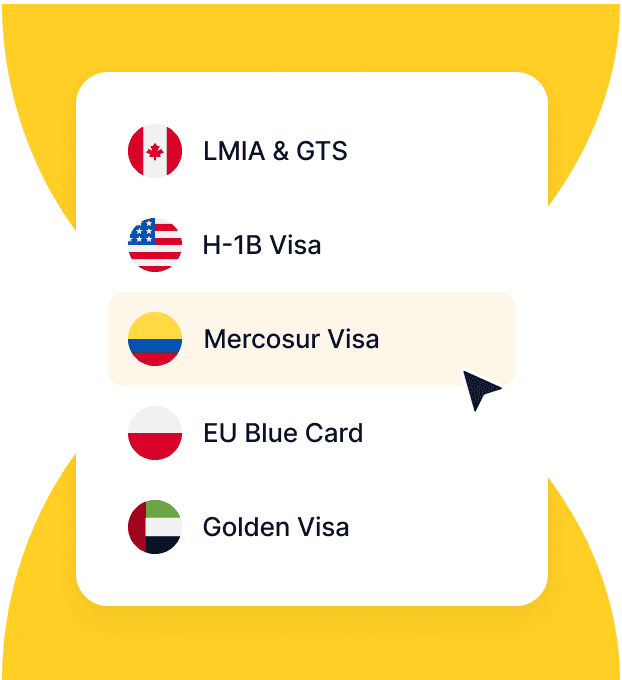
Supported visa types: Deel supports the H-1B in the US (including lottery participation and H-4 dependent visas), the UK Skilled Worker Visa (both Deel-sponsored for EOR employees and client-sponsored for direct employees), EU Blue Cards in multiple countries, and work and residence permits across 75+ countries and 200+ work permit types
Dependent and family coordination: Dependent visa applications are handled alongside the primary case. Submitting concurrently rather than sequentially avoids the additional processing time that staggered submissions create
Integrated payroll and HR: Because Deel Mobility sits on the same platform as Deel's global payroll and EOR solution, work permit approvals, employment contracts, and payroll tax setup are coordinated within one system. HR does not have to manage the handoff between immigration status and employment records across separate tools
Standalone availability: Companies that have their own entities can use Deel Mobility independently of EOR. This makes it suitable for organizations at different stages of global expansion: hiring through Deel's EOR solution to sponsor without an entity early on, and switching to entity-based employment later while retaining Deel's immigration infrastructure

Deel Mobility
Seamless global mobility without the hassle
What to ask vendors during evaluation
When speaking with any visa sponsorship tool vendor, the following questions will quickly separate credible solutions from marketing claims:
Which countries do you support for visa sponsorship specifically, not just for EOR hiring?
In each of those countries, do you have owned entities, or do you work through third-party aggregators?
What is your standard SLA for case completion in the top five countries where our employees are likely to relocate?
How do you handle renewals: is there an automated workflow, and what happens if documents are late?
How does your platform track changes in immigration law across jurisdictions, and how quickly do process updates reach active cases?
Can you show us the applicant-facing portal that employees would use?
What happens when a government authority makes a Request for Evidence or requests additional information?
How does your immigration service connect to payroll when an employee's work permit is approved?
The answers will reveal whether the platform is built for the complexity of real-world corporate immigration or whether it was designed for a simpler use case.
Sponsor remote employee visas effortlessly with Deel
Managing visa sponsorship for remote employees requires the right infrastructure behind the platform, not just a well-designed dashboard. Traditional case management tools serve a specific and real need, but they cannot sponsor work permits, and they cannot operate without a local entity already in place.
EOR-based visa sponsorship addresses that structural gap. Deel Mobility brings together the owned-entity infrastructure, immigration specialists, compliance monitoring, and payroll and HR integration that HR leaders need to support global talent mobility without adding vendor complexity. That combination means HR teams can retain a relocating engineer, open a new sales market, or support a key hire in a new country, without establishing a legal entity first or relying on a patchwork of vendors and tools.
Book a free consultation with the Deel team below to see how Deel Mobility handles visa sponsorship for remote employees across 75+ countries.
Deel Mobility
Get your immigration and mobility questions answered

FAQs
What is the difference between visa sponsorship and an immigration case management tool?
Visa sponsorship means a legal employer petitions a government on behalf of an employee to allow them to work in a country. Immigration case management tools help track and organize that process but do not provide the legal employer status required for sponsorship. That still requires the company or its EOR to own the sponsorship infrastructure.
Can a company sponsor a visa without having a legal entity in the destination country?
Yes, through an Employer of Record. When an EOR has owned entities and sponsorship infrastructure in the destination country, it can sponsor work permits on behalf of client companies, eliminating the need for the client to establish its own entity first.
What happens to visa sponsorship if an employee leaves the company?
When an employee leaves, the sponsoring entity (whether the company or its EOR) typically has an obligation to notify the relevant government authority. The employee's right to work under that visa may be tied to the sponsor, and they will need to either transfer sponsorship to a new employer or leave the country within a defined grace period, depending on the visa type and jurisdiction.
How long does it take to sponsor a visa through an EOR?
Timelines vary significantly by country and visa type. Some jurisdictions, like the Netherlands' Highly Skilled Migrant Program, can process in approximately two weeks for recognized sponsors. Others, like the US H-1B, involve a lottery and standard USCIS processing times.
EOR-based sponsorship generally accelerates the process relative to a company establishing sponsorship infrastructure independently, since the EOR already has recognized sponsor status and established workflows in each country.
Can an EOR sponsor visas for both existing employees and new hires?
Yes. EOR-based visa sponsorship applies to new international hires who need a work permit in the destination country, as well as existing employees who are relocating to a new country where the company does not have a legal entity.
What should HR teams prioritize when comparing visa sponsorship platforms?
The most important factors are whether the platform can actually sponsor (not just track) visas in the relevant countries, whether it operates through owned entities or third-party aggregators, how it handles renewals and compliance monitoring, how it integrates with payroll, and what support is available when a case encounters complications.
Related resources on global hiring and immigration
Jemima is a nomadic writer, journalist, and digital marketer with a decade of experience crafting compelling B2B content for a global audience. She is a strong advocate for equal opportunities and is dedicated to shaping the future of work. At Deel, she specializes in thought-leadership content covering global mobility, cross-border compliance, and workplace culture topics.