
Global Work Glossary
- Results for ""
Table of Contents
What is document authenticity verification?
How document authenticity verification works
What document authenticity verification checks for
Document authenticity verification vs. related identity checks
Key facts
Detect identity fraud with Deel Security
FAQ
What is document authenticity verification?
What is document authenticity verification?
Document authenticity verification is the process of confirming that an identity document is genuine, unaltered, and validly issued by the authority named on it. Organizations use this type of verification to catch forged, tampered, or fraudulently obtained documents, such as identity y or eligibility-to-work documents, including passports, national ID cards, residence permits, and visas. This type of verification can be a standalone check or part of a broader identity verification process during hiring or onboarding.
How document authenticity verification works
Document authenticity verification compares a document's physical and digital security features with what the issuing authority would produce. It could involve several types of checks:
Security feature analysis looks at holograms, watermarks, UV and infrared patterns, and microprinting that counterfeit documents may fail to replicate accurately.
Machine-readable zone (MRZ) validation checks that the encoded information on a passport or ID card is internally consistent and matches the printed fields.
Where a document contains a chip, near-field communication (NFC) reading may confirm that the chip data matches the document's printed fields and has not been tampered with.
Artificial intelligence (AI)-based template comparison matches the document against a database of known legitimate templates. It flags fonts, spacing, or printing patterns that differ from what a genuine document from that issuer should show.
What document authenticity verification checks for
During a document authenticity verification, verifiers look for signs of document forgery: altered photographs, overwritten data fields, inconsistent fonts, MRZ checksum failures, missing security features, and mismatches between a chip and the printed page. Artificial intelligence-generated identity documents pose a newer challenge, as AI tools could produce templates that closely mimic legitimate documents and defeat basic visual inspection.
Identity fraud often depends on a fraudulent document passing these checks. The check also covers metadata: a digital copy of a document might carry creation or modification timestamps that suggest recent alteration.
Document authenticity verification vs. related identity checks
Document authenticity verification, face matching, liveness detection, and biometric verification each check a different part of a hiring process. Here's how they differ and connect:
Face matching compares the photograph on a document to the face of the person presenting it. It confirms the holder's appearance matches the document rather than verifying the document itself. Running it after document authentication covers both a fake document and a genuine document presented by the wrong person.
Liveness detection confirms that the face captured during verification belongs to a live person, not a photograph or recording. It addresses presentation attacks, while document authentication addresses document fraud. Where someone uses a deepfake or recorded video to present a document, liveness detection could catch the fake presentation.
Biometric verification uses physical characteristics such as fingerprints or facial geometry to confirm who a person is. It answers "is this the right person?" rather than "is this document real?" Biometric checks typically run after document authentication confirms a document is worth comparing against.
Key facts
Here are some key facts about document authenticity verification, the threats it addresses, and how organizations use it.
Document authenticity verification may catch forged credentials, tampered documents, and synthetic identity fraud where a fraudster backs a fabricated identity with a fake document.
It applies at multiple points in the worker lifecycle: pre-hire screening, onboarding for right-to-work checks, and when a worker changes roles or relocates.
Verification works best alongside other checks such as a background check, employment history verification, and liveness detection.
CV fraud and document fraud could appear together: a candidate might falsify qualifications and support them with a fraudulent identity document.
Automated verification tools help organizations check documents at scale across multiple jurisdictions and reduce their reliance on manual inspection.
Detect identity fraud with Deel Security
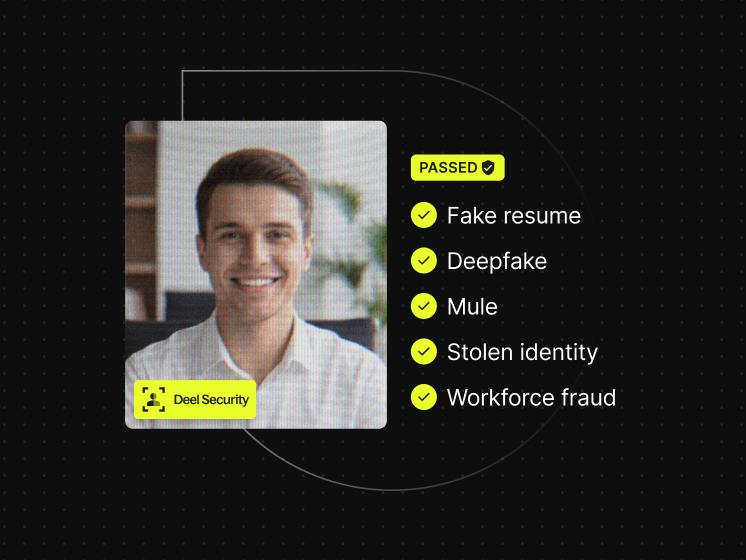
Forged or AI-generated documents can make fraudulent candidates appear legitimate. Deel Security helps businesses detect fake candidates, synthetic identities, deepfakes, and impersonation attempts throughout hiring, onboarding, and ongoing employment.
Deel Security works with your existing applicant tracking system (ATS), surfacing identity fraud alerts directly within recruitment workflows. HR and security teams can review these signals, investigate potential fraud, and make more informed hiring decisions.
Book a demo to see how Deel Security helps protect your hiring process from identity fraud.
Deel Security
Hire real people, keep fraud out from hiring to offboarding
FAQ
What documents does document authenticity verification typically check?
It checks any document used to confirm identity or eligibility to work, including passports, national identity cards, residence permits, visas, and work authorization documents. The specific documents required depend on the jurisdiction and the role.
How does document authenticity verification differ from a background check?
A background check verifies a person's history: criminal records, employment records, and qualifications. Document authenticity verification focuses on a single document and whether it was genuinely issued. Both are part of thorough pre-hire screening but examine different things.
At what point in hiring should document authenticity verification run?
Most organizations run it during onboarding, when a new hire must provide documents to confirm their identity or right to work. Some run it at the offer stage for roles with elevated security requirements. It may also run when a worker changes roles, relocates, or requires renewed work authorization.
Can AI-generated documents defeat document authenticity verification?
AI tools could produce documents that closely mimic genuine ones and might pass manual inspection. Automated verification using template databases and security-feature analysis may detect these fakes, though methods on both sides continue to evolve. Template databases improve as new forgeries emerge, and high-risk cases often benefit from human review alongside automated checks.
Who handles document authenticity verification in a global team?
Who handles verification depends on the employment model. Where an employer of record manages onboarding in a foreign jurisdiction, the EOR typically handles right-to-work checks and document verification for that local context. HR and security teams set the overall policy.
This content is for general informational purposes only and organizations should consult qualified legal advisers for guidance on identity document requirements in their jurisdictions.