
Article
14 min read
8 Top Benefits Enrollment and Headcount Forecasting Tools for 2026
Global HR

Author
Shannon Ongaro
Last Update
December 03, 2025

Table of Contents
Deel benefits enrollment and headcount forecasting
ADP Workforce Now
Anaplan
ClearCompany
Workday Adaptive Planning
Planful
Paycor
Vena
Cube
Key benefits of using benefits enrollment and headcount forecasting tools
How to choose the right tool for your organization
Prepare your workforce strategy for 2026 with confidence

Explore this topic with AI
Key takeaways
-
Benefits enrollment and headcount forecasting platforms replace manual planning with integrated data, predictive analytics, and automated workflows that improve accuracy and speed.
-
The best tools for 2026 combine seamless HR and payroll integrations, scenario modeling, and compliance automation to support agile, cost-aware workforce decisions.
-
Deel stands out by unifying global benefits, payroll, compliance, and AI-driven headcount forecasting in one platform across 150+ countries, giving leaders real-time visibility and expansion-ready planning.
Organizations preparing for 2026 face mounting complexity in workforce planning, from navigating compliance requirements to managing distributed teams and volatile labor markets. Benefits enrollment and headcount forecasting software automates benefits selection, ensures regulatory compliance, and provides data-driven predictions on staffing needs and budget requirements.
This guide examines eight leading platforms that streamline these critical HR functions, offering feature comparisons and practical criteria to inform your software selection. Whether you're scaling internationally or optimizing domestic operations, the right tool can transform manual, error-prone processes into strategic advantages through integration, real-time analytics, and automated compliance.
Deel benefits enrollment and headcount forecasting
Deel consolidates benefits administration, payroll, and workforce planning into a unified global platform that operates across 150+ countries. This integration eliminates the fragmentation that typically plagues international HR operations, where separate systems for benefits, payroll, and compliance create data silos and manual reconciliation work.
By automating local and global compliance and benefits administration within a single interface, Deel reduces the administrative burden associated with managing entities in multiple jurisdictions.
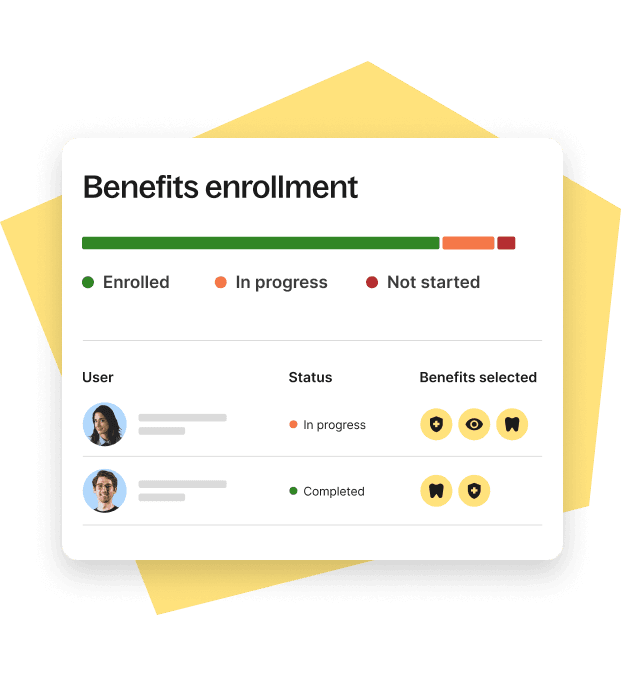
The benefits module supports localized plan design and enrollment, automated eligibility rules and qualifying life-event management, open enrollment workflows, and an intuitive employee self-service experience for comparing and selecting plans. Elections sync directly to payroll so employee deductions and employer contributions are calculated correctly for each jurisdiction and currency.
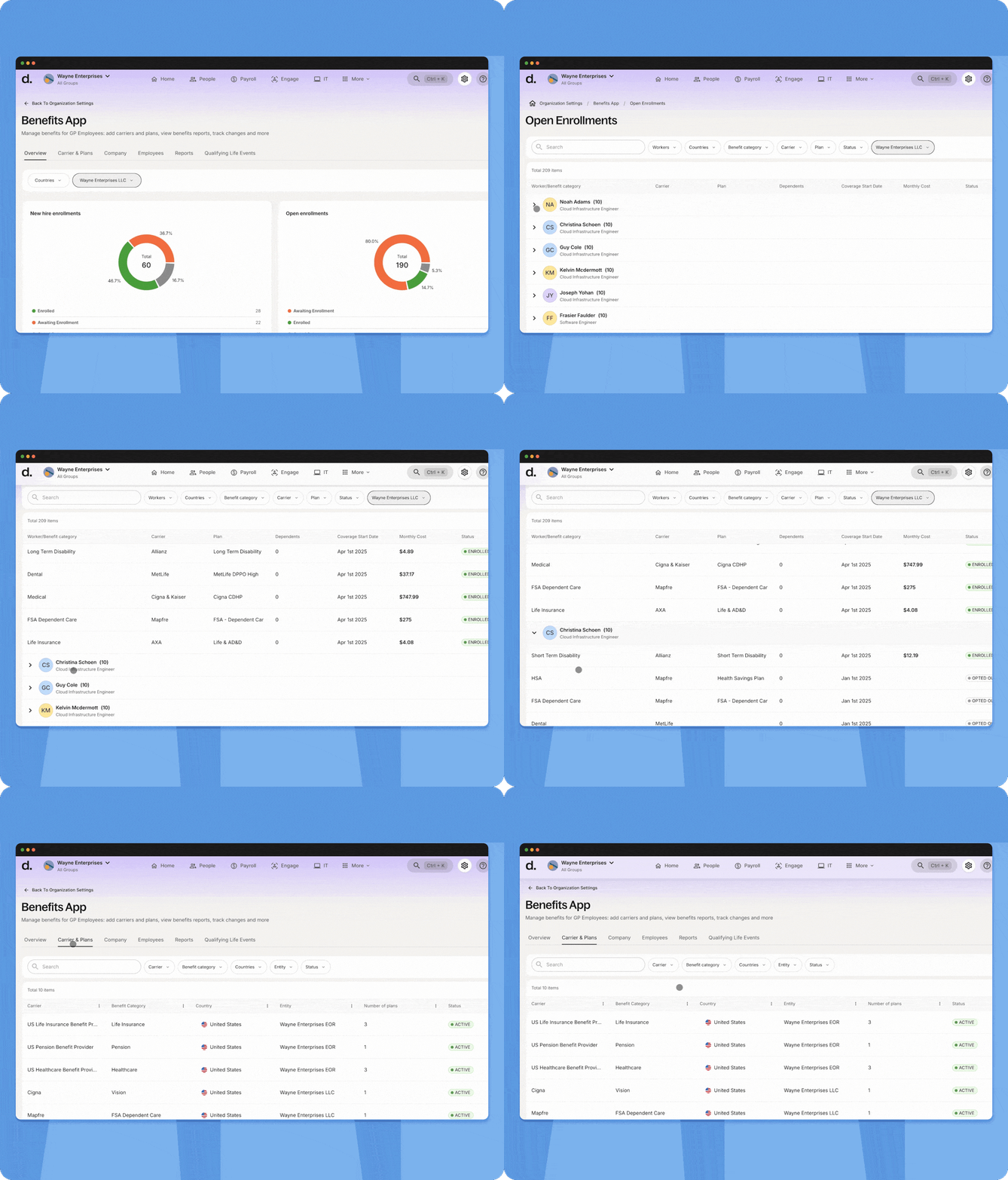
The platform's headcount forecasting capabilities combine AI-driven analytics with integrated HR, payroll, and finance data. This seamless data flow means workforce projections automatically incorporate real compensation figures, benefits costs, and statutory requirements specific to each country where you operate.
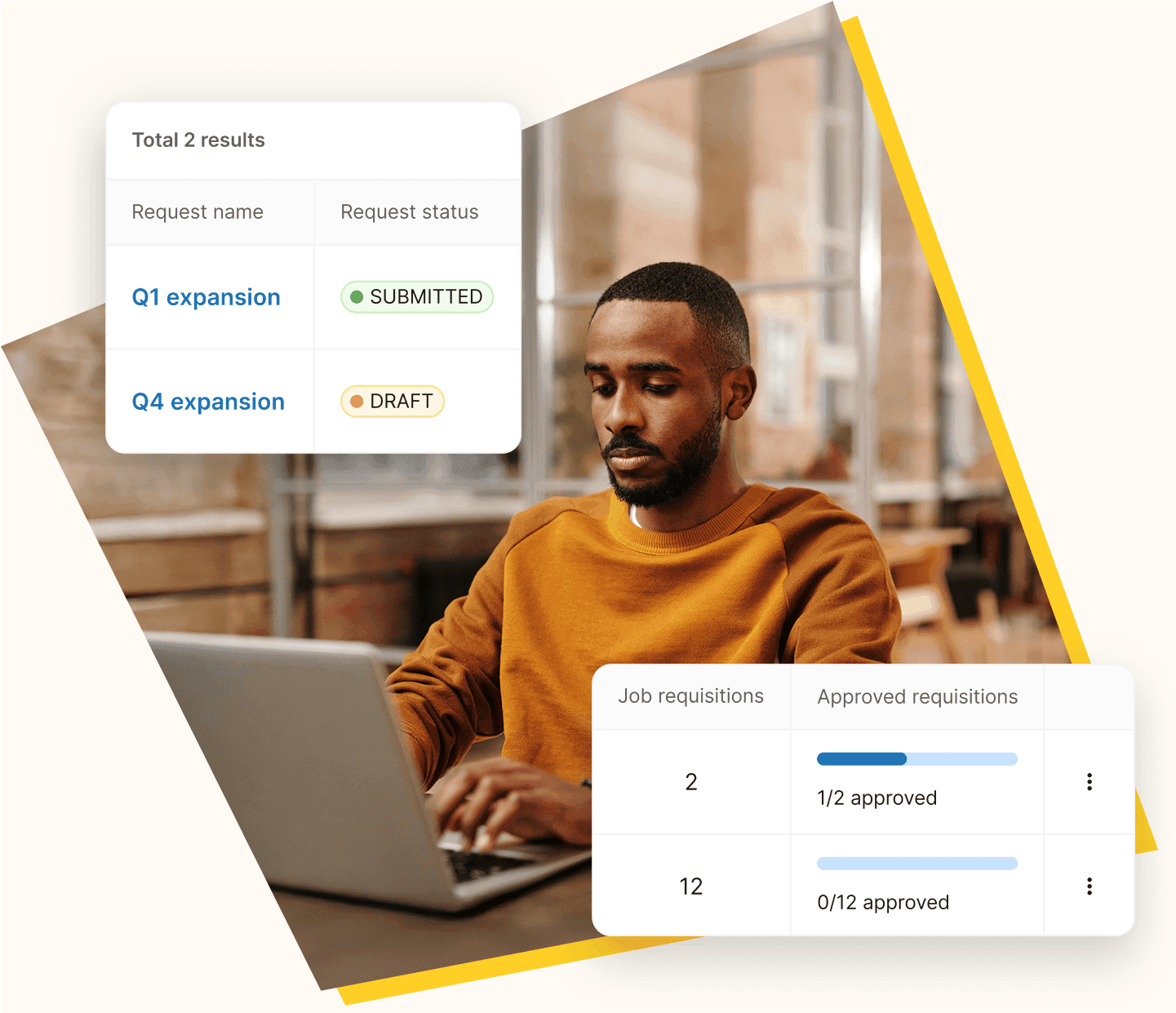
Deel's distinctive advantage emerges for companies managing both local and international teams. The platform provides worldwide entity coverage with automated compliance updates, ensuring benefits offerings and employment practices remain current with local regulations.
Real-time global workforce data flows through a single dashboard, giving leadership visibility into headcount distribution, compensation trends, and benefits utilization across all markets.
This unified approach proves particularly efficient when planning expansions, as you can forecast costs and compliance requirements for new countries without engaging separate vendors or building custom integrations.
In practice, teams can configure compliant, country-specific benefits packages with guidance from in-country experts, monitor enrollment and utilization, and forecast the budget impact of contribution strategies or plan design changes—all within Deel’s platform and fully synced to payroll and workforce plans.
Live Demo
Get a live walkthrough of the Deel platform

ADP Workforce Now
ADP Workforce Now delivers customizable dashboards and predictive analytics designed for strategic HR decisions around headcount and attrition forecasting. The platform allows HR teams to build workforce models using Excel-like interfaces, making it accessible for users comfortable with spreadsheet-based planning while providing more sophisticated data integration than standalone files.
The system integrates payroll, benefits enrollment, time and attendance tracking, and talent management into a unified environment. This consolidation means headcount forecasts automatically incorporate actual pay rates, benefits elections, and attendance patterns rather than relying on estimates. HR leaders can analyze turnover trends, identify retention risks, and model the financial impact of different staffing scenarios using historical data drawn from across the platform.
ADP's strength lies in its analytical depth and flexibility for organizations with complex workforce structures. However, the lack of transparent pricing requires prospective buyers to engage in detailed vendor discussions before understanding total cost of ownership, which can complicate initial evaluation and budget planning.
Anaplan
Anaplan specializes in detailed scenario modeling that lets HR and finance teams compare multiple staffing and budget strategies side-by-side. Scenario modeling is the process of creating parallel planning versions to evaluate different business assumptions, such as aggressive hiring versus conservative growth, or the impact of different attrition rates on staffing needs. This capability proves invaluable when leadership needs to understand the financial implications of strategic alternatives before committing resources.
The platform integrates HR and payroll data to generate comprehensive salary and benefits forecasts, supporting both tactical planning and long-range workforce strategy. Anaplan's architecture handles complex organizational structures and can model intricate relationships between headcount, compensation, benefits costs, and business outcomes. Finance teams particularly value the ability to link workforce planning directly to revenue forecasts and operational budgets, ensuring talent investments align with business capacity.
The tradeoff for this sophistication is a steep learning curve and complex initial setup. Organizations without dedicated planning resources or technical expertise may struggle with implementation, making Anaplan better suited for larger enterprises with mature planning processes rather than smaller teams seeking straightforward workforce tools.
Deel Workforce Planning

ClearCompany
ClearCompany centralizes headcount forecasting, staffing scenarios, and budget planning in a unified interface that supports analytics-driven HR management. The platform emphasizes ease of use while providing the depth needed for strategic workforce planning, letting teams model different hiring timelines, evaluate budget constraints, and assess the impact of organizational changes.
Integration with leading payroll and HRIS platforms ensures ClearCompany can pull actual compensation data and benefits costs into workforce models rather than relying on manual updates or estimates. This connectivity reduces the reconciliation work that typically accompanies planning cycles and improves forecast accuracy by grounding projections in real employment data.
ClearCompany positions itself as accessible for mid-sized organizations that want robust planning capabilities without enterprise-level complexity. The platform delivers unified HR analytics that connect recruiting, onboarding, performance management, and workforce planning. Like several competitors, ClearCompany does not publish transparent pricing, requiring direct vendor engagement to understand costs and evaluate budget fit.
Workday Adaptive Planning
Workday Adaptive Planning employs artificial intelligence and machine learning to power dynamic forecasting across financial, workforce, and operational domains. This AI-driven approach allows HR and finance leaders to generate sophisticated workforce models that account for seasonality, growth trends, attrition patterns, and market dynamics.
The platform supports collaborative planning where multiple departments can contribute assumptions and review impacts, ensuring workforce plans align with revenue forecasts and operational capacity. Workday's integration with its broader HCM suite provides particularly deep functionality for organizations already using Workday for core HR processes.
Despite its advanced capabilities, Workday Adaptive Planning maintains some dependency on spreadsheets for certain workflows. Organizations seeking to eliminate spreadsheets entirely from their planning processes may find this limitation frustrating, particularly given the platform's otherwise modern architecture and sophisticated modeling engine.
Benefits Administration
Planful
Planful automates budgeting, forecasting, and headcount planning with a focus on aligning HR and finance strategy in real time. The platform provides financial planning and performance management capabilities that extend beyond workforce planning to encompass broader organizational budgeting, making it attractive for finance-led planning processes where headcount represents one component of comprehensive financial models.
HR teams can build detailed workforce plans that automatically flow into departmental budgets and company-wide forecasts. Planful's automation reduces the manual consolidation work that typically accompanies planning cycles, where HR submits headcount requests that finance must manually incorporate into budget models. Instead, workforce plans update financial forecasts instantly, giving leadership immediate visibility into the budget implications of staffing decisions.
The platform integrates with popular HRIS, payroll, and analytics systems, ensuring workforce data remains synchronized across the planning ecosystem. Planful emphasizes user-friendly interfaces that make planning accessible to business users rather than requiring specialized technical skills. However, like several enterprise planning platforms, Planful does not publish pricing publicly, which may slow initial vendor comparisons for organizations evaluating multiple options.
Paycor
Paycor focuses on straightforward benefits enrollment and core HR administration suited for small to mid-sized businesses, prioritizing ease of use over advanced analytics. The platform handles essential HR tasks efficiently, with an interface designed for teams that need reliable benefits management without the complexity of enterprise workforce planning systems.
Benefits enrollment through Paycor provides employees with guided experiences that simplify decision-making during open enrollment periods. The system manages eligibility rules, enrollment deadlines, and benefits communications, reducing the administrative burden on HR teams. Integration with Paycor's payroll system ensures benefits deductions flow automatically into pay processing.
The tradeoff for this simplicity is limited sophistication in workforce forecasting and a traditional approach to benefits that lacks modern options like flexible stipends or lifestyle benefits. Organizations seeking to differentiate their benefits offerings or requiring detailed headcount modeling and scenario planning will likely find Paycor's capabilities insufficient. The platform serves organizations that value operational efficiency in core HR tasks over strategic workforce analytics.
Leading Global Hiring Platform

Vena
Vena delivers deep Excel integration that appeals to finance-driven teams requiring detailed labor and payroll planning within familiar spreadsheet environments. The platform allows finance and HR to collaborate on workforce models using Excel as the interface, while Vena provides the backend infrastructure for data consolidation, workflow management, and reporting. This approach lets organizations leverage existing Excel expertise and models while gaining automation and control that standalone spreadsheets cannot provide.
Vena automates variance analysis, which compares planned (budgeted) figures to actual results to identify discrepancies and inform future planning. This capability proves particularly valuable in workforce planning, where understanding why actual headcount or compensation differs from projections helps refine future forecasts. The platform tracks changes, maintains audit trails, and consolidates inputs from multiple contributors while preserving the Excel experience users prefer.
Organizations already Excel-centric will find Vena's approach natural and efficient, avoiding the learning curve associated with entirely new planning interfaces. However, teams seeking to move away from spreadsheet-based planning or wanting more modern, browser-native experiences may view Vena's Excel dependency as a limitation rather than an advantage. The platform works best for finance teams that view Excel as a strategic asset rather than a legacy tool to replace.
Cube
Cube leverages AI models to generate predictive forecasts for financial and workforce planning, with customizable pricing that adapts to different business sizes and needs. The platform provides a resource library supporting ongoing user education, helping teams maximize the value of their investment through best practices and implementation guidance.
Cube's AI-driven approach analyzes historical data to identify patterns and generate forward-looking projections for headcount needs, compensation trends, and benefits costs. These predictive capabilities help organizations anticipate workforce requirements before gaps emerge, supporting proactive talent acquisition rather than reactive hiring. The platform's flexibility allows configuration for various organizational structures and planning methodologies, from simple headcount tracking to sophisticated workforce optimization models.
Like Vena, Cube maintains integration with Excel, which provides familiarity for finance users but may be less appealing for organizations pursuing spreadsheet-free planning environments. The platform positions itself as accessible for growing companies that need more sophistication than basic spreadsheets provide but aren't ready for enterprise-grade planning complexity. Cube's customizable pricing model accommodates this market, scaling costs with organizational size and feature requirements.
Deel HR
Key benefits of using benefits enrollment and headcount forecasting tools
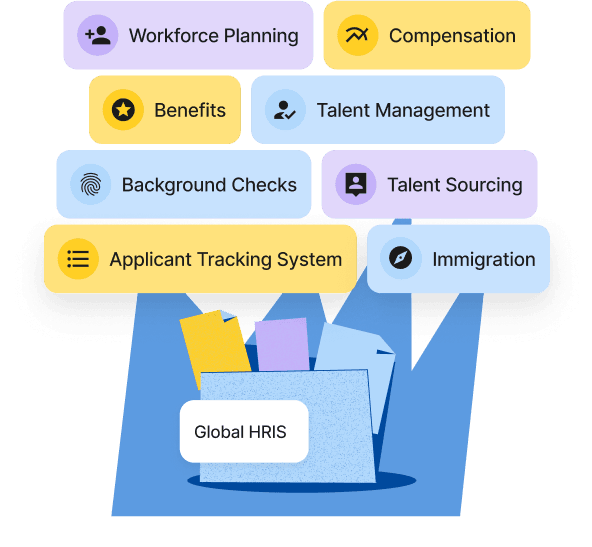
Modern benefits enrollment and headcount forecasting platforms deliver measurable value for organizations preparing for 2026 workforce demands:
- Improved forecasting accuracy through predictive analytics that use current and historical data to forecast future outcomes, ensuring talent plans align with business needs and growth trajectories.
- Reduced labor costs via data-driven planning that identifies optimization opportunities, eliminates redundancies, and ensures hiring aligns with revenue capacity.
- Greater operational agility from real-time dashboards and analytics that let leadership respond quickly to market changes, competitive pressures, or unexpected turnover.
- Seamless integration with existing HRIS, applicant tracking systems, and payroll platforms that eliminates manual data entry and ensures planning uses accurate, current information.
- Compliance automation that keeps benefits offerings and employment practices aligned with evolving regulations across multiple jurisdictions.
- Strategic alignment between HR, finance, and business leadership through shared visibility into workforce costs, capacity, and planning assumptions.
Automation platforms can complete processes faster with fewer errors compared to manual approaches, representing substantial efficiency gains that free HR teams to focus on strategic initiatives rather than administrative tasks.
How to choose the right tool for your organization
Selecting the optimal benefits enrollment and headcount forecasting platform requires systematic evaluation of how different solutions align with your organizational requirements and strategic direction. Use this framework to guide your assessment:
- Identify core business needs by documenting your primary pain points, whether that's compliance complexity, international scaling, forecast accuracy, or integration challenges. Prioritize must-have capabilities versus nice-to-have features.
- Evaluate integration compatibility with your current HR, payroll, and finance systems. Confirm the platform can access the data it needs without requiring manual exports or custom development. Consider whether you need real-time data synchronization or if periodic updates suffice.
- Trial usability with stakeholders by involving HR administrators, finance partners, and managers who will interact with the system. Assess whether the interface matches your team's technical sophistication and whether training requirements fit your timeline and resources.
- Review pricing models and total cost of ownership, including implementation fees, training costs, ongoing support, and potential charges for additional users or features. Request detailed pricing breakdowns rather than accepting high-level estimates.
- Assess vendor track record for product updates, customer support responsiveness, and strategic roadmap alignment with your long-term needs. Evaluate whether the vendor invests in innovation and how they incorporate customer feedback.
Compare functionality, integration capabilities, ease of use, and cost-effectiveness across shortlisted platforms using a structured comparison table. Weight criteria based on your organization's priorities, whether that's global compliance, predictive analytics, user experience, or total cost. Consider creating proof-of-concept scenarios using your actual data to test how well platforms handle your specific planning complexity and use cases.
Prepare your workforce strategy for 2026 with confidence
For organizations managing international growth or balancing local and global teams, Deel offers a uniquely consolidated approach to workforce management.
By connecting benefits enrollment directly to payroll and real compensation data, and layering in AI-driven forecasting across countries and currencies, Deel helps you model scenarios faster, stay compliant automatically, and make staffing decisions with a clear view of total workforce cost.
Ready to streamline benefits and forecast headcount in one global system? Book a demo with Deel to see how unified enrollment, payroll sync, and real-time workforce analytics can support your 2026 plans.
FAQs
What features should I look for in benefits enrollment software?
Prioritize user-friendly interfaces, real-time dashboards, seamless integration with HR and payroll systems, personalized decision support, and automated eligibility verification to simplify enrollment and improve the employee experience.
How can forecasting tools improve workforce planning accuracy?
Forecasting tools analyze historical data using predictive analytics, allowing organizations to anticipate future headcount needs and make informed staffing and budgeting decisions rather than relying on intuition.
What are common challenges with current enrollment systems?
Organizations frequently encounter steep learning curves, dependence on manual spreadsheets, opaque pricing, and limited flexibility in benefits offerings that restrict their ability to differentiate employee value propositions.
How important is integration with existing HR and payroll systems?
Integration is essential for ensuring data accuracy, eliminating manual entry, and enabling smooth information flow across HR, payroll, and finance functions that ground planning in reality.
What improvements in speed and accuracy can I expect from these tools?
Modern benefits and forecasting platforms deliver processes faster with fewer errors compared to manual approaches, representing transformative efficiency gains.
Shannon Ongaro is a content marketing manager and trained journalist with over a decade of experience producing content that supports franchisees, small businesses, and global enterprises. Over the years, she’s covered topics such as payroll, HR tech, workplace culture, and more. At Deel, Shannon specializes in thought leadership and global payroll content.


