Article
8 min read
5 Best Automated US Payroll Solutions for Tech Companies (2026)
US payroll

Author
Shannon Ongaro
Last Update
October 21, 2026
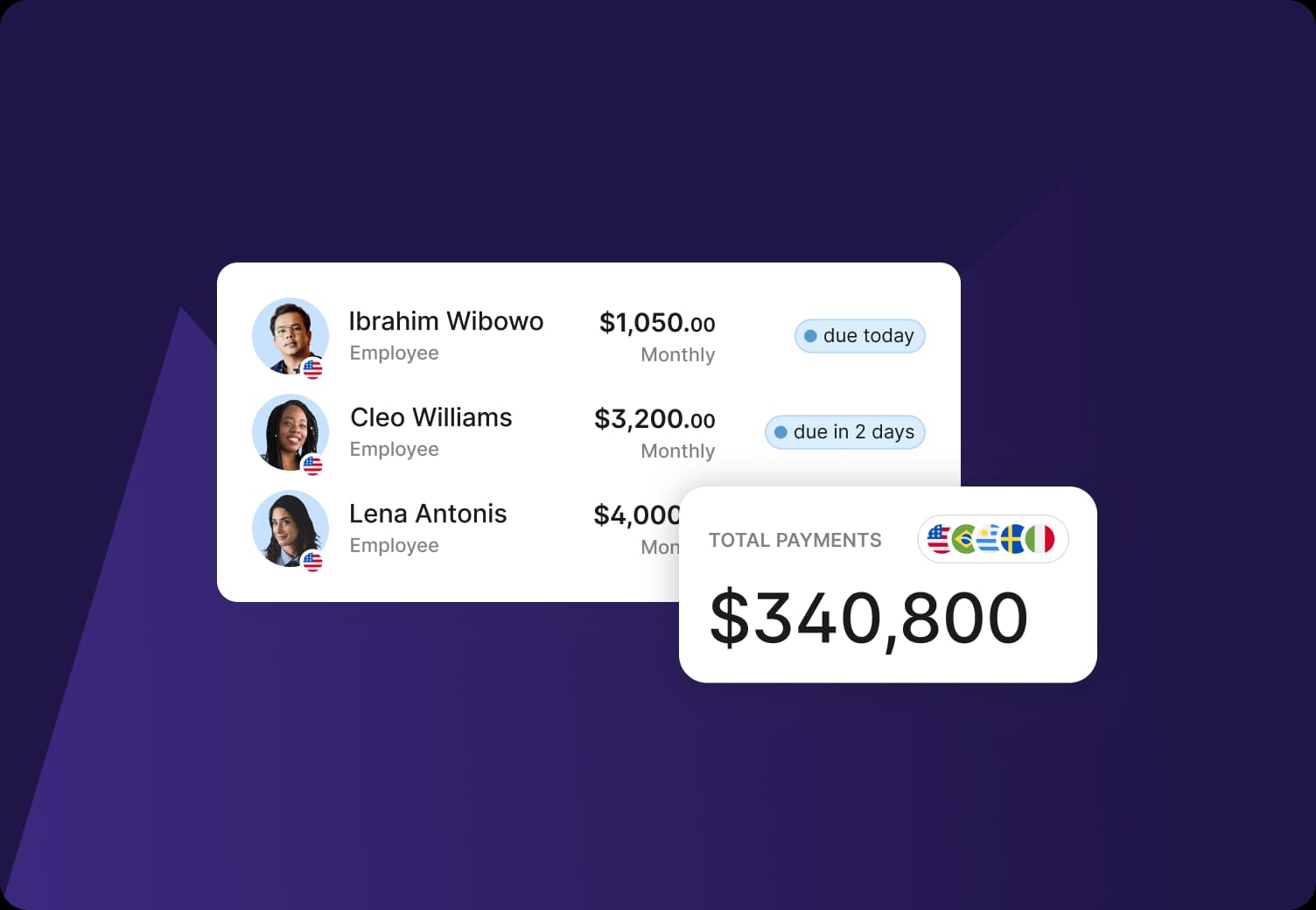
Table of Contents
Why tech companies need specialized payroll automation
Deel Payroll (US): Best for growing tech teams running payroll across all 50 states
Gusto
ADP Workforce Now
Paylocity
Paycom
How to choose the right automated payroll solution for a tech company
Automate your tech company payroll with Deel
Key takeaways
Multi-state taxes, W-2/1099 contractor mixes, and equity compensation make standard payroll software insufficient for tech companies.
Automated payroll platforms reduce the processing errors that lead to retroactive corrections, a common and avoidable compliance cost for distributed tech teams.
Deel Payroll (US) helps companies run accurate, compliant US payroll with the flexibility to self-run their payroll or rely on Deel for expert payroll support and review.
Distributed tech teams have payroll responsibilities that most general HR software can’t handle. Engineers in California, New York, Washington, and Texas mean four sets of state withholding rules, four state unemployment insurance (SUI) accounts, and filing deadlines that don’t align. W-2 employees, 1099 contractors, and equity events add more tax rules on top.
And errors can cost you significantly. Employer payroll taxes make up about 9.1% of total compensation in the US, and wrong filings add penalties, interest, and corrections. SHRM found that 64% of US employers have run retroactive payroll adjustments because of processing errors. Payroll automation targets this problem.
This guide compares six automated US payroll platforms for tech companies on automation depth, multi-state compliance, and integration fit. The right choice depends on headcount, growth, and entity structure.
Why tech companies need specialized payroll automation
Tech companies often scale headcount across states, worker classifications, and compensation structures simultaneously, which puts multi-state payroll compliance well beyond what a general-purpose HR tool is designed to handle.
Multi-state payroll tax and SUI requirements
When workers are registered in multiple states, each state comes with its own income tax withholding requirements, SUI account registration, and filing schedules. The Department of Labor's localization-of-work rules further complicate SUI for remote workers. Determining which state's unemployment tax applies when an employee regularly works across state lines isn't always straightforward, and getting it wrong creates retroactive liability.
Supplemental wages and equity tax withholding
On top of multi-state complexity, tech compensation structures create distinct payroll tax obligations that differ from standard wages. Bonuses and certain equity events are classified as supplemental wages under IRS employer payroll tax rules, which require separate withholding treatment from regular salary. Incorrect withholding on equity events is a common source of W-2 corrections.
Supplemental wages and equity tax withholding
Companies with both W-2 employees and 1099 contractors face a further layer of complexity. The two worker classifications carry entirely different tax treatment, withholding obligations, and year-end reporting requirements (W-2 versus 1099-NEC). Managing them in the same system requires a platform that handles the classification distinction reliably, not one that treats all workers as the same type by default.
Specialized payroll automation handles multi-state tax filings, multi-worker-type payroll processing, and integration with equity platforms and enterprise resource planning (ERP) systems in a single workflow, so Finance spends its time on workforce strategy rather than compliance maintenance.
Deel Payroll (US) vs. Deel EOR: which fits?
Deel Payroll (US) is for companies with a US employing entity. Deel processes payroll and the client company remains the legal employer. Deel's EOR solution is for companies without their own US employing entity, where Deel's entity serves as the legal employer.
Deel Hire
Planning to expand into the US?
Deel Payroll (US): Best for growing tech teams running payroll across all 50 states
Deel Payroll (US) helps companies run accurate, compliant US payroll with the flexibility to self-run their payroll or rely on Deel for expert payroll support and review. Teams choose the option that best fits their needs for US payroll, and get support that adapts as their payroll complexity grows.
AI-assisted tax filing and automated compliance monitoring
Deel Payroll (US) calculates and files federal, state, and local payroll taxes across all 50 states. This covers state income tax withholding, SUI, and applicable city and county taxes. It also covers year-end W-2s. Deel applies continuous compliance monitoring across all 50 states.
Deel’s AI-assisted capabilities support payroll preparation, readiness checks, anomaly detection, workflow automation, and payroll information retrieval. They surface possible issues before teams submit payroll, not after.
AI within Deel supports the preparation, validation, and explanation of the work around each run. The payroll engine remains responsible for payroll calculation, and people review the work where judgment is required.
Deel also helps with tax notices. When a team uploads a notice, Deel’s Tax Registration Hub extracts the details right away, creates a tracked case automatically, and shows real-time status. Teams can always see where a tax agency matter stands. Watch the video below to learn more.
Time tracking connected to payroll
Deel’s Time Tracking is built into the platform. Workers log hours, managers approve timesheets, and approved hours sync into payroll using a real-time API, so teams don't re-enter time data. Deel Payroll (US) supports break policy configuration, overtime calculation, and geofencing for location-based clock-in validation. Time Tracking is included in Deel contracts.
Deel integrates with HR, accounting, and benefits tools, including Workday, HiBob, BambooHR, UKG, SAP, NetSuite, Xero, Human Interest, and Employee Navigator. It is also a certified Workday payroll partner.
One platform for payroll, benefits, HR, IT, and mobility
Teams pay US and global employees from one Deel platform, with no replatforming as they grow. Deel Payroll (US) pays W-2 employees. Teams can pay contractors through Deel's contractor solution on the same platform.
Teams can also add other Deel solutions to the same platform:
Deel Benefits syncs benefit elections to payroll, so deductions match what employees chose.
Deel HR manages worker records and the employee lifecycle, and it connects to Deel Payroll.
Deel IT covers equipment and app provisioning, device lifecycle management, and mobile device management.
Deel Mobility supports immigration cases, including work permits and visas.
Payroll, benefits, HR, IT, and mobility data then sit in a single system of record, with one login for the teams that manage them.
Equity connected to payroll
Tech teams that pay equity can connect it to payroll. Deel Equity, Deel's core equity product, syncs grants with an equity management platform such as Carta. Finance and HR then see equity next to payroll and HR data.
For taxable events, Deel's optional Equity & Token Services lets Deel experts review each event, apply the right withholding, and reflect it in payroll. Deel never holds the securities.
With Deel Payroll, all I have to do is log in, click ‘Approve Pay’, and that’s it. It’s the smoothest solution on the market.
—Marion Passalinqua,
Mobility and Legal Operations Specialist, Gecko Robotics, Inc.
Key capabilities:
Self-serve or managed options: Run payroll independently with our self-serve option, or use our managed option that includes a Deel payroll expert dedicated to your business.
Multi-state tax filing with continuous compliance monitoring: Deel Payroll (US) handles federal, state, and local payroll tax calculations and filings across all 50 states.
Time tracking connected to payroll: Approved hours sync into payroll using a real-time API, with break policies, overtime calculation, and geofencing supported.
AI-assisted payroll preparation with human oversight: AI-assisted readiness checks and anomaly detection help teams find possible issues before they submit payroll.
Payroll, benefits, HR, IT, and mobility on one platform: Teams can manage benefits, IT, HR, and mobility on the same Deel platform.
Best for: Growing tech companies, typically 10 to 200 US employees, with a US employing entity that want accurate multi-state payroll and support that adapts as their payroll complexity grows.
Worth knowing: Deel Payroll (US) is for companies with a US employing entity. Companies without one should evaluate Deel's EOR solution, where Deel's entity serves as the legal employer.
Platform Tour
See how US payroll works
Gusto
Gusto serves small and growing businesses, including tech startups that don't yet have a dedicated payroll or HR administrator. The platform emphasizes self-serve setup and onboarding for non-specialists. Gusto is aimed at startups from seed through Series A or B. As headcount and multi-state complexity grow, some companies review whether their payroll platform still fits.
Key capabilities:
Automated federal and state tax filing: Gusto handles payroll tax calculations, deposits, and filings at the federal and state levels, including new-hire reporting and year-end W-2s.
Mixed W-2/1099 workforce support: Employees and independent contractors are managed in the same platform, with separate workflows for each classification.
Self-serve HR administration: Benefits enrollment, PTO, and compliance notices are bundled into one interface for use without a dedicated HR or payroll specialist.
Typical fit: Early-stage tech startups, from seed through Series B, that want payroll with basic HR functionality.
Worth knowing: Companies that approach 100 employees or add multi-state complexity should check whether Gusto's workflows and integrations still match their requirements at that scale.
Read more about how Deel compares to Gusto for US payroll.
ADP Workforce Now
ADP Workforce Now serves the mid-market segment. It offers compliance reporting and a wide set of integrations. Tech companies with roughly 200–1,000 employees that already use financial and HR systems may consider it.
The platform handles multi-state payroll tax filing, garnishments, and year-end filings. Its compliance reporting tools show filing status across jurisdictions. ADP connects to ERP, benefits, and time-and-attendance platforms, so companies with an existing financial or HR stack can connect payroll to it instead of replacing it.
Key capabilities:
Multi-state payroll compliance: ADP handles payroll tax calculations, filings, and year-end processing across states.
Integrations: ADP Workforce Now connects to ERP systems, benefits platforms, and time-and-attendance tools.
Compliance reporting and audit trails: Finance teams can view multi-state filings, payroll audit logs, and regulatory updates.
Typical fit: Mid-market companies with roughly 200–1,000 employees that need connections into existing ERP and financial platforms.
Worth knowing: ADP Workforce Now supports configurable mid-market use cases, so organizations should check its implementation requirements against their payroll complexity before they commit.
Read more about how Deel compares to ADP for US payroll.
Why integrations matter for payroll
A payroll platform that syncs natively with the existing HRIS and ERP eliminates manual reconciliation steps after every pay run. Before selecting a platform, confirm which specific integrations are supported for the US payroll product, as general integration libraries don't always extend to every payroll module.
Paylocity
Paylocity targets mid-market companies that want payroll connected to talent management, employee engagement, and benefits administration in one product. Tech Finance teams that prefer one view of payroll and HR over separate point solutions may find this structure relevant.
The platform includes payroll processing, time and attendance, benefits administration, recruitment support, and performance management. Paylocity also provides implementation and ongoing support.
Paylocity's mid-market focus places it between early-stage payroll tools and enterprise platforms.
Key capabilities:
Payroll and talent in one product: Paylocity combines payroll processing with talent acquisition, performance management, employee engagement, and benefits.
Time and attendance integration: Time tracking, scheduling, and approval workflows connect to payroll calculations.
Mid-market support model: Paylocity provides account management and implementation support with the platform.
Typical fit: Finance and HR teams at mid-market tech companies (roughly 50–500 employees) that want a unified payroll and talent platform.
Worth knowing: Teams that mainly need payroll should compare the scope and cost of Paylocity's broader suite with the modules they need.
Read more about how Deel compares to Paylocity for US payroll.
Leading Global Hiring Platform
The world’s #1 platform for global employment

Paycom
Paycom's main feature is Beti (Better Employee Transaction Interface), a self-service model. Beti shows payroll data to employees before the run processes, so they can confirm or flag their own records. Paycom designed it to reduce retroactive adjustments and post-payroll corrections.
Key capabilities:
Beti self-service payroll: Employees review and confirm their payroll data before each run.
Single-database HCM: HR, payroll, and workforce management draw from one data source.
Built-in error detection: Automated workflows flag payroll discrepancies before runs process, in addition to the employee self-review step.
Typical fit: Mid-market tech companies with roughly 200–2,000 employees whose teams can take part in a self-service payroll model.
Worth knowing: The Beti model needs consistent employee engagement with the review process. Organizations with lower HR self-service adoption may see smaller gains in payroll accuracy.
How Strada effortlessly runs payroll in the US with Deel
Strada is reinventing insurance communications with AI-powered phone agents that handle calls around the clock. When the time came for Strada to run payroll for US-based employees, it knew that making sure everything was 100% compliant and all legal details were being followed was a top priority.
“It was important for us to find a partner that had experience in these HR processes and that offered a seamless experience not only for us but also for our employees,” mentioned Amir Prodensky, co-founder and CEO at Strada.
Since using Deel, they have saved over 5 hours per employee on hiring and onboarding and over 4 hours monthly on US payroll.
“We found everything we needed in Deel – hiring contractors, running US payroll, managing benefits and taxes, setting up new entities, and more, all in one place.” — Amir Prodensky, Co-founder and CEO, Strada
How to choose the right automated payroll solution for a tech company
Selecting the right US payroll platform comes down to four variables: company stage, multi-state footprint, existing tech stack, and entity status.
Company stage and headcount
Early-stage companies benefit from self-serve platforms that handle the basics without extensive configuration. Mid-market companies (roughly 100–1,000 employees) need deeper multi-state compliance capability and integration support. Enterprise organizations above 1,000 employees need platforms built for organizational complexity, AI-assisted compliance automation, and financial consolidation.
Multi-state footprint
For companies with workers in three or more states, automation depth on state income tax, SUI, and local tax filing becomes the primary selection criterion. Deel Payroll (US) handles federal, state, and local payroll tax filing across all 50 states, with continuous compliance monitoring. Other platforms handle multi-state payroll as well, so comparing each vendor's specific filing and registration support against the company's actual state footprint is the right evaluation step.
Deel really helped us get into one system, create a streamlined process, and account for the various pay components for each person. This elevated the performance review process as employees could tie their recognition and see the visible change year-to-year.
—Dawn Williams,
Director of People Operations, Serverfarm
Integration stack
Payroll doesn't operate in isolation. Companies should compare each platform against their current ERP, human resources information system (HRIS), time-and-attendance, and benefits tools. A payroll platform that integrates natively with existing financial systems saves significant reconciliation time every payroll cycle.
Entity status
Companies with a US employing entity should evaluate payroll platforms directly. Companies without a US employing entity, or non-US companies hiring US-based workers, should evaluate an EOR solution alongside or in place of a standalone payroll platform.
Step-by-step guide
How to Switch Payroll Providers for 2026
Automate your tech company payroll with Deel
For growing tech teams with a US entity, Deel Payroll (US) covers multi-state payroll with continuous compliance monitoring. It also gives a clear path to international hiring, IT, benefits, and mobility, with no replatforming.
Payroll in a tech company is a compliance system with significant financial and legal consequences every pay cycle, not a background administrative function. The right automated platform handles the multi-state complexity, worker classification requirements, and integration needs of a growing tech team, rather than requiring Finance to maintain those layers manually.
With Deel, companies can start with US payroll and add international payroll, EOR, or contractor management without reimplementing their workforce system. Book a demo below to see how Deel Payroll (US) handles multi-state payroll tax filing and fits into a company's current tech stack.
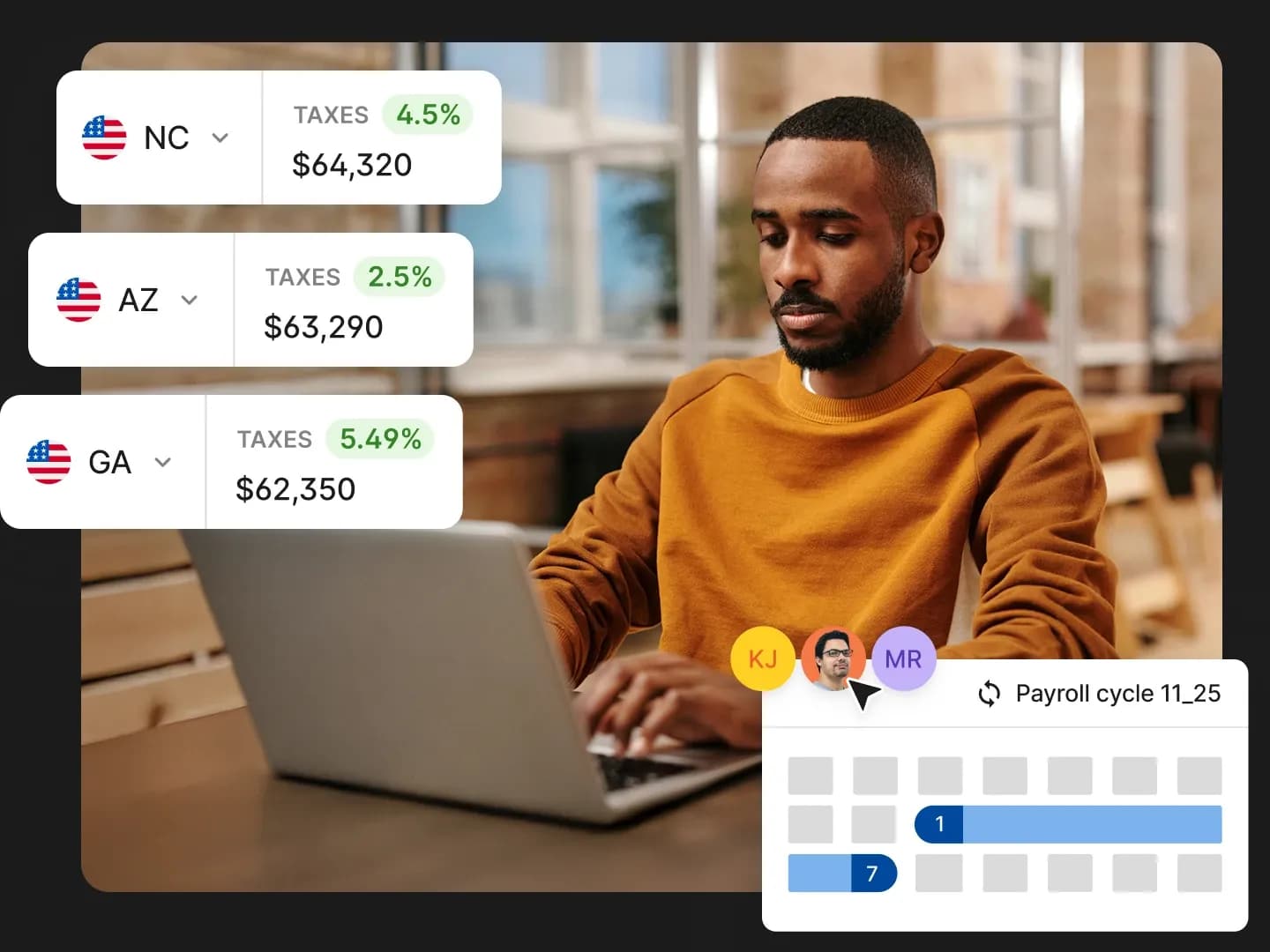
Deel Payroll - US
Stay compliant, save time, and pay your US team with confidence
FAQs
What is automated US payroll and how does it work for tech companies?
Automated US payroll software handles tax calculations, multi-state filings, payment processing, and year-end reporting without requiring manual intervention at each step. For tech companies, automation addresses the specific complexity of multi-state SUI registrations, mixed W-2/1099 workforces, and integration with HRIS and ERP platforms.
How do payroll platforms handle multi-state tax for distributed engineering teams?
Purpose-built platforms automate state income tax withholding and payroll tax filings across the states where workers are employed. The Department of Labor's localization-of-work rules determine which state's SUI applies for remote workers. Employers should confirm how each platform handles SUI registration and localization-of-work determinations for their specific workforce.
Can payroll software automate RSU and stock option tax withholding?
Payroll platforms generally handle supplemental-wage withholding, which covers bonuses and some equity events as classified under IRS rules.
Dedicated RSU-vest withholding and sell-to-cover coordination often requires a separate equity management platform integrated with payroll. Confirm the specific equity withholding workflows with any platform before relying on it for equity-event payroll processing.
What is the difference between Deel Payroll (US) and Deel's EOR?
Deel Payroll (US) is for companies that already have a US employing entity. Deel processes payroll and handles compliance, while the client company remains the legal employer. Deel's EOR solution uses Deel's entity as the legal employer for companies that do not have their own US employing entity.
How should a company choose between a standalone US payroll tool and a full HCM suite?
Standalone payroll tools offer deeper specialization and faster implementation, while HCM suites add HR, talent, and benefits modules in a unified system. For tech companies below roughly 200 employees, a focused payroll platform paired with a separate HRIS often outperforms a full HCM on cost and configuration simplicity. Above that threshold, the integration value of a connected HCM typically grows as organizational complexity increases.
Which payroll platforms integrate with Workday, BambooHR, NetSuite, and Xero?
Deel Payroll (US) integrates with Workday, BambooHR, NetSuite, and Xero, and it is a certified Workday payroll partner. For other vendors, confirm that their US payroll product supports the connection, because general integration libraries don't always cover every payroll module.
Disclaimer: This article is provided for general informational purposes and should not be treated as legal or tax advice. The data outlined in this content is accurate at the time of publishing and is subject to change or updating. Deel does not make any representations as to the completeness or accuracy of the information on this page.
Shannon Ongaro is a content marketing manager and trained journalist with over a decade of experience producing content that supports franchisees, small businesses, and global enterprises. Over the years, she’s covered topics such as payroll, HR tech, workplace culture, and more. At Deel, Shannon specializes in thought leadership and global payroll content.