
Article
24 min read
How Can AI Help HR Become More Strategic: From Admin to Impact
Global HR
AI

Author
Lorelei Trisca
Last Update
October 14, 2025
Table of Contents
1. Freeing HR from repetitive tasks
2. Scaling HR knowledge and compliance support
3. Facilitating compensation benchmarking and scenario planning
4. Strengthening workforce and talent management
5. Matching candidates for internal mobility opportunities
6. Analyzing exit trends and worker sentiment
7. Turning HR data into business intelligence
What AI can’t replace in HR strategy
Deel, the partner for future-proof strategic HR
Key takeaways
- HR’s mandate is shifting from operations to strategy. Today’s people teams are expected to go beyond admin to focus on workforce planning, talent development, and creating measurable business impact.
- AI is the catalyst for this shift. Beyond automating tasks, AI provides predictive insights and workforce intelligence that enables HR leaders to forecast needs, close skills gaps, and strengthen retention.
- Deel builds AI into every corner of HR. From hiring and payroll to performance and offboarding, Deel’s AI Workforce acts as a series of digital teammates, helping HR leaders unlock efficiency and deliver real strategic value.
HR leaders have long been tired of being seen as the “admin team.” For years, people ops has been buried in paperwork, payroll, and policies, while the C-suite ponders why they’re not more “strategic.”
AI has the power to change that narrative, but only if you look beyond its generative capabilities. While it’s certainly valuable for HR to use gen AI as an admin helper to whip up a new letter or development plan, the real opportunity presented by AI is far more impactful. When used strategically, the technology can give HR leaders the same forecasting power your finance team has with their budgets or sales with pipelines. And by doing so, HR can better predict needs, model scenarios, and drive real growth for the overall organization.
This article explores seven high-impact use cases, showing how AI is transforming HR and helping it claim its rightful seat at the decision-making table. With real-life examples and practical tips on balancing AI and human judgment, you’ll see how HR teams can move from support function to strategy driver.
1. Freeing HR from repetitive tasks
The first thing most of us think about when it comes to AI in HR is its ability to take repetitive work off our plates. And for good reason, as HR has historically been an administrative function, charged with following some incredibly mundane and repetitive workflows. While these workflows have kept the company’s operational cogs turning, they’ve sidetracked people teams from the strategic decision-making executives want them to focus on.
AI can now step in and handle tasks like:
- Scheduling and rostering: Auto-creating employee shifts and resolving conflicts in seconds
- Drafting policies and documentation: Producing first drafts of staff handbooks, contracts, or policy updates that HR can then fine-tune
- Answering FAQs: Using AI assistants to handle repetitive queries around leave, payroll, benefits, or compliance
- Generating reports: Turning workforce data into dashboards on headcount, turnover, or DEI metrics without hours of spreadsheet wrangling
- Surveying employees: Running everything from pulse checks to company-wide NPS, deployed and analyzed instantly
- Creating learning content: Building courses and training modules at speed, ready for managers and employees to engage with
The impact can be dramatic when AI and automation are embedded into a unified HR platform. At fintech company Ladonware, for example, switching to Deel’s AI-powered HR stack transformed how their people team worked. Within months, they reported:
- 75% reduction in monthly payroll admin time
- 50+ international transfers consolidated into a single bulk payment
- Two months of goal-setting work automated into a single cycle
- 15 minutes to launch a company-wide NPS survey
Through the AI incorporated in the learning development module, I am able to build fantastic courses in half an hour.
—Lucía Rodriguez,
Head of HR, Ladonware
Ladonware is just one example of an HR team shaving hours off their task list and using the time to reinvest in more value-adding initiatives like culture shaping or leadership development. But here’s the catch: time savings alone don’t make HR more strategic. It’s what you do with the extra hours in your time bank that makes the difference.
Tip: Create a bridge between efficiency and impact by being intentional about where your “time dividend” goes. Instead of letting it vanish into yet more day-to-day firefighting, set aside dedicated cycles for work that shifts the needle, such as reviewing your skills strategy, piloting new engagement programs, or partnering with the business on workforce planning.
2. Scaling HR knowledge and compliance support
Even the most strategic HR professionals lose a huge chunk of their day answering questions, which is only natural, as employees want clarity on topics like workplace policies and queries about leave or payroll. Meanwhile, managers are also knocking on HR’s door for advice on compliance or hiring in new markets.
AI can ease the burden. With tools like the Deel AI 24/7 chat, HR teams can:
- Redirect routine employee and manager questions to an AI assistant trained on company policies and global compliance data
- Get instant, legally vetted answers when exploring new markets, from local benefits requirements to statutory leave rules
- Ensure consistent, accurate responses, instead of HR teams having to research or interpret laws manually
- Scale support globally, without hiring local HR specialists in every region
That’s exactly what US-based startup MarqVision achieved when it expanded rapidly into eight countries across Europe and Asia. Instead of drowning in local labor laws and payroll complexity, the company used Deel to stay compliant while onboarding over 30 international workers, a process that threw up more than a few questions.
Using Deel AI, they also scaled HR’s knowledge bank, as Yunjung (Rina) Bae, Director of People at MarqVision, explains:
Our global team can turn to Deel AI for instant answers to their HR questions, anytime. It’s been a huge time-saver for our People team.
—Yunjung (Rina) Bae,
Director of People, MarqVision
Tip: Use the questions your AI assistant handles as a data source. Tracking recurring queries can reveal hidden pain points, such as confusing benefits policies or visa bottlenecks, that HR can proactively address at a strategic level.
3. Facilitating compensation benchmarking and scenario planning
Compensation is one of the most important areas for your HR function to get right. Your people deserve a fair wage for the work they do, and they want to know they’re receiving a good deal compared to the rest of the market. However, running those benchmarks can be a major strain on HR teams, not just in terms of gathering accurate data but also in modeling the different scenarios leadership wants to see before making a decision.
Instead of HR teams spending days scraping salary data from multiple sources, AI can instantly:
- Compare salaries across roles, levels, and locations
- Model different hiring scenarios. For example, what if we hire for this role in Brazil vs. Spain?
- Flag potential equity issues between employees or teams
- Forecast the budget impact of new headcount
With the Deel AI Workforce, this capability is already built in. Our Hiring Guru agent analyzes compensation data across global markets and produces clear, actionable insights in minutes. Need to advise leadership on whether to expand a team in one region versus another? Hiring Guru can show you the cost difference, talent availability, and compliance implications, without HR having to cross-reference five different systems.
Tip: Don’t treat benchmarking as a once-a-year process. Use AI to keep compensation data live and scenario planning continuous. So, when leadership asks for options, you already have the models at hand, and HR shows up as a strategic advisor, not a bottleneck.
More resources
Learn more about using agentic AI tools in HR, and specific use cases for agentic AI in HR.
4. Strengthening workforce and talent management
It’s not enough to know how many people you have in the business. The real concern should be whether you have the right skills in the right places to deliver on your business strategy. That’s a tough ask when roles are changing faster than job descriptions can keep up.
Using AI in your talent management can add real strategic value here. Instead of relying on outdated competency models or biased surveys, AI infers skills directly from employee data, giving HR leaders a dynamic map of workforce strengths and gaps. With those insights, HR can:
- Pinpoint skills shortages across regions or functions
- Recommend career paths and training that match employee growth and business needs
- Build succession pipelines backed by data rather than gut feel
- Tie talent strategy directly to your business growth plans
Read more
Learn more about how to use AI in your talent management forecasting in our detailed guide.
Johnson & Johnson (J&J) provides one of the clearest examples of leveraging AI for workforce and talent management. Starting with its 4,000-strong Technology group, J&J built a three-step AI-powered talent management process, which involved:
- Defining a skills taxonomy: A list of 41 “future-ready” skills grouped into 11 capabilities, validated by over 100 business leaders and subject matter experts
- Gathering skills evidence: Pulling data from HR systems, recruiting, learning platforms, and project tools to capture 60-70% of each employee’s skills profile
- Running a passive skills assessment: Using machine learning to generate proficiency scores (0-5) for each skill, then refining them with employee self-assessments and manager input
As a result, J&J saw a 20% uptick in voluntary learning activity after the first round of skills inference as employees used the insights to guide their own development. Continuous learning habits deepened over time, reinforced by J&J Learn, the company’s AI-powered L&D ecosystem. By March 2024, over 90% of employees in J&J’s Technology group had engaged with the platform for training, growth assignments, or mentoring.
In leadership, executives gained a live dashboard showing skill proficiency by region and business line. This heat map fed directly into real-world hiring, retention, and advancement decisions, so HR’s workforce plans closely matched the company’s growth trajectory.
Tip: Follow J&J’s lead and start with a bounded use case. Don’t try to measure every skill at once. Instead, define the handful of “future-ready” capabilities that matter most to your business. Your AI insights will be easier to act on, and employees will be more likely to engage with the process.
5. Matching candidates for internal mobility opportunities
Hiring from the outside is expensive and slow. On the other hand, hiring from within saves time and budget and strengthens retention by proving to employees that growth opportunities are real. The challenge for HR has always been visibility: who has the right skills, experiences, and ambitions to take on an open role?
AI can provide visibility by analyzing data across skills, past performance reviews, and career goals to recommend internal candidates for open roles. Everyone benefits: the business fills critical roles faster, and employees see a clear pathway for development without leaving the company.
Spotify’s Echo is a great example of this strategic HR practice. Launched to help employees (known as “band members”) explore internal opportunities, Echo leans on AI to match people to projects, roles, and mentorships based on their skills and aspirations. In its first year:
- Over 6,000 employees engaged with Echo
- 70% of project assignments were cross-departmental, helping people stretch into new areas
- 50% of mentorship pairings crossed either departments or locations, fostering broader knowledge sharing
Spotify has since expanded Echo to include more opportunities across disciplines and improved its AI matching, profile management, and hiring functionality. According to its 2024 Equity & Impact Report, the platform has grown into a core part of their internal talent strategy, with 24% of all open roles filled by internal candidates in a recent year.
That said, Spotify has been candid about the limits of talent intelligence. In some cases, they’ve “over-optimized for internal candidates,” and matches don’t always yield the best hire. It’s a reminder that AI tools in HR should only ever be a guide, not a replacement, for human judgment.
Tip: Use AI-driven internal mobility tools to spark cross-functional growth. When employees take on stretch projects or cross-departmental mentorships, they develop faster, and HR builds a stronger, more versatile talent pool for the future.
6. Analyzing exit trends and worker sentiment
Turnover is one of the biggest hidden costs in any organization, but recruitment spend is only part of it. When experienced people leave, teams lose institutional knowledge and morale takes a hit for remaining team members. The question for HR is: how do you get ahead of any dips in worker sentiment?
AI can help here by:
- Identifying the most common reasons for turnover across teams, roles, or demographics
- Forecasting who is most at risk of leaving, giving HR time to act
- Enabling targeted retention strategies, such as career development programs, manager check-ins, or flexible working arrangements
- Feeding insights into workforce planning, so future gaps are anticipated rather than a nasty surprise
Research into the Impact of AI-driven predictive analytics on retention strategies proves how this approach works in practice. At Deloitte, for example, predictive models combining performance management data, compensation, and internal survey results revealed the top drivers of attrition in its consulting practice: career growth and work-life balance. Armed with this intel, Deloitte could design tailored interventions that addressed the real reasons people were leaving, rather than relying on broad, one-size-fits-all policies.
Deel AI’s Goodbye Genie agent complements this by focusing on the other side of the equation: making sure that when exits do happen, they’re smooth, compliant, and respectful. The Goodbye Genie can:
- Build tailored exit plans based on country laws, worker type, contract clauses, and tenure
- Generate performance improvement plans (PIPs)
- Update payroll data automatically.
All of this takes seconds, compared to hours of manual work.
Tip: Treat exit data as more than an administrative formality. Every resignation, survey response, or offboarding note contains hints and patterns you can use to improve retention upstream. The more you feed those strategic insights back into career planning and engagement strategies, the fewer “goodbyes” you’ll need to process in the first place.
7. Turning HR data into business intelligence
Most HR teams already sit on a wealth of data, from performance reviews and surveys to payroll and learning records. The challenge is making sense of it all. AI changes the game by turning those scattered data points into patterns and predictions. Instead of asking “What happened?” HR can finally start asking “What’s likely to happen next?”
AI’s predictive analytics close the loop for HR. Using finance-style forecasting for your people strategy, you can:
- Model headcount needs under different business scenarios
- Spot early warning signs of attrition
- Track skills supply versus demand across functions or regions
- Forecast the cost and availability of talent, the same way your finance team forecasts budgets
IBM’s AskHR platform, powered by watsonx Orchestrate, shows what this looks like in practice at scale. Initially built as a virtual assistant, AskHR now acts as a digital HR agent by:
- Handling more than 2.1 million employee conversations annually and automating 80+ HR tasks
- Resolving 94% of common queries without escalation and cutting support tickets by 75% since 2016
- Delivering a 40% reduction in HR operational costs over four years
- Supporting over 7,000 policy pages and collecting more than 55,000 pieces of feedback in 2024 alone
While those efficiency gains are impressive, the real strategic value is the insight layer. Every interaction, whether a payroll query in one region or repeated confusion about a policy, feeds a living dataset that HR can analyze to find blind spots or pinpoint where employees need more support, for example. Now, HR teams can show up to the C-suite armed with forecasts for the future.
Tip: Start small by choosing one domain, like attrition, headcount, or skills demand, and build a predictive model. Once HR leaders see the accuracy of those forecasts, it becomes far easier to expand into a full workforce-planning capability.
What AI can’t replace in HR strategy
AI can automate the busywork and even augment complex processes, but it can’t replace the human side of HR. At its heart, People ops is about trust, judgment, and culture, and no algorithm can replicate those.
Some tasks will always need a human touch. For example:
- Conflict resolution and employee relations: AI can flag sentiment shifts, but it can’t navigate power dynamics or rebuild trust after a conflict
- Culture and psychological safety: Data can show engagement trends, but culture is built through relationships, rituals, and values-led leadership
- Coaching and development: An AI can suggest a course; only a human can sit with someone who’s burnt out, overlooked, or doubting their place
- Strategic and ethical decisions: Dashboards reveal trends, but judgment in ambiguity, especially when people’s wellbeing is on the line, is something only leaders can own
The point isn’t to resist AI. It’s to decide where to automate, where to augment, and where to own the work as humans.
Read more
Learn more about where AI should stop and humans should step in by checking out our detailed guide on: Has AI Come for Your Job? 7 HR Tasks Humans Must Perform.
Deel, the partner for future-proof strategic HR
For years, HR has been asked to do more with less: to manage payroll, compliance, hiring, development, and engagement, among countless other jobs, often across multiple systems and countries. Deel’s universal HR platform brings it all together. From planning and hiring to paying and offboarding, every stage of the worker lifecycle runs through a single, compliant system, across all worker types in 150+ countries. The result?
- Tens to hundreds of hours saved on admin every month
- 45 days faster to hire and onboard new talent
- 50% less time spent compiling reports
But what sets Deel apart is intelligence. AI is embedded in every corner of the platform, helping HR leaders shift from firefighting to forecasting. With the Deel AI Workforce, you don’t just get dashboards, you get digital teammates. Along with the Hiring Guru and Goodbye Genie you’ve already met, you also get:
- Time Off Fairy: Smooths out leave requests and follows policies consistently
- Payroll Detective: Spots errors before they hit your workers’ payslips
- Border Buddy: Guides you through international hiring, compliance, and visa requirements
- Schedule Sheriff: Keeps calendars and shifts running smoothly
The future of HR requires the perfect blend of foresight, data, and trusted automation to drive business growth. Deel is building that future, giving HR the platform, the insights, and the AI partners to move from operational busywork to strategic impact.
Book a free demo to see how Deel solutions can support your people function.
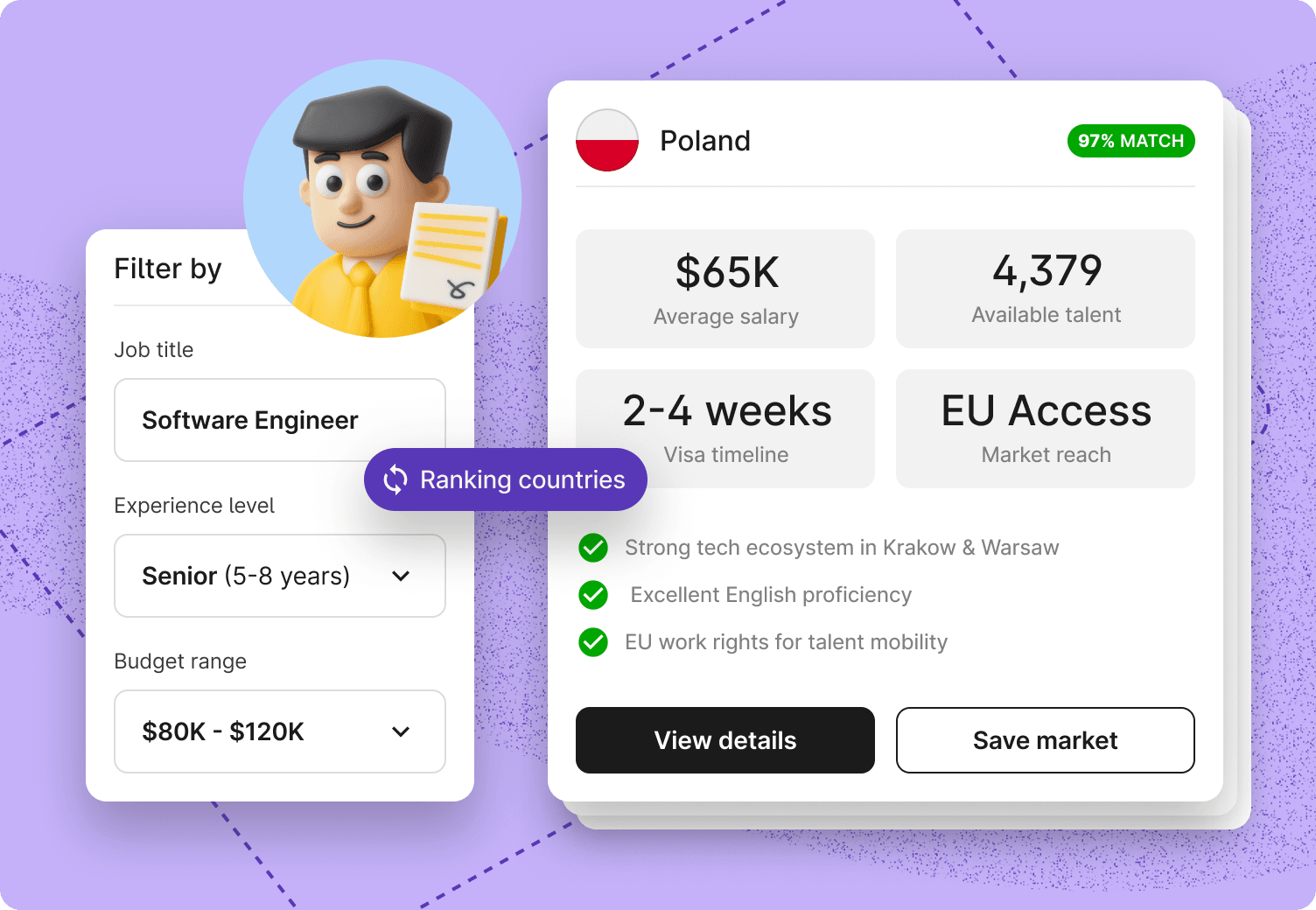
Deel AI Workforce: The Hiring Guru
Lorelei Trisca is a content marketing manager passionate about everything AI and the future of work. She is always on the hunt for the latest HR trends, fresh statistics, and academic and real-life best practices. She aims to spread the word about creating better employee experiences and helping others grow in their careers.


