Article
3 min read
Lock In Data Center Staffing Costs: Know Your Full Employment Budget Before Breaking Ground
Employer of record
Global expansion
Global HR
Global hiring

Author
Jemima Owen-Jones
Last Update
August 04, 2026

Table of Contents
The hidden machinery of agency markup
How Deel locks staffing cost
Case study: 90-day commission, four countries
Volume advantage without complexity
Cost lock across project phases
Protecting margin in competitive bids
Transparency for stakeholders
Getting started: Locking your staffing cost
Lock in data center staffing costs with Deel
Key takeaways
Most data center operators budget staffing as "estimated days × estimated day rate"—then watch costs drift 15–25% higher by project end due to seasonal premiums, currency fluctuations, vendor markups, and overtime creep. That margin erosion gets absorbed by the project.
Transparent, fixed pricing locks your full staffing cost upfront: one rate across the entire build, all countries, for the complete deployment duration. No seasonal adjustments. No currency risk passed to you. No mid-project markup surprises.
Deel Field EOR operates on owned infrastructure with direct accountability—not an agency network. You get one invoice, one vendor, one rate. Your staffing cost becomes as predictable as power or construction, letting you bid more confidently and protect margin in competitive bids.
You've locked your data center build down to the decimal. Power costs? Fixed. Construction? Fixed. Equipment? Fixed. Every major line item has a price that survives scrutiny in your financial model.
Then staffing hits different.
Most data center operators budget for site crew as "estimated days × estimated day rate"—a figure that feels precise until month three, when seasonal premiums kick in. Month four brings currency swings. Month six, a vendor notifies you that market rates have risen. By commissioning end, your staffing estimate has drifted significantly—in the case we examin below, 20% higher. The margin erosion lands somewhere—usually against your project profitability. You've absorbed the variance without being able to predict it.
The staffing cost you estimate in Q1 is never the cost you pay in Q4.
This isn't a staffing problem. It's a visibility problem. Traditional staffing agencies operate on opaque day rates that layer in 40–70% markup per vendor, depending on role complexity and location.When you're managing site crews across three countries with three different agencies, you're paying three different markups on top of each other, plus seasonal adjustments, plus currency risk that vendors pass through. Your finance team can't forecast it. Your bid can't defend it. You're building in a buffer you hope you won't need.
Deel Field EOR was built for exactly this scenario. Our approach to locked, transparent staffing pricing eliminates the machinery that makes costs creep. This guide walks you through how staffing cost becomes a variable you can control—the same way you control power, construction, and equipment—and why that changes how you bid.
The hidden machinery of agency markup
Here's how staffing costs creep:
Markup layers
Your primary staffing vendor quotes a day rate. That rate already contains their markup—typically 40–70% above local talent cost, depending on role complexity and location. If you're using multiple vendors across different countries, each is adding their own margin, and you're often comparing apples to different fruit in different currencies.
Variable invoicing
Shift premiums vary by location and season. Overtime multipliers differ by country: 1.5x in Brazil (weekday minimum), 1.5x in Germany. Danger pay, hardship allowances, and site premiums get negotiated separately with each vendor. Your invoice in month two doesn't match month three because the crew roster changed and overtime requirements shifted.
Currency drift
You budget in USD. Your Brazil team is paid in BRL, which can fluctuate 10–15% within a given year depending on monetary policy and capital flows.". Your vendor passes through currency risk or builds in a buffer that inflates invoices. Either way, you pay.
Seasonal adjustment
Some markets have seasonal labor shortages. Your vendor notifies you in month six that 'market rates have risen 9–11% due to competing projects.' You accept or risk coverage gaps.
By project end, your "estimated" staffing cost has drifted significantly. You've absorbed the difference.
How Deel locks staffing cost
Deel Field EOR operates on fixed, transparent pricing. It's the opposite of the agency model.
Here's what locked staffing cost means in practice:
One rate, one invoice, full build locked
You provide your deployment specs: 25-person site team across three countries, 90-day commissioning. Deel quotes transparent pricing from $599/month, locked across the full build.
That's it. No mark-up adjustments. No seasonal premiums. No "market rate" changes mid-project. You know your full staffing spend before you break ground. You can build a financial model that holds.
Full transparency: No hidden layers
Deel's fee is visible and flat. It includes:
Gross local salary (market-rate, transparent)
Employer contributions (fully itemized: social security, benefits, taxes)
Deel's fixed management fee (clearly stated)
Full employer responsibility and legal liability
You're not paying a "day rate" that obscures whether you're paying the technician $50 or $30. You see the full employment cost. You see what the technician earns versus what Deel manages. You can compare intelligently against other options.
For a 25-person, 90-day deployment like the one we examined below, this transparency saves approximately $85k—simply because you're not paying three to four different vendor markups layered on top of each other.
No currency risk passed to you
Transparent, locked pricing by country. Deel provides fixed rates per country, with employer contributions fully itemized. You know upfront what an electrical technician in Germany costs ($7,761/month) versus Poland ($3,601/month). There are no mid-project surprises or "market adjustment" fees. Deel manages currency exposure across deployed countries, so you're invoiced in USD regardless of whether your team is paid in EUR, PLN, or BRL.
Staffing cost becomes predictable
Consider the operational advantage: You can forecast staffing cost with confidence. You're not reviewing invoices and discovering surprises. You're not negotiating "market adjustment" fees mid-project. Your finance team can trust the staffing line item in your P&L.
Field Services
Deploy onsite workers compliantly in days

Case study: 90-day commission, four countries
A data center operator commissioned a new facility across Germany, Poland, and Czechia. Site team: 22 people (8 in Germany overseeing electrical and controls; 7 in Poland on mechanical work; 7 in Czechia on infrastructure). Commissioning: 90 days.
Traditional staffing approach (how it worked out before):
Engaged three different staffing agencies (one per country)
Initial quoted cost: ~$376k for 90 days (based on transparent local salary data)
Actual cost post-project: $450k (20% variance)
Cost drivers: Seasonal labor premium in month two, overtime requirements higher than estimated, currency fluctuations (BRL and PLN movements), vendor "market adjustment" notified in month three
With Deel Field EOR:
Fixed quoted cost: $376.5k for 90 days
Actual cost: $376.5k (zero percent variance)
Cost locked regardless of seasonal pressure, overtime requirements, or currency movement
Deel absorbed the risk; the operator didn't
The difference? The operator bid the project more confidently because she knew staffing cost wouldn't drift. Her final margin was protected. She didn't absorb the $74k variance.
Global Hiring Toolkit
Employee Cost Calculator

Volume advantage without complexity
Here's another advantage of locked Deel pricing: you can scale without introducing complexity.
If you add five more team members mid-project, Deel quotes the incremental cost using the same fixed rate as your original team. You're not renegotiating with multiple vendors or triggering volume minimums. You're adding headcount to a transparent, fixed-fee model.
This simplicity—one vendor, one rate structure, one invoice—also reduces administrative overhead. Your finance team isn't reconciling invoices across three staffing agencies or explaining cost variance to leadership.
Cost lock across project phases
Data center deployments typically follow phases: construction, commissioning, and transition to permanent operations.
Deel's fixed pricing approach works across all phases:
Construction/build phase: Deploy site crew at fixed rate
Commissioning: Same crew continues at same rate
Handover: Some team members roll off at predetermined date; others transition to Deel's permanent payroll in-country if you're keeping a local operations presence
You never encounter a "commissioning completion premium" or "transition surcharge." Your cost remains locked.
Protecting margin in competitive bids
Data center contracts are often won on razor-thin margins. One percentage-point difference in staffing cost can swing a project's profitability.
Deel's locked, transparent staffing pricing lets you bid more aggressively because you know your cost won't drift. You're not building in a 5% buffer to cover "possible staffing overruns." You know what staffing costs.
This pricing confidence often translates to winning bids that competitors won't touch because they can't predict staffing cost accurately.
Time Tracking
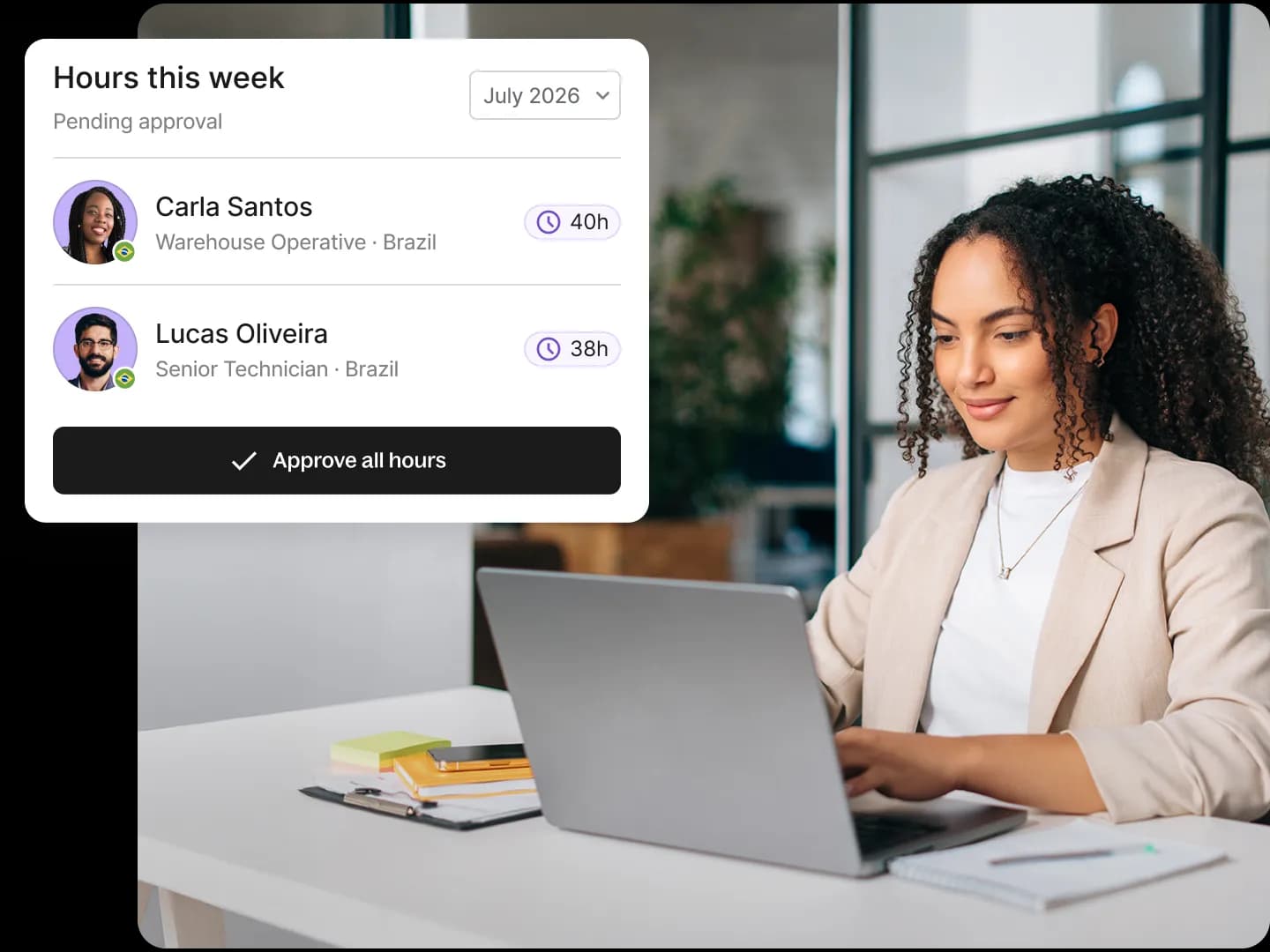
Time tracked. Payroll trusted. Nothing to reconcile.
Transparency for stakeholders
When you report project spend to your board or your customer, locked staffing cost removes the question mark.
"Staffing is running 18% higher than budgeted, and we're not sure why" becomes "Staffing is locked at the agreed rate, no variance."
Transparency builds confidence with stakeholders. It simplifies project reporting. It eliminates post-project finger-pointing about cost overruns.
Getting started: Locking your staffing cost
To get a fixed quote from Deel for your data center deployment, provide:
Site locations and deployment duration
Team composition (job titles, required experience levels)
Team size
Start and end dates
Deel will quote your full staffing cost: one locked rate for the entire build, across all locations. No surprises. No drift. No mid-project adjustments.
Lock in data center staffing costs with Deel
Staffing cost shouldn't be a variable in your project model. It should be as locked as power or construction cost.
Deel Field EOR gives you transparent, fixed pricing from $599/month upward—locked across your full build, across all countries, for the entire deployment duration.
You know your cost before you bid. You hit your margin when you deliver.
Ready to lock in staffing costs? Book a demo below to speak to the Deel team about Field EOR for your next data center project.
Deel Hire
Find, hire, and manage anyone, anywhere

FAQs
What exactly is Deel Field EOR?
Deel Field EOR is an employer of record service built specifically for workers who must be physically on-site. Unlike remote-focused EOR providers, Field EOR handles the unique compliance, health and safety, and employment liability that come with field and site-based roles. You define the role, manage the work, and set performance expectations. Deel becomes the legal employer, handling everything from local contracts and payroll to statutory benefits and labor law compliance—across 150+ countries.
How is Deel Field EOR different from traditional staffing agencies?
Traditional staffing agencies operate on opaque day rates with embedded markups (typically 40–70%, depending on role complexity and location) layered on top of local talent costs. Costs drift with seasonal premiums, currency swings, and vendor "market adjustments."
With Field EOR, your pricing is fixed, transparent, and locked for the entire project duration. You see the full employment cost: local salary, employer contributions, and Deel's fee. No hidden markups. No mid-project adjustments. One invoice, one vendor, one rate.
Can I add team members mid-project if I need more crew?
Yes. If you need to scale mid-project, Deel quotes the incremental cost using the same fixed rate as your original team. No renegotiation with multiple vendors. No volume minimums. You're adding headcount to the same transparent, fixed-fee model. This keeps onboarding simple and costs predictable even as your crew size changes.
Which countries does Deel Field EOR cover?
Deel Field EOR is live in 150+ countries, including all major data center markets. Whether you're commissioning in Germany, Brazil, Poland, or Southeast Asia, Deel has owned legal entities and local expertise in place. If you're unsure whether your specific location is covered, your Deel team can confirm during the quote phase.
How quickly can Deel deploy a team?
Once your employment agreements are signed and all required documentation is submitted, Deel can deploy site crews in as few as 7 days. This is significantly faster than building a local legal entity (which typically takes 3–12 months) or cycling through multiple staffing agencies. For data center commissioning projects with tight deadlines, this speed advantage can be the difference between hitting your contract start date and paying penalties.
What happens to my staffing costs if a project gets delayed?
Your per-person monthly rate stays locked for the agreed-upon duration. If commissioning runs longer than expected, you extend at the same locked rate—no mid-project "market adjustment" fees, no seasonal premium surprises. You know exactly what you're paying from day one through project completion.
Can I transition Field EOR staff to Deel payroll after the project ends?
Yes. Some clients keep a local operations presence after commissioning and transition team members to Deel's payroll in-country. The transition is straightforward because the employee is already in Deel's system. Others roll staff off at the predetermined project end date. The choice is yours, and the transition process is handled smoothly by Deel's team.
How does Deel handle currency risk?
You're invoiced in USD (or your home currency). Your employment costs are locked at transparent, per-country rates. Whether your team is paid in EUR, PLN, or BRL, you see one consolidated invoice in your home currency. This eliminates the complexity of tracking multiple vendors' currency pass-through costs and surprise FX adjustments that operators typically absorb month-to-month.
What's included in Deel's fixed pricing?
The fixed price includes: gross local salary (market-rate, transparent), employer contributions (social security, benefits, taxes fully itemized), Deel's fixed management fee (clearly stated), and full legal employer responsibility and liability. You see the complete employment cost. There are no hidden layers, no separate vendor markups, no "market adjustments" buried in the invoice.
Why is Field EOR better than just building my own local legal entity?
Building a local entity takes 3–12 months and requires you to maintain internal HR and payroll infrastructure. Field EOR lets you deploy in 7 days without setting up a local company. You also avoid the ongoing burden of managing local payroll, tax filings, labor law compliance, and H&S liability. Deel handles the operational complexity; you focus on the project. For temporary projects (commissioning, construction phases), this is dramatically cheaper and faster.
Can Deel lock pricing across multiple countries simultaneously?
Yes. If you're commissioning across Germany, Poland, and Czechia—or any mix of countries—Deel provides one locked rate for the entire deployment across all locations. Multi-country pricing is built into the model. You get one quote, one invoice, one rate. No complexity, no fragmentation.
What's your process for getting a quote?
It's straightforward. You provide: site locations and deployment duration, team composition (job titles, experience levels), team size, and start/end dates. Deel's team will quote your full staffing cost—one locked rate for the entire build. Most quotes are delivered within a few business days. Once you're ready to move forward, onboarding can start immediately.
Does Deel provide training or site induction?
H&S training and site inductions are completed by the employee during onboarding. Deel ensures all documentation is in place and that compliance requirements are met. Your team manages day-to-day work direction and performance expectations. Deel handles the legal and administrative side.
What if I need to end the engagement early?
Deel's agreements are flexible. If your project timeline changes or concludes early, you can wind down the engagement. There are no long-term contracts or penalty clauses. You pay for the services rendered and can adjust headcount or end the engagement as needed. This flexibility is especially valuable for project-based work where timelines sometimes shift.
How does Deel support these teams once they're deployed?
Deel provides comprehensive deployment support. This includes ongoing payroll processing, local compliance monitoring, visa and work permit support through Deel Mobility, and equipment provisioning coordination. Your team retains full day-to-day management control. If questions about employment law, benefits, payroll, or work authorization arise, Deel's local experts are available. For your operational team, it's one point of contact—no juggling multiple vendors or agencies.
Why does Deel offer locked pricing when other EOR providers don't?
Deel operates on owned infrastructure in 150+ countries with direct accountability—no third-party aggregator networks. That means transparent, per-country pricing without the markup layers that staffing agencies add. You get one quote, one vendor, one locked rate per country. No renegotiating with multiple vendors or absorbing hidden margin increases. It's a structural business model difference that keeps your staffing costs predictable and your margins protected.
Jemima is a nomadic writer, journalist, and digital marketer with a decade of experience crafting compelling B2B content for a global audience. She is a strong advocate for equal opportunities and is dedicated to shaping the future of work. At Deel, she specializes in thought-leadership content covering global mobility, cross-border compliance, and workplace culture topics.