Article
2 min read
Spain Time Tracking Law: Royal Decree-Law 8/2019 Explained
Worker experience

Author
Jemima Owen-Jones
Last Update
July 06, 2026

Table of Contents
The origin story: Why Spain led Europe on time tracking
What Spain time tracking law requires
Penalties for non-compliance
The incoming digital registration mandate—Act now
How to stay compliant: The practical checklist
How Deel handles Spain time tracking compliance
Track time compliantly in Spain—automatically, with Deel
If you employ anyone in Spain, you need to understand Royal Decree-Law 8/2019 (RDL 8/2019). In 2019, Spain became the first EU country to mandate daily time tracking for all workers—and today, it remains one of Europe's strictest compliance requirements.
The stakes are real. Non-compliance carries penalties up to €10,000 per worker. Manual tracking systems leave you exposed: one corrupted spreadsheet or missing record during a labor inspection can result in six-figure penalties and mandatory back-wage calculations. A new digital registration standard is coming in 2026, and paper-based systems won't survive the audit.
Deel has navigated this territory for years. Our 2,000+ in-house compliance experts operate across 150+ countries and have built Spain's regulatory requirements directly into our platform from the ground up. We help companies hire, manage, pay, and equip anyone, anywhere—which means we understand compliance at scale, across jurisdictions, in real time.
This article is for Global HR leaders, compliance teams, and companies actively hiring or managing workers in Spain. You need to know RDL 8/2019's requirements, prepare for the digital mandate shift, and move from manual risk to automated certainty. Deel is trusted by 40,000+ customers supporting 1.5m workers globally—and we'll walk you through exactly how to stay compliant, so you can focus on running your business.
Here's what you need to know.
The origin story: Why Spain led Europe on time tracking
Spain's time tracking mandate didn't emerge from a boardroom brainstorm. It came from a lawsuit.
In 2019, Spain's largest labor union, CCOO (Confederación Sindical de Comisiones Obreras), took Deutsche Bank to court. The argument was straightforward: the bank had no systematic way to track working hours, making it impossible to enforce legal limits on overtime, calculate compensation fairly, or detect wage theft. The court sided with CCOO. The ruling became a rallying cry for labor advocates across Spain—and a warning to employers.
Spain's government responded swiftly. Within months, they introduced RDL 8/2019, making it a legal requirement for every employer to record the daily start and end time of every worker. No exceptions. No ambiguity.
The law wasn't about micromanagement. It was about accountability. If companies had to record hours openly, workers couldn't be forced into unpaid overtime. Wage calculations would be transparent. Disputes would have proof.
Today, RDL 8/2019 serves as the template for similar laws across Europe. But Spain still has the strictest enforcement.
Time Tracking
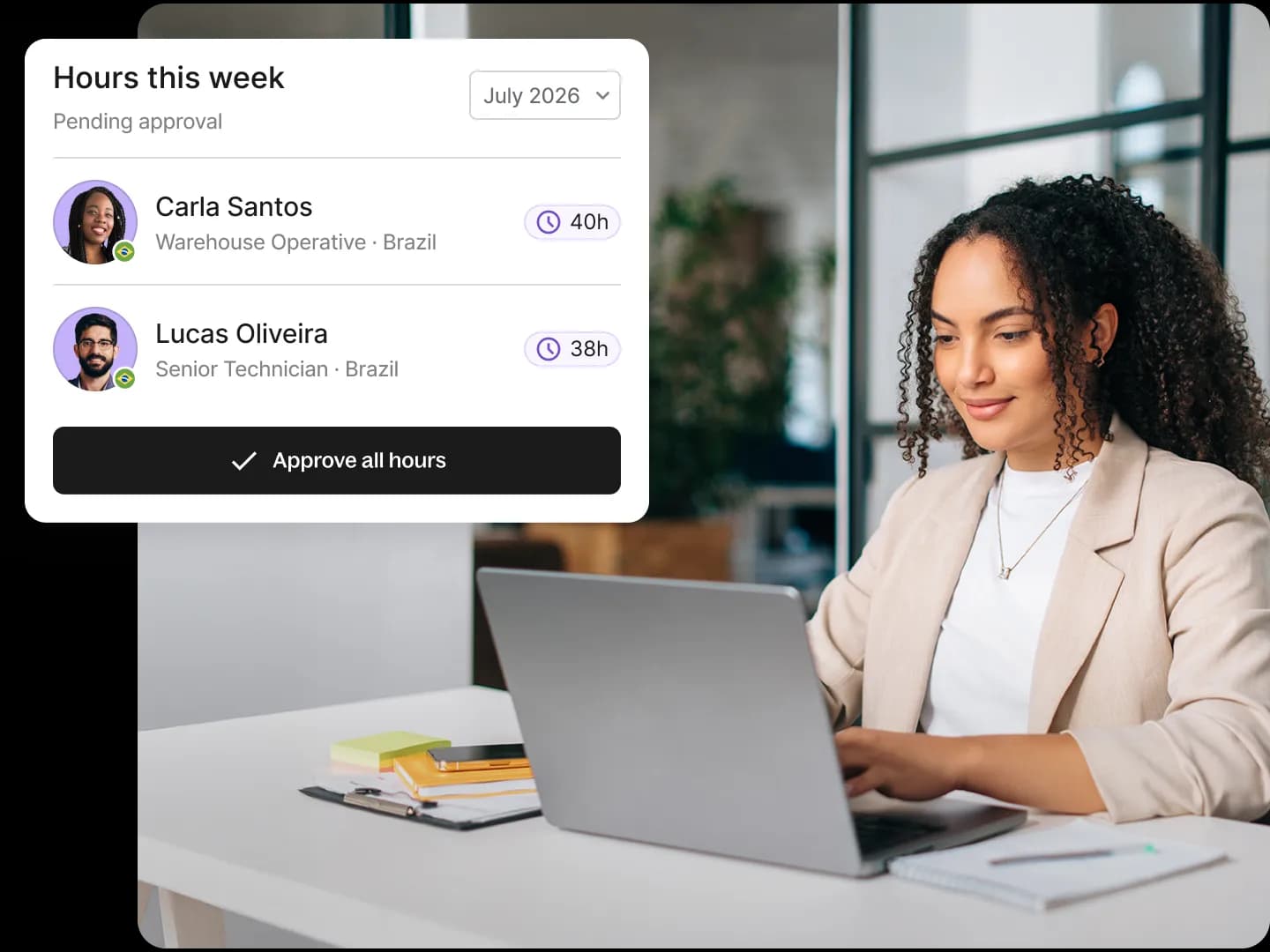
Time tracked. Payroll trusted. Nothing to reconcile.
What Spain time tracking law requires
RDL 8/2019 applies to every employer in Spain, regardless of company size. There's no de minimis threshold. A freelancer hiring one contract worker? Still required.
Here's what the law mandates.
Daily recording of start and end times
Employers must record when each worker begins and ends their shift. The recording must be made on the day it occurs—not retroactively at month-end. The format doesn't matter (paper, spreadsheet, software), but it must show:
Worker name or ID
Date
Start time
End time
Breaks aren't deducted automatically. Legally mandated breaks (like lunch) are unpaid, but discretionary breaks count as working time. Your system needs to distinguish between the two.
At least four years of retention
Records must be kept for a minimum of four years. This requirement may extend to five years once the incoming digital registration reform takes full effect. Spanish labor inspectors (Inspección de Trabajo) regularly request records during audits. If you can't produce them, it's treated as non-compliance, and you're liable for penalties.
Union and worker access to records
Companies with more than 50 employees must make time tracking records available to worker representatives and unions upon request. More importantly, workers themselves have the right to real-time, on-demand access to their own time records. This isn't optional transparency—it's a legal requirement. Smaller companies aren't exempt from the law, but they have fewer third-party transparency obligations.
Proof of compliance
Spain's labor authority expects you to be able to demonstrate compliance on demand. "We tried our best" isn't a defense. Either you have the records or you don't.
Penalties for non-compliance
Spain doesn't treat time tracking violations as technical breaches. They're infractions against workers' rights.
Here's the penalty structure:
Minor infractions (incomplete records, minor delays in recording): €300–€3,000
Serious infractions (systematic failure to record hours, records that don't match reality): €3,001–€10,000 per worker
Very serious infractions (persistent non-compliance or evidence of wage theft enabled by lack of records): up to €10,000 per worker, plus potential criminal charges
And that's just the financial piece. Labor inspectors also can:
Require immediate remediation
Mandate back-wage calculations based on legal working hour limits
Impose additional penalties if records are destroyed or falsified
In practice, companies that can't produce records during an inspection often face six-figure penalties when labor inspectors calculate what workers should have been paid.
The incoming digital registration mandate—Act now
Spain is moving toward a much stricter standard: mandatory digital time tracking. This isn't a future proposal anymore—it's happening soon.
As of late 2025, Spain's government finalized regulations requiring all time tracking to be done through approved digital systems—not paper timesheets or spreadsheets. Once the regulation is published in the Official State Gazette (BOE), it enters into force within 20 days. While an adaptation period of up to six months has been discussed during parliamentary debate, the final duration hasn't been confirmed.
The takeaway: Don't wait. Paper and spreadsheets will no longer be legally compliant under the new digital registration standard. Companies should begin evaluating compliant digital systems now rather than waiting for the BOE publication. Once the regulation is published, thousands of businesses will be competing for the same implementation slots, creating bottlenecks and delays.
If you start now, you'll have:
Time to evaluate options properly
Access to vendor support and implementation help
A clear record showing compliance before inspectors request it
Breathing room instead of panic
How to stay compliant: The practical checklist
To meet RDL 8/2019 requirements and prepare for the incoming digital registration mandate, ensure your time tracking system captures:
Clock in/out records with exact timestamps — not estimates or end-of-day totals
Daily records — recorded on the day the work occurs
Tamper-proof or auditable records — any edits must create a timestamped log showing who changed what and when (spreadsheets fail this test by design)
At least four-year storage — with redundancy and backup
Real-time audit trails — showing who recorded what time and when
Break tracking — distinguishing legally mandated breaks from paid work time
Accessibility for employees, inspectors, and union representatives — on demand, in a readable format
Integration with payroll — so records directly tie to wage calculations
GDPR compliance — employees must have visibility, consent must be documented, and data access controls must meet privacy standards
If you're using spreadsheets or paper, understand that you're operating under expectations that are changing. Once the new digital registration requirement takes effect, these methods will no longer meet legal standards. The cost of waiting to transition is higher than the cost of moving now.
How Deel handles Spain time tracking compliance
Deel's platform is built from the ground up for Spanish compliance. Here's how we automate RDL 8/2019 requirements for your Spanish workers.
1. Automatic daily recording
When your Spanish workers clock in and out through Deel's Time Tracking, the system records the exact timestamp for each shift. No manual entry required. No gaps.
2. Immutable audit trail with four-year retention
All records are stored securely with an immutable audit trail. Any changes generate a timestamped log entry. You can pull any worker's time records for the past four years in seconds. If a labor inspector asks, you have proof—not excuses.
3. Integration with Spanish payroll
Time records flow directly into your payroll calculations. Overtime is flagged. Legally mandated breaks are accounted for. Wage calculations are automatically accurate. No reconciliation needed.
4. Built for the incoming digital registration mandate
Deel's system already meets the incoming digital registration standard. When Spain mandates digital-only time tracking, you won't need to migrate or rebuild. You're already compliant. Your team can begin building audit history now, so records are complete when inspectors ask.
5. Real-time access for workers and unions
Workers can access their own time records instantly through their Deel dashboard. Union representatives can request records through a secure interface without administrative overhead. Full transparency, built in.
6. GDPR compliant from the start
Deel enforces consent documentation, data access controls, and privacy standards by design. No retrofitting needed when compliance requirements shift.
For Spanish companies or global teams with Spanish workers, Deel takes compliance off your plate. You focus on running your business. We ensure your time tracking meets RDL 8/2019 requirements, the incoming digital registration mandate, and the stricter rules coming next.
Track time compliantly in Spain—automatically, with Deel
Spain's time tracking law is one of Europe's strictest for good reason: workers' rights matter, and records prove it.
Here's what you need to remember:
RDL 8/2019 is mandatory for all employers in Spain, regardless of company size
Daily recording is required—start time, end time, every day, with exact timestamps
Records must be kept for at least four years (possibly five after the reform) and must be producible on demand
Penalties are steep: up to €10,000 per worker for serious infractions
Paper and spreadsheets will no longer be compliant under the incoming digital registration requirement
Digital registration is coming soon—prepare now by evaluating a compliant system
Deel automates all of this for your Spanish workers, giving you proof of compliance and peace of mind
If you're hiring, managing, or paying workers in Spain, RDL 8/2019 isn't a box to check. It's the foundation of fair, transparent labor practices. And it's non-negotiable.
Don't let compliance become a crisis. Deel’s Time Tracking automates RDL 8/2019 requirements for your Spanish workers—automatic daily recording, four-year audit trails, payroll integration, and real-time reporting for labor inspectors. You get proof of compliance. Your workers get transparency. Your business gets peace of mind.
Ready to move from manual risk to automated certainty?
If you're already on Deel, you can set up your first time tracking policy in Organization Settings under Time Tracking, assign work schedules, and start tracking time for payroll.
New to Deel, or want to see how it fits your workforce? Book a demo below, and we'll walk through it with your worker types and countries in mind.
Live Demo
Get a live walkthrough of the Deel platform
Jemima is a nomadic writer, journalist, and digital marketer with a decade of experience crafting compelling B2B content for a global audience. She is a strong advocate for equal opportunities and is dedicated to shaping the future of work. At Deel, she specializes in thought-leadership content covering global mobility, cross-border compliance, and workplace culture topics.