Article
2 min read
Retail Time and Attendance: Meet Opening Deadlines and Control Labor Costs
Global HR
Global payroll
Legal & compliance

Author
Jemima Owen-Jones
Last Update
August 05, 2026

Table of Contents
The pain points keeping global retail operations up at night
How Deel Time Tracking fixes global retail scheduling
From time clock to accurate paycheck
A retail scenario: established fashion retailer across multiple countries
Getting started with global retail Time Tracking on Deel
Key takeaways
Global retail stores face wage audits and back-wage liability when managing part-time workforces across multiple countries, each with different overtime and break rules, while relying on disconnected systems (POS, punch clocks, spreadsheets) that don't talk to payroll.
Retail chains need real-time time tracking that integrates with scheduling and payroll, enforces jurisdiction-specific wage-and-hour rules automatically, and creates an audit trail linking scheduled hours to actual hours to actual pay.
Deel's Time Tracking feature, integrated into its global people platform, gives retailers jurisdiction-specific wage enforcement, geofencing verification, and closed-loop payroll—so hours tracked automatically flow into accurate, compliant paychecks without manual reconciliation.
Retail operates on timelines—not HR timelines. When you're managing 50+ part-time staff across multiple countries or regions, with high turnover and shift swaps happening constantly, time tracking becomes a labor cost control problem, not just an administrative task.
Most retailers still track hours with spreadsheets, punch clocks, or basic POS systems. The result: wage audit exposure (missed breaks, overtime miscalculations), payroll delays (hours in one system, wages in another), and compliance gaps (different countries, different rules). Labor regulators globally impose back pay, liquidated damages, and significant penalties for wage violations—costs that multiply across multiple jurisdictions and years of lookback periods.
Deel understands retail's complexity. We work with 40,000+ companies globally, helping retailers manage time tracking, compliance, and payroll across multiple countries and wage jurisdictions—without the manual reconciliation that creates gaps.
This guide is for retail store managers and HR leaders who operate across multiple countries, need real-time visibility into labor costs, want to prevent wage audits before they happen, and are tired of managing compliance rules that differ by jurisdiction.
By the end, you'll know how time tracking built for global retail—not offices—can simplify opening new stores, reduce payroll processing time, and protect your business from wage violations across borders.
The pain points keeping global retail operations up at night
Retail scheduling and payroll are unusually complex because retail labor is fragmented—and complexity multiplies when you operate across borders.
Scheduling nightmares during peak season
Back-to-school, Black Friday, and the December holidays drive 30–50% spikes in customer traffic. Retailers must ramp staffing weeks in advance—but they don't know exactly how many hours they'll need until the season hits.
Schedule too heavy and labor budget blows.
Schedule too light and your store runs with skeleton crews, sales drop, and customer service suffers.
Once peak season hits and payroll runs, reconciling actual hours against the original budget is a spreadsheet nightmare.
High turnover and compliance risk across jurisdictions
Retail has the highest voluntary turnover rate of any sector—around 60% annually. This means constant training of new staff, constant schedule adjustments, and constant on-boarding into your timekeeping system.
New workers often don't understand local wage-and-hour rules. They miss meal breaks, work off the clock, or unknowingly work shifts that trigger overtime. The result: wage audits from labor regulators in each jurisdiction and wage claims from former employees.
Each violation—a missed break, an uncompensated hour, a miscalculated shift—can trigger penalties and back-wage liability, potentially across dozens of employees and multiple years of lookback.
Wage-and-hour law complexity by jurisdiction
Every country and region has different rules around meal breaks, overtime thresholds, rest periods, and time-off requirements.
The UK has Working Time Regulations
Australia has National Employment Standards
Canada has provincial labor codes
A retailer operating in five countries needs to track hours differently in each jurisdiction. Most time tracking systems apply one rule globally, leading to systematic compliance gaps that can trigger wage audits or wage claims.
Shift swaps and "open" shifts across locations
Retail workers trade shifts constantly. Someone gets sick, another picks up the shift, a third person's availability changes mid-week. Managing this via group chat, email, or even a shared spreadsheet is chaos. There's no central record of who's actually scheduled, what their experience level is, or whether the new arrangement violates local wage-and-hour rules.
Without visibility, a supervisor might approve a shift swap that pushes a worker into overtime, or assign an under-trained worker to a critical shift.
Buddy punching and time theft
Retail stores with physical punch clocks are especially vulnerable. Employees clock in for friends, stay clocked in after leaving, or clock out late to avoid closing the register down. It's estimated that time theft costs retailers billions annually.
Most point-of-sale systems don't have geofencing; they just track a time-clock somewhere in the back office. Without proof that an employee was actually on premises, disputes are hard to settle—especially across borders where employment law favors employee claims.
Seasonality collides with compliance across borders
Holiday hiring brings in hundreds of temporary workers who stay for 6–12 weeks. These temporary staff need to be onboarded, trained on local compliance rules, scheduled, and tracked just like permanent staff. But because they're temporary, training often gets short-changed. They're more likely to miss breaks, work off the clock, or be assigned unsafe hours. When they leave, their time records must remain auditable in each jurisdiction—but liability for wage violations stays with your business.
How Deel Time Tracking fixes global retail scheduling
Deel's Time Tracking feature is purpose-built for retail's realities: high employee turnover, complex scheduling across borders, and accurate payroll that enforces wage-and-hour rules by jurisdiction.
Real-time time tracking with accurate hour records
Employees clock in and out via the Deel app, creating a verified record of hours worked. This gives managers visibility into actual labor deployment across locations. Shift schedules are recorded in the system, so there's always a clear trail of who was scheduled and who actually worked—eliminating the need to manually reconcile punch cards or email confirmation threads.
Jurisdiction-specific wage-and-hour tracking
Deel Time Tracking is configured with your compliance rules for each jurisdiction. Once hours are logged, the system automatically calculates overtime based on each location's rules (UK, Australia, Canada all have different thresholds).
Overtime is flagged during payroll processing so you can verify it before paychecks run, rather than discovering errors after the fact.
Geofencing for location-verified clock-in
When employees clock in via the Deel app, geofencing verifies they're at the correct work location at the time of clock-in. This prevents buddy punching and creates a location-verified time record. For investigating wage claims or supporting dispute resolution, you have documented proof of where and when the employee clocked in—valuable evidence if questions arise with labor regulators or in local labor tribunals.
Accurate break and rest tracking
Time tracking records when breaks are taken and how much time elapsed between shifts. This creates a complete audit trail showing breaks logged and rest periods between shifts.
During payroll processing, the system flags any gaps in break records or violations of local rest-period requirements, so you can address them before paychecks go out.
Schedules that feed directly into payroll
Weekly and rotating schedules (where supported by your worker type and jurisdiction) are tracked in the same system as time records. This means scheduled hours and actual hours are in one place, reducing the manual work of reconciling two separate systems before payroll runs.
From time clock to accurate paycheck
The biggest waste in retail payroll is the gap between timekeeping and payroll processing.
Hours are tracked in one system (maybe the POS, maybe a punch clock). Finance imports those hours into payroll software. An accountant manually reconciles discrepancies. Overtime is calculated differently in each jurisdiction. Days later, payroll finally runs—and errors compound across multiple countries.
Deel's closed-loop payroll significantly reduces this friction. Hours tracked in Deel automatically flow into payroll. Overtime is calculated based on each jurisdiction's rules. Bonuses, premiums, and adjustments are applied correctly for each location. Paychecks run with minimal manual re-entry.
For retailers with multiple locations across countries, payroll for all stores runs on one system—so you get consistent, auditable payroll processing across your entire global operation.
Time Tracking
Time tracked. Payroll trusted. Nothing to reconcile.
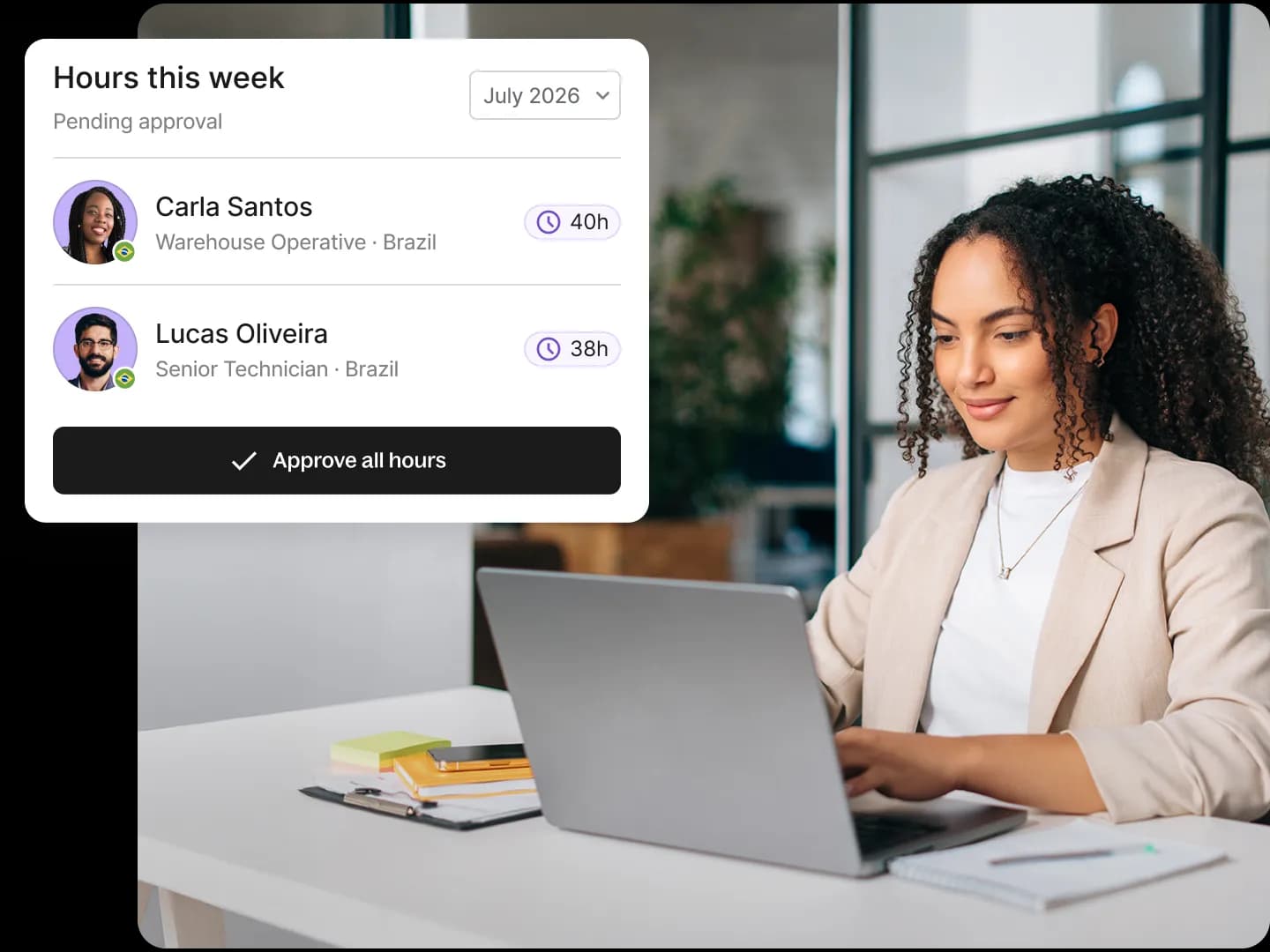
A retail scenario: established fashion retailer across multiple countries
A fashion retail chain operates 24 stores across five countries: UK (6 stores), Australia (5 stores), Canada (5 stores), Germany (4 stores), and France (4 stores). The chain employs 380 part-time and full-time workers.
Each country has different wage-and-hour rules: UK has Working Time Regulations; Australia has National Employment Standards; Canada has provincial labor codes; Germany has strict working-time directives; France has specific overtime and rest-period rules.
The chain manages scheduling and payroll through disconnected systems: spreadsheets for scheduling, POS for time tracking, and separate payroll software for each country.
Before Deel
Compliance was reactive and fragmented. Scheduling happened in spreadsheets that didn't talk to payroll. When staff worked different hours than scheduled, reconciliation was manual and error-prone. Overtime was calculated differently in each country, but the chain had no central way to flag violations before paychecks ran.
Break requirements, rest periods, and consecutive-shift limits varied by jurisdiction—but the payroll system didn't distinguish between them.
During a wage audit in Australia, the chain couldn't quickly produce audit-trail evidence of breaks logged or rest periods tracked. Payroll processing took 5–7 days per country because hours from the POS needed manual reconciliation against spreadsheets, then against payroll.
Temporary hiring during peak season created additional chaos: seasonal staff were tracked in yet another system with no compliance oversight.
After Deel
Time tracking is now centralized across all 24 stores on one platform.
Compliance rules are configured once per country—UK rest periods, Australian leave laws, Canadian overtime thresholds, German working-time limits, French rest requirements.
When employees clock in via the Deel app, geofencing confirms location. Hours flow directly into payroll, which calculates overtime correctly for each jurisdiction without manual adjustment. Before payroll runs, the system flags any gaps in break records or violations of local rest-period rules.
During the recent UK wage audit, the chain pulled a complete audit trail for any employee in any time period—hours worked, breaks logged, rules applied, pay calculated—in minutes.
Temporary workers are tracked in the same system as permanent staff, subject to the same jurisdiction-specific compliance rules from day one.
Result
Payroll processing time drops from 5–7 days per country to 1 day globally. Overtime calculations are consistent and auditable across all five jurisdictions. Break and rest-period compliance is visible before paychecks go out, reducing audit risk significantly.
Wage audits become straightforward because the company has complete, linked documentation of hours, rules, and pay for every employee in every location.
The company reduces wage-and-hour compliance risk across all 24 locations without changing employment structures or adding HR headcount.
Getting started with global retail Time Tracking on Deel
Rolling out a new time tracking system across multiple countries means training floor managers and employees, ensuring geofencing works across all locations, and building confidence in mobile check-in. Deel works with global retail operations to:
Map wage-and-hour rules for each jurisdiction where you operate
Configure geofencing at each store location
Train store managers on time tracking, approval settings, and local compliance rules
Roll out employee app to floor staff
Run parallel payroll during the first month to verify accuracy against your current system
Integrate payroll with your accounting system so finance has full visibility into labor costs by location and jurisdiction
Ready to simplify time tracking for global retail? Learn more about Deel's Time Tracking solution or book a demo below.
Deel Hire
Find, hire, and manage anyone, anywhere

More resources
FAQs
How does time tracking integrate with payroll for global retailers?
Time Tracking in Deel feeds directly into payroll calculations. Hours clocked in the app automatically flow to Deel Payroll, which applies each jurisdiction's overtime rules, shift differentials, and adjustments automatically. This eliminates the spreadsheet gap where hours from one system are manually imported into another, reducing manual reconciliation and payroll processing time.
Can we track staff across multiple store locations and countries?
Yes. Deel's Time Tracking is location-aware. You can configure geofencing for each store location and track hours separately by store and country for multi-location payroll and labor cost visibility. Staff can be assigned to multiple stores; hours are recorded separately for each location with compliance rules applied per jurisdiction.
What happens if an employee works overtime?
Deel tracks hours worked and calculates overtime based on each jurisdiction's rules. (UK, Australia, and Canada all have different thresholds and calculations.) When payroll runs, overtime is calculated automatically at the rate required by each jurisdiction based on the rules you've configured for each country. Managers can set approval requirements so they review and approve overtime hours before payroll processes.
How do we ensure compliance with local break and rest period rules?
You configure the compliance rules you need per jurisdiction. When time is logged, the system records when breaks are taken and tracks time between shifts.
During payroll processing, the system flags any gaps in break records or violations of local rest-period requirements you've configured, so you can review and address them before paychecks go out.
Note that break policies are currently available in select jurisdictions—check with your Deel team about availability for your specific locations.
How does time tracking help with seasonal hiring across borders?
During peak season (back-to-school, Black Friday, holidays), you hire temporary workers quickly in each market. In Deel, temporary workers are added to the same time tracking system as permanent staff from day one. They follow the same jurisdiction-specific compliance rules, so there are no compliance blind spots. When they leave, their time records remain auditable in each country's system.
What if there's a mismatch between scheduled hours and actual hours?
Deel's system captures both scheduled and actual hours. You can see what was scheduled vs. what was actually worked and reconcile them before payroll runs. This is especially valuable during peak season when schedules change frequently or when staff call in sick and schedules shift mid-week.
The complete record of clock-in times, approvals, and hours also creates an audit trail if an employee disputes their hours or makes a wage claim.
Does time tracking prevent buddy punching?
Geofencing significantly reduces it. When employees clock in via the Deel app, geofencing verifies they're physically at the configured work location. This creates location-verified time records at the moment of clock-in and clock-out, making it harder to dispute attendance records.
Can time tracking handle shift differentials and premium pay across jurisdictions?
Yes. Deel can apply shift differentials (e.g., 10% premium for evening shifts), overtime multipliers, and other pay adjustments automatically based on when and where the hours were worked and adjusted for each jurisdiction's rules. These are calculated without manual intervention during payroll processing.
How long does it take to implement across multiple countries?
Implementation timelines vary depending on the complexity of your compliance rules and the number of locations. Your Deel implementation team will work with you to map wage-and-hour rules for each jurisdiction, configure geofencing at all store locations, train managers on time tracking and local compliance requirements, roll out the employee app, run parallel payroll for one month to verify accuracy, and integrate with your accounting system.
What compliance records do we keep across jurisdictions?
Deel maintains a complete record of clock-in and clock-out times, breaks logged, and approval history for each employee in each jurisdiction. This audit trail helps support your compliance documentation during wage audits or employment disputes. You can pull records for any employee, any time period, and any location showing hours worked and how pay was calculated.
Are we liable for wage violations in multiple countries?
Yes, employment law follows your business across borders. If you operate in the UK, Australia, and Canada, you're subject to each country's labor law and enforcement.
Having accurate time records, documented compliance rules, and a clear audit trail of hours and approvals strengthens your position if questions arise with labor regulators.
Jemima is a nomadic writer, journalist, and digital marketer with a decade of experience crafting compelling B2B content for a global audience. She is a strong advocate for equal opportunities and is dedicated to shaping the future of work. At Deel, she specializes in thought-leadership content covering global mobility, cross-border compliance, and workplace culture topics.