Article
7 min read
When Attrition Spikes, the Real Crisis Is Happening in Your 1:1s
Global HR
Worker experience

Author
Ellen Simmonds
Last Update
November 19, 2026

Table of Contents
What high attrition is actually doing to your remaining team
What the 1:1 has to carry right now
Cascading hard messages without losing credibility
The operational moves that work when attrition is already high
How Proper runs its full talent cycle in Deel HR
Act on attrition signals earlier with Deel HR
Key takeaways
High attrition hits the team that stays hardest: workload, uncertainty, and a trust deficit that only direct, honest 1:1 conversations can address.
Managers account for 70% of team engagement variance, making check-in quality the primary variable in whether attrition spreads or stabilizes.
Engage within Deel HR gives managers shared check-in records, AI-generated survey summaries, and Kudos tools, supporting consistent follow-up on employee feedback.
Attrition can spike for many reasons, and HR's instinctive reaction is usually to accelerate hiring. This might include a conversation with leadership about which roles really need replacing, or recalibrating skills matrixes.
So it's normal that the focus is on figuring out what to do about the team that left, and not on reassuring the team that stays. But they're already watching. They're absorbing extra work and reconsidering their future with the company. They're also judging whether their manager understands what's happening and has anything honest to say about it. If that manager is dodging questions, over-promising stability, or showing up to 1:1s unprepared, those judgments arrive quickly.
Leadership communication determines whether high attrition accelerates or begins to stabilize. The tools are specific: 1:1 structures for trust-deficit environments, message-cascading that holds credibility, and early-signal systems that tell HR who's close to leaving before the decision is made.
What high attrition is actually doing to your remaining team
Recruitment fills the open seat. The exit interview documents the reason. And the employees who stayed watch all of it happen, draw their own conclusions, and start doing math.
That's the core problem with high attrition: it's not primarily a staffing challenge. According to The HR Tech Consolidation Report, 70% of HR leaders say fragmented people systems hurt their ability to hire, retain, and manage talent. When information stays siloed, flight-risk signals don't reach the people who could act on them in time. That fragmentation can delay the organization's response.
There's also a less-measured cost: survivor syndrome. The employees who remain after a wave of departures carry redistributed workload, unanswered questions about job security, and an acute awareness of how leadership is or isn't responding. While employees continue working, they also watch how leadership responds. The manager's next 1:1 becomes evidence for a decision those employees haven't made yet.
According to Gallup, managers account for 70% of the variance in team engagement scores. When attrition is active, that number carries a different weight. The manager isn't just managing tasks and output. The 1:1 is where managers can address uncertainty and rebuild trust. Employee retention strategies that hold at scale still depend on the manager's ability to hold individual conversations well.

Guide
Expand your global HR strategy
What the 1:1 has to carry right now
During high attrition, the 1:1 becomes a key channel for identifying flight risk. A standard agenda of project updates and blockers doesn't reach what's actually happening for the employee sitting across the table.
What the check-in needs to do, and what most managers haven't been taught to do with it, is create conditions where the employee can say something honest. That requires different questions and a different way of listening to what isn't said.
Examples: Questions that go beyond "How are you?"
A meaningful check-in during attrition doesn't open with workload. It opens with the employee's experience of the environment.
On workload and acknowledgment:
"What's feeling unclear to you right now that wasn't unclear three months ago?"
"Is there anything you've taken on since [person who left] that we haven't formally acknowledged?"
"What would you need to feel good about this quarter, not just get through it?"
On morale and belonging:
"What parts of your work feel most meaningful right now?"
"Is there anything we used to do as a team that's gone quiet since the recent changes?"
"Who do you feel most connected to on this team at the moment?"
On direction and future:
"Are there things you'd like to be doing more of that we haven't talked about lately?"
"What would make you feel like this team is heading in a good direction in the next six months?"
These questions address workload, morale, and the unstated anxiety that builds when colleagues leave without warning. Managers should notice what employees deflect as much as what they say directly. An employee who can't answer the third question, or who answers too quickly with the official line, is worth following up with.
Disengagement often sounds like certainty before it sounds like frustration: "I'm fine" and "It's all good" with no elaboration, week after week. That pattern is early signal. Thoughtful 1:1 questions create the conditions for a person to tell you what's actually true.
What not to say when trust is fragile
Three responses tend to erode credibility faster during high attrition than at any other time.
Overpromising. Phrases like "We're not going anywhere" or "this role is safe" without actual information to back them up. These statements are well-intentioned and often wrong in a way the employee will remember. Managers should state clearly when they don't have certainty.
Minimizing. "People leave all the time" or "this is normal for this stage" can read as dismissal rather than context. Acknowledging the specific person who left and what they meant to the team, before moving to normalization, holds more trust.
Deflecting. "I can't talk about that" with no follow-up offer. When a decision falls outside a manager's visibility, stating that plainly builds more trust than silence: "I don't have that information yet. I'll bring it here as soon as I do." Silence creates narrative, usually the wrong one.
The honest answer, delivered directly, almost always holds more trust than a polished one that doesn't quite land.
The manager's impact, by the numbers
According to Gallup, managers account for 70% of the variance in team engagement scores. During high attrition, check-in quality becomes the primary lever for rebuilding or maintaining trust with the team that stays.
Cascading hard messages without losing credibility
The 1:1 is where individual trust is built or depleted. But high attrition usually traces back to something at the leadership level (a reorg, a strategy shift, a cost-reduction initiative), and HR's job is to help the management layer carry that message downward without distortion.
That translation problem is where credibility tends to break.
Leaders are often honest but communicating inside a time horizon that doesn't match what managers on the ground are living. By the time a decision makes it from the executive team to a team lead's 1:1 agenda, it's traveled through legal review, communications scrubbing, and multiple levels of "wait until we're ready." The team lead is then expected to explain something they just heard themselves, to employees who've already been forming their own interpretations.
HR Dive's coverage of Gallup's 2026 workplace findings highlights the broader context: Gallup's 2026 State of the Global Workplace research shows global manager engagement fell to 22% in 2025, down nine percentage points since 2022. Managers who aren't themselves engaged can't hold that translation layer. They either over-share anxiety they haven't resolved or give rote answers that no one believes.
The fix isn't a better message template. It's giving managers enough time, context, and permission to process the news before they deliver it. HR can build that into the cascade: a manager briefing ahead of the all-hands, a channel for questions that have no clean answer yet, and clear guidance on what "I don't know" sounds like when it's coming from an informed manager, not avoidance.
Dr. Ben Granger, Chief Workplace Psychologist at Qualtrics, puts the stakes plainly: trust “may very well be the most valuable currency organizations deal in.” He also argues that the trust problem is largely a communication one, since leaders often roll out changes without making clear what employees stand to gain.
Deel HR
Build high-performing teams with half the work

The operational moves that work when attrition is already high
Engagement surveys, stay interviews, and recognition programs are often positioned as retention strategy. During active high attrition, they serve a different purpose: early-signal detection.
The exit interview is too late. By the time someone is walking out, the decision to leave is weeks or months old, and the information they offer is shaped by whatever relationship they're preserving on the way out. The Bureau of Labor Statistics Job Openings and Labor Turnover Survey (JOLTS) tracks voluntary quit rates as a lagging indicator of workforce sentiment: useful for benchmarking, but not for catching a flight risk in time to act.
Engagement surveys run on a short cadence during a high-attrition period (monthly or even bi-weekly) give a leading indicator. Not the annual all-hands version. A focused pulse asking about workload, manager clarity, and sense of belonging. HR teams can use that data to address specific concerns: a team carrying unexpected load, or a manager whose reports aren't sure what's expected of them. Well-designed employee engagement survey questions surface what employees won't say unprompted.
Stay interviews surface the specific, person-level reasons someone is staying and the conditions under which that might change. They're not a retention guarantee. They're a conversation that shows the organization is paying attention before the decision point. Stay interview questions that work focus on what the person values, what risks they see in their role, and what would need to change for them to still be there in 12 months.
Recognition deployed consistently rather than reactively sustains the perception that contributions are seen. When teams are stretched, work that would have been celebrated gets absorbed into the baseline. That disappearance matters more than it looks.
Tracking the right retention metrics helps HR quantify where risk is concentrated: which teams, which tenure bands, which roles carry the highest replacement cost, and where the operational response needs to go first.
How Proper runs its full talent cycle in Deel HR
When things get chaotic, manually gathering employee feedback takes hours that many organizations simply can't spare. Having tools that simplify the process with automation removes the lift from HR teams. When that feedback is gathered in a consolidated HR system like Deel HR, it sits alongside the rest of your workforce data, instead of being abandoned in a spreadsheet until it's no longer relevant.
With Deel HR, organizations can run their entire talent cycle; performance reviews across all departments, automated onboarding and pulse surveys, learning courses, and company-wide goals—all connected to the same employee record.
For example Proper, which provides expert, AI-powered property management bookkeeping for property managers and asset managers across the US, turned to Deel when their fragmented system started causing more problems than it solved.
Before Deel, worker information was scattered. It wasn't user-friendly, and it wasn't easy to find what you needed.
—Merari Ocampo Caro,
HR Operations Analyst, Proper
Using the platform's automation tools, Proper's People Ops team built and configured workflows to manage each stage of the employee journey, no matter whether they were direct employees, contractors, and PEO-covered workers. Everyone received the same worker experience.
Gathering feedback became easy, from running full performance review cycles to setting up quick pulse surveys.
With Deel, we save one to two hours per day just from the automations. Manually tracking each thing was a real time cost. Now, we're not just more efficient; we feel genuinely supported.
—Merari Ocampo Caro,
HR Operations Analyst, Proper
Read the full case study to see how Proper's annual 360 review reached a 90% completion rate thanks to Deel HR.
Act on attrition signals earlier with Deel HR
Attrition rarely announces itself. The signal is in a check-in that's going through the motions, a survey response that dropped a point since last month, a team that's stopped sharing what's hard. By the time those signals become a resignation, the conditions that produced them have been building for a while.
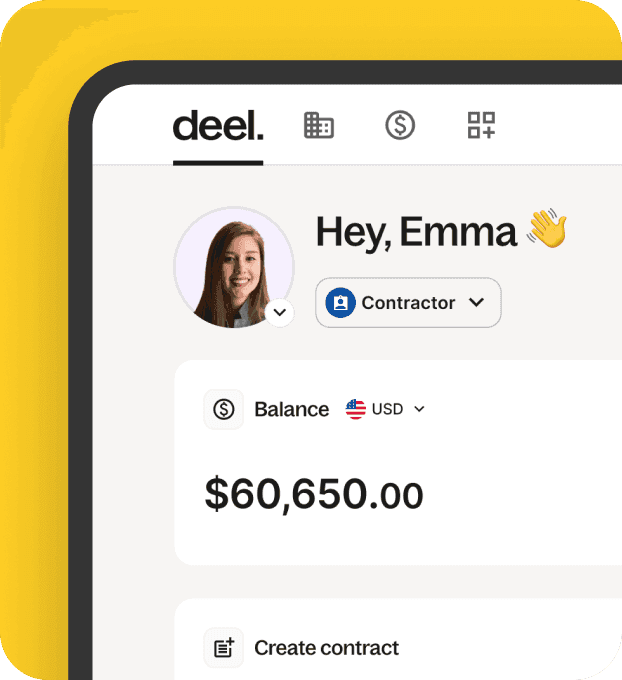
Engage, the talent management module within Deel HR, gives managers and HR teams tools to follow up earlier and more consistently. Recurring check-ins create a shared record (agenda, action items, notes) that persists across meetings, so managers and employees can revisit prior discussion points, commitments, and follow-up actions over time. Engagement surveys run on whatever cadence fits the environment, with AI-generated summaries that surface themes and sentiment. Recognition through Kudos lets teams acknowledge contributions publicly, tagged to company values, visible across the organization.
Together, these workflows help HR and managers notice when engagement may be changing and give them an opportunity to follow up before disengagement deepens.
Live Demo
Get a live walkthrough of the Deel platform
High attrition doesn't become a retention crisis overnight. It becomes one when the signals that could have changed it weren't visible in time, and when the conversations that could have held trust were too generic or too late.
The 1:1 is the single highest-leverage tool a manager has during active attrition, not as a retention tactic but as the place where trust is built or depleted one conversation at a time. HR's job is to make sure those conversations are happening, that managers have something honest to say when they do, and that the systems underneath them are surfacing signal early enough to matter.
Engage within Deel HR brings recurring check-ins, engagement surveys, and recognition workflows into one consistent experience. When something changes, HR and managers have what they need to start an informed conversation.
This article is provided for general informational purposes and should not be treated as HR, legal, or professional advice. Consult a qualified professional for guidance specific to your situation.
FAQs
How can HR stabilize a team when several people leave at once?
Prioritize direct communication: acknowledge the departures explicitly with the remaining team, redistribute work visibly rather than silently, and increase 1:1 frequency for the next 2–4 weeks. Stability comes from transparency, not from acting as if nothing changed.
What should HR tell employees worried about job security?
HR should distinguish clearly between confirmed information and unresolved questions, and communicate both directly. Giving honest answers about what HR doesn't yet know, and committing to a timeline for when that will change, builds more credibility than optimistic framing that hasn't caught up with reality.
How often should managers hold 1:1s during high attrition?
Increasing cadence to weekly is worth it if it isn't already there. Gallup's research consistently shows that employees who receive meaningful feedback and regular contact from their manager are substantially more engaged than those who don't, and weekly check-ins also serve as an early-signal check that monthly conversations can't provide.
How do managers spot a flight risk without crossing a line?
Listening for behavior changes over time is more reliable than asking direct questions about whether someone is planning to leave. Decreased initiative, reduced engagement in team conversations, shorter answers in 1:1s, and declining survey scores can indicate that a supportive follow-up conversation is warranted, though none proves that someone intends to leave.
What's the difference between a stay interview and a regular check-in?
A regular check-in covers ongoing work, goals, and development. A stay interview is a dedicated conversation about why the person is still at the company and what would change that, usually scheduled once or twice a year or when attrition on the team is visibly rising.
About the author
Ellen Simmonds is a content marketing manager with a decade of experience in tech, leadership, startups, and the creative industries. A long-time remote worker, she's passionate about WFH productivity hacks and fostering company culture across globally distributed teams. She also writes and speaks on the ethical implementation of AI, advocating for transparency, fairness, and human oversight in emerging technologies to ensure innovation benefits both businesses and society.