Article
5 min read
AI Hiring Tools: What They Are and Why Humans Should Make the Final Call
AI
Global HR

Author
Jemima Owen-Jones
Last Update
October 27, 2026

Table of Contents
What is AI-assisted hiring?
The hiring pain points that make teams reach for AI
Where AI speeds up the hiring process
Where humans must stay in charge
Bias, governance, and what "human oversight" really means
A checklist for hiring teams using AI tools
Hire faster and decide confidently with Deel's ATS and Talent
Key takeaways
The final hiring decision requires human judgment at every stage, even when AI handles sourcing and shortlisting.
AI adoption in recruiting has doubled in a year because it genuinely reduces time spent on high-volume sourcing and screening.
Deel's Applicant Tracking System (ATS) and Talent marketplace give hiring teams faster pipelines while keeping humans accountable for every final decision.
AI tools can handle the most time-intensive parts of recruiting: scanning hundreds of applications, matching profiles to job criteria, and building a first-pass shortlist. For hiring teams under real volume pressure, that gives teams practical relief.
But speed in sourcing and screening is only valuable when the decisions that follow stay with a person.
AI has already transformed how global recruiting works, and the efficiency gains are well-documented. The risk is more subtle: most recruiting teams haven't clearly defined where AI assistance ends and where AI judgment begins, and that distinction carries real professional and legal weight.
This article explains what AI-assisted hiring is, where it adds genuine value, and why the final call on any candidate should stay with a human every time. Whether you're a fractional talent acquisition (TA) leader building a governance framework or an HR director reviewing your team's tool stack, you'll come away with a sharper picture of how to use AI to move faster without giving up the accountability that defines a well-run hiring practice.
What is AI-assisted hiring?
AI-assisted hiring uses machine learning and natural language processing to automate or accelerate specific recruitment tasks. The core applications cover three workflow stages:
Sourcing: finding candidates across job boards, professional networks, and talent databases
Screening: analyzing submitted applications against defined job criteria
Shortlisting: ranking candidates to surface the strongest profiles for recruiter review
The key distinction is assistance versus decision. When AI flags which 40 of 600 applications look most relevant, a recruiter still reviews and validates that list. When a scoring model ranks candidates by fit, a hiring manager still decides who moves forward and why.
AI-assisted hiring keeps a person in control of every gate that matters.
That's different from fully automated tools that reject or advance candidates without human review, a practice that creates real legal exposure in jurisdictions with enacted AI hiring regulations.
Where AI adds genuine value is in high-volume, pattern-matching work that doesn't scale manually. Where it falls short is anything requiring contextual judgment, interpersonal read, or understanding of a candidate's complete professional story.
Deel HR
Hire and recruit faster, with less effort
The hiring pain points that make teams reach for AI
Recruiters manage volume that compounds every year: more open roles, more applicants per role, tighter timelines, and growing pressure to fill positions faster without cutting quality. The administrative overhead alone can consume a working day before anyone has spoken to a real candidate.
Several specific pain points drive most AI adoption in recruiting. Understanding them explains both why AI tools spread quickly and where governance controls tend to be missing.
Volume overload
A competitive job posting at a mid-market company routinely attracts hundreds of applications. Manually reviewing each one isn't sustainable at the pace hiring teams need to move, and the cost of moving slowly is real: strong candidates accept competing offers in weeks, not months.
Manual sourcing time
Proactively finding qualified candidates, rather than waiting for applications, means researchers scanning multiple platforms, cross-referencing criteria, and tracking outreach. This is structured, repetitive work well-suited to automation.
Speed-to-hire pressure
Every week a role stays open carries a direct productivity cost, and in revenue-generating functions a measurable business impact. Faster first-pass screening reduces hiring time without shortening the human evaluation stages that actually predict job performance.
Slow feedback loops
Candidates often wait days or weeks for any response after applying. Those delays cause candidates to withdraw. The strongest applicants, who have options, don't wait indefinitely, and a poor communication experience shapes how they talk about the company regardless of outcome.
Governance risk from unsupervised tools
When teams adopt AI hiring tools without a written policy, they accumulate compliance risk that's difficult to audit later. Effective recruiting strategies account for governance from the start rather than retrofitting it after an incident.
AI recruiting by the numbers
According to SHRM's 2025 Talent Trends Survey of 2,040 HR professionals:
51% of organizations use AI for recruiting (up from 26% the year before)
89% of those say AI saves them time or increases their efficiency
Top uses: writing job descriptions (66%), screening resumes (44%), and automating candidate searches (32%)
Talent
Find top talent, hire globally
Where AI speeds up the hiring process
The efficiency case for AI in recruiting is now well-documented. According to SHRM's 2025 Talent Trends Survey of 2,040 HR professionals, 51% of organizations use AI to support recruiting, up from 26% the previous year. Of those, 89% say AI saves them time or increases their efficiency. The most common applications are writing job descriptions (66%), screening resumes (44%), and automating candidate searches (32%).
Deloitte's research on talent acquisition technology trends documents how AI integration into recruiting workflows drives productivity and compresses time-to-hire, particularly for teams handling high application volumes where manual first-pass review isn't scalable. The scale of adoption signals that these gains are real. Organizations with meaningful hiring volumes have tested and validated them in practice.
The specific gains cluster in three areas.
Sourcing at scale
AI searches thousands of candidate profiles across platforms simultaneously, applying consistent criteria without fatigue. A search that might take a recruiter a full day manually runs in minutes. This matters most for hard-to-fill roles where the right candidate isn't actively applying and needs to be found proactively.
Skills-based matching
Modern AI tools parse job requirements and match them against applicant experience with more precision than keyword search alone. They surface candidates who meet the underlying criteria even when their phrasing doesn't map neatly to the job description.
Shortlist creation
By narrowing a field of hundreds to a manageable list, AI reduces the cognitive load of first-pass review and keeps recruiters focused on genuine evaluation rather than elimination. The shortlist is an input for human judgment, not a replacement for it. A well-run team maintains that distinction explicitly.
Where AI screening reaches its limits: nuance, professional context, and anything requiring judgment about a candidate's complete story. A person returning from a career break, one who changed industries for strong reasons, or one whose most relevant experience appears in an unconventional role may score poorly on automated criteria while being exactly right for the job. These are precisely the calls a person needs to make.
Where humans must stay in charge
AI can narrow a candidate pool. It shouldn't close one.
The decisions that define an employer's reputation, and that carry legal accountability, require human judgment at every meaningful stage. Several deserve particular attention.
Messaging tone and candidate experience
How a recruiter communicates with a candidate shapes how that person perceives the company, regardless of outcome. Tone, timing, and genuine attentiveness in candidate communication are relationship-building tasks, not pattern-matching ones.
Final shortlist selection
An AI shortlist is a starting point, not a final answer. A recruiter reviewing that list brings knowledge the algorithm doesn't have: context about team dynamics, how the role has evolved since the job description was posted, the hiring manager's actual working style, and what "strong fit" really means for the team's current composition.
When a scoring model's ranking becomes the de facto final shortlist, this review step disappears without anyone deciding to remove it.
Interviews and real assessment
Evaluating how a candidate thinks under pressure, how they handle ambiguity, and whether their experience translates into the judgment the role demands is a human task. AI interview-scoring tools exist and process verbal and behavioral patterns at scale, but they have documented reliability concerns. Their outputs shouldn't substitute for informed human assessment.
Final offers and rejections
These decisions carry employment law implications in most jurisdictions. Automated rejection of candidates without a human review step is legally fraught in a growing number of markets. More fundamentally, a hiring decision affects a person's livelihood. The organization making that decision should own the accountability for it, not outsource it to a scoring model.
This isn't an argument against AI adoption. It's a definition of what AI is for in a well-run team: handling volume and pattern recognition so that recruiters and hiring managers have more time and better information for the decisions that genuinely require them.
What genuine human oversight looks like
Four practices that meet regulatory expectations and protect candidates and employers:
Audit AI tools for disparate impact before deployment, not after a complaint
Name one person (not a team or vendor) as accountable for AI-assisted hiring decisions
Train every recruiter and hiring manager who acts on AI outputs
Document which AI tools were used at each stage for every candidate
Bias, governance, and what "human oversight" really means
Human oversight in AI-assisted hiring isn't just best practice. In a growing number of jurisdictions, it's a legal requirement, and the compliance obligations are becoming more specific.
AI hiring tools learn from training data. When that data reflects historical hiring patterns, which in most organizations means patterns shaped by years of conscious and unconscious bias, the model replicates those patterns at scale. This is a documented outcome, not a hypothetical concern, and regulators in several major markets have moved to address it directly.
Three regulatory frameworks stand out for organizations hiring in North America or Europe.
The EEOC has stated clearly that using an AI tool doesn't transfer liability for discriminatory outcomes. If an automated screening tool produces results that violate Title VII or other federal anti-discrimination statutes, the employer remains legally responsible, not the software vendor. This applies regardless of whether the organization developed the tool or simply deployed one built by a third party.
The EU AI Act (Regulation 2024/1689) classifies AI systems used in hiring and employment decisions as high-risk under Annex III. This classification triggers requirements for human oversight, transparency, and documentation of how automated systems affect individuals. Compliance obligations for providers and deployers of high-risk AI systems in hiring take effect from December 2027.
New York City's Local Law 144 already requires annual independent bias audits for any automated employment decision tool used with NYC-based candidates or employees, with public disclosure of results. It's one of the first enacted US laws specifically targeting AI in hiring, and similar rules are advancing in other states.
Genuine human oversight isn't adding a person to the end of an automated pipeline to sign off on whatever the algorithm produced. That approach doesn't satisfy regulatory requirements and doesn't protect candidates or employers. Real oversight means four concrete actions:
Auditing tools for disparate impact before deployment, not after a complaint
Keeping a named person accountable for AI-assisted decisions (not a team, not the vendor)
Training every team member who acts on AI tool outputs on what those outputs represent and what they can't determine
Documenting which decisions involved AI assistance and how, for every candidate
Organizations building governance frameworks for agentic AI tools in HR workflows are finding that hiring is one of the higher-stakes contexts where this rigor applies. A framework built for simpler AI features needs updating when systems can act across multiple steps without a human trigger at each one.
A checklist for hiring teams using AI tools
Use the following checklist to audit your current AI recruiting setup against a human-in-the-loop standard. Each item reflects a governance requirement that regulators and employment attorneys are specifically looking for.
Role clarity. For every stage where AI produces an output (a sourcing list, resume scores, or a ranked shortlist), a recruiter has documented their independent review of that output before it moves to the next stage.
Bias audit. AI screening and scoring tools have been assessed for disparate impact at least once annually, against criteria relevant to the roles and locations where they're applied.
Named governance owner. One person (not a team, not the vendor) is accountable for the accuracy and fairness of AI-assisted hiring decisions at the organization.
Training completed. Every recruiter and hiring manager who acts on AI tool outputs has completed training covering what those outputs represent and what they can't determine on their own.
Documentation trail. For any hired or rejected candidate, the organization can reconstruct which AI tools were used and at which stages of the process.
Override rule. A written policy defines when human judgment overrides an AI recommendation, not just a verbal understanding between team members that erodes when people change roles.
Regulatory review. Legal has confirmed which AI-specific hiring regulations apply in the jurisdictions where the company hires and what each law requires from employers using these tools.
Deel AI
Get global HR insights fast with Deel AI
Hire faster and decide confidently with Deel's ATS and Talent
Speed and accountability aren't competing priorities. They need the right system behind them to coexist.
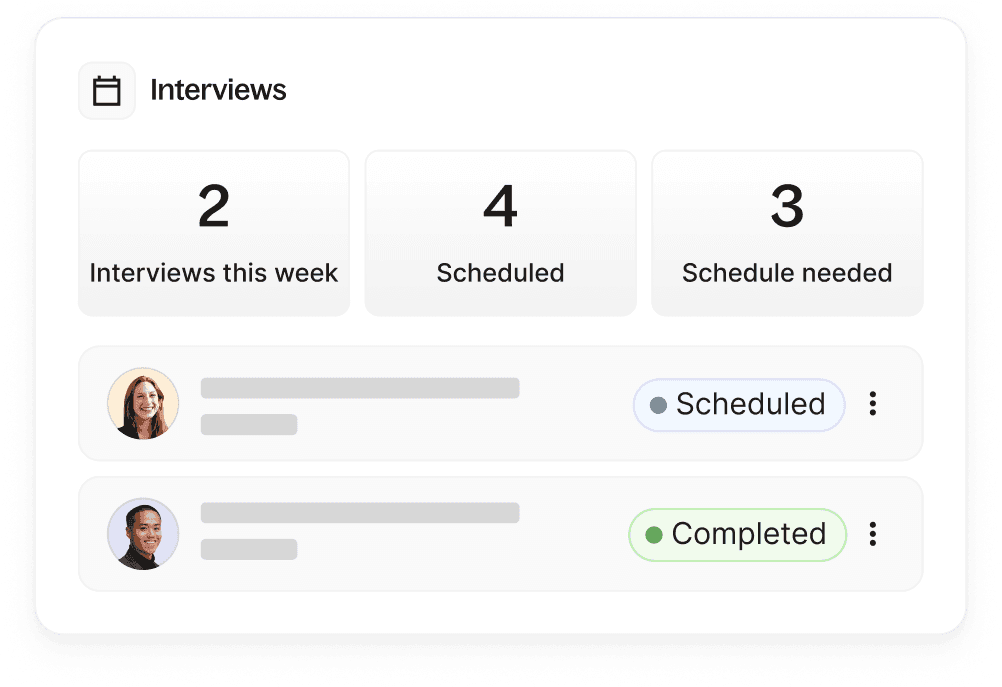
Deel's applicant tracking system gives hiring teams a structured pipeline for tracking candidates from application to offer, with workflows that automate the administrative steps (job posting, applicant tracking, stage progression, and interview scheduling) while supporting documented feedback and human review at key decision stages.
Hiring managers and recruiters can move faster through high-volume stages without removing accountability from the final calls. Candidate stages, interview feedback, and offer activity can be recorded within the workflow, helping teams maintain the recruitment records that matter.
Deel's Talent supports sourcing by connecting hiring teams with AI-vetted candidate suggestions and vetted recruitment partners through a shared sourcing workflow.
For teams hiring internationally, this matters. Finding the right candidate in a new market involves understanding local compensation norms, professional context, and market expectations that a profile match alone doesn't capture.
Both modules work within Deel's connected platform, so the hiring workflow feeds into onboarding and the right employment path for each hire, whether that's EOR, PEO, Deel Payroll, or Contractor, without re-entry in a separate hiring system. Because these workflows connect with the broader Deel platform, compliance is applied continuously as workers move from hiring into the appropriate onboarding and employment workflows.
Deel makes it effortless to hire, manage, pay, and equip any worker, anywhere—across 150+ countries.
Book a demo below to see how Deel HR's applicant tracking system (ATS) and Talent modules can help your team source candidates, manage hiring workflows, and preserve human decision-making throughout.
Live Demo
Get a live walkthrough of the Deel platform
FAQs
What is the difference between AI sourcing and AI screening in hiring?
AI sourcing finds candidates: it searches job boards, professional networks, and talent databases to identify profiles that match a role's criteria. AI screening reviews applications already submitted, analyzing resumes for relevant experience or skills before a recruiter sees them. Sourcing is about finding people not yet in the pipeline. Screening is about filtering those who are.
Can AI make the final hiring decision?
No, and in a growing number of jurisdictions, fully automated hiring decisions carry legal risk. AI tools produce rankings, scores, and shortlists to support human decision-making. The final decision on whether a candidate receives an offer should involve a human who reviews the candidate's full profile and can document the rationale.
How do I test an AI hiring tool for bias?
Request an independent bias audit from the vendor, or commission one externally before deployment. The audit should test for disparate impact across protected characteristics relevant to your hiring jurisdictions.
NYC Local Law 144 requires annual audits with public disclosure for tools used with NYC candidates or employees. Annual reviews are also a practical standard elsewhere, even where not yet legally required.
What governance steps should a team put in place when using AI recruiting tools?
Four steps matter most:
name a single person accountable for AI-assisted decisions
train everyone who acts on AI outputs
document which tools were used at each stage for every candidate
define a written policy for when human judgment overrides an AI recommendation
These steps address missing accountability controls identified by regulators, including the EEOC and the EU AI Act.
Is AI-assisted hiring legal and what regulations apply?
AI-assisted hiring is legal in most markets, but the regulatory environment is changing quickly. In the US, the EEOC has confirmed that anti-discrimination law applies to AI tool outputs as it does to any other employment decision.
NYC Local Law 144 requires annual bias audits for automated hiring tools used in New York City. The EU AI Act classifies these tools as high-risk and mandates human oversight and transparency, with full compliance obligations taking effect from December 2027.
Consulting legal counsel on the specific requirements in your hiring jurisdictions before deploying AI tools is essential.
How does the ATS module within Deel HR support connected global hiring?
The ATS module within Deel HR operates inside Deel's connected platform, so candidate data can move into connected onboarding and the appropriate employment or contractor workflow without being re-entered in a separate hiring system. Once the hiring decision is made, Deel can connect the candidate to the appropriate onboarding path for EOR, PEO, Deel Payroll, or Contractor, depending on how the company chooses to hire.
This article is provided for general informational purposes and should not be treated as legal or HR advice. Consult a qualified employment lawyer or HR professional for guidance specific to your situation.
Jemima is a nomadic writer, journalist, and digital marketer with a decade of experience crafting compelling B2B content for a global audience. She is a strong advocate for equal opportunities and is dedicated to shaping the future of work. At Deel, she specializes in thought-leadership content covering global mobility, cross-border compliance, and workplace culture topics.