Article
5 min read
Why Anonymous Reporting Tools Fail Without Psychological Safety
Global HR

Author
Ellen Simmonds
Last Update
September 17, 2026

Table of Contents
Why culture determines whether the tool works
Three barriers to an effective anonymous reporting program
What psychological safety actually requires from HR leaders
The EU Whistleblowing Directive and EU AI Act add a compliance floor, not a ceiling
How to audit whether your anonymous reporting program is actually working
Building a reporting culture with Deel
Key takeaways
Anonymous reporting technology works best alongside deliberate efforts to build psychological safety, communicate the process, and demonstrate consistent follow-through.
The difference between "structurally anonymous" and "culturally safe" is what separates programs with active report submission from compliance checkboxes that gather dust.
Deel HR's Engage combines anonymous reporting, case-management controls, and engagement tools that can help organizations reinforce a trustworthy speak-up process.
This article is provided for general informational purposes and should not be treated as legal advice. Refer to your local regulations and applicable national transposition legislation and consult a qualified legal professional for specific guidance.
Most HR leaders could show you the anonymous reporting tool their organization deployed. Fewer can show you the submission data, and fewer still can show that data trending upward. The tool exists. Employees don't use it.
Anonymous employee feedback research consistently shows that the presence of a reporting channel doesn't guarantee it gets used. Technology alone cannot create a speak-up culture. Trust also depends on privacy safeguards, responsive case handling, leadership behavior, and visible follow-through, and none of those elements can be configured in a software dashboard alone.
Why culture determines whether the tool works
According to HR Acuity's 2025 Workplace Harassment and Misconduct Statistics study, 55% of employees experienced or witnessed misconduct in 2025, a near seven-year high. Among those who didn't report, the reasons rarely came down to not knowing the reporting channel existed. They came down to not believing anything useful would happen if they used it.
This is the core insight that most vendor-led conversations about anonymous reporting miss: psychological safety is the prerequisite for tool adoption, not the outcome. The organizational psychologist Amy Edmondson, whose research on team performance and speaking-up behavior is widely cited in management literature, frames psychological safety as the shared belief that a team is safe for interpersonal risk-taking. In reporting contexts, that risk-taking means telling a manager or an HR system about a colleague's or supervisor's behavior, with confidence that doing so won't make things worse.
When that belief isn't in place, the tool sits idle. Employees who experienced or witnessed misconduct but said nothing weren't necessarily unaware of the reporting channel. They assessed whether using it was worth the risk and decided it wasn't.
Deel HR
A safe, compliant way for people to speak up
Three barriers to an effective anonymous reporting program
HR teams can strengthen reporting programs by addressing three common barriers.
1. Employees don't believe the anonymity is real. There's an important distinction between architectural anonymity and policy-based anonymity. Architectural anonymity uses technical safeguards intended to prevent a reporter's identity from being exposed through the reporting workflow. Policy-based anonymity relies on internal agreements not to investigate the source. From an employee's perspective, policy-based assurances are only as credible as the organization's track record of keeping them. In organizations where trust in leadership is already low, policy-level promises about anonymity carry little weight.
2. Reports disappear into silence. The Traliant State of Workplace Harassment Report, which surveyed more than 2,000 US employees in December 2025, found that 33% of employees would only report harassment if anonymity was guaranteed, and 71% of employees who felt unprotected cited retaliation fear as the primary reason they didn't feel safe reporting. What drives that fear isn't just a bad past experience with a specific manager. It's watching colleagues submit reports that seem to disappear without consequence or acknowledgment. Even employees who never report themselves notice when nothing happens after a report goes in. Visible follow-through (case acknowledgment, status updates, documented outcomes) shapes the perception of the system for everyone, not only for the person who submitted.
3. Manager behavior contradicts the system. A manager who visibly punishes or subtly discourages speak-up behavior can undermine any reporting tool. When a team member submits a concern and then finds themselves left off project invites, reassigned to less visible work, or passed over for a review they expected, the message to the rest of the team is unambiguous, regardless of whether the manager's behavior was intentional. Technical privacy controls can prevent a manager from knowing who filed a report. They cannot prevent a manager from creating a climate where filing a report looks like professional self-harm.
The awareness gap matters as much as the tool
HR Acuity's research found that employees who know an anonymous reporting option exists are 1.8x more likely to report misconduct than those who don't. Communicating the channel exists is as important as building it correctly.
What psychological safety actually requires from HR leaders
Diagnosing the failure modes is useful. Knowing what HR leaders must actively build is what helps them act on the diagnosis.
Leadership modeling. Psychological safety in reporting contexts is established from the top down. When senior leaders speak publicly about cases that were resolved through the reporting system, without compromising anyone's identity, they signal that the system is real and that leadership takes it seriously. Organizations where executives express visible support for reporting channels tend to see higher submission rates than those where the system is treated as a legal formality.
Manager training on non-retaliatory response. The most common form of retaliation in reporting contexts isn't formal. It's the quiet withdrawal of opportunities, the shift in tone, the exclusion from decisions. Preparing managers to recognize these patterns in themselves and to respond to reports with genuine neutrality is more protective than a policy document. Training needs to address both the behavioral cues that constitute retaliation and the emotional dynamics that make retaliatory responses feel justified to the people engaging in them.
Transparent case-closure communication. Many organizations underinvest in closing the loop. When a report results in action, that outcome doesn't need to name names, but it does need to be communicated in a way that lets employees know something happened. A message to a team that acknowledges a concern was raised, investigated, and addressed (with no identifying information) answers the question the entire team may have: does anything actually happen when someone speaks up here?
The EU Whistleblowing Directive and EU AI Act add a compliance floor, not a ceiling
For organizations operating in the EU, the EU Whistleblowing Directive (2019/1937) established minimum requirements for internal reporting channels. Private-sector organizations with 50 or more employees are covered, with the general EU phase-in deadlines having already passed: organizations with 250 or more employees were subject to the earlier implementation stage, while those with 50 to 249 employees were generally required to comply by December 2023, though national implementation timelines varied by member state.
The Directive requires organizations to acknowledge reports within seven days (per Article 9), maintain confidentiality of the reporter's identity, and provide follow-up within three months. These requirements establish a regulatory minimum. Organizations looking to build genuine EU compliance often underestimate how little the minimum achieves in isolation: a system that meets the letter of the Directive while delivering no visible follow-through and offering no cultural safety still produces the low submission rates the Directive was partly designed to address.
The EU AI Act introduces a separate but related consideration. High-risk AI systems used in employment contexts, covering recruitment, performance monitoring, task allocation, and similar decisions, carry transparency, documentation, and human oversight requirements. While these are distinct from the Whistleblowing Directive's requirements, they share an underlying logic: workers need structured, trustworthy channels to raise concerns, and organizations that meet only the regulatory minimum tend to remain more exposed in both legal and cultural terms.
Deel HR
One place for simplified, smarter global HR
How to audit whether your anonymous reporting program is actually working
A functioning reporting program produces signals. Here's where to look.
Submission rate trends over time. An absolute submission number tells you relatively little. The trend, and how it compares across teams, regions, or time periods, tells you whether trust in the system is growing or eroding. A flat submission rate after a major communication push usually indicates that the communications landed but the underlying trust barrier didn't move.
Report-to-resolution cycle time. The EU Whistleblowing Directive's three-month follow-up requirement exists for a reason. Extended case timelines, where reporters receive no status update for weeks or months, are among the most reliable predictors of low future submission rates. Tracking how long cases spend in each stage (acknowledged, under review, resolved) surfaces bottlenecks before they become reputation-defining for the program.
Closing-the-loop communications. Does your organization have a documented process for communicating case outcomes in a way that protects reporter identity but still signals to the broader team that the system worked? Using surveys to run periodic pulse checks on employee perceptions of the reporting system can serve as a useful leading indicator, well before submission rates tell you something has gone wrong.
Here's a practical checklist for auditing your current program:
Review submission rate data segmented by team and region, looking for differences that team size doesn't explain
Calculate average report-to-resolution cycle time and compare against the three-month follow-up window
Confirm you have a documented case-closure communication template that protects reporter identity
Assess whether managers have received explicit training on non-retaliatory response behaviors in the past 12 months
Run a pulse survey on employee perception of the reporting system's trustworthiness and follow-through
Building a reporting culture with Deel
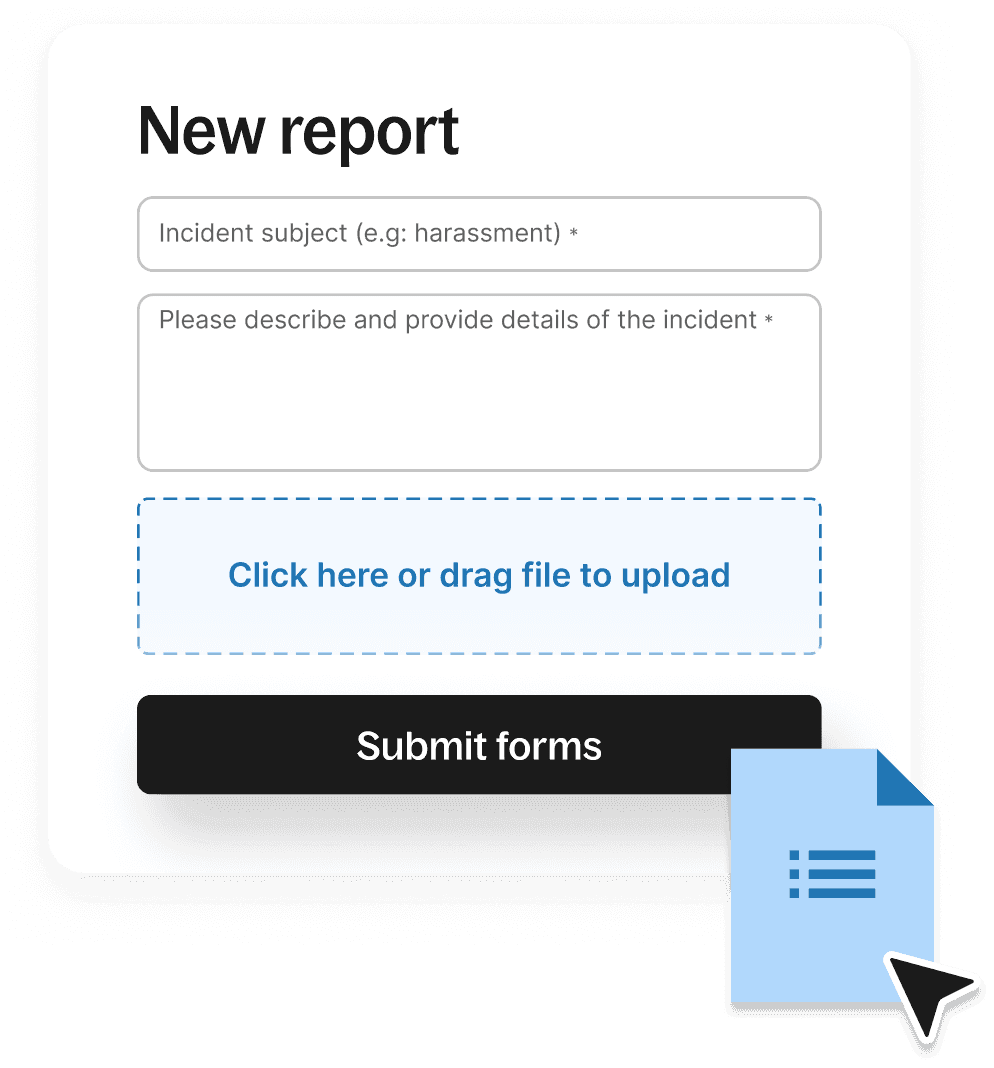
Deel's Anonymous Reporting tool provides a truly anonymous, two-way communication channel where employees can report concerns safely and confidently. Built directly into the Deel platform alongside your HR workflows, it eliminates the friction of managing separate tools while delivering audit-ready case management, encrypted records, and compliance with EU whistleblowing requirements and global regulations including GDPR, SOX, and Dodd-Frank. Organizations like Revolut and Puma use Anonymous Reporting to surface issues early, build employee trust, and demonstrate governance to regulators and boards.
Ready to turn your safety culture into action? If you're not yet on Deel, book a demo to see how Anonymous Reporting integrates into your platform. If you already use Deel, connect with your account manager to enable Anonymous Reporting for your organization. Either way, join 40,000+ companies empowering their teams to speak up safely.
Live Demo
Get a live walkthrough of the Deel platform
FAQs
How do we know if our anonymous reporting tool is actually anonymous?
Ask your vendor how they provide anonymity, including whether it relies on technical controls, internal policy, or both. Technical safeguards, which use the system's architecture to limit identity exposure through the reporting workflow, generally provide a more robust foundation than policy commitments alone.
What's the difference between confidential and truly anonymous reporting?
A confidential report is one where the reporter's identity is known to at least some people handling the case but is committed to being held in confidence. Truly anonymous reporting means the reporting workflow is designed to protect the reporter's identity from people handling the case.
How do we communicate that reports are acted on without compromising reporter identity?
General outcome communications to a team or department, confirming that a concern was raised, reviewed, and resolved without naming the reporter or the subject, are the standard approach. The goal is to answer the question others are watching: does this system produce results?
Does the EU Whistleblowing Directive apply to our company size?
The Directive covers private-sector organizations with 50 or more employees across EU member states. Organizations with 250 or more employees were subject to the earlier phase of implementation, while those with 50 to 249 employees had a general compliance deadline of December 2023, with variation by member state.
How do we get managers to stop chilling speak-up behavior?
The most effective approach combines explicit training on what retaliation looks like in practice (including informal retaliation) with clear organizational consequences for retaliatory behavior when identified. Structural training that only covers formal retaliation tends to miss the subtle behavioral patterns that are most damaging to reporting culture.
Ellen Simmonds is a content marketing manager with a decade of experience in tech, leadership, startups, and the creative industries. A long-time remote worker, she's passionate about WFH productivity hacks and fostering company culture across globally distributed teams. She also writes and speaks on the ethical implementation of AI, advocating for transparency, fairness, and human oversight in emerging technologies to ensure innovation benefits both businesses and society.