Article
1 min read
Better Together: How Deel + EPI-USE Help Enterprises Simplify Global Payroll Transformation
Global payroll

Author
Dr Kristine Lennie
Last Update
June 09, 2026
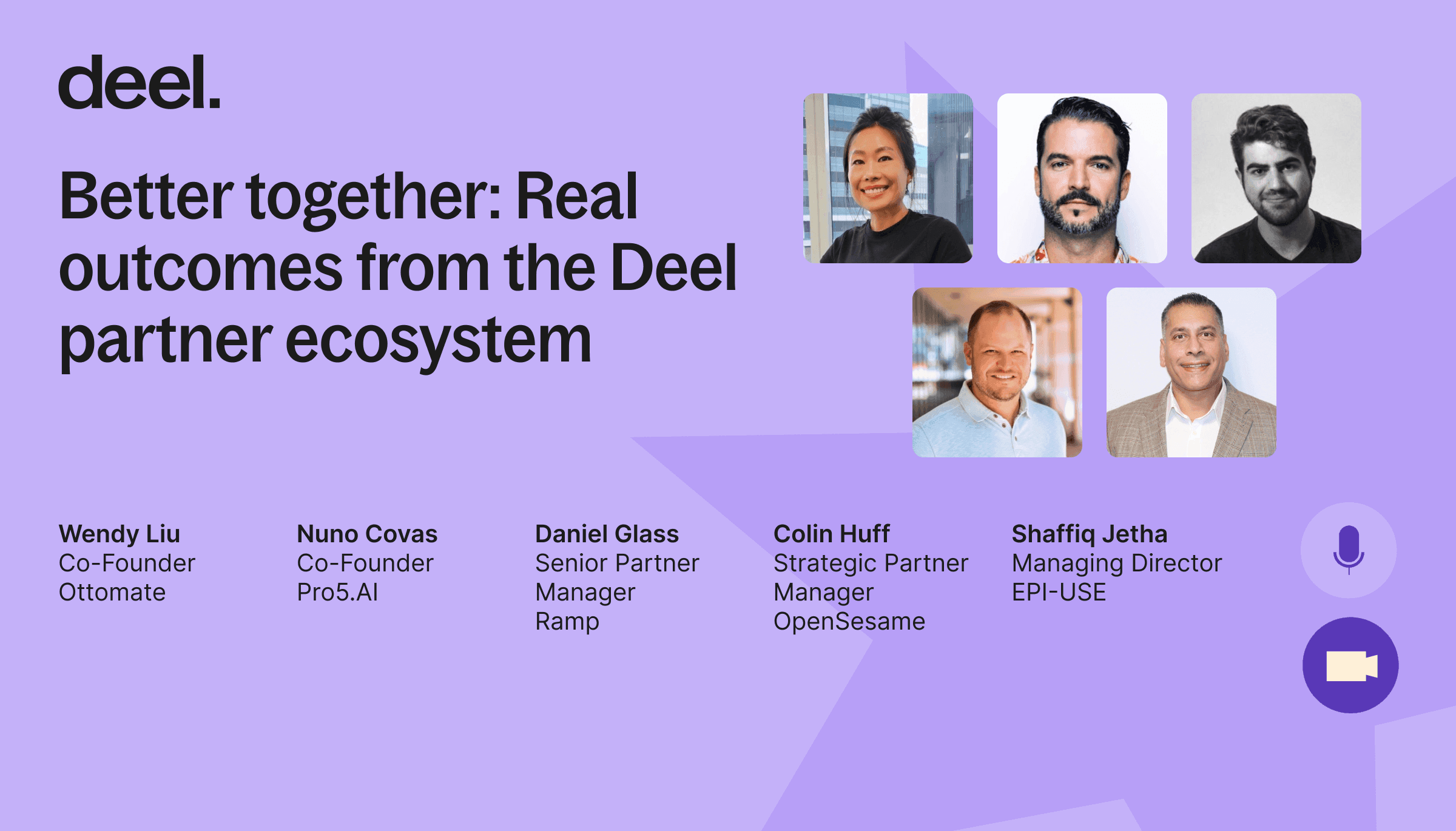
Table of Contents
Takeaway #1: Many companies still don’t truly have a global payroll
Takeaway #2: Payroll can no longer operate in isolation
Takeaway #3: Enterprise organizations need flexibility across different markets
Takeaway #4: Successful transformation projects require more than technology
Takeaway #5: Companies increasingly want strategic partners, not just vendors
The main takeaway: global payroll transformation requires connected systems and strong partnerships
As companies continue expanding across borders, managing payroll and workforce operations becomes significantly more complex.
Many organizations operate across dozens of countries, multiple payroll providers, disconnected HR systems, and varying local compliance requirements, making it difficult to maintain visibility, consistency, and operational efficiency at scale.
This was the topic Neil Carpenter, who leads HCM Strategic Partnerships at Deel, and Shafiq Jetha, Managing Director at EPI-USE, explored as part of the Better Together webinar series, discussing the evolving challenges enterprise organizations face with global payroll and why integrated workforce infrastructure is becoming increasingly important for long-term transformation.
Here are some key takeaways from the conversation.
Takeaway #1: Many companies still don’t truly have a global payroll
According to Shafiq, one of the biggest misconceptions in the market comes from the fact that companies believe they already operate a global payroll system when, in reality, they’re still managing fragmented local providers country by country.
A business may operate in 50 or 60 countries, but if payroll is managed separately in each location through different vendors and disconnected systems, organizations still lack a truly centralized global payroll infrastructure.
“That's not global payroll because you don't have a single system of record. You have zero transparency and visibility into your payroll,” Shafiq pointed out.
Without a unified approach to payroll management, companies struggle to generate consistent reporting, analyze workforce data globally, or maintain the operational visibility needed to effectively manage international teams.
That fragmentation also creates additional administrative complexity across HR, finance, payroll, and compliance functions.
As Shafiq emphasized throughout the conversation, the challenge is no longer simply paying employees accurately. It’s building a connected global workforce infrastructure that enables organizations to operate more efficiently overall.
Here is a country-by-country guide for global payroll compliance.
Takeaway #2: Payroll can no longer operate in isolation
One of the major themes from the discussion was that payroll is increasingly interconnected with every other part of the business. Payroll systems now need to integrate closely with HR platforms, financial systems, compliance workflows, and broader workforce management infrastructure.
“Payroll does not sit on an island anymore,” Shafiq said.
That shift is changing how organizations think about payroll transformation projects. Instead of viewing payroll as a standalone administrative function, businesses are beginning to see it as part of a much larger operational ecosystem.
“One of the things we still need to do a lot more of is educate the market on what global payroll really can do for them,” Shaqiq noted. According to him, organizations that connect payroll with HR, finance, and workforce transformation initiatives are better positioned to improve employee experience, increase engagement, and drive operational efficiency at scale.
The impact extends far beyond payroll processing itself. Connected systems help companies improve visibility, reduce manual work, and create more seamless employee experiences globally.
Find out if your payroll tech is helping or hindering talent retention.
Takeaway #3: Enterprise organizations need flexibility across different markets
EPI-USE specializes in supporting large, highly complex enterprise organizations operating across multiple countries and large workforce populations.
But as Shafiq explained, even large global enterprises often face challenges supporting smaller “long-tail” countries where workforce populations may be smaller, but operational requirements still exist.
That’s where Deel Payroll helps fill a critical gap.
“What Deel helps us do is meet very critical requirements in smaller long-tail HR and payroll countries,” Shafiq explained.
Together, EPI-USE and Deel help organizations manage both large-scale enterprise payroll complexity and smaller distributed country operations within one connected framework.
For example, a company operating across a few dozen countries may have most of its workforce concentrated in ten major markets, while the remaining employees are distributed across the many additional countries.
In those cases, EPI-USE may support the largest and most complex payroll markets while Deel provides infrastructure for the remaining countries, creating a unified end-to-end experience for the customer.
The result is a more scalable and flexible global payroll strategy without requiring organizations to manage fragmented providers independently.
Learn how global payroll compliance supports enterprise growth.
Takeaway #4: Successful transformation projects require more than technology
One of the strongest points Shafiq made during the conversation was that many workforce transformation projects fail long before implementation even begins.
According to him, technology itself is rarely the main issue. Instead, problems often stem from insufficient collaboration, a lack of organizational alignment, and unclear ownership across teams.
“Projects fail because there needs to be more collaboration within businesses,” Shafiq explained. “There needs to be more visibility on the process of why, how, and what's in it for the business. At the end of the day, that is going to drive ownership, collaboration, and accountability.”
Successful transformations require cross-functional support from leadership, HR, payroll, finance, and frontline employees alike. Organizations also need clear visibility into why the transformation is happening, what outcomes they’re trying to achieve, and how the new systems will impact day-to-day operations.
Without that alignment, even the best technology solutions can struggle to deliver long-term value. Shafiq also emphasized the importance of understanding what functions organizations want to keep in-house versus outsource as part of their transformation strategy.
“Make sure that you understand what the strengths and weaknesses are for your particular business based on what you do and how you do it, and how much you either keep in-house or you outsource. ”
That level of clarity helps companies make better long-term infrastructure decisions while reducing operational risk during implementation.
Takeaway #5: Companies increasingly want strategic partners, not just vendors
As global workforce operations become more complex, organizations are placing greater value on long-term strategic partnerships rather than transactional vendor relationships.
According to Shafiq, companies need partners who understand their business, align culturally, and remain invested in long-term success beyond the initial implementation phase.
“Don’t pick simply a vendor,” he said. “You’ve got to pick a partner. Your partner will be with you today, tomorrow, and many years from now. Make sure that your partner is culturally aligned with you. Make sure that your partner understands that they need to put skin in the game in order to ensure your success.”
That partnership mindset becomes especially important during large-scale HR and payroll transformations that often evolve over multiple years and require ongoing operational support.
Both Deel and EPI-USE position themselves as long-term partners helping organizations navigate increasingly complex global workforce challenges while allowing internal teams to focus on their core business priorities.
Read: Is a Flexible, Consolidated Approach to Global Payroll and Vendor Management Possible?
The main takeaway: global payroll transformation requires connected systems and strong partnerships
Across the board, enterprise organizations are rethinking how they manage payroll, HR, and workforce operations globally as fragmented systems become increasingly difficult to scale.
Deel and EPI-USE help companies build more scalable global workforce operations by combining enterprise payroll expertise with modern global HR and payroll infrastructure designed for international growth.
Book a demo to find out more.
Deel Payroll
Run payroll on one platform, globally

Dr Kristine Lennie holds a PhD in Mathematical Biology and loves learning, research and content creation. She had written academic, creative and industry-related content and enjoys exploring new topics and ideas. She is passionate about helping create a truly global workforce, where employers and employees are not limited by borders to achieve success.