Article
3 min read
How to Build a Business Case for a People Management Platform
Global HR

Author
Ellen Simmonds
Last Update
June 04, 2026

The promotion conversation that didn't happen well. The review cycle that got pushed back three weeks because chasing down 40 managers in a spreadsheet took longer than running the actual reviews. The strong performer who left, and the exit interview that said something vague about not seeing a path forward, even though you'd had that exact conversation with them six months earlier, in a Google doc nobody can find now.
None of this feels like a crisis in the moment. It accumulates quietly, one workaround at a time, until the cost of patching things together is higher than the cost of actually fixing them. That's usually when people leaders start building a business case: not because something broke, but because they've finally done the math on how much the current setup is costing the business every year.
This guide is about how to have that conversation with leadership. Not the HR version of it, where you explain the problem in terms of process gaps and tool fragmentation. The version that gets a yes.
Deel HR
One place for simplified, smarter global HR
The actual cost of spreadsheet-based people management
Spreadsheets feel free. They're not.
The cost of running talent management on disconnected tools is mostly invisible, distributed across a hundred small inefficiencies that nobody bothers to measure because nobody owns the total. That's what makes it so easy to defend the status quo: no single line item looks alarming enough to act on.
But the total tells a different story. Here's where the money actually goes.
Managers making calls without data. When performance history lives in a spreadsheet that one person maintains, and comp decisions happen in a separate process, calibration becomes a matter of who presents most confidently in the room. High performers who don't advocate loudly for themselves get overlooked. The bias isn't intentional; it's structural. And it's expensive, because the people most likely to leave when they feel undervalued are exactly the ones you most want to keep.
Review cycles that consume weeks of HR bandwidth for outputs nobody fully trusts. At 100 people, running a manual 360-degree review means tracking submission status across dozens of forms, sending individual follow-ups, reconciling responses, and then synthesizing results into something usable. The cycle ends, the data is already stale, and six months later you do it again. A Forrester study found that teams using Deel recaptured 60% of payroll processing time through automation. The same logic applies to performance: time spent on logistics is time not spent on the work itself.
Career paths that exist only in conversation. If an employee has to ask their manager what it looks like to get to the next level, and the answer is informal, inconsistent, or doesn't exist, they're already looking. Over 42% of voluntary turnover is preventable, and inadequate development is one of the most cited reasons people leave. A platform that makes career frameworks visible, ties development plans to real milestones, and gives managers and employees a shared view of progress isn't a nice feature. It's a retention mechanism.
HR doing the wrong work. The hours spent building review templates from scratch each cycle, reformatting data for leadership, and manually tracking who's completed what aren't just inefficient. They crowd out the strategic work that a people function at a growing company actually needs to be doing: workforce planning, manager development, culture-building. That's the opportunity cost that never shows up on a budget proposal but compounds every quarter.
Free guide
Build your HR foundation the right way from day one
Translating the people problem into a business case
Most HR business cases lose in the room because they're framed as HR problems. Inconsistent review cycles, disconnected tools, manager training gaps: these are real, but they don't make a CFO's ears prick up.
The translation work is the most important part of this process. Every HR problem has a business equivalent, and that's the version you need to be able to say out loud.
| The HR problem | The business framing |
|---|---|
| Review cycles are manual and inconsistent | Promotion and compensation decisions are being made without reliable data |
| High performers are leaving | We're spending 1.5–2x salary to replace people we could have retained |
| No visible career frameworks | Our managers can't do one of their most important jobs without the right infrastructure |
| HR buried in admin | We're paying strategic-hire salaries for coordination work |
| No audit trail on performance decisions | We have legal and compliance exposure we're not accounting for |
The goal isn't to make leadership care about HR processes. It's to show them that these aren't HR processes. They're business processes, and right now they're running badly.
Building the ROI
You don't need a precise number. You need a defensible one, built from inputs your audience already believes.
Start with attrition. Pick a role in your organization: a mid-level engineer, a senior account manager, someone whose institutional knowledge matters. The widely accepted cost of replacing them is 1.5 to 2 times their annual salary, accounting for recruiting fees, lost productivity during the gap, onboarding time, and the disruption to the team they leave behind. If you lose five people a year who could have been retained with stronger development and clearer career paths, and the average salary is $90,000, that's $675,000 to $900,000 in replacement cost. Before you've added a single other line item.
Then add the manual hours. Count the number of managers involved in your last review cycle. Estimate how many hours each spent on coordination, form-filling, reminder-chasing, and calibration. Add HR's time on top, and multiply by two for the cycles you run per year. At 30 managers spending eight hours each per cycle, plus 40 hours of HR coordination, that's 520 hours annually at a fully-loaded cost of around $75 per hour. Roughly $39,000 a year in labor spent on process, not outcomes. That's a conservative estimate, and it doesn't account for the downstream cost of delayed or incomplete results.
Finally, name the risk. Undocumented performance decisions create legal exposure. Inconsistent application of compensation frameworks creates pay equity risk. These are harder to quantify but often the most effective numbers to introduce into a leadership conversation, particularly with a general counsel or CFO who's had to deal with an employment dispute before.
Against all of this, the cost of a consolidated people management platform looks different. Deel prices its talent management suite at a fixed per-employee monthly rate, and the Forrester Total Economic Impact study found a 67% ROI for teams using the platform. The math doesn't require a leap of faith. It requires honest accounting of what you're already spending.
The objections you'll face
"We can keep using Google Forms."
You can, for a while. But Google Forms doesn't connect to your HR data, your goals, or your compensation process. Every cycle, someone rebuilds the wheel. Every output requires manual work before it's usable. And at 200 people, the version of this that worked at 80 people breaks, usually mid-cycle, at the worst possible time.
"Can't we just build something internally?"
Only if the team building it can also maintain it indefinitely, iterate on it as your needs change, and support it when something goes wrong during review season. In practice, internal tooling for HR processes gets deprioritized the moment engineering has real product work to do. The build-vs-buy math rarely favors building for infrastructure that already exists and is actively maintained.
"We're too small for a platform like this."
The opposite is true. Building consistent talent practices at 100 people is significantly easier than retrofitting them onto a team of 500. The companies that struggle most with performance and retention at scale are usually the ones that treated people infrastructure as a "later" problem. Platforms like Deel are designed for teams from 50 to 5,000, and the value compounds as the team grows.
"Let's wait until next quarter."
Every quarter you wait is another review cycle run manually, another set of career conversations that didn't happen, another exit interview where someone says they didn't see a path forward. The cost of inaction doesn't stay flat. It accumulates. Waiting for a better moment usually means waiting for a bigger problem.
Deel HR
Build high-performing teams with half the work
What to bring to the meeting
A long presentation won't close this. A clear, one-page summary will, one that leads with the business problem rather than the HR problem.
Structure it like this:
The problem: We're managing performance, development, and engagement across [X] people with disconnected tools. The result is decisions made without reliable data, retention risk we can't see until it's too late, and a people team spending its time on coordination instead of strategy.
The cost of inaction: Estimated annual cost of regrettable attrition at current rates: $[X]. Annual hours spent on manual review coordination: [X] hours / $[X]. Compliance and pay equity exposure: unquantified but real.
The solution: A consolidated people management platform that connects performance reviews, goals, development, and engagement, with automation that eliminates manual work and analytics that support better decisions. We'd implement Deel, which covers all of this in a single system and connects directly to our existing HR data.
The ask: $[X] annually. Implementation support included. Estimated payback period of [X] months based on attrition and admin savings alone.
What success looks like at 12 months: Review cycle completion above [X]%, reduction in voluntary attrition among high performers, manager confidence in people tools improved, HR admin hours on talent processes down by [X]%.
The conversation underneath the business case
The ask you're making isn't really about software. It's a question of whether your company is serious about building a high-performance culture, and whether it's willing to give its people leaders the tools to do that job properly.
Spreadsheets send a signal. So does investing in the right infrastructure. The companies that get this right early don't spend years trying to patch over the gaps that accumulate when they don't.
When you're ready to show leadership what that infrastructure looks like, Deel's people management platform brings together performance, learning, goals, and career development in one place, built to scale with your team from the start.
Live Demo
Get a live walkthrough of the Deel platform
FAQs
What is a people management platform?
A people management platform consolidates performance reviews, goal-setting, employee development, engagement, and career planning into one connected system. It links these processes so that performance data informs compensation decisions, development plans tie to career frameworks, and managers have a complete view of their team without switching between tools.
How do I build a business case for HR software?
Quantify the cost of your current setup: manual hours on review cycles, replacement costs for preventable attrition (typically 1.5–2x salary), and compliance exposure from undocumented decisions. Then translate each HR problem into business language. Inconsistent reviews become unreliable promotion data; high attrition becomes a hard dollar cost. Present leadership with a clear payback period.
How much does people management software cost?
Most platforms charge a per-employee, per-month fee. Deel's talent management suite is priced at a fixed monthly rate per employee with implementation included. Factor the platform cost against your current spend on manual processes and attrition. Forrester's 2025 study found Deel delivers a 67% ROI for teams that consolidate onto the platform.
When is the right time to invest in a people management platform?
Earlier than most companies expect. Building consistent performance practices at 100 people is far easier than retrofitting them at 500. Teams that treat people infrastructure as a "later" problem typically face higher attrition and weaker manager effectiveness at scale. Most platforms, including Deel, are built to grow with you from 50 employees upward.
What's the difference between an HRIS and a people management platform?
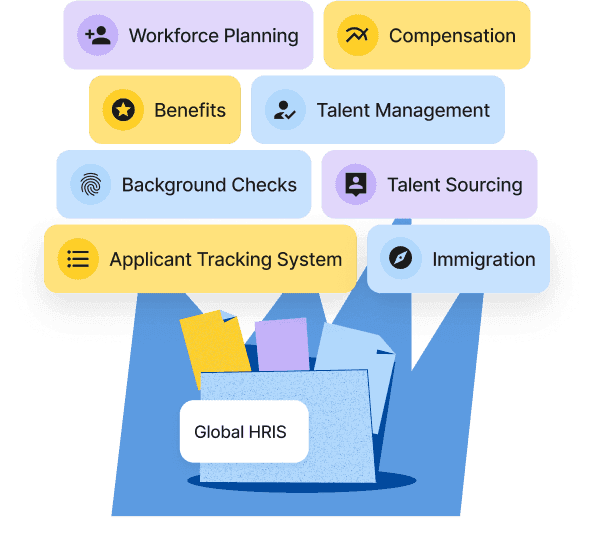
An HRIS manages core employee data: records, payroll, time off, org structure. A people management platform focuses on the talent layer: performance, development, and career progression. The two are complementary; Deel HR combines both, with a global HRIS as the foundation and Engage covering performance, learning, goals, and career management in one system.
How do I get leadership buy-in for a people management platform?
Lead with the business cost of inaction: estimated attrition cost, annual hours lost to manual review cycles, and compliance exposure from undocumented performance decisions. Bring a one-page summary with the total investment, payback period, and 12-month success metrics. Specificity closes the conversation. Vague proposals are easy to defer.
Ellen Simmonds is a content marketing manager with a decade of experience in tech, leadership, startups, and the creative industries. A long-time remote worker, she's passionate about WFH productivity hacks and fostering company culture across globally distributed teams. She also writes and speaks on the ethical implementation of AI, advocating for transparency, fairness, and human oversight in emerging technologies to ensure innovation benefits both businesses and society.